WORLD
WORLD
Yakusa-no-ikazuchi-no-kami
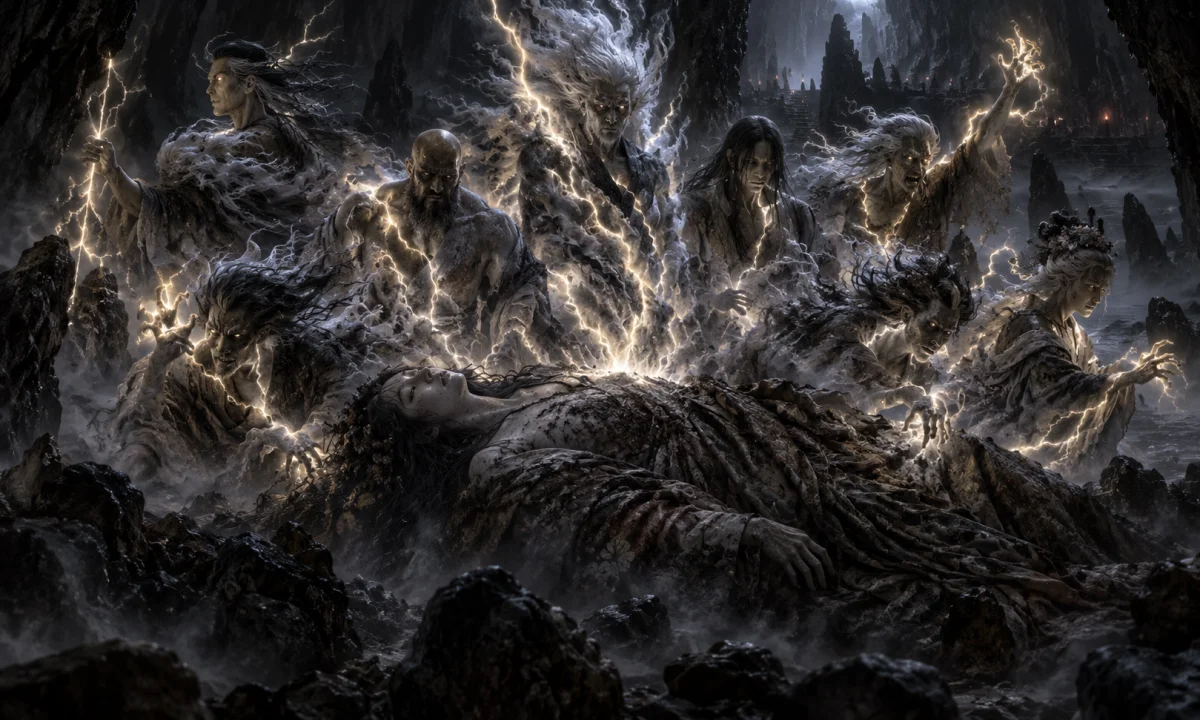
Yakusa-no-ikazuchi-no-kami is the collective name for the eight thunder deities who appear in the Japanese creation narrative preserved in the Kojiki. They are born from the body of Izanami after her death and later pursue Izanagi through the underworld of Yomi. Although the name is sometimes treated as that of a single thunder god, the surviving myth presents Yakusa-no-ikazuchi-no-kami as a group of eight related kami rather than one individual being.
Name and identity
Yakusa-no-ikazuchi-no-kami can be written in Japanese as 八種雷神, with the sense of “the kami of eight kinds of thunder” or “the eight thunder deities.” Romanisations vary, including Yakusa no Ikazuchi no Kami and Yakusa-no-Ikazuchi-no-Kami. The precise force of yakusa is interpreted somewhat differently, but it clearly indicates a set of eight forms or kinds.
The word ikazuchi refers to thunder and lightning. In ancient Japanese religious language, thunder was not merely a natural sound. It could be understood as the manifestation of a powerful kami, associated with the sky, violent weather, fertility, danger and sudden transformation. The Kojiki, however, does not provide a theological explanation of Yakusa-no-ikazuchi-no-kami. It introduces the group within a dramatic story and gives the members individual names.
The term should not automatically be translated as the name of a single “god of thunder.” A more accurate description is the eight thunder kami. Some modern retellings combine or simplify them, but this can obscure the structure of the original myth.
The source in the Kojiki
The principal surviving account appears in the Kojiki, or “Record of Ancient Matters,” compiled in the early eighth century. The work combines genealogical traditions, myths concerning the origins of the Japanese islands and kami, and stories connected with the imperial line. Its creation narratives are not a systematic mythology in the modern sense. They preserve overlapping traditions, poetic names and episodes shaped by the concerns of the text’s compilers.
Yakusa-no-ikazuchi-no-kami appears in the story of the creator deities Izanagi and Izanami. The pair produce islands, natural features and numerous kami. Izanami then gives birth to the fire deity Kagutsuchi. The birth burns her severely, and she dies as a result.
After Izanami’s death, additional kami emerge from her body. The eight thunder deities are associated with different parts of her corpse. The story then moves from the creation of the living world to the frightening boundary between life and death. Izanami travels to Yomi, the realm of the dead, while Izanagi later follows her in an attempt to bring her back.
The eight thunder deities
The Kojiki names the eight forms of thunder in a sequence connected with Izanami’s body. Spellings and English renderings differ because the names are ancient and their precise meanings are not always certain.
- Ōikazuchi, often rendered “Great Thunder,” associated with the head.
- Honoikazuchi, associated with the breast or chest.
- Kuroikazuchi, “Black Thunder,” associated with the belly.
- Sakuikazuchi, associated with the genitals.
- Wakaikazuchi, often understood as “Young Thunder,” associated with the left hand.
- Tsuchiikazuchi, whose name may suggest earth or soil, associated with the right hand.
- Naruikazuchi, associated with the left foot.
- Futsui-kazuchi or Futsunokazuchi, associated with the right foot.
The exact romanisation of the final name varies, and the component meanings of several names remain uncertain. The text does not explain the eight deities as a fixed set of meteorological functions, nor does it clearly assign each one a separate power. It is therefore safer to preserve the names and bodily associations than to treat later word interpretations as established doctrine.
The listing of the deities across the body creates a vivid image of thunder inhabiting a corpse. It also reflects a recurring feature of early Japanese myth: natural forces, bodily processes and sacred beings are closely connected. The divine body is not an abstract symbol removed from nature. It is a source from which other kami emerge, even in death and decay.
The encounter with Izanagi in Yomi
After Izanami dies, Izanagi seeks her in Yomi. He asks her to return with him, and she says that she must consult the deities of the underworld. She warns him not to look at her. Izanagi nevertheless sees her later, discovering that her body has decayed and that the eight thunder deities are present upon it.
The scene changes the emotional character of their relationship. Izanami is no longer presented only as the mother of the islands and kami. She has become part of the dangerous realm of death, and her altered body is surrounded by beings of frightening power. Izanagi is horrified and flees.
Izanami is angered by his flight and sends forces after him. The eight thunder deities pursue Izanagi together with the Yomotsu-shikome, female beings of Yomi often translated as the hags or frightful women of the underworld. In some translations, the thunder gods themselves are the main pursuers; in others, the narrative gives attention to both the thunder deities and the underworld women. The broader point is that Izanagi is being chased by the powers of death after violating the boundary between the living and the dead.
During his escape, Izanagi throws objects behind him to delay his pursuers. He uses a head ornament and other items that become plants or food, and finally throws three peaches. The peaches halt or repel the pursuing forces. At the boundary of Yomi, Izanagi places a large rock to block the passage and declares an end to his relationship with Izanami.
Yakusa-no-ikazuchi-no-kami therefore belongs to one of the most important episodes in Japanese mythology concerning death, separation and ritual danger. The group is not portrayed as a heroic army or as independent storm rulers. It functions as an expression of the hostile and unsettling power of Yomi.
Thunder, death and liminal power
Thunder in this myth has a distinctly ominous aspect. The eight kami are born from the dead body of a creator deity, appear in the underworld and join the pursuit of a living god. Their presence links lightning and thunder with death, bodily transformation and the breakdown of ordinary order.
This does not mean that thunder was always considered evil in Japanese tradition. Thunder could bring rain, which was essential for agriculture, and could therefore be associated with fertility and the renewal of life. At the same time, lightning could destroy crops, kill people, start fires and signal the presence of a dangerous supernatural force. The thunder deities in the Yomi episode emphasise this threatening side.
Their number is also meaningful within the narrative. The eight beings are not simply repeated versions of one character. They form a structured group whose names and locations create a complete image of Izanami’s body. The story turns the corpse into a landscape occupied by divine powers. This combination of physical horror and sacred generation is characteristic of the myth’s treatment of creation and death: the same divine world can produce islands, fire, decay and thunder.
Relationship to Kagutsuchi and Izanami
Yakusa-no-ikazuchi-no-kami is closely connected with Izanami, but the eight thunder deities are not her children in the same straightforward sense as the islands and other kami produced during her creative activity. The Kojiki describes them as emerging from parts of her body after her death. Their origin is therefore part of the transition from Izanami as creator to Izanami as a being of Yomi.
Their appearance follows the birth of Kagutsuchi, the fire deity whose birth causes Izanami’s death. Fire and thunder are both dangerous forces, but they are not the same kami. Kagutsuchi is a distinct deity with his own role in the creation narrative. The eight thunder deities should not be described as forms or offspring of Kagutsuchi unless a particular later interpretation explicitly makes that connection.
Nor are they the attendants or ordinary servants of Izanami in a developed pantheon. Their relationship to her is created by the narrative circumstances of death and underworld pursuit. The text gives no extended account of their individual personalities, cults or later adventures.
Variants and limits of interpretation
The Nihon shoki, compiled in the same broad historical period as the Kojiki, preserves alternative accounts of the origins of the world and the early kami. Its creation narratives do not simply reproduce every detail of the Kojiki, and accounts connected with Izanami, fire and thunder vary among the traditions recorded there. Consequently, the Kojiki version should not be assumed to represent a single universally fixed account in ancient Japan.
Even within modern translations, the names of the eight deities are not entirely uniform. Japanese writing from the early period does not always make pronunciation and word division transparent to modern readers. Translators may differ over whether a name should be divided as Futsui-kazuchi or rendered in another form, and proposed meanings for elements such as saku, ho or futsu are not equally secure.
For this reason, interpretations that assign each thunder deity a precise physical, seasonal or magical function should be treated cautiously. The ancient text gives names, bodily locations and narrative roles, but it does not present a detailed catalogue of eight separate thunder powers. Much of the elaborate symbolism found in modern discussions is scholarly interpretation rather than information stated directly by the myth.
Distinction from other Japanese thunder beings
Yakusa-no-ikazuchi-no-kami should be distinguished from Raijin, the better-known thunder deity of Japanese religious art and folklore. Raijin is commonly depicted as a powerful figure surrounded by drums, which he beats to create thunder. His familiar visual form developed through later religious and artistic traditions, including influences associated with Buddhist imagery. The eight thunder kami of the Kojiki are not described with drums, a single humanoid body or the distinctive iconography commonly associated with Raijin.
They should also not be confused with individual kami whose names contain ikazuchi. The word can appear as part of different divine names and does not by itself identify Yakusa-no-ikazuchi-no-kami. Likewise, the final element no-kami means “kami” or “deity” and does not establish that the group has one unified personality.
The name Yakusa may also look similar in romanisation to yakuza, the modern Japanese term associated with organised criminal groups. The two are unrelated. Yakusa-no-ikazuchi-no-kami is an ancient mythological designation, while yakuza has a different history, spelling and meaning.
Religious and cultural significance
The myth of the eight thunder deities contributes to a Japanese understanding of sacred power as present in both the natural world and the human body. Mountains, rivers, fire, wind and thunder can be kami, but so can forces encountered through birth, illness, death and purification. Izanagi’s experience in Yomi shows that contact with death is not merely emotional; it is a religious danger requiring separation and cleansing.
Immediately after escaping Yomi, Izanagi performs purification. That episode leads to the birth of important kami, including Amaterasu, Tsukuyomi and Susanoo, from parts of his cleansed body. Yakusa-no-ikazuchi-no-kami is not one of these later major deities, but the thunder group helps create the narrative contrast between pollution associated with death and renewed divine generation through purification.
The eight kami are consequently important less as independently worshipped personalities than as part of the architecture of the Yomi story. They embody the threatening energy that surrounds Izanami’s corpse and make the underworld encounter physical and immediate. Their presence also demonstrates how early Japanese myth could treat thunder as a force crossing boundaries: between sky and earth, life and death, fertility and destruction, and the world of the living and the realm of the dead.
Later reception
Yakusa-no-ikazuchi-no-kami has not achieved the same broad popular recognition as Amaterasu, Susanoo, Izanagi, Izanami or Raijin. In modern retellings, the eight deities may be omitted, reduced to a single thunder monster or recast as a group of elemental warriors. Such treatments belong to modern fiction and fantasy rather than to the surviving early narrative.
When the name appears in contemporary discussions of Japanese mythology, it is most accurately presented as a collective group from the Kojiki: eight thunder kami born from Izanami’s dead body and involved in Izanagi’s flight from Yomi. Their importance lies in that unsettling mythic setting, where thunder is not simply a weather phenomenon but a manifestation of the dangerous sacred power of death.