WORLD
WORLD
Izanagi
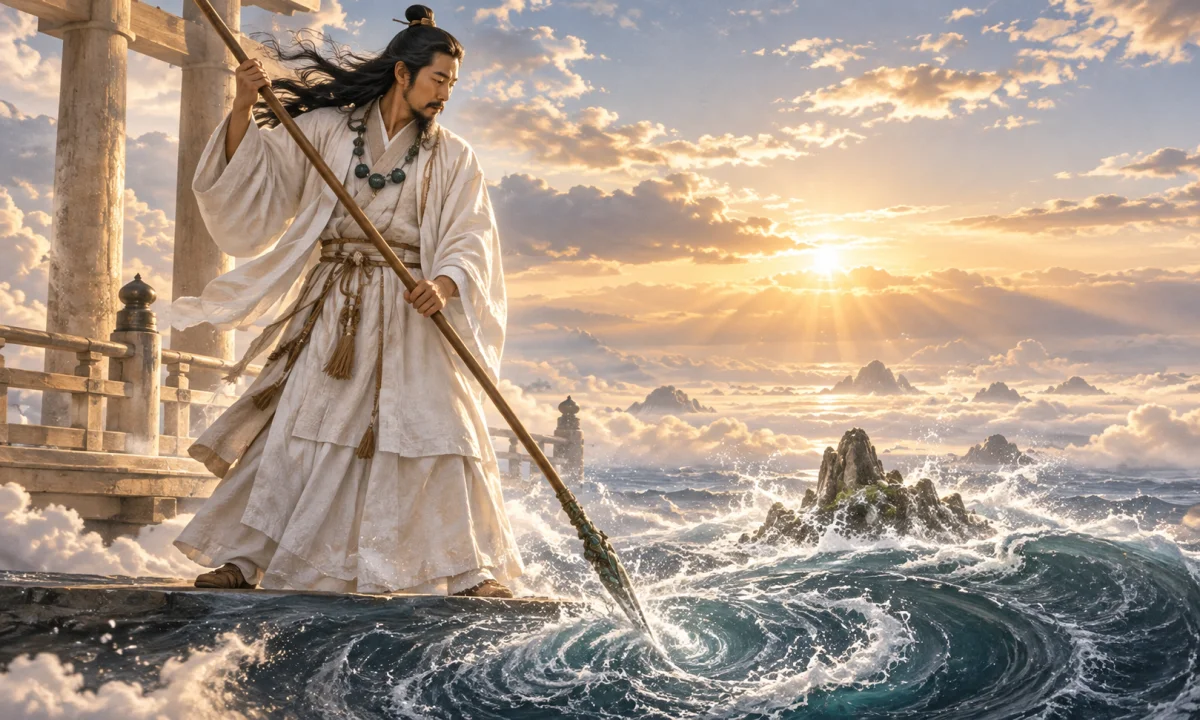
Izanagi, also known as Izanagi-no-Mikoto, is a major creator kami in Japanese mythology and one of the central figures of the Kojiki and Nihon Shoki, Japan’s earliest surviving mythological and historical chronicles. Together with his partner Izanami, Izanagi helps form the Japanese islands and gives birth to numerous kami. His stories also explain the origins of death, ritual purification, and several of the most important deities in the Shinto tradition.
Izanagi is not simply a “god of creation” in the narrow sense. The surviving myths present him as a generative, ancestral, and sovereign figure whose actions establish the structure of the world. He is associated with the formation of land, the birth of divine powers, the boundary between the living and the dead, and the purification of ritual pollution. His relationship with Izanami is especially important because it links creation with loss: the same divine pair who bring the islands and many kami into existence are divided by death.
Origins in Japanese mythological tradition
The principal accounts of Izanagi appear in the Kojiki, compiled in 712, and the Nihon Shoki, completed in 720. These works were produced in the early eighth century under the Yamato court and combine genealogical traditions, accounts of imperial origins, ritual ideas, and stories about kami. They are not identical versions of a single fixed mythology. The Nihon Shoki, in particular, preserves several variant accounts, sometimes differing in sequence, names, or details.
The chronicles describe Izanagi and Izanami as a younger generation of kami who appear after a succession of primordial divine beings. The earliest gods are often presented in brief, abstract terms, while Izanagi and Izanami receive a much fuller narrative. The texts call them to complete the work of forming the unstable world and establish a relationship that produces land and further kami.
The names are commonly written with characters meaning “male who invites” and “female who invites,” although this is an interpretation based on the written forms rather than a definitive explanation of their original etymology. The names also appear in variant forms. Izanagi is sometimes rendered as Izanaki, especially in discussions of historical Japanese pronunciation and textual variation. In English, “Izanagi” is the most familiar spelling.
The heavenly command and the formation of the islands
In the Kojiki, the heavenly kami give Izanagi and Izanami a jeweled spear and instruct them to solidify and complete the drifting world. Standing on the Ame-no-ukihashi, usually translated as the Heavenly Floating Bridge, they stir the sea below with the spear. When they withdraw it, brine drips from its tip and forms the island of Onogoro.
The couple descends to Onogoro and establishes a dwelling there. They perform a marriage ritual by circling a central pillar, with Izanami moving in one direction and Izanagi in the other. In the Kojiki, Izanami speaks first when they meet after circling the pillar. Their first children are regarded as defective or incomplete, and one, Hiruko, is set adrift. The couple then consult the heavenly kami and repeat the ceremony, with Izanagi speaking first. Their subsequent union produces a series of islands.
The birth of the islands is known as the kuniumi, or “birth of the land.” The accounts name many places that correspond broadly to the Japanese archipelago, though the sequence and identification of some islands vary. The stories do not present a modern geographical map. Instead, they provide a sacred genealogy of the land, connecting the islands to divine ancestry and to the authority of the Yamato-centered tradition.
After the islands, Izanagi and Izanami produce numerous kami. These include deities connected with the sea, winds, trees, mountains, fields, rivers, and other features of the natural world. The birth narratives express a world in which landscape and divine personality are closely related. A mountain, a body of water, or a force of nature may be treated not merely as an object but as a presence with sacred identity.
Izanami’s death and the birth of fire
The creation process becomes dangerous when Izanami gives birth to the kami of fire, usually called Kagutsuchi or Hi-no-Kagutsuchi. The flames burn her, and she dies from her injuries. In the Kojiki, further kami emerge from her suffering and from her body after death. These include deities associated with metal, earth, water, and other natural powers. The myth therefore presents destruction and creation as intertwined rather than completely separate.
Izanagi grieves intensely over Izanami’s death. In one striking episode, he kills the fire deity, and additional kami arise from the blood and body of the slain god. The precise details differ between the Kojiki and the Nihon Shoki, but the broad pattern is consistent: fire brings about Izanami’s death, Izanagi responds with grief and violence, and the event produces new divine beings.
Izanami’s death marks a decisive change in the myth. Creation is no longer an unbroken process of generation. Mortality, separation, and pollution enter the divine world. Izanagi’s later journey to the land of the dead develops these themes and explains why the living and the dead cannot simply return to their former relationship.
The journey to Yomi
Unable to accept Izanami’s death, Izanagi follows her to Yomi, the land of the dead. He asks her to return with him, but she explains that she has already eaten the food of Yomi and cannot easily leave. She nevertheless agrees to ask the powers of the underworld whether she may go back, on the condition that Izanagi does not look at her.
Izanagi breaks this promise. Using a comb tooth or another source of flame, depending on the version, he looks upon Izanami and sees her in a frightening, corrupted condition, surrounded by decay and associated with terrifying beings. His violation of the taboo leads to pursuit. Izanami sends forces of the underworld after him, and Izanagi escapes by using objects such as a comb, clothing, and a peach to delay or repel them.
At the boundary between Yomi and the world of the living, Izanagi blocks the passage with a great boulder. Izanami confronts him from the other side and declares that she will cause the death of a thousand people each day. Izanagi answers that he will cause a thousand and five hundred to be born each day. This exchange is a mythic explanation for the continuing balance between death and birth.
The story is not a simple account of an evil underworld. Yomi is a realm of death and pollution, and Izanami’s transformation reflects the danger of crossing the boundary between the living and the dead. The episode also shows that the old marital and creative relationship cannot be restored after death. Izanami becomes linked with the forces of death, while Izanagi returns to the world of the living alone.
Purification and the birth of major kami
After escaping from Yomi, Izanagi performs ritual purification. He washes away the pollution acquired through contact with the land of the dead, an act that provides one of the most important mythic foundations for Shinto ideas about harae and misogi. Harae refers broadly to the removal of pollution or ritual impurity, while misogi is purification through water. Their later forms are diverse, and the myth should not be treated as a complete description of every historical Shinto purification practice.
In the Kojiki, Izanagi carries out the purification at a river mouth in the land of Himuka, often identified with part of present-day Kyushu. As he removes clothing and objects, various kami arise. When he washes his left eye, Amaterasu-Omikami, the sun kami, is born. When he washes his right eye, Tsukuyomi-no-Mikoto, associated with the moon, appears. When he washes his nose, Susanoo-no-Mikoto, the storm and sea-associated kami, is born.
Izanagi assigns these three children important realms. Amaterasu receives the High Plain of Heaven, Tsukuyomi receives the night, and Susanoo is connected with the sea. The arrangements are not entirely stable, however. Susanoo’s grief over his dead mother and his desire to see her lead to conflict with Izanagi. In the Kojiki, Izanagi eventually expels him from the divine order.
The birth of Amaterasu, Tsukuyomi, and Susanoo from Izanagi’s purification is especially significant for later Japanese religious and political traditions. Amaterasu became the central ancestral kami of the imperial line in the mythology of the Yamato court. Susanoo received a major cycle of stories of his own, including his struggle with the eight-headed serpent Yamata no Orochi. Tsukuyomi, by contrast, remains comparatively less prominent in surviving narrative traditions.
Relationships with Izanami and the younger kami
Izanami is Izanagi’s partner, counterpart, and eventual opponent. Their relationship is not merely romantic or domestic. Together they embody the generative pairing through which land and kami are produced. Their separation explains a fundamental division between life and death, and their descendants occupy central places in Japanese mythological genealogies.
The relationship between Izanagi and the younger kami is hierarchical but not always peaceful. His command over Amaterasu, Tsukuyomi, and Susanoo reflects an ordering of the cosmos, yet the myths repeatedly show that divine relationships involve conflict, refusal, grief, and negotiation. Izanagi’s authority is therefore part of a developing sacred order rather than evidence of absolute control over every event.
In the Nihon Shoki, the stories sometimes give Izanagi and Izanami different roles or present different sequences of creation. Some variants describe the production of the islands and kami without exactly repeating the ritual problem found in the Kojiki. These differences are important because they show that early Japanese mythology existed as a collection of related traditions rather than as one universally standardized narrative.
Attributes and symbolic significance
Izanagi does not have one fixed appearance or a universally consistent set of visual attributes in ancient sources. The chronicles focus more on his actions and relationships than on a detailed physical description. Later artistic depictions may show him as a dignified male deity, often paired with Izanami, but such images belong to particular periods and religious contexts rather than to a single ancient canon.
- Creator and progenitor: Izanagi helps generate the Japanese islands and a large number of kami.
- Partner of Izanami: Their union represents the generative pairing through which the world is formed.
- Boundary figure: His journey to Yomi places him at the dividing line between life and death.
- Purifier: His washing after leaving Yomi provides a foundational myth for purification through water.
- Ancestor of major kami: Amaterasu, Tsukuyomi, and Susanoo emerge from his purification in the Kojiki.
- Organizer of the cosmos: His assignments to the younger kami help establish distinctions between heaven, night, sea, and the human world.
The most lasting symbolism associated with Izanagi concerns purification after contact with death. His washing does not erase death from the world; instead, it restores a boundary between polluted death and living order. The myth gives religious meaning to cleansing and helps explain why water purification became such a prominent feature of many Shinto practices.
Religious and cultural context
Modern descriptions often call Izanagi a “Japanese creator god,” but this phrase can obscure the character of the tradition. Shinto has no single creed or universally binding mythology comparable to a centralized theological system. Local shrines, ritual lineages, regional traditions, and historical institutions have all shaped the ways kami are understood. The Kojiki and Nihon Shoki preserve important narratives, but they do not represent every Japanese religious tradition.
The early chronicles also served political purposes. Their genealogies connect heavenly kami, the land, and the imperial line. Izanagi’s importance must therefore be understood both as a religious figure within creation myths and as part of texts that organized the sacred history of the early Japanese state. His role does not by itself prove that all communities in ancient Japan worshipped him in the same way.
Izanagi is associated with several shrines and sacred sites in later Japanese religious practice, although the importance and traditions of those sites differ. Some traditions connect him and Izanami with Awaji, the first island named in certain creation sequences, while others emphasize places associated with his purification in Kyushu. These associations reflect the development of shrine traditions over time and should not be assumed to reproduce an unchanged ancient cult.
Distinction from similar figures
Izanagi should not be confused with Izanami, whose name is similar but who is a distinct female kami and his partner. Nor should he be merged with Amaterasu, who is one of his offspring in the Kojiki and later became the most prominent ancestral kami of the imperial mythology. Susanoo is also distinct: he is another child of Izanagi, associated with storms, the sea, disorder, and heroic myths.
Izanagi is sometimes compared with creator figures from other religions, but such comparisons are interpretive rather than evidence that the traditions share a common origin. He also differs from a supreme, all-powerful creator in monotheistic theology. The Japanese myths describe several generations of kami, and the world emerges through succession, birth, ritual action, and conflict rather than through one solitary act of creation.
Later reception and modern popular culture
Izanagi remains relevant in contemporary Japan through Shinto shrine traditions, festivals, religious studies, literature, art, and popular storytelling. Modern audiences may encounter him in manga, anime, video games, novels, and films, where his name can be adapted into a character with powers or relationships that do not belong to the classical myths.
Some modern works use Izanagi as a symbolic figure of creation, identity, or the Japanese past, while others treat him as a combatant or supernatural character. These portrayals can be imaginative and culturally significant, but they should be distinguished from the accounts in the Kojiki and Nihon Shoki. In the traditional narratives, Izanagi’s defining episodes are the formation of the islands with Izanami, the failed recovery of his dead partner from Yomi, and the purification that gives birth to Amaterasu, Tsukuyomi, and Susanoo.