WORLD
WORLD
Shoki
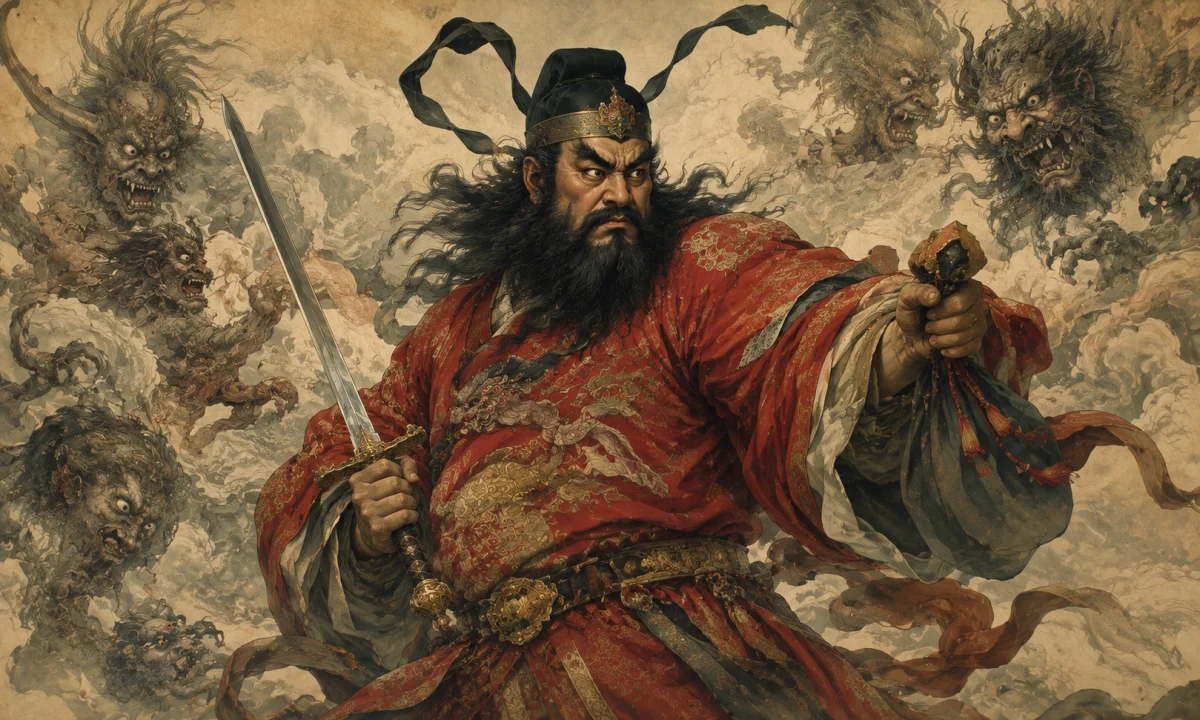
Shoki (Japanese: Shōki; Chinese: Zhong Kui) is a legendary demon-queller associated with protection against evil spirits, illness and misfortune. Although Shoki is often discussed within Japanese mythology, his immediate origin is Chinese rather than native Japanese. Japan adopted and reshaped the figure over many centuries, turning him into a familiar protective presence in folk religion, household ornament and seasonal art.
Origins in Chinese tradition
Shoki is the Japanese form of the Chinese figure Zhong Kui, whose name is written with the characters Zhong Kui in Chinese and Shōki in Japanese. The best-known legend places Zhong Kui during the Tang dynasty, although the story survives in forms that were written down after the period in which it is supposed to have occurred. The historical existence of Zhong Kui as a real person is uncertain, and he is generally treated as a legendary figure rather than a securely documented historical official.
According to the traditional account, Zhong Kui was a learned man who travelled to the imperial capital to take the civil-service examinations. Despite his ability, he was denied the honour he deserved, sometimes because of his unattractive appearance or because of political prejudice. Humiliated by the result, he died by suicide. In one widespread version, the emperor later fell gravely ill and dreamed of a large, frightening man who seized and ate a demon troubling him. The figure identified himself as Zhong Kui and explained that he had been appointed to protect the emperor and the empire from harmful spirits.
The emperor accepted Zhong Kui as a supernatural guardian. The story helped explain why a man who had failed in life could receive authority in death. Zhong Kui became an avenger of injustice and a powerful hunter of ghosts, demons and other malignant beings. The legend also gave artists a reason to portray him as an imposing, sometimes rough-looking figure whose fearsome appearance was itself useful against supernatural enemies.
Details vary between tellings. Some versions stress his learning and loyalty; others focus on his anger at unfair treatment or his status as a powerful spirit official. These variations are important because there is no single universally authoritative narrative equivalent to a fixed sacred biography. Zhong Kui developed through a combination of legend, ritual practice, popular storytelling and visual art.
Arrival and development in Japan
The figure entered Japan through the long cultural exchange between China and Japan. Written Chinese culture, Buddhist institutions, court customs and protective rites all travelled across the sea, and foreign religious or legendary figures were often reinterpreted within Japanese settings. Shoki was not originally one of the ancient kami described in the Kojiki or Nihon Shoki. He belongs instead to a later layer of Japanese religious and folkloric culture shaped by continental influences.
The exact date at which Shoki first became known in Japan is difficult to establish with certainty. References and images appear in different periods, while the evidence for early transmission is not always clear enough to support a simple origin story. By the medieval and early modern periods, however, Shoki was recognisable in Japan as a guardian who drove away demons and disease. His image became especially prominent in domestic decoration, painting, sculpture, printed books and festival customs.
Japanese religious life has often allowed figures from different traditions to coexist rather than requiring them to belong to a single exclusive category. Shoki could be understood through Buddhist ideas about demons and protective guardians, through folk beliefs about harmful spirits, and through practical customs intended to defend a household. He is therefore best described as a Chinese-derived protective figure in Japanese folk religion and popular mythology, rather than as a native Japanese god in the narrowest sense.
Name and classification
In Japanese, the name is usually pronounced Shōki, although English-language writing often drops the macron and uses “Shoki.” The Japanese form is written with the same Chinese characters used for Zhong Kui. The name may also be encountered in the context of images labelled Shōki-sama, an honorific expression that treats him as a revered protector.
Shoki is sometimes called a god, demon hunter, guardian spirit, legendary hero or yōkai. None of these labels is entirely precise in every context. He is not simply a demon, despite his frightening appearance, and he does not fit neatly into the category of yōkai as a strange or supernatural being. In ritual and household settings he functions more like a protective supernatural authority. In art and folklore he may appear as a heroic warrior, an official of the spirit world or a powerful figure standing outside ordinary human society.
The term oni is also relevant. Japanese oni are commonly translated as demons or ogres, but they have a broad range of meanings and appearances. Shoki is generally portrayed as the enemy of oni, not as one of them. Confusion can arise because both Shoki and oni may be shown with large bodies, wild hair, fierce expressions and dramatic costumes. The crucial distinction is their role: Shoki subdues or expels harmful beings, while oni are often the beings he confronts.
Appearance and attributes
Traditional images usually show Shoki as a large, powerful man with a long black beard, broad body and intense expression. His eyes are often wide and glaring, and his eyebrows may be sharply defined to emphasise his stern authority. He commonly wears the robes and headgear of a Chinese official or warrior, reflecting the story of his learned and imperial associations rather than presenting him as an ordinary Japanese soldier.
A sword is one of his most familiar attributes. It identifies him as an active demon-queller and gives visual form to his ability to cut down or drive away spiritual threats. Some images show him holding the sword upright; others depict him in a forceful pose, stepping forward or preparing to strike. He may also be shown holding a scroll, a seal or another object associated with official power and learning.
His face can look angry, but the expression is not normally intended to portray evil. The ferocity is protective. Shoki’s frightening appearance is directed outward, against demons and disease-bearing spirits. As with other apotropaic figures, an image is effective partly because the beings it repels are imagined to fear the guardian himself.
Artists have not followed one fixed standard. Sculptures can make him compact and muscular, while paintings may emphasise his height and flowing robes. Some works show a demon at his feet or fleeing before him. Other images present Shoki alone, allowing his gaze and posture to perform the protective function. Differences in style often reflect the period, medium, region and purpose of the object rather than different named versions of the character.
Protection against demons and illness
Shoki’s main role in Japan is apotropaic: he is used to prevent or repel harm. His traditional enemies include oni, ghosts and other malignant spirits. In popular belief, such beings could cause misfortune, illness or disruption in human life. A visible guardian placed near a home created a symbolic boundary between the household and the dangerous forces outside it.
Shoki became particularly associated with protection from epidemic disease. Before modern medical explanations of infection, serious illnesses were often understood through a mixture of environmental, spiritual and religious ideas. Smallpox, in particular, was feared as a devastating disease, and images of protective figures could be used alongside prayers, charms and other customary measures. Shoki did not replace all other disease-related figures or rituals, but he became one of the most recognisable guardians against illness-causing spirits.
The protective meaning of his image could extend beyond disease. A household might display Shoki to guard against general misfortune, malicious spirits or the hostile influences believed to enter through doors and windows. The image was not merely decorative in such settings. Its placement expressed a wish for safety and made the home visibly associated with a powerful supernatural protector.
Rooftop images and household customs
In parts of Japan, especially in Kyoto and other areas with a strong tradition of machiya townhouses, Shoki figures have been placed on rooftops or near the entrances of buildings. These figures are often made of ceramic, plaster or other durable materials. They may stand upright with a sword, glare across the street or confront an imagined demon approaching the household.
Rooftop Shoki figures are sometimes discussed alongside shachihoko, roof ornaments and other architectural protectors, but they are not the same type of being. Shoki’s image is recognisably human and connected with a specific legend. His location above the street allows him to watch over the building and to confront danger before it reaches the people inside.
Local customs vary, and there is no single rule governing every Shoki figure. In some cases, the image may be placed in response to the design or position of a neighbouring building, while in others it serves as a general household guardian. Explanations based on direction, rivalry between protective figures or the need to face a particular threat should therefore be treated as local interpretations rather than universal features of Shoki worship.
Shoki and seasonal festivals
Shoki has also been associated with celebrations for children, including customs connected with the Boys’ Festival, now commonly known as Children’s Day and observed on 5 May. Protective images, banners and dolls could be displayed to express hopes for a boy’s health, strength and successful growth. His stern appearance represented the ability to overcome danger, while his official and scholarly associations could suggest discipline, achievement and social standing.
In festival settings, Shoki is not necessarily the central figure. Other objects, including warrior dolls and images of famous heroes, may be displayed at the same time. Shoki’s presence adds a distinct protective dimension: he is not simply a model of military courage but a supernatural guardian who drives away forces that threaten children and families.
These customs should not be treated as evidence of a single ancient Japanese rite. Some developed or became especially widespread during the early modern period, when household displays, commercial crafts and printed images brought legendary figures into everyday life. Their meaning could combine family hopes, religious protection, seasonal celebration and local artistic practice.
Shoki in Japanese art
Shoki has been a popular subject for painters, sculptors, print designers and ceramic artists. His strong silhouette and dramatic expression make him well suited to visual art. He can be portrayed as a solitary guardian, a comic pursuer of a tiny demon, a dignified official or a fierce warrior in motion.
Paintings sometimes place him in a tense encounter with an oni. The contrast between Shoki’s imposing body and the demon’s smaller or more agitated form can produce both menace and humour. In other works, artists concentrate on his face, beard and sword, creating an image intended to be displayed for its protective force rather than its narrative detail.
During the Edo period, the growth of urban culture and commercial publishing helped circulate images of Shoki to a wide audience. Artists could draw on Chinese models while adapting costume, composition and expression to Japanese tastes. The result was not a simple copy of the Chinese Zhong Kui tradition. Japanese versions retained the central demon-queller identity but developed their own visual conventions and domestic uses.
Interpretation and cultural significance
Shoki’s story brings together several ideas that have made him durable across cultures. He is a scholar who becomes a warrior, a wronged man who gains supernatural authority, and a frightening figure who protects ordinary people. His legend suggests that ability and moral purpose may receive recognition even when worldly institutions fail to provide it.
His association with official clothing and imperial appointment is also significant. Shoki is not merely a physically strong monster fighter. He possesses recognised authority over the spirit world. The sword gives him force, while the robes and attributes of an official give that force legitimacy. In this sense, images of Shoki present protection as both violent and orderly: demons are not just attacked but brought under the control of a guardian with a mandate.
The figure also demonstrates how religious and folkloric traditions change when they cross cultural boundaries. Chinese Zhong Kui supplied the basic legend and iconography, but Japanese communities gave the figure new settings and meanings. He became part of Japanese architecture, family customs and seasonal displays without becoming identical to every other Japanese protective deity or spirit.
Distinguishing Shoki from related figures
Shoki is sometimes confused with Fudō Myōō, the Buddhist Wisdom King known in Sanskrit-related traditions as Acala. Both can have fierce expressions and protective roles, and both may be shown with swords. Their identities and religious contexts are different. Fudō Myōō is a major Buddhist deity associated with immovable wisdom, the destruction of delusion and tantric Buddhist iconography. Shoki is a Chinese-derived legendary demon-queller whose Japanese presence is especially strong in folk protection and household art.
He should also be distinguished from Susanoo, a native Japanese kami associated with storms, disorder and important myths in the Kojiki and Nihon Shoki. Susanoo may defeat dangerous beings in particular stories, but he is not another name for Shoki and does not share Shoki’s Chinese origin or characteristic visual identity.
Likewise, Shoki is not the same as an oni, nor is every bearded warrior figure on a Japanese roof a representation of him. Identification depends on context and attributes, especially the combination of a Chinese-style official or warrior appearance, a fierce protective expression and a demon-quelling role.
Later reception
Shoki remains visible in Japanese craft traditions, architecture, festival goods, paintings, decorative ceramics and popular representations of protective folklore. His image may appear in homes, shops and cultural exhibitions as a symbol of guarding against bad luck, even when the owner does not observe a formal religious practice. In modern settings, the figure can function simultaneously as a traditional guardian, an example of Japanese decorative art and a reminder of historical exchange with China.
Modern manga, animation, games and fantasy fiction occasionally borrow Shoki’s name or basic concept for characters who fight demons. Such adaptations may alter his personality, powers, costume or historical setting. A modern character called Shoki is therefore not automatically evidence of a traditional belief or a faithful retelling of the Zhong Kui legend. The enduring traditional image is the stern, bearded protector whose authority is directed against demons, spirits and disease, adapted in Japan into one of the most recognisable guardians of the household.