WORLD
WORLD
Yomi
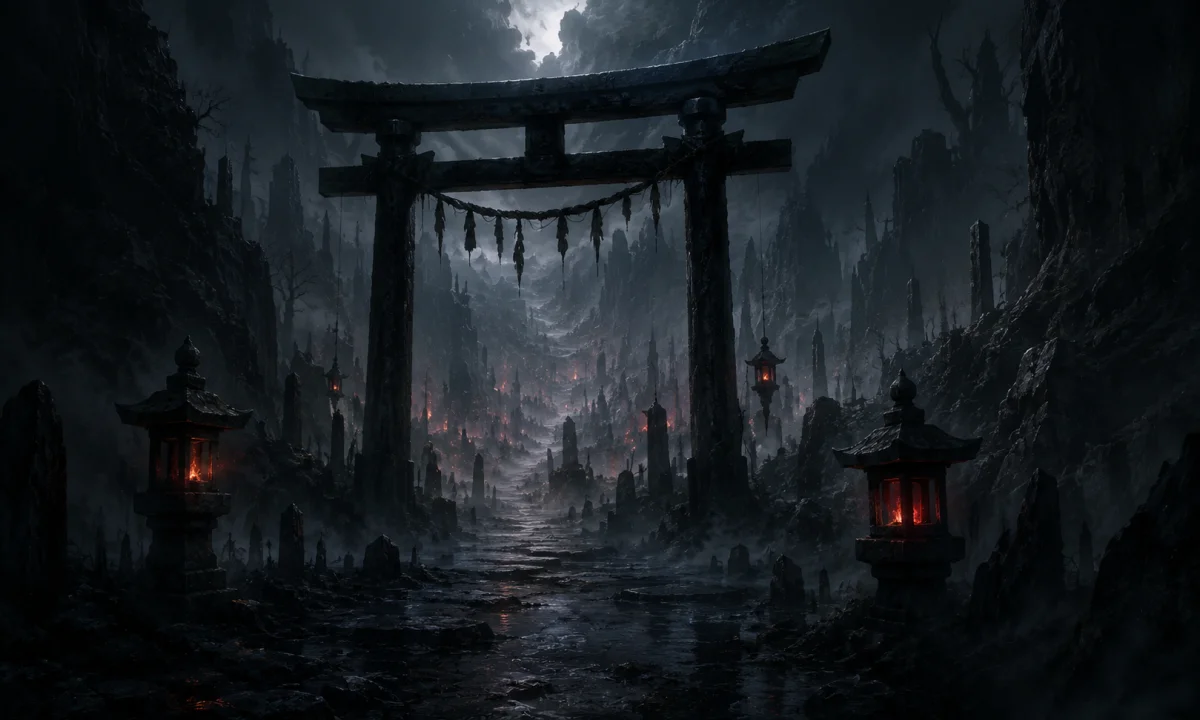
Yomi, also called Yomi no kuni or the “Land of Yomi,” is the realm of the dead in early Japanese mythology. It is best known from the story of the creator kami Izanagi and Izanami, preserved most fully in the Kojiki of 712. Yomi is an underworld associated with death, bodily decay, pollution and separation from the living. Unlike later Buddhist hells, however, it is not primarily a place of moral punishment, judgment or eternal torture.
Origins and surviving traditions
The most important account of Yomi appears in the Kojiki, an early Japanese record of myths, genealogies and court traditions compiled in the early eighth century. A related version occurs in the Nihon Shoki, completed in 720. These works preserve traditions connected with the worship of the kami and with the mythic ancestry of the Japanese imperial line, although they were written in historical and political circumstances shaped by the early Japanese state.
The two chronicles do not tell every story in exactly the same way. The Kojiki gives the most developed narrative of Izanagi’s descent into Yomi and uses the expression Yomi no kuni. The Nihon Shoki contains parallel material, but its wording, sequence and terminology vary. Some passages use expressions that can be translated as the “land of roots” or a similar underworld region. These differences show that early Japanese ideas about the realm of the dead were not set out in one single, fully systematized doctrine.
Yomi should therefore be understood as a mythic otherworld rather than as a precisely mapped religious geography. Ancient Japanese traditions also refer to other distant or supernatural lands, including Takama-ga-hara, the High Plain of Heaven, and Tokoyo, a remote or everlasting realm. These places are not simply interchangeable with Yomi. Their relationships vary according to the text and interpretation.
The name Yomi
The Japanese name is commonly written with the characters 黄泉, which can be read as “Yellow Springs.” In Chinese tradition, “Yellow Springs” was an established term for the underworld, and the written form probably influenced how the Japanese word was represented. The original meaning and etymology of the spoken word Yomi, however, remain uncertain. The spelling should not automatically be taken as proof that ancient Japanese people imagined Yomi as a yellow-coloured landscape or as a world containing literal springs.
The longer form, Yomi no kuni, means “the land of Yomi.” English translations sometimes call it the “Land of the Dead,” “Underworld” or “Land of Darkness.” Each conveys part of the idea, but none is a perfect equivalent. Yomi is linked with the dead and with the hidden world beneath or beyond ordinary human life, yet early sources do not provide a single detailed description of its physical form.
Yomi is also not the name of a goddess, demon or individual spirit. It is a place or realm. This distinction matters because names such as Yomotsu-shikome, the frightening women associated with Yomi, refer to beings connected with the underworld rather than to Yomi itself.
The death of Izanami
The central myth begins with Izanagi and Izanami, the male and female creator kami. They produce islands, natural features and many other kami. Izanami eventually gives birth to the kami of fire, usually identified as Kagutsuchi or Hinokagutsuchi. The birth burns her severely, and she dies from her wounds.
In the Kojiki, Izanami’s death does not end her activity. She travels to Yomi, leaving Izanagi among the living. Grieving and unwilling to accept the separation, Izanagi follows her into the land of the dead. He asks Izanami to return with him and continue their work in the world above.
Izanami replies that she cannot simply leave because she has eaten the food of Yomi. This detail resembles a widespread mythic pattern in which eating the food of an otherworld creates a bond that prevents a person from returning. Izanami says that she will consult the deities of Yomi, but she warns Izanagi not to look at her while she is gone.
The taboo is central to the story. Izanagi waits for a long time, then breaks off a tooth from his comb, lights it and enters the darkness. He sees Izanami’s dead body in a state of corruption. Thunder deities or other frightening manifestations are associated with her decaying form in the Kojiki. The scene makes Yomi’s most striking feature clear: death is not presented as a beautiful spiritual transformation but as a physical condition of decay.
Horrified, Izanagi flees. Izanami, angered and humiliated that he has seen her in this condition, sends the fearsome Yomotsu-shikome after him. These beings are often translated as the “hags of Yomi” or “ugly women of Yomi,” although translations differ. They pursue Izanagi toward the boundary between the underworld and the land of the living.
Izanagi attempts to escape by throwing objects behind him. In the Kojiki, items such as a headdress, a comb, food and peaches become obstacles or sources of distraction. The peach in particular helps drive back the pursuing forces. Izanagi eventually reaches the passage known as Yomotsu Hirasaka, commonly translated as the “Slope of Yomi.” There he places a great boulder across the entrance and seals the boundary.
Izanami then declares that, because he has rejected her, she will cause a thousand people to die each day. Izanagi answers that he will cause fifteen hundred people to be born each day. The exchange presents death and birth as opposing but connected forces. It also provides a mythic explanation for the continuing rhythm of human mortality and reproduction.
Yomi as a realm of death and pollution
The myth does not describe Yomi as a kingdom ruled by a devil-like monarch. Nor does it describe a formal court in which the dead are judged according to their virtues and sins. The strongest themes are death, defilement, taboo and the irreversible separation of the dead from the living.
Izanagi’s encounter with the dead body of Izanami is especially significant. Death is not only the absence of life; it is a condition that can contaminate or disturb the living. After escaping from Yomi, Izanagi performs purification rites in a river. As he washes, new kami emerge from his body. The cleansing of his eyes produces Amaterasu, the sun goddess, Tsukuyomi, associated with the moon, and Susanoo, associated with storms and the sea in different parts of the tradition.
This episode connects Yomi with the mythic importance of purification, although later Shinto ideas about impurity developed over a long period and cannot be reduced entirely to this one story. The narrative does not establish a complete set of historical ritual rules. It does, however, provide an influential mythic image of contact with death followed by cleansing and the restoration of order.
The boundary at Yomotsu Hirasaka is equally important. Yomi is not merely a distant country that can be visited freely. It is separated from the human world by a threshold, and crossing that threshold has consequences. Izanagi can enter, but he cannot bring Izanami back. Once the boulder is placed across the passage, the relationship between the two realms becomes permanently restricted.
Izanami’s role after death
The myth changes Izanami’s status without turning her into a simple villain. As a creator kami, she is associated with the generation of the world and its divine beings. After her death, she becomes a powerful figure linked to Yomi and to the destructive inevitability of mortality. Her anger toward Izanagi reflects grief, betrayal and the violation of the rule against looking at her, rather than a straightforward struggle between good and evil.
In some readings, Izanami’s threat to increase death shows her as a force governing the boundary of life. Izanagi’s response does not abolish death. Instead, it establishes a balance between death and birth. The story therefore explains a cosmic condition rather than presenting a hero’s victory over the underworld.
Some later religious and cultural interpretations have connected Izanami with death more strongly than the surviving early myths do. These interpretations should be distinguished from the original narrative, in which she remains both a creator and a deceased kami whose presence defines the separation between the living world and Yomi.
Yomi and other Japanese afterlives
Yomi is sometimes described as “Japanese hell,” but this wording can be misleading. In Japanese religious history, ideas about the afterlife were later influenced by Buddhism, which introduced or developed concepts of Jigoku, multiple hells, karmic judgment and punishments appropriate to particular wrongdoing. Buddhist accounts may include judges such as Enma, the Japanese form of the Indian and Buddhist figure Yama. These traditions are not the same as the early Shinto-associated mythology of Yomi.
Yomi is not identical to Jigoku. Yomi is primarily the land of the dead in an ancient mythic narrative. Jigoku belongs to a Buddhist framework involving karma, judgment and rebirth. In popular descriptions, the two are often blended because both are translated as “hell” or “underworld,” but their religious structures and meanings differ.
Yomi should also be distinguished from Tokoyo. Tokoyo may represent a distant, enduring or otherworldly realm and appears in several different contexts. It is not simply another name for the place where Izanami goes. Likewise, Takama-ga-hara is the heavenly realm associated with major kami and is not a synonym for Yomi.
The phrase Yomotsu Hirasaka names the boundary or slope leading to Yomi, not the entire underworld. In later Japanese culture, it has sometimes been treated as a symbolic location where the worlds of the living and the dead meet. Its precise geographical meaning in the ancient texts is less certain than its mythic function as a threshold.
Cultural significance
The story of Yomi expresses several concerns that are important in the mythology of death. First, it recognizes that death cannot simply be reversed, even when the living person refuses to accept it. Izanagi’s journey is motivated by love and grief, but his attempt to reclaim Izanami ends in terror and permanent separation.
Second, the myth links death with physical transformation. Izanami’s decomposing body confronts Izanagi with the reality that the dead do not remain unchanged. This aspect differs from traditions in which the deceased immediately appears in an idealized or perfected form.
Third, the narrative gives mythic form to the idea of boundaries. The entrance to Yomi, the prohibition against looking, the boulder at the threshold and the ritual washing after escape all emphasize that the living must treat death as a powerful and dangerous condition. The myth does not offer a detailed doctrine about what every human soul experiences after death. Instead, it explores what happens when the living cross into the domain of the dead.
The story also connects cosmology with ordinary human experience. Birth and death are presented as complementary forces, while purification provides a way to recover from contact with disorder. The creation of Amaterasu, Tsukuyomi and Susanoo from Izanagi’s cleansing gives the aftermath of the Yomi episode importance for the wider mythology of Japan.
Yomi in later interpretation and popular culture
Yomi has remained a recognizable symbol in Japanese literature, art, religious discussion and entertainment. Modern works frequently use the name for a dark underworld, a realm of monsters or a dangerous world beyond human society. Such portrayals may draw on the Izanagi and Izanami myth, but they often combine it with Buddhist hells, local ghost traditions and general fantasy ideas about the afterlife.
Modern games, manga, anime and films may also portray Yomi as a location with rulers, armies, levels or supernatural creatures. These features are usually creative developments rather than details supplied by the early mythological sources. The traditional Yomi is more mysterious and less bureaucratically organized: its defining image is the forbidden land of the dead and the boundary that separates it from life.
For that reason, Yomi is best understood not as a single Japanese equivalent of every underworld in world mythology, but as a specific early Japanese conception of death’s realm. Its enduring power comes from the story at its center: a creator kami enters the land of the dead to retrieve his lost partner, discovers that death has changed her beyond recognition, and returns to the living world only after accepting that the boundary cannot be undone.