WORLD
WORLD
Izanami
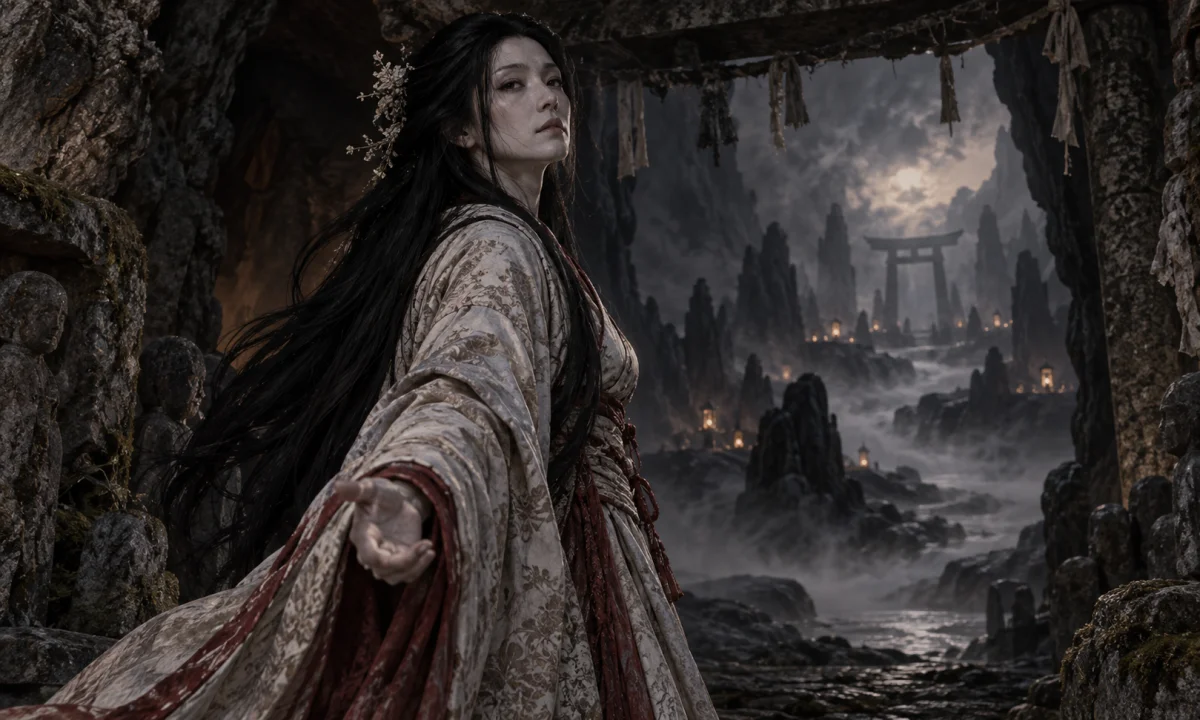
Izanami, also known as Izanami-no-Mikoto, is one of the principal creator kami of Japanese mythology. She appears most prominently in the Kojiki, compiled in 712, and the Nihon Shoki, completed in 720. In these early mythological traditions, Izanami and her male counterpart, Izanagi, establish the Japanese islands, generate many kami, and take part in a story about death, pollution, separation and the limits of human contact with the dead.
The word “kami” is often translated as “god” or “goddess,” but neither translation fully captures its meaning in early Japanese religious thought. Kami can include powerful beings associated with nature, ancestors, places, events and social institutions. Izanami is therefore described as a goddess in many English-language works, but “female kami” is also a more precise way to indicate her traditional status.
Origins in Japanese mythological tradition
Izanami belongs to the generation of kami responsible for bringing the ordered world into being. The surviving creation narratives do not present a single, completely uniform account. The Kojiki and Nihon Shoki share major themes, especially the partnership of Izanami and Izanagi, but differ in wording, sequence and details. The Nihon Shoki also preserves several variant accounts, reflecting the diversity of traditions known to its compilers.
These texts were produced in the early eighth century under the authority of the Japanese court. They are not simple records of popular belief, nor are they equivalent to a single sacred scripture accepted in exactly the same form by all Shinto communities. They combine inherited oral traditions, regional materials, genealogical interests and ideas connected with the political and religious order of ancient Japan.
The opening episodes describe a primeval world in which heaven and earth are not yet fully separated. A succession of early kami appears, including solitary beings and paired generations. Izanami and Izanagi emerge among the later generations and are given the task of stabilising and completing the land below heaven. The texts portray them as both divine ancestors and active creators.
The name and identity of Izanami
The name is commonly written as Izanami in English, with the honorific form Izanami-no-Mikoto in Japanese religious and mythological contexts. The corresponding name of her partner is Izanagi-no-Mikoto. The elements of the names are often associated with inviting, calling or enticing, leading to the familiar interpretation that Izanami is “she who invites” and Izanagi is “he who invites” or “he who beckons.”
This interpretation should not be treated as an unquestionable etymology. The precise historical development and meaning of the names remain matters for linguistic and scholarly discussion. Popular explanations often use the paired names symbolically, presenting them as complementary forces, but the ancient texts do not provide a modern-style dictionary definition of each name.
Izanami is not merely a personification of the earth, fertility or death. She has associations with all of these themes in different parts of the mythology, but her identity changes dramatically during the narrative. At first, she is a creative and generative kami who works with Izanagi to form the land and produce other divine beings. After her death, she becomes the ruler or great power of Yomi, the realm of the dead. These roles are connected within the story but should not be reduced to a single fixed attribute.
The heavenly spear and the formation of the islands
In the central creation episode, the heavenly kami command Izanami and Izanagi to make firm the drifting land below. They give the pair a jeweled or ornamented heavenly spear. Standing on the Floating Bridge of Heaven, Izanami and Izanagi stir the indistinct sea beneath them with the spear. When they withdraw it, brine gathers and forms an island.
This first island is called Onogoro in the Kojiki. The name is often translated in ways such as “self-forming island,” although the exact interpretation is not entirely certain. Izanami and Izanagi descend to it and establish a dwelling place, including a central pillar. Their union then becomes the means by which they produce further islands and kami.
The creation of the Japanese archipelago is not presented as a geographical survey. It is a sacred genealogy of land, in which islands are born through the activity of divine beings. The sequence and names of the islands vary between the Kojiki and the Nihon Shoki. In the Kojiki, the pair produce what are known as the “Great Eight-Island Country,” a poetic designation for Japan, before generating many other beings associated with the landscape and natural world.
The myth therefore links the Japanese land to divine ancestry. It also gives Izanami an important place in the imagined origins of the archipelago. She is not a passive consort: she speaks, acts, gives birth and shares responsibility for the formation of the world with Izanagi.
The marriage ritual and the problem of precedence
One episode describes Izanami and Izanagi circling their central pillar and meeting from opposite directions. Izanami speaks first when they encounter one another. They then consummate their union, but their first child is considered physically incomplete and is set aside. In the Kojiki, this child is called Hiruko, often identified in later tradition with the deity Ebisu, although that identification is not established directly by the early text and should not be assumed in every context.
The pair consult the heavenly kami and are told that the ritual went wrong because Izanami, the female partner, spoke first. They repeat the ceremony, with Izanagi speaking before Izanami. Their subsequent offspring are regarded as properly formed. This scene has often been interpreted as reflecting patriarchal ritual assumptions in the society that transmitted and compiled the myths. It is important, however, to distinguish the narrative’s ritual hierarchy from the broader creative power assigned to Izanami, who remains one of the principal makers of the land and its kami.
The episode is also a mythological explanation of why certain beings or births are anomalous. It is not evidence that every historical Japanese marriage ceremony followed this exact pattern. Rather, it presents a divine precedent within a particular mythic order.
Birth of the kami and Izanami’s death
After the corrected union, Izanami and Izanagi produce islands and a large number of kami. These include beings connected with the sea, winds, trees, mountains, plains and other features of the natural world. The details differ between the early sources, and later traditions often expand or reorganise the divine genealogies.
The birth of the fire kami marks the turning point in Izanami’s story. In the Kojiki, the child is named Kagutsuchi, while the Nihon Shoki preserves related but not identical forms and accounts. Because fire burns her as she gives birth, Izanami becomes ill and dies. Even as she lies dying, her bodily emissions give rise to further kami, including deities associated with mining, clay, water and agriculture in the Kojiki account.
Her death illustrates a recurring pattern in Japanese creation mythology: generation and destruction are closely connected. The same birth that brings fire into the world also ends the life of its mother. Izanami’s body continues to produce sacred beings after her death, but her creative role is no longer the same as before. The mythology moves from the generation of land and kami to the establishment of boundaries between life and death.
In grief and anger, Izanagi kills the fire child in the Kojiki. From the blood and dismembered body of the fire kami arise additional deities, especially those linked with mountains, rocks and weapons. This violent episode is another example of the texts presenting divine bodies as sources of further creation, even in death.
Izanami in Yomi
Unable to accept Izanami’s death, Izanagi follows her into Yomi, the land of the dead. He asks her to return with him. Izanami replies that she has already eaten the food of Yomi and cannot simply leave. She says that she will consult the powers of the underworld, but instructs Izanagi not to look at her.
Izanagi eventually breaks this prohibition. He lights a fire and sees Izanami’s transformed corpse, described in the Kojiki as infested or surrounded by creatures associated with decay and death. Terrified, he flees. Izanami is enraged by his violation of her command and sends beings of Yomi, including the fearsome hags known as yomotsu-shikome, in pursuit of him.
The chase ends at the boundary between the worlds, often identified with Yomotsu Hirasaka, the slope or passage leading from Yomi. Izanagi blocks the opening with a huge boulder. The former partners exchange final threats and declarations. Izanami says that she will cause a thousand people to die each day, while Izanagi answers that he will cause a thousand and five hundred to be born each day. This exchange is presented as a mythic explanation for the continuing balance between death and birth.
The separation is more than a failed attempt to restore a marriage. It establishes death as a condition that cannot be reversed through ordinary desire or physical pursuit. Izanagi’s failure also results from his inability to accept the transformed reality of the dead. The prohibition against looking back or looking upon the dead has parallels in many world traditions, but Izanami’s story remains specifically rooted in Japanese mythological ideas about Yomi, pollution and ritual separation.
Death, pollution and purification
After leaving Yomi, Izanagi performs a purification ritual. In the Kojiki, he washes in a body of water, and various kami arise from the substances removed from his body and clothing. When he washes his face, three especially important deities appear: Amaterasu, associated with the sun, from his left eye; Tsukuyomi, associated with the moon, from his right eye; and Susanoo, associated with the sea and storms, from his nose.
These births are sometimes described as a direct continuation of Izanami’s family line, but the myth makes a distinction. Amaterasu, Tsukuyomi and Susanoo are born from Izanagi’s purification rather than from a joint act of Izanami and Izanagi. Izanami remains their mythological predecessor through the earlier creation story, but she is not their birth mother in the same narrative episode.
The purification scene is important for the later religious significance of the myth. Contact with death and the underworld is treated as a condition requiring cleansing. Shinto concepts of kegare, often translated as impurity or pollution, are complex and should not be equated simply with moral sin. Kegare can arise through death, illness, blood and other conditions understood to disrupt ritual vitality. Purification, or harae, restores proper relation with the community, the kami and the surrounding world.
Attributes and symbolic interpretations
- Creator of land: Izanami helps form the islands of Japan and is portrayed as one of the divine ancestors of the land.
- Mother of kami: She gives birth to numerous beings connected with natural features and processes.
- Bearer of dangerous life: Her death during the birth of the fire kami links fertility with pain, injury and mortality.
- Ruler or power of Yomi: After death, she becomes associated with the realm of the dead and with the irreversible character of mortality.
- Agent of separation: Her conflict with Izanagi establishes a boundary between the living and the dead.
- Figure of ritual significance: Her story helps explain why contact with death is followed by purification in the Izanagi narrative.
Modern interpretations sometimes describe Izanami as a “death goddess” or as the Japanese equivalent of a universal mother-goddess. Such labels can be useful shorthand, but they are incomplete. The early myths do not present her as an all-powerful ruler over every aspect of death, nor do they define her through a single universal archetype. She is simultaneously a creator, mother, deceased spouse, transformed underworld figure and ancestor of divine beings.
Variants between the early texts
The Kojiki offers the most continuous and detailed version of the Izanami and Izanagi cycle, while the Nihon Shoki includes a main account together with alternative traditions. Names of kami, the order of events, the description of the islands and details surrounding Izanami’s death may vary. Some versions place greater emphasis on the production of the islands; others focus on the birth of deities or the political ancestry of the imperial line.
These differences do not necessarily indicate that one text preserves a universally “correct” version and the other contains mistakes. They show that early Japanese mythology was transmitted through multiple traditions before and during its compilation. Later Shinto institutions, medieval religious writers and local shrine traditions also developed their own interpretations of the creator pair.
Worship and religious context
Izanami is venerated as a kami at shrines in Japan, although the form and emphasis of her worship vary. Some traditions honour her together with Izanagi, reflecting their role as divine partners and creators. Others place her within local genealogies or identify her with particular sacred landscapes. Shrine practice cannot be inferred entirely from the narratives of the Kojiki and Nihon Shoki; living religious traditions develop through ritual, locality and historical change.
The association of Izanami with death does not mean that all worship dedicated to her is focused on funerary rites. In Shinto, a kami connected with a dangerous or polluting power may also be approached for protection, fertility, household welfare, safe childbirth or the well-being of a community. The meaning of a deity depends on the shrine, its traditions and the needs of worshippers.
Distinguishing Izanami from similar figures
Izanami should not be confused with Amaterasu, the solar kami and ancestor of the imperial line in the myths of the Kojiki and Nihon Shoki. Amaterasu is born from Izanagi’s purification after his return from Yomi, not directly from Izanami’s body. Nor is Izanami identical to Konohanasakuya-hime, a kami associated with blossoms, Mount Fuji and the fragility of life, or to Jigoku no Yama figures from later Buddhist imagery.
She is also distinct from Buddhist or folk figures such as Enma, the judge of the dead, and Jigoku, the Buddhist hell realms. Yomi and Buddhist hells are not interchangeable concepts. Yomi is the underworld of the Izanami and Izanagi myth, whereas Buddhist traditions describe postmortem judgment and punishment through different doctrines, texts and iconographies.
Later reception and modern adaptations
Izanami continues to appear in Japanese literature, visual art, games, manga and anime, where creators often draw on her roles as a creator, a deceased mother or a powerful underworld figure. Modern works may give her supernatural abilities, alter her relationship with Izanagi or merge her with ideas drawn from other mythologies. These portrayals are creative adaptations rather than evidence for the contents of the early myths.
Contemporary discussions also revisit Izanami’s story through themes of gender, childbirth, grief, bodily transformation and ecological creation. Some readers focus on the unequal ritual rule that condemns Izanami’s first birth, while others emphasise that she remains an active maker of islands and kami. Her descent into Yomi can be read as a story about mourning and the inability of the living to retrieve the dead, but such psychological readings are modern interpretations rather than explanations stated by the ancient texts themselves.
The enduring force of Izanami lies in the tension within her character. She begins as a creator of land and divine life, dies while giving birth to fire, and becomes a formidable presence on the far side of death. Her mythology does not remove death from the creative order; it makes death one of the powers that shape the world.