WORLD
WORLD
Kojiki
The Kojiki, usually translated as Records of Ancient Matters, is the oldest surviving major work of Japanese literature and one of the principal sources for Japanese mythology. Compiled in the early eighth century, it presents stories about the formation of the Japanese islands, the origins of the kami, the deeds of legendary rulers and heroes, and the genealogy of the imperial house. It is important both as a mythological text and as a work shaped by the political and religious culture of the early Japanese court.
Origins and historical setting
The Kojiki was completed in 712, during the reign of Empress Genmei. Its preface attributes the work to Ō no Yasumaro, who recorded and organized material recited by Hieda no Are. The preface also connects the project with the earlier reign of Emperor Tenmu, who is said to have ordered the preservation of ancient genealogies and traditions after concerns that important records were being altered or lost.
The work emerged during a period when the court at Yamato was developing more centralized institutions and presenting a coherent history of its rule. Japan had no single, universally fixed mythology in the modern sense. Local communities maintained their own traditions about kami, sacred places, ancestors and origins. The Kojiki gathered some of these materials into a court-centered narrative that connected the imperial lineage with the heavenly kami and with the creation of the land.
The text was written in literary Chinese script, but Japanese names, songs and speech were represented through complex combinations of Chinese characters. This mixture reflects the linguistic circumstances of the period: Chinese writing provided the script, while the traditions being recorded were rooted in Japanese oral and ritual culture. The Kojiki therefore preserves not only stories but also early forms of Japanese language, poetry and naming.
Structure and contents
The Kojiki consists of three books or scrolls. The first presents the age of the kami, beginning with the emergence of the earliest heavenly beings and continuing through the creation of the islands and the succession of divine generations. The second moves from the divine age into the stories of early rulers, including Emperor Jimmu, and contains many of the best-known heroic episodes. The third continues the imperial genealogy and includes accounts associated with rulers traditionally placed in the early centuries of Japanese history.
Myth, genealogy, ritual memory and political history are not sharply separated in the work. The text moves from cosmic beginnings to family relationships, battles, journeys, marriages and royal succession without adopting the modern distinction between “myth” and “history.” Some rulers and events may preserve memories of early political developments, but the narratives also contain supernatural births, divine transformations and encounters with other worlds.
The Kojiki contains songs and poetic passages that are especially valuable for understanding early Japanese literary expression. These include laments, courtship songs, declarations of identity and verses associated with dangerous journeys. The songs sometimes preserve emotional or local perspectives that differ from the formal tone of the genealogies.
The name and religious character of the Kojiki
Kojiki is written with characters meaning “records of ancient matters.” The title does not mean that the work is a complete record of every ancient Japanese tradition. It is a selected and arranged account, shaped by the compilers and by the interests of the court that sponsored it.
The beings described in the text are commonly called kami. Translating kami simply as “gods” can be convenient, but it is incomplete. Kami may be associated with heavenly powers, natural features, ancestors, rulers, animals, forces of fertility or danger, and beings whose status changes according to the story. The Kojiki does not provide a systematic theology in which every kami has a fixed rank and clearly defined domain.
Nor does the work describe “Shinto” as a fully organized religion in the later institutional sense. The traditions it preserves belong to an early religious world of ritual purity, sacred descent, offerings, kinship, taboo and reverence for powerful beings. Later Shinto scholars and religious institutions treated the Kojiki as an important sacred and classical text, but its original setting was an early court society in which religious and political authority were closely connected.
Creation and the birth of the kami
The opening of the Kojiki describes the beginning of the world in a series of divine appearances. At first, the universe is not presented as a finished cosmos. Kami emerge in stages, and some disappear after appearing. Among the earliest are Ame-no-Minakanushi-no-Kami, Takamimusubi-no-Kami and Kamimusubi-no-Kami. Their roles are not explained in a single consistent doctrine, and their prominence differs across early Japanese sources.
Further generations arise, including the male and female kami Izanagi and Izanami. Their names are often interpreted in relation to inviting or initiating, although the precise force of the names should not be treated as a complete definition of their characters. The older kami instruct them to solidify the unstable world, and they stand on the heavenly floating bridge while stirring the sea with a jeweled spear. The brine that drips from the spear forms the first island, traditionally called Onogoro.
Izanagi and Izanami establish a marriage ritual and produce islands and kami. Their union is not entirely successful: Izanami gives birth to the fire kami Kagutsuchi and dies from the resulting injuries. In grief and anger, Izanagi kills Kagutsuchi, and further kami emerge from the blood and body of the slain fire deity. These details show how creation, death and the generation of new sacred beings are intertwined in the Kojiki.
Yomi and the separation of life and death
After Izanami dies, Izanagi follows her into Yomi, the land of the dead, hoping to bring her back. Izanami warns him not to look at her before she has obtained permission to leave. He eventually sees her in a decayed and terrifying state, surrounded by the forces of death. Izanagi flees, and Izanami pursues him until he blocks the entrance with a great stone.
The two exchange a final declaration. Izanami threatens to cause the deaths of many people each day, while Izanagi replies that he will cause many more to be born. The episode establishes a mythic explanation for the continuing opposition between death and life. It also presents death as a condition that cannot simply be reversed, even when the dead person was once a divine partner.
After escaping from Yomi, Izanagi performs a purification. From this cleansing arise several important kami, including Amaterasu Ōmikami from his left eye, Tsukuyomi-no-Mikoto from his right eye and Susanoo-no-Mikoto from his nose. This account links ritual purification with renewed creation and gives the three kami distinct places in later Japanese religious and cultural traditions.
Amaterasu, Susanoo and the heavenly rock cave
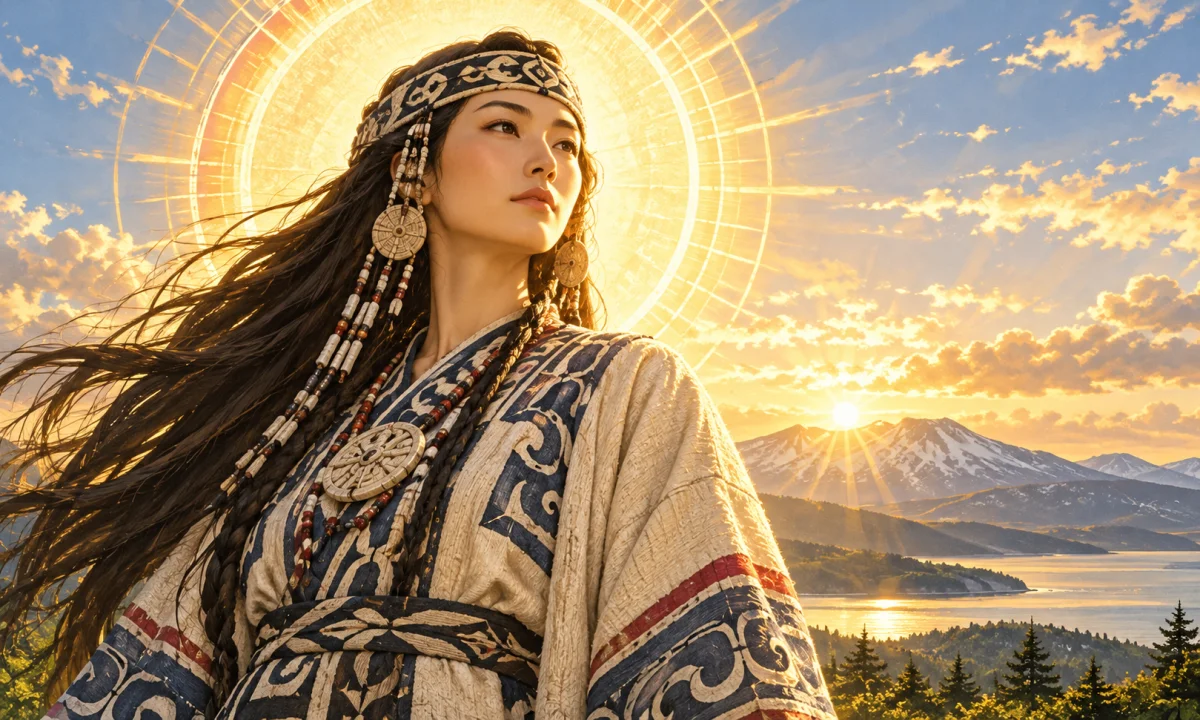
Amaterasu is the sun kami and one of the central figures of the Kojiki. She is also presented as an ancestor of the imperial line. Her relationship with her younger brother Susanoo is complex. Susanoo is associated with the sea and with violent, disruptive behavior, although his characterization varies between episodes and sources. He is not simply an embodiment of evil.
Before leaving the heavenly realm, Susanoo visits Amaterasu. They perform a test involving sacred objects, and the test produces new kami. The episode can be read as a contest over trust, legitimacy and the interpretation of ritual signs. Susanoo then behaves destructively, damaging fields and violating the order of Amaterasu’s heavenly residence. In response, Amaterasu hides inside the Ama-no-Iwato, the heavenly rock cave, and the world is plunged into darkness.
The other kami devise a plan to draw her out. They place a mirror and jewels near the cave and create a noisy celebration. The goddess Ame-no-Uzume performs a provocative dance, causing the gathered kami to laugh. Curious about the apparent joy outside, Amaterasu emerges far enough to see her reflection in the mirror. The strong kami Ame-no-Tajikarao pulls her from the cave, restoring light to the world.
The rock-cave story is often associated with the renewal of cosmic order. It also contains themes of ritual performance, laughter, music, sacred objects and communal cooperation. Later Shinto ritual and cultural representations have given special prominence to the mirror, jewels and sword connected with the imperial regalia, although the Kojiki’s accounts of these objects are part of a larger set of myths rather than a modern constitutional description of royal symbols.
Susanoo and the serpent Yamata no Orochi
After his conflict with Amaterasu, Susanoo is expelled from the heavenly realm and descends to the land of Izumo. There he meets an elderly couple whose eight daughters have been threatened by the eight-headed, eight-tailed serpent Yamata no Orochi. Only one daughter, Kushinada-hime, remains.
Susanoo promises to defeat the serpent in return for Kushinada-hime’s marriage. He transforms her, in one version of the episode, into a comb and places her in his hair. He then prepares eight containers of strong fermented drink. The serpent drinks from them, falls into a stupor, and Susanoo cuts it apart. Inside its tail he discovers the sword later called Kusanagi-no-Tsurugi.
The story combines a monster-slaying adventure with a foundation legend for an important sacred object. The sword is sent to Amaterasu and later becomes one of the three imperial regalia in the Kojiki’s broader account of heavenly descent and imperial succession. The serpent’s exact symbolic meaning is not fixed by the text. Interpretations have connected it with floods, dangerous waterways, political enemies or the ritual control of wild nature, but these are scholarly interpretations rather than explicit explanations supplied by the narrative.
Ōkuninushi and the ordering of the land
In the land of Izumo, the powerful kami Ōkuninushi-no-Kami becomes central to a long cycle of stories. He is associated with the development and ordering of the earthly realm, as well as with marriage, medicine, relationships and prosperity. His name is sometimes translated as “Great Lord of the Land,” but translations do not capture all the associations attached to him in later religious traditions.
Ōkuninushi faces repeated hostility from his numerous brothers and survives several dangerous ordeals. In one episode he meets Suseri-bime, a daughter of Susanoo, and wins her despite Susanoo’s severe tests. He also encounters Ōnamuchi, a name or identity associated with him in the narrative, and receives assistance from the small kami Sukunabikona. Together they establish aspects of civilization, including healing and the ordering of the land.
The heavenly kami later demand that the earthly land be transferred to their authority. Ōkuninushi agrees after receiving guarantees concerning a grand shrine and continued recognition. The story is often called the kuni-yuzuri, or “transfer of the land.” It gives mythic form to the relationship between the earthly traditions of Izumo and the heavenly lineage centered on Amaterasu and her descendants.
Ninigi and the descent from heaven
Amaterasu sends her grandson Ninigi-no-Mikoto to rule the earthly land. This descent, known as tenson kōrin, is a pivotal link between the kami of heaven and the later imperial genealogy. Ninigi receives sacred objects, including the mirror, jewels and sword, and travels to the earthly realm with divine companions.
Ninigi marries Konohanasakuya-hime, a beautiful daughter of the mountain kami Ōyamatsumi. Her name is associated with blossoming flowers, especially the image of flowers blooming briefly and brilliantly. When Ninigi questions her fidelity after she becomes pregnant soon after their marriage, she proves her innocence by entering a sealed hut and setting it on fire. Because the children survive, the story presents them as divine births under extraordinary circumstances.
One of their sons, Hoori, becomes involved in a story about a lost fishhook, rivalry with his brother Hoderi and a journey to the palace of the sea kami. Hoori marries Toyotama-bime, who gives birth to their child in a form that she forbids him to see. When he violates the prohibition, she returns to the sea. Their son is raised by Toyotama-bime’s younger sister, Tamayori-bime, and later becomes the father of Emperor Jimmu.
Jimmu and the imperial genealogy
The Kojiki presents Emperor Jimmu as the first ruler of the imperial line. His eastern expedition begins in the region of Kyushu and eventually reaches the Yamato area. The journey includes battles, difficult terrain, divine intervention and encounters with local powers. In one episode, the army is endangered by a poisonous mist, but a sacred crow guides Jimmu through the mountains.
Jimmu’s accession is not described as the beginning of Japanese civilization in a neutral historical account. It is part of a genealogy designed to connect the ruling house with the heavenly kami. The narrative gives the court a sacred ancestry while also describing the conquest and incorporation of territories. Its political meaning was especially significant in a period when the Yamato court was consolidating authority over different communities.
After Jimmu, the Kojiki records successive rulers, marriages, births and notable episodes. Some later sections are brief genealogical notices, while others include dramatic stories such as the deeds attributed to Yamato Takeru. These accounts blend royal ideology with themes of exile, disguise, military service, grief and the difficulty of serving a distant sovereign.
Relationship to the Nihon Shoki and other traditions
The Kojiki is not the only early source for Japanese mythology. The Nihon Shoki, completed in 720, offers another court-sponsored history and often records multiple versions of the same traditions. Its creation narratives, genealogies and political presentation overlap with the Kojiki but are not identical. Differences in names, sequence, emphasis and interpretation are important evidence that early Japanese traditions existed in varying forms.
Other materials, including regional traditions later associated with provincial records, shrine traditions, ritual texts and oral narratives, preserve additional kami and local origin stories. No single book contains a complete or universally authoritative version of Japanese mythology. The Kojiki is exceptionally influential, but it should be understood as one major compilation within a wider and changing religious landscape.
Interpretation and cultural significance
The Kojiki has been interpreted in several different ways. It can be read as a collection of sacred narratives, a work of literature, a linguistic record, a repository of oral traditions or a political genealogy. These approaches need not exclude one another. The text’s stories carry religious meaning, but their arrangement also serves the interests of the early imperial court.
Its treatment of descent is especially significant. Authority is repeatedly expressed through relationships between heavenly kami, earthly rulers and ancestral lines. At the same time, the stories preserve figures and traditions that do not fit a simple hierarchy. Ōkuninushi, Susanoo, Ame-no-Uzume and other kami have distinctive roles that can be locally important or later interpreted in ways not limited to the imperial narrative.
From the medieval period onward, commentators and religious institutions reread the Kojiki in changing contexts. In the early modern period, scholars associated with Kokugaku, or “National Learning,” treated ancient Japanese texts as a means of recovering an indigenous cultural and religious tradition distinct from imported Buddhist and Confucian learning. In the modern period, the Kojiki was also used in nationalist accounts of Japan and the imperial institution. Those later uses should be distinguished from the circumstances of its original compilation.
Distinctions from similar names and modern adaptations
Amaterasu, Susanoo, Izanagi, Izanami and other Kojiki figures are sometimes treated in popular culture as if they were characters from a single standardized pantheon. The early sources are less uniform. A kami’s name, genealogy, powers and importance may differ between the Kojiki, the Nihon Shoki, shrine traditions and later interpretations.
The Kojiki itself should also not be confused with the Nihon Shoki. Both are early Japanese chronicles, but they are separate works with different structures and emphases. Nor should the Kojiki be treated as a Japanese equivalent of a single “Bible” or as a complete scripture for all forms of Shinto. Its religious importance is substantial, but Japanese traditions have never depended on one text alone.
Modern novels, manga, anime, video games and films frequently adapt Kojiki figures. They may portray Amaterasu as a heroic sun goddess, Susanoo as a warrior, or Izanagi and Izanami as combatants in supernatural conflicts. Such portrayals can introduce these names to new audiences, but they often combine Kojiki material with elements from the Nihon Shoki, later folklore, Buddhist imagery or entirely new fictional systems. Their characters and powers should therefore be distinguished from the narratives preserved in the early text.