WORLD
WORLD
Raijin

Raijin is the Japanese kami, or supernatural deity, associated with thunder, lightning and violent storms. He is commonly shown as a fierce, oni-like figure surrounded by a ring of drums, which he beats to produce thunder. Raijin belongs to a wider Japanese religious and folkloric tradition in which storms could be understood both as natural events and as signs of divine activity. His identity is not confined to one single myth or standardized religious system: the figure known as Raijin developed through interactions among older Japanese beliefs, Shinto traditions, Buddhist imagery and later popular storytelling.
Name and identity
The name Raijin is written 雷神, meaning “thunder deity” or “thunder god.” The first element, rai, means thunder, while shin or jin means a deity or divine spirit. The same character can be read in different ways, so Raijin is also called Raiden, “thunder and lightning,” and Kaminari-sama, a respectful name meaning roughly “Honoured Thunder.” Narukami, “resounding deity,” is another poetic or religious term associated with thunder.
These names do not always indicate completely separate beings. Japanese religious language has often allowed a divine power to be known by several titles according to locality, ritual context or literary tradition. At the same time, not every thunder-related deity in Japanese mythology should automatically be treated as Raijin. Ancient texts name particular thunder beings, while later art and folklore often gather several ideas about thunder into the familiar drum-bearing figure.
Raijin is best understood as a thunder kami and storm spirit rather than as a character with a single universally accepted biography. Shinto does not possess one canonical account of every kami, and local traditions may emphasize different aspects of a deity. Some communities have worshipped thunder and lightning as powerful manifestations of the sacred landscape, especially because storms affect rice cultivation, water supplies and the fertility of the land.
Origins in Japanese religious tradition
The oldest written Japanese myths do not present Raijin in exactly the form familiar from modern illustrations. The Kojiki, compiled in 712, and the Nihon Shoki, completed in 720, contain accounts of thunder deities and thunder-associated beings, but their names and details vary between passages and manuscripts.
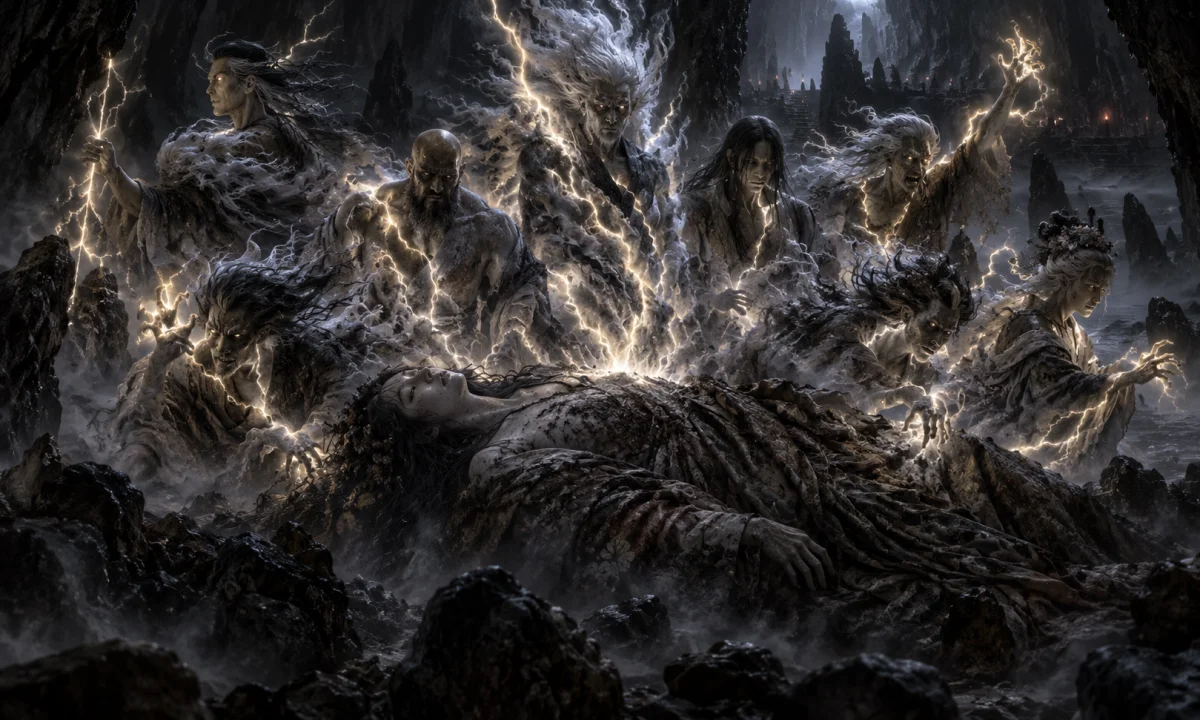
In the mythology surrounding Izanami and Izanagi, Izanami dies after giving birth to the fire deity and descends to Yomi, the realm of the dead. In the Kojiki, Izanagi encounters her changed and terrifying form, and thunder beings are described among the frightening entities connected with her body. The text lists multiple thunder deities rather than presenting one simple character called Raijin with the later standard appearance. The Nihon Shoki contains related but not identical versions of the story.
This distinction is important. The ancient Ikazuchi or thunder beings of myth are part of early cosmological narratives, whereas the horned, drum-carrying Raijin of paintings and folklore is a later and more visually unified representation. Scholars and translators sometimes use “thunder god” to describe both, but that does not mean that every ancient thunder deity was originally identical to the later Raijin.
Japanese traditions also used names such as kaminari and narukami for thunder itself or for the divine power believed to produce it. In agricultural society, thunder was not merely a destructive force. Storms brought rain, and rain sustained rice fields. Lightning could therefore be feared as a dangerous sign while also being associated with seasonal renewal, fertility and the nourishment of crops.
Religious and cultural setting
Raijin belongs to a religious world in which natural phenomena can possess spiritual presence. Mountains, rivers, rocks, trees, unusual animals and weather events may all be associated with kami. A thunderstorm could be interpreted as the activity of a local divine power, a warning, a blessing or a manifestation of sacred energy.
There was no single ancient Japanese doctrine that defined Raijin in the same way everywhere. Some shrines and local festivals honour thunder deities under regional names. Rituals for protection from lightning and storms could overlap with prayers for rain and agricultural success. In this context, Raijin is not simply a villain who causes damage. His power is ambivalent: thunder can destroy buildings, kill people and ruin crops, yet the rain accompanying it can make cultivation possible.
Japanese religious history also includes extensive shinbutsu shūgō, the combination and mutual interpretation of Shinto kami and Buddhist figures. Before the formal separation of Shinto and Buddhism in the modern period, temples and shrines often operated within a shared religious environment. Thunder deities could consequently appear in Buddhist temple art, alongside figures from Buddhist cosmology, without being treated as entirely foreign to Japanese worship.
The visual form of Raijin reflects this mixed cultural history. Japanese images of thunder gods developed alongside older East Asian representations of storm deities and Buddhist guardian figures. Chinese traditions included powerful thunder beings, while Buddhist art supplied many models for supernatural beings with muscular bodies, dramatic movement and fearsome expressions. This does not mean that Raijin is simply a copy of one foreign deity. Rather, the familiar figure emerged through the adaptation of several artistic and religious currents within Japan.
Appearance and attributes
Raijin is usually portrayed as a compact, muscular and menacing figure with a red, brown or dark body. He often has the features associated with an oni: wild hair, prominent fangs, sharp claws and sometimes horns. Artists may give him a tiger-skin loincloth, another feature commonly associated with oni-like supernatural beings. His expression is fierce, but the degree of grotesqueness varies considerably from one work to another.
The most recognizable attribute is the circle of drums surrounding his body. These drums are often called taiko, the general Japanese term for barrel-shaped drums. Raijin beats them with sticks, creating the rumble of thunder. In many images the drums form a complete or partial halo, making the deity immediately identifiable even when his face or clothing differs.
Some depictions show him riding or standing upon clouds. Others emphasize a dynamic, airborne pose, as though he is moving through the sky during a storm. Lightning may be suggested by the drums, clouds, energetic posture or surrounding flashes rather than by one fixed object held in his hand. His iconography is therefore flexible, but the combination of oni-like body, cloud setting and thunder drums is especially characteristic.
Raijin is frequently paired with Fūjin, the wind deity. Fūjin is generally shown as a wild, muscular figure carrying a large sack of wind over his shoulders, while Raijin carries or stands within his ring of drums. Their pairing expresses the relationship between wind and thunder in a storm and creates a balanced visual arrangement. The two are often treated as companions in art, but traditions do not provide one universally fixed story explaining their relationship. They should not be assumed to be brothers, spouses or enemies unless a particular source or modern adaptation explicitly makes that claim.
Thunder, lightning and the agricultural year
Raijin’s power has several related meanings. Thunder is loud, sudden and difficult to control, making it a natural image of divine authority. Lightning illuminates the sky, strikes the earth and can destroy trees or buildings in an instant. Such events encouraged fear and the practice of protective rites.
At the same time, thunder usually arrives with rain. In a farming culture dependent on seasonal water, storms could be welcomed as well as dreaded. The thunder deity could therefore be approached through prayers for rain, fertile fields and the continuation of the agricultural cycle. The same divine force might be blamed for lightning damage and thanked for the rain that followed.
Japanese folklore also preserves the idea that thunder beings may descend close to the human world. Stories sometimes describe thunder deities becoming trapped, falling to earth or interacting with people. These narratives vary by region and period, and they should not be reduced to one official legend of Raijin. Their recurring theme is that the dangerous power of the sky can unexpectedly enter an ordinary village or household.
Important myths and variants
Raijin does not have a single cycle of heroic adventures comparable to the stories of Susanoo or the exploits of many legendary heroes. His importance comes more from his role as a divine force and from his repeated appearance in religious art, weather lore and local practice.
The thunder beings connected with Izanami’s death are among the most important early mythic references relevant to his background. They belong to a dramatic story about death, pollution, separation and the structure of the cosmos. However, identifying those beings directly with the later drum-bearing Raijin can obscure the differences between early textual mythology and later iconography.
Some modern retellings describe Raijin as a son of Izanami, a partner or brother of Fūjin, or a member of a clearly defined divine family. These relationships are not consistent features of the major classical accounts. They may arise from attempts to organize a diverse tradition into a character-based mythology, from regional stories or from modern fiction. A careful description should therefore distinguish attested traditional associations from later inventions and simplified genealogies.
There are also stories and customs involving children and thunder. In some areas, people once believed that loud thunder might threaten children or that particular gestures, charms or foods could protect against storms. Such beliefs belong to broader Japanese thunder folklore rather than proving the existence of one standardized Raijin narrative.
Raijin and Fūjin in art
The paired images of Raijin and Fūjin became especially influential in Japanese visual culture. Temple paintings, screens, sculptures and printed images often place the two figures opposite one another, creating a dramatic contrast between the storm’s wind and thunder. Their bodies twist through clouds, and their equipment forms strong circular or diagonal shapes across the composition.
One celebrated artistic treatment is the Wind God and Thunder God screen tradition associated with Tawaraya Sōtatsu and later artists who copied or reinterpreted it. The figures are not merely illustrations of a written myth. They are also powerful demonstrations of movement, rhythm and visual balance. Raijin’s ring of drums gives the image a circular structure, while Fūjin’s wind bag suggests the spreading motion of air.
In Buddhist temples, thunder and wind deities could appear among protective supernatural beings. Temple art often presents them as guardians of sacred space or as forces operating within a vast cosmic order. Their fearsome appearance is not necessarily evidence that they are evil. In religious iconography, frightening beings may protect the Dharma, control dangerous natural forces or demonstrate the power of the sacred.
Distinguishing Raijin from related figures
- Fūjin: Fūjin is associated primarily with wind, while Raijin is associated with thunder and lightning. They are frequently paired, but they are not the same deity.
- Ikazuchi and other ancient thunder beings: These figures appear in early Japanese mythological passages and may be described as thunder deities. They should not automatically be treated as the fully developed later image of Raijin.
- Susanoo: Susanoo is a major kami connected with storms, the sea and other domains, but he is not simply another name for Raijin. Some modern fiction merges storm-related attributes that traditional sources keep distinct.
- Amaterasu: Amaterasu is the sun kami and a central figure in imperial and Shinto mythology. She is not a thunder deity, even though myths involving her can include storms, disorder and conflict.
- Oni: Raijin often looks like an oni because artists use horns, claws and a fearsome body to express supernatural power. He is nevertheless a thunder deity, not merely an ordinary oni from a folktale.
Interpretations and cultural significance
Raijin can be interpreted as a personification of the tension between danger and necessity. Thunder threatens human life, yet the rains of the storm support agriculture. His frightening form acknowledges the destructive force of nature, while his place in ritual and seasonal culture recognizes that human communities depend on the same weather they fear.
His drums also give thunder a distinctly human and performative image. Rather than imagining an invisible atmospheric process alone, the tradition pictures a powerful being actively making sound. This transforms an unpredictable natural event into an encounter with a willful presence. The image is memorable because it explains thunder in a simple visual language without reducing it to a harmless character.
Raijin’s shifting identity demonstrates how Japanese mythology has developed through layers rather than through one fixed canon. Early kami traditions, local weather beliefs, classical texts, Buddhist institutions, temple art and popular entertainment have all contributed to the figure. For that reason, the most accurate account does not insist on one definitive family tree or one unchanging appearance.
Modern reception
Raijin remains widely recognizable outside religious contexts. His drum circle, horns and storm-cloud setting have made him a popular figure in manga, anime, video games, fantasy art and other forms of global popular culture. Modern works may portray him as a warrior, a monster, a guardian, a comic character or a ruler of lightning.
These portrayals can preserve elements of traditional iconography while changing Raijin’s personality, powers and relationships. A fictional character named Raijin may use lightning attacks or be paired with a wind-based character without representing Japanese religious tradition in a strict sense. In particular, modern stories often give him a detailed biography that is not found in classical mythology.
Traditional Raijin is best approached as a powerful and sometimes dangerous thunder kami whose meaning has been shaped by weather, agriculture, Shinto and Buddhist religious culture, and centuries of artistic interpretation. His familiar drums are not simply decorative: they express the ancient effort to understand thunder as the action of a divine presence moving across the sky.