WORLD
WORLD
Amenominakanushi
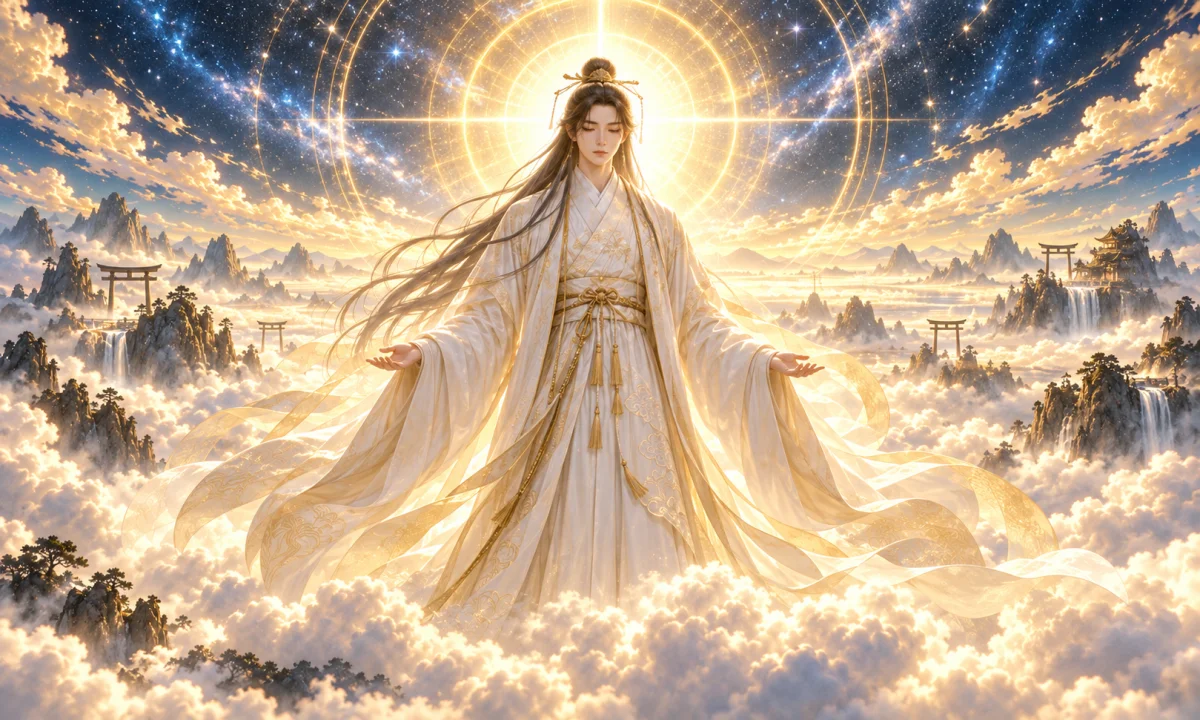
Amenominakanushi is a primordial kami in Japanese mythology, best known from the opening cosmogony of the Kojiki, Japan’s oldest surviving chronicle of myths and genealogies. His name is commonly translated as “Master of the August Center of Heaven” or “Heavenly-Center Lord.” In the Kojiki, Amenominakanushi appears at the beginning of the formation of the cosmos, before the better-known deities Izanagi, Izanami and Amaterasu. He is one of three solitary kami who arise in Takamanohara, the High Plain of Heaven, and then withdraw from the narrative.
Amenominakanushi is therefore not a mythological hero with a sequence of adventures. The surviving early texts give him no personal dialogue, family story, physical description or recorded deed. His importance comes from his position at the beginning of the cosmic order and from the interpretations later attached to that position. In traditional and modern Shinto discussions, he may be regarded as a supreme, universal or central divine principle, but those ideas go beyond what the earliest myth itself explicitly says.
Origins in early Japanese myth
The most important surviving account of Amenominakanushi occurs in the Kojiki, compiled in 712. The work begins with the separation and emergence of Heaven and Earth. At this initial stage, the world is not yet described as a fully ordered landscape inhabited by human beings and familiar gods. From this primordial condition, a kami named Amenominakanushi no Kami comes into existence in Takamanohara. Two further kami then appear: Takamimusubi no Kami and Kamimusubi no Kami.
The text treats all three as hitorigami, or solitary kami. They arise individually rather than being born from a divine couple, and the narrative says that they conceal or withdraw themselves. The wording does not present them as being killed or defeated. Their disappearance is instead part of the distinctive style of the Kojiki’s opening creation account, in which several primordial beings emerge briefly and then give way to later generations of deities.
After the appearance of these three, other early kami come into existence. The Kojiki then moves through a sequence of primordial beings before reaching the generation of Izanagi and Izanami, the divine pair associated with the formation of the Japanese islands and the birth of many kami. Amenominakanushi is thus placed at the very beginning of the genealogy, but he does not take part in the island-creation episode or in the later heavenly conflicts and journeys.
The Nihon Shoki, completed in 720, presents a different opening cosmology. Its principal account begins with Kuni-no-Tokotachi, followed by other primordial beings, rather than making Amenominakanushi the first named kami. The Nihon Shoki also preserves variant accounts and does not offer a single completely uniform creation story. This difference is important: Amenominakanushi is central to the Kojiki’s opening, but he is not the universally established first deity in every early Japanese account.
The meaning of the name
The name is usually divided into three elements: ame, meaning “heaven” or “heavenly”; minaka, meaning “center” or “middle”; and nushi, meaning “master,” “lord” or “possessor.” English renderings therefore include “Lord of the Center of Heaven,” “Master of the August Center” and “Heavenly Central Lord.” The exact nuance depends on how the honorific elements of the old Japanese name are translated.
The name suggests a location or principle at the center of the heavenly realm, but it should not automatically be treated as proof that Amenominakanushi was originally an astronomical deity. The Kojiki does not describe him as the sun, moon, Pole Star or a particular constellation. Nor does it give him an iconographic form. Later religious interpretations connected him with cosmic centrality and, in some contexts, with celestial bodies, but these associations are developments in interpretation rather than clear statements in the earliest myth.
The word nushi appears in the names of several Japanese kami and can indicate authority over a place, object or domain. It does not by itself establish that Amenominakanushi was a king in a human-like sense. Similarly, the name does not determine a masculine or feminine appearance. Japanese kami are not always defined by the gender categories used for human characters, and the early text gives no physical description of this deity.
The Three Creation Kami
Amenominakanushi is traditionally discussed together with Takamimusubi and Kamimusubi, the three primordial kami who appear at the start of the Kojiki. Later scholars and religious traditions often call them the zōka sanshin, or “three kami of creation.” This label is useful, but it can also be misleading if it implies that the three are described in the text as a coordinated creator triad with clearly divided responsibilities. The Kojiki mainly records their emergence and withdrawal.
Takamimusubi becomes much more active in later sections of the mythology. He is associated with the heavenly kami and plays an important role in decisions concerning the descent of Ninigi, grandson of Amaterasu, to rule the terrestrial realm. Kamimusubi also appears in later myths, particularly in episodes connected with the deity Ōkuninushi and with the land of Izumo. Amenominakanushi, by contrast, is not given a comparable role in the narrative.
This contrast has encouraged different interpretations. Some readers understand Amenominakanushi as the most abstract or transcendent member of the group, while Takamimusubi and Kamimusubi represent more active forms of generative power. Others avoid assigning such a hierarchy because the Kojiki does not explicitly state that Amenominakanushi rules the other two or creates them. The order of appearance may suggest priority, but it is not a complete theological system.
Attributes and mythological role
Amenominakanushi has few conventional attributes. He is not described as carrying a weapon, dwelling in a named shrine, riding an animal or engaging in a contest. No story tells of his birth from a parent, marriage, battle or death. His defining feature is his position in the opening of the cosmos.
His role can be described in several carefully distinguished ways:
- Primordial kami: He belongs to the earliest layer of divine beings in the Kojiki.
- Cosmic centrality: His name places him at the center of Heaven, suggesting order, origin or a central point in the heavenly realm.
- Solitary deity: He arises independently rather than through the union of a male and female kami.
- Foundational figure: His appearance marks the beginning of the Kojiki’s divine genealogy.
- Textually inactive presence: After appearing, he withdraws and does not become a protagonist in the myths that follow.
Calling Amenominakanushi a “creator god” requires some qualification. The Kojiki places him at the start of creation, and later Shinto thought often treats him as a supreme or creative divine power. Yet the text does not show him deliberately shaping the universe in the manner of a craftsman. His creative significance is primarily positional and theological: he is present at the beginning of the cosmic sequence.
Cosmic center and later interpretation
The idea of a heavenly center has allowed Amenominakanushi to receive meanings that are broader than his brief appearance in the Kojiki. He has been interpreted as an invisible source of existence, the unity behind the multiplicity of kami, or a principle of balance within the cosmos. Such interpretations are especially common in theological explanations that seek a single highest reality behind the many deities of Shinto.
These explanations should be distinguished from the early myth itself. Shinto has never possessed only one fixed theology shared equally by every period, shrine and school. Medieval Shinto developed through interaction with Buddhism, continental religious ideas, court ritual and native traditions. Scholars and religious institutions repeatedly reinterpreted ancient kami in response to changing intellectual and devotional settings.
In some medieval and early modern forms of shinbutsu shūgō, the combination or mutual interpretation of kami and Buddhist figures, Amenominakanushi was associated with Buddhist or astral divinities. One notable comparison is Myōken, a Japanese Buddhist deity connected with the Pole Star and the Big Dipper in certain traditions. Because both figures could be understood through ideas of cosmic centrality and celestial order, some religious systems treated them as related manifestations or corresponding identities.
This does not mean that Amenominakanushi and Myōken were originally the same being. Myōken belongs to a Buddhist and astral religious context, while Amenominakanushi is introduced in the Kojiki as a primordial kami. Their identification is a later syncretic interpretation, not a fact established by the early Japanese creation narrative.
Worship and religious significance
Amenominakanushi has not generally occupied the same popular position as Amaterasu, Inari, Hachiman or Susanoo. His appearance in the Kojiki is brief, and there is no large cycle of myths explaining his festivals, miracles or earthly interventions. Nevertheless, his name has continued to appear in Shinto theology and in the traditions of particular shrines.
Some shrines and religious movements present him as a supreme or universal kami associated with the origin of the universe, the harmony of existence and the unity of all divine powers. In such settings, his ancient textual position can support a theology of an ultimate heavenly source. These beliefs reflect particular traditions and interpretations rather than a single universally accepted doctrine across all Shinto institutions.
The use of Amenominakanushi in worship also illustrates an important feature of Japanese religious history: a deity can remain significant even when the early myth provides little narrative material. Ritual, shrine tradition, theological writing and local religious practice may give a kami meanings that are not fully developed in the oldest surviving text. The absence of stories does not necessarily mean the absence of religious importance.
Distinguishing Amenominakanushi from similar figures
Amenominakanushi is sometimes confused with other supreme, heavenly or primordial beings. These comparisons can be useful, but they should not erase differences between traditions.
- Amaterasu: Amaterasu is the solar kami and ancestor of the imperial line in the major court myths. She has extensive narratives involving her birth, withdrawal into the rock cave and relationship with Susanoo. Amenominakanushi is an earlier, much more abstract figure and is not the sun goddess.
- Izanagi and Izanami: These divine partners create or give birth to islands and numerous kami in the Kojiki. They belong to a later generation and have a detailed story of marriage, childbirth, death and the underworld. Amenominakanushi is not one of their parents or partners in the early text.
- Takamimusubi and Kamimusubi: These are the two kami who appear alongside Amenominakanushi in the Kojiki’s opening. They are related by their place in the primordial sequence, but each has a distinct name and later mythological role.
- Kuni-no-Tokotachi: This primordial kami is prominent in the main creation account of the Nihon Shoki. He should not be treated as simply another name for Amenominakanushi, even though both occupy an early position in Japanese cosmology.
- Myōken: Myōken is a Buddhist astral deity associated in some traditions with the Pole Star or the Big Dipper. Associations between Myōken and Amenominakanushi arise from later syncretism, not from identical origins.
- Dainichi Nyorai: In some forms of Buddhist-Shinto interpretation, kami were understood as manifestations of Buddhas or bodhisattvas. Comparing Amenominakanushi with Dainichi reflects this later religious framework and should not be presented as the original meaning of his name.
Presence in modern culture
Amenominakanushi is less visible in international popular culture than figures such as Amaterasu, Susanoo or the yokai of later folklore. When he does appear in modern fiction, games, manga, spiritual writing or new religious presentations, he is often portrayed as an omnipotent creator, a cosmic ruler or a personification of the universe’s center.
Those portrayals usually expand a very limited ancient description. The original Kojiki does not provide a character design, personality or catalogue of powers from which such depictions can be reconstructed. A modern work may therefore use the name as a foundation for imaginative or theological invention. Such portrayals belong to modern adaptation or later religious interpretation, not to a detailed ancient legend about an active divine protagonist.
Amenominakanushi remains most distinctive as a figure of cosmic beginnings: a kami whose name and placement establish a heavenly center before the more familiar stories of Japanese mythology unfold. His significance lies less in dramatic action than in the question he raises about how early Japanese tradition imagined the origin and organization of the divine world.