WORLD
WORLD
Adachigahara
Adachigahara is a haunted place in Japanese folklore, best known as the home of an onibaba, or demon hag, who preys upon travellers. The name refers to the Adachi plain or moor in what is now Fukushima Prefecture, in northeastern Japan, rather than to a single supernatural being. The legend is also associated with Kurozuka, meaning “Black Mound,” and with the classical Noh drama Kurozuka, in which an apparently ordinary old woman is revealed as a murderous demon.
The place called Adachigahara
Adachigahara is traditionally identified with a locality near present-day Nihonmatsu in Fukushima. In earlier periods, the region belonged to the broad historical province of Mutsu, a frontier area that medieval travellers could experience as remote, sparsely settled and dangerous. Such landscapes frequently became settings for stories about ghosts, bandits, monsters and other beings that threatened people travelling between communities.
The landscape is especially linked with a mound or hill known as Kurozuka. In local tradition, this was the place where the monstrous old woman lived or where her remains were buried. The relationship between Adachigahara and Kurozuka is not identical in every telling: sometimes the names describe the haunted place and its mound, while in theatrical and literary contexts Kurozuka is the title used for the demon woman’s story.
Adachigahara should therefore be understood first as a legendary location. The supernatural figure associated with it is variously called an onibaba, the old woman of Adachigahara, or Kurozuka. These names do not necessarily indicate separate beings. They reflect different ways of referring to the same cluster of regional traditions and artistic representations.
The old woman and the onibaba tradition
An onibaba is an ogre-like or demonized old woman in Japanese folklore. The word combines oni, a broad term for a monstrous or demonic being, with baba, meaning “old woman” or “grandmother.” Onibaba figures are often presented as human women who have become monstrous through grief, isolation, resentment, madness or a life of violence. In other stories, they are supernatural from the beginning.
The Adachigahara figure belongs to the more threatening end of this tradition. She lives alone in a desolate place and offers shelter to people who arrive after dark. Her apparent hospitality conceals a murderous nature. Travellers who enter her dwelling may discover evidence of earlier victims, often in the form of human bones, before the old woman returns in demonic form.
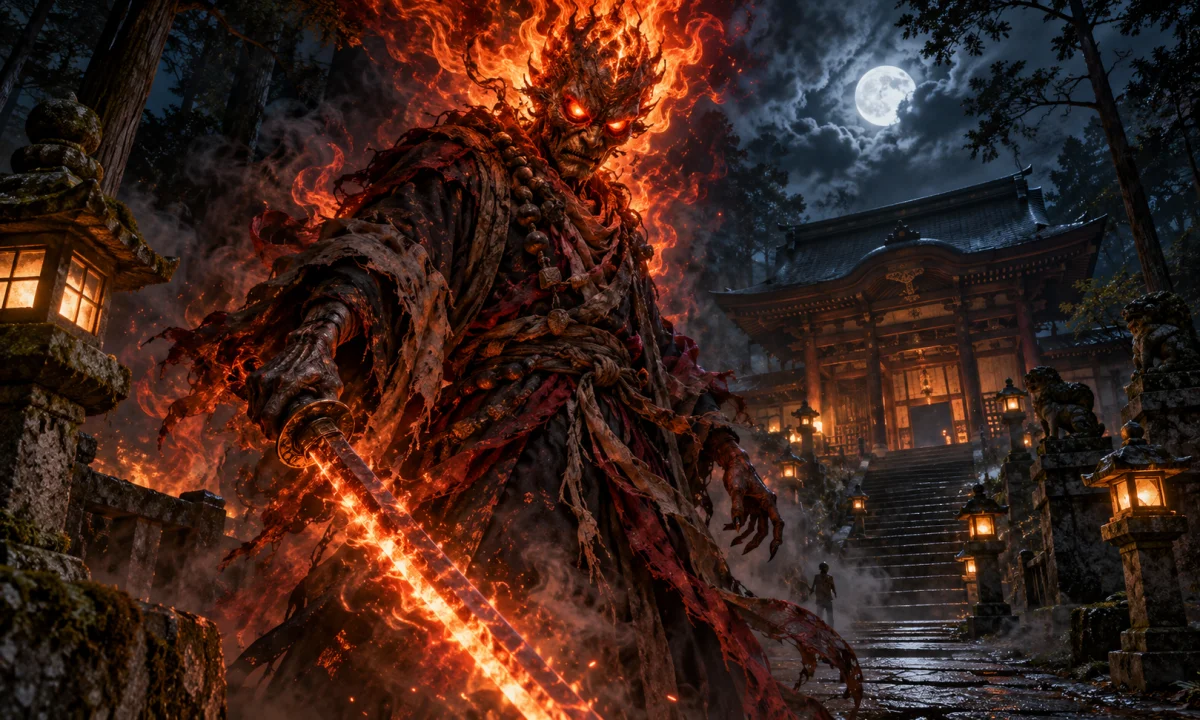
Descriptions vary, but the transformed woman is commonly imagined with the visual features associated with Japanese demons: wild hair, a distorted face, great physical strength and a frightening, almost animal-like appetite. She may be shown carrying a knife or other weapon, or wielding a large object as she attacks her victims. These details belong mainly to folklore, theatre and visual art; they are not fixed characteristics of a single canonical creature.
The central legend
The best-known narrative follows a travelling Buddhist monk and his attendant as they cross the lonely region of Adachigahara. As evening approaches, they encounter an old woman living in an isolated hut. She appears poor but harmless, and the travellers ask for a place to stay. She agrees to receive them, often on the condition that they do not disturb a particular room or area of the dwelling.
When the old woman leaves or falls asleep, curiosity leads the travellers to investigate the forbidden space. There they find human bones, bloodstained objects or other proof that the hut has been the scene of repeated killings. The old woman is not an unfortunate recluse but the predator responsible for the deaths of those who sought refuge with her.
After her secret is discovered, she returns in a terrifying form. The quiet hostess becomes an onibaba, pursuing the monk and his companion through the wilderness. In versions shaped by Buddhist drama, the travellers resist her through prayer, sacred authority and spiritual discipline rather than through ordinary physical strength. The demon is eventually defeated, driven away or made to confront the consequences of her actions.
The story has no single universally fixed ending. Some versions emphasize the demon’s defeat; others concentrate on her suffering and the karmic burden that has led to her monstrous existence. The difference is important because the woman is not always portrayed as a simple creature of evil. Her violence remains horrifying, but the narrative may also invite reflection on the circumstances that turned a human being into a demon.
Origins and surviving traditions
The Adachigahara story circulated through oral tradition, local custom and religious storytelling before becoming established in literary and theatrical forms. Its precise origin is uncertain. There is no single ancient text that can be treated as the definitive source for every detail now associated with the legend. Different versions developed in different settings, and later performers and writers reshaped the material for their audiences.
The most influential surviving form is the Noh play Kurozuka, also known as Adachigahara in some contexts. Noh developed from medieval performance traditions and often presented encounters between the living and the dead, the human and the supernatural, or worldly suffering and Buddhist insight. In Kurozuka, the old woman is not merely a monster waiting to attack. Her speech, memories and eventual transformation make her inner state central to the drama.
The play follows a travelling religious figure and his companions who encounter the woman at her dwelling. She talks with them, performs domestic work and recounts aspects of her life. The seemingly ordinary actions of spinning or preparing a shelter create a deliberate contrast with the violence hidden behind them. When the forbidden part of the house is revealed, the woman’s identity changes, and the second part of the drama presents her as a furious supernatural being.
As in many Noh plays, the structure moves from an apparently realistic meeting to a disclosure of the past and then to a supernatural climax. The woman’s appearance in the first part may be understood as that of a human or spirit in disguise, while her later appearance exposes the emotional and karmic force that has been concealed. Buddhist ideas about attachment, delusion and the consequences of action are present in the background, although the play remains a work of theatre rather than a simple doctrinal lesson.
Variants of the woman’s past
Stories connected with Adachigahara do not always agree about how the old woman became a killer. In the most common outline, she has spent many years alone in the wilderness and has murdered travellers who came to her hut. The legend’s power lies partly in this stark image: a place that should offer shelter becomes a trap.
Other retellings supply a more elaborate personal history. Some connect the woman’s transformation with service in a wealthy household, a sick mistress or a terrible mistake involving a pregnant woman and an unborn child. In these versions, the old woman discovers that one of her victims is connected to her own past, producing a shock of recognition and guilt. Details differ substantially, and not every version includes this episode.
These variations should not be treated as if they were parts of one securely documented biography. They represent attempts to explain the emotional origin of the onibaba. One version portrays her as a predatory murderer; another presents her as a person trapped in grief, poverty or moral corruption; a theatrical version may leave the past deliberately ambiguous so that the audience encounters her first as a lonely human figure and only later as a demon.
Symbols of danger and concealed violence
The setting is essential to the meaning of the legend. Adachigahara is not simply a backdrop but a borderland between settled society and the unknown. Travellers are separated from familiar communities, roads are difficult to navigate and night removes the protections of ordinary social life. The hut offers warmth and shelter, yet its isolation also makes escape difficult.
The forbidden room is one of the story’s most memorable features. It represents the hidden history of a household and the danger of trusting appearances without question. A fire, a meal and the presence of an elderly hostess suggest domestic safety. The bones behind the barrier reveal that this safety has been manufactured by a killer.
The legend also reverses expectations about age and gender. An old woman may appear weak, dependent or deserving of protection, but the Adachigahara figure possesses physical and supernatural power. Her apparent vulnerability becomes part of her disguise. At the same time, the story reflects the social dangers faced by travellers who depended on strangers for food and lodging, especially in places beyond the effective reach of law.
From a Buddhist perspective, the demon’s condition can be interpreted through karma and attachment. A human being consumed by rage, hunger, grief or resentment may become spiritually monstrous. The transformation is not necessarily a biological change; it can represent the visible form of an inward corruption. The demon’s defeat, when it occurs, does not erase the suffering that produced her. This gives the story a tragic dimension absent from a purely sensational monster tale.
Adachigahara in Noh and performance
Kurozuka is important because it preserves the basic legend in a highly concentrated dramatic form. Noh relies on controlled movement, stylized speech, music and symbolic costume rather than naturalistic horror effects. The old woman’s transformation is therefore achieved through performance conventions: changes in posture, voice, dance, mask and rhythm can reveal what has been concealed.
The mask used for the demon woman is not simply a portrait of an ugly elderly person. Noh masks operate through angle, lighting and movement, allowing a face to appear sorrowful, threatening or strangely animated. The performer’s restrained gestures make the sudden violence of the demon’s dance especially powerful. Instead of presenting the monster as a continuously visible creature, the play builds fear through delay and revelation.
The Noh version also gives unusual attention to speech and memory. Before the attack, the woman is allowed to occupy the stage as a person with a voice and a history. Her transformation does not merely introduce a new antagonist; it reveals the destructive force that has been present beneath the conversation from the beginning.
Local memory and religious context
Legends such as Adachigahara’s have often been connected with temples, shrines, mounds and other sites where local communities preserved memories of the supernatural. A place associated with a dangerous spirit could be treated with caution, but it might also become a site of ritual attention, storytelling and cultural identity. The existence of a named mound or reputed dwelling does not by itself prove that the events occurred historically. It shows that the story became attached to a particular landscape.
Religious interpretations likewise vary. Buddhist storytelling provided a language for explaining demonic transformation, karmic consequences and the possibility of release from suffering. Local beliefs about dangerous spirits and haunted places could coexist with these ideas. Japanese religious culture has frequently allowed Buddhist, Shinto and folk practices to overlap, so it is misleading to classify the Adachigahara legend as belonging exclusively to one formal religious system.
Nor should the onibaba be treated as a standard figure in Japanese theology. She is primarily a folkloric and theatrical image. The term oni itself has a broad history and can refer to different kinds of demons, ogres or threatening supernatural beings depending on context. The old woman of Adachigahara is one regional and literary expression of this wider demonology.
Distinguishing Adachigahara from similar figures
Adachigahara is sometimes confused with other dangerous women in Japanese legend, particularly the yamauba, or mountain woman. Both may live in remote areas and both can be represented as old, wild and threatening. They are not automatically the same figure. Yamauba traditions are diverse: some portray the mountain woman as a man-eater, while others give her magical knowledge, a maternal role or an ambiguous relationship with travellers. The Adachigahara onibaba is specifically associated with the murderous legend of the haunted hut and Kurozuka.
She should also be distinguished from ubume, the ghost of a woman who died during pregnancy or childbirth, and from yūrei in general, the broad category of Japanese ghosts. The Adachigahara woman may have a tragic backstory in some retellings, but her usual identity is that of a living or transformed demon who attacks travellers, not a ghost defined by death in childbirth.
Likewise, “Kurozuka” can refer to the black mound or to the Noh drama, while “Adachigahara” can identify the geographical setting or the legend as a whole. These terms are related but should not be assumed to name a separate species, deity or demon hierarchy.
Later reception
The story continued to circulate through Japanese theatre, illustrated books, prints and local retellings. Its stark visual elements—an isolated hut, an old woman, a forbidden room and a mass of human bones—made it especially suitable for dramatic and graphic representation. Artists could emphasize either the grotesque horror of the demon or the sorrowful human history suggested by her face and posture.
In modern popular culture, the onibaba of Adachigahara contributes to the broader image of the Japanese demon woman: a figure who may combine fear, age, isolation and suppressed suffering. Manga, anime, film, games and horror fiction often borrow the idea of a seemingly harmless elderly woman who conceals monstrous power. Such adaptations may use the name Adachigahara or Kurozuka while changing the plot, setting and nature of the creature. These modern versions should be distinguished from the local legend and from the Noh play, which place greater emphasis on landscape, Buddhist themes, performance and the revelation of a troubled past.
The enduring force of Adachigahara lies in the tension between hospitality and danger. A traveller seeks protection from the night and finds a house that has turned refuge into a weapon. Behind the demon’s frightening appearance is a tradition concerned with isolation, moral transformation and the unstable boundary between an ordinary human life and a monstrous one.