WORLD
WORLD
Amaterasu
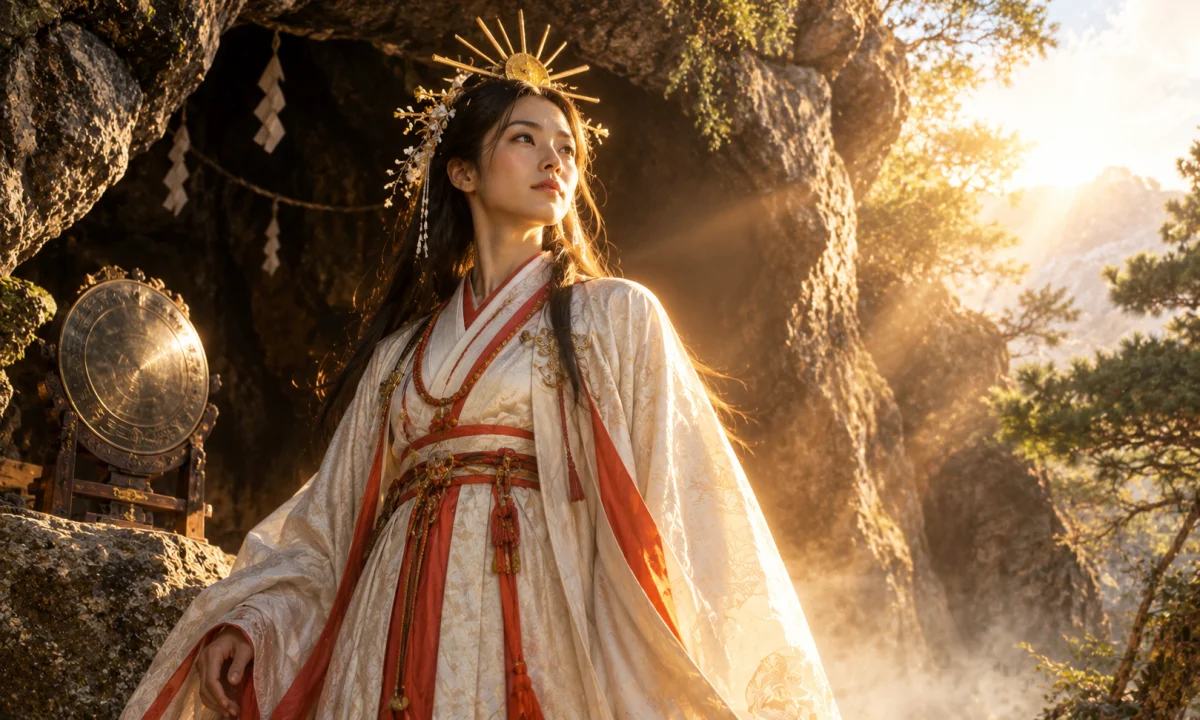
Amaterasu, more fully Amaterasu Ōmikami or Amaterasu-Ōmikami, is the principal sun kami of Japanese mythology and one of the most important deities in Shinto tradition. She is associated with daylight, order, fertility, imperial ancestry and the life-giving power of the sun. In the mythological genealogies preserved by the Japanese court, Amaterasu is also presented as an ancestor of the imperial line, although the political meaning of that relationship developed alongside the formation of the early Japanese state.
Origins and surviving traditions
The oldest extended written accounts of Amaterasu appear in two eighth-century works: the Kojiki, completed in 712, and the Nihon Shoki, completed in 720. Both were compiled under the early Japanese court and preserve traditions that had previously circulated orally and through ritual practice. They are important sources for Japanese mythology, but they are not identical versions of a single fixed scripture. The Nihon Shoki includes several alternative accounts, while the Kojiki presents its own distinctive sequence and style.
These works describe the origins of the Japanese islands, the births of numerous kami, conflicts among divine beings and the descent of Amaterasu's descendant to rule on earth. Their genealogies helped connect the imperial house with the sacred history of the land. This does not mean that every Japanese religious tradition treated the myths in exactly the same way. Local shrine traditions, ritual texts and later interpretations added different emphases, and the modern category of “Shinto mythology” brings together traditions that were not originally organized as one uniform system.
Amaterasu has been worshipped at many shrines, but her most important sanctuary is the Inner Shrine, or Naikū, of Ise Jingū in Mie Prefecture. Ise is traditionally dedicated to Amaterasu and remains one of the central religious sites associated with her worship. The shrine's traditions and rituals have changed over time, and the present form of the Ise complex cannot simply be projected unchanged into the distant past.
Name and identity
The name Amaterasu is commonly understood as meaning “she who illuminates heaven” or “the one who shines in heaven,” although translations vary because the name reflects Japanese grammar and honorific usage. Her formal title, Amaterasu Ōmikami, contains an honorific meaning “great august kami.” She is also called Amaterasu-Ōmikami and, in older forms or particular contexts, Amaterasu no Ōkami.
Amaterasu is generally described in English as a goddess, but kami is not precisely equivalent to the Western category of “god” or “goddess.” Kami may be associated with natural forces, places, ancestors, extraordinary persons or sacred phenomena. In the classical myths, Amaterasu has a female identity and is treated as a prominent member of the heavenly kami, yet her significance cannot be reduced to a simple counterpart of a sun goddess from another culture.
Her solar character is central, but the ancient texts do not present her as a fully detailed humanlike figure with a single canonical appearance. Religious art and later popular imagery may show her as a radiant woman, but traditional worship focuses more on her sacred presence, names, rituals and symbols than on a fixed portrait.
Birth from Izanagi's purification
Amaterasu belongs to the generation of kami connected with Izanagi and Izanami, the divine pair who create or organize much of the Japanese world in the opening myths. After Izanami dies and Izanagi returns from the land of the dead, he purifies himself in water. During this purification, several important kami are born.
In the Kojiki, Amaterasu emerges from Izanagi's left eye, while the moon deity Tsukuyomi emerges from his right eye and Susanoo, the storm-associated kami, emerges from his nose. The Nihon Shoki records variants in which Amaterasu and the other deities are born in different ways or in a different sequence. These differences demonstrate that early Japanese mythology did not preserve only one universally standardized account.
Izanagi assigns Amaterasu authority over the heavenly realm and the high plain of heaven, often called Takamagahara. Tsukuyomi is associated with the night or moon, while Susanoo receives authority connected with the sea in the Kojiki. Susanoo's dissatisfaction and disruptive behaviour lead to one of the most famous conflicts in the mythology of Amaterasu.
The conflict with Susanoo
Before Amaterasu's withdrawal into the cave, she and Susanoo take part in a ritual contest. Susanoo visits the heavenly realm, claiming that he wishes to say farewell before departing. Amaterasu distrusts him and prepares for conflict. To establish the sincerity of his intentions, they perform a divination contest using sacred objects.
In the Kojiki, Amaterasu takes Susanoo's sword and breaks it into pieces, chewing or blowing upon the fragments to produce female kami. Susanoo takes the jewels worn by Amaterasu and produces male kami from them. The exact details and names differ among sources, but the contest is treated as proof that Susanoo's intentions are, at least temporarily, peaceful. Amaterasu claims the beings born from his jewels, while Susanoo claims responsibility for those produced from her sword.
The peace does not last. Susanoo behaves violently in the heavenly realm, destroying boundaries and damaging cultivated fields. His most shocking act is the throwing of a flayed heavenly horse into Amaterasu's weaving hall. A weaver dies in the disturbance in the Kojiki, and Amaterasu is frightened and outraged. In response, she enters a rocky chamber known as the Ama-no-Iwato, the Heavenly Rock Cave, and seals the entrance.
The Heavenly Rock Cave
Amaterasu's retreat causes the world to become dark. The myths do not describe this simply as a natural eclipse in the modern astronomical sense; rather, the disappearance of the sun kami produces a cosmic and social crisis. The other kami are unable to restore light by force, so they devise a ritual and theatrical plan to draw her out.
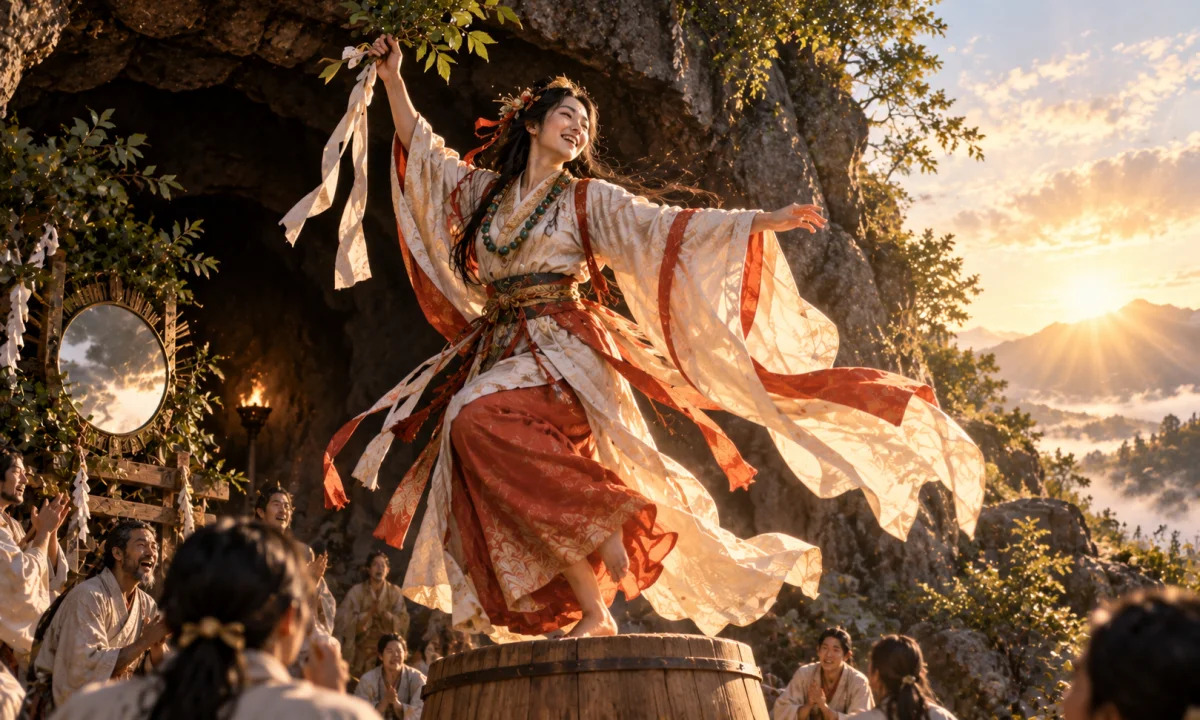
The kami gather outside the cave. They place offerings, perform divination and hang a mirror and jewels on a sacred tree. The goddess Ame-no-Uzume begins a provocative and comic dance, causing the assembled kami to laugh loudly. Amaterasu, curious about the noise, asks why they are celebrating when the world is supposed to be in darkness. Ame-no-Uzume replies that a deity greater than Amaterasu has appeared.
Amaterasu opens the cave door slightly to see this supposed greater deity. She sees her own reflection in the mirror, an object often identified in later tradition as Yata no Kagami. As she reaches toward the image, the strong deity Ame-no-Tajikarao pulls the door open, allowing light to return. The gods then secure the cave so that Amaterasu cannot withdraw in the same way again.
The story explains the return of daylight, but it also explores themes of ritual performance, social cooperation and the restoration of order after pollution and violence. The mirror does not merely function as a piece of decoration. It helps Amaterasu encounter her own sacred radiance, while the dance, laughter and collective action of the other kami make the restoration possible.
Reconciliation and the descent of the heavenly grandson
After the cave episode, Susanoo is punished and expelled from the heavenly realm. In the Kojiki, he descends to the land of Izumo, where he defeats the serpent Yamata no Orochi and acquires the sword later known as Kusanagi-no-Tsurugi. The sword becomes part of the regalia associated with Amaterasu and the imperial line, although its myths are closely connected with Susanoo's adventures.
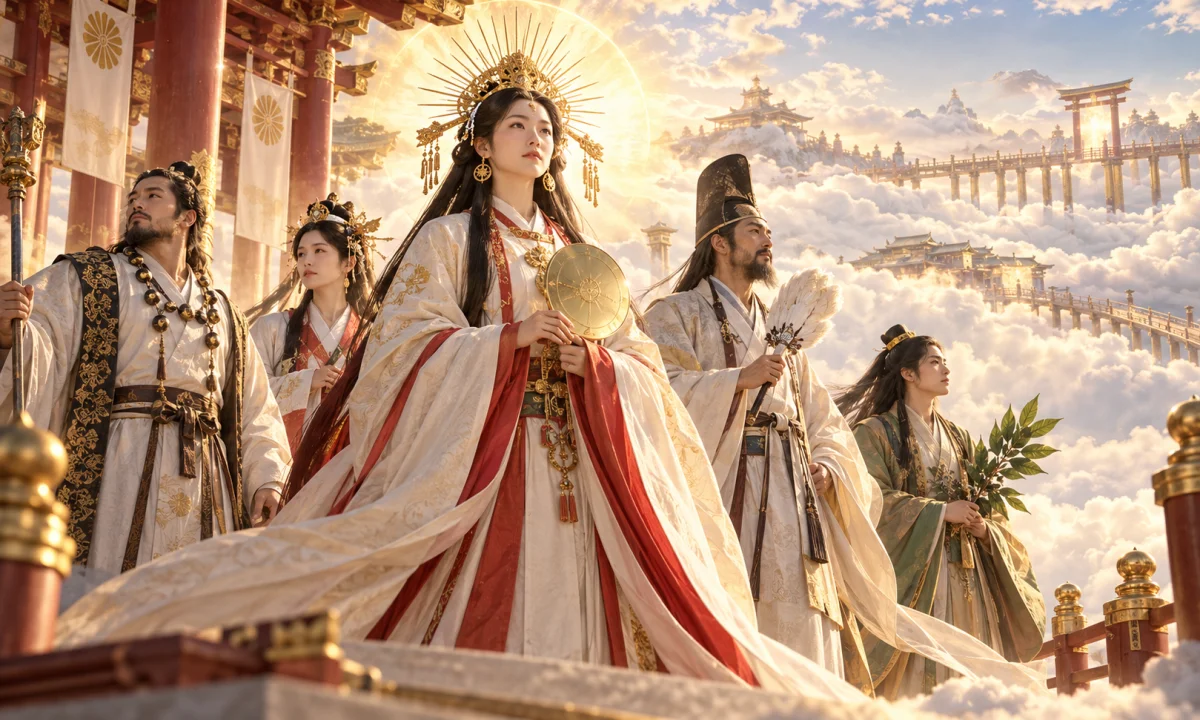
Amaterasu's most important role in the later divine genealogy is her relationship with Ninigi-no-Mikoto, her grandson. The heavenly kami send Ninigi down to rule the terrestrial world in an episode called tenson kōrin, the descent of the heavenly grandson. Before he descends, Amaterasu gives him sacred objects, including the mirror, the jewel and the sword. These become the Three Sacred Treasures of Japan, also called the Imperial Regalia.
The regalia are traditionally identified as the mirror Yata no Kagami, the curved jewel Yasakani no Magatama and the sword Kusanagi-no-Tsurugi. In the myths, they signify authority and connection with the heavenly kami. They are not ordinary public possessions, and their physical identification and history are matters of religious and imperial tradition rather than independently verifiable archaeological evidence. The objects used in imperial ceremonies are not generally available for public inspection, so claims about their exact physical form should be treated cautiously.
Ninigi's descendant is Jimmu, the legendary first emperor in the traditional genealogies. Modern historians do not treat the mythic genealogy as straightforward documentary evidence for an emperor named Jimmu ruling in the dates assigned by later tradition. Instead, the stories are important evidence for how early court traditions represented political authority, sacred ancestry and the relationship between the ruling house and the land.
Symbols, powers and religious significance
Amaterasu is associated above all with the sun and the return of light. Her presence supports life, agriculture and the ordered passage of time. Because sunlight makes cultivation possible, her significance is not limited to celestial brightness. She represents conditions under which human communities can work, reproduce, perform rituals and maintain social order.
- Sunlight: Amaterasu's radiance dispels darkness and sustains the visible world.
- The mirror: The sacred mirror is linked with her appearance in the cave story and with the imperial regalia. It can suggest truth, reflection and the revelation of divine presence.
- The jewels: Curved beads and jewels are part of the ritual treasures connected with royal and sacred authority.
- The sword: Kusanagi represents one part of the regalia and has a separate narrative history involving Susanoo.
- Heavenly authority: Her role in sending Ninigi to the earthly realm connects her with rulership and the legitimization of the imperial line.
These associations do not mean that every worshipper interprets each object in exactly the same way. The meanings of the regalia have been shaped by court ritual, shrine practice, political history and later religious interpretation. Amaterasu is also invoked in contexts involving prosperity, purification and the well-being of the nation, although the emphasis varies according to the shrine and ritual.
Amaterasu at Ise and in Japanese religious history
Ise Jingū is the most prominent centre of Amaterasu's worship. The Inner Shrine, traditionally called Kōtai Jingū, is dedicated to her, while the Outer Shrine is dedicated primarily to Toyōuke Ōmikami, a kami associated with food, clothing and the necessities of life. The two shrines are connected in ritual practice, but Toyōuke is not another name for Amaterasu and should not be treated as the same deity.
From the medieval period onward, Shinto kami were often interpreted through relationships with Buddhist figures. Amaterasu was sometimes associated with Dainichi Nyorai, the cosmic Buddha of certain Buddhist traditions. Such interpretations belong to the long history of shinbutsu shūgō, the combination of Buddhist and kami worship, rather than to the original wording of the early myths. After the Meiji government established policies separating Buddhism and Shinto in the nineteenth century, official interpretations increasingly presented Amaterasu as a central national deity in a more distinctively Shinto framework.
Before 1945, state institutions used Amaterasu's connection with the imperial house to support a system often called State Shinto. This political structure promoted imperial rites and treated the emperor's lineage as central to national ideology. Postwar reforms removed the emperor's formal divine status in the constitution and separated religious institutions from the state, although the imperial family's ceremonial relationship with Ise and Amaterasu remains significant within Japanese tradition.
Distinctions from similar figures
Amaterasu should not be confused with Tsukuyomi, the moon kami who is usually presented as her sibling, or with Susanoo, whose storms, violence and adventures make him one of her principal mythological counterparts. She is also distinct from Toyōuke Ōmikami, the deity of the Outer Shrine at Ise, and from Dainichi Nyorai, a Buddhist figure with whom she was historically associated in some interpretations.
She should not automatically be equated with every solar deity from another culture. Comparisons with goddesses such as the Greek Helios-related figures, the Roman Sol or the Hindu Surya can be useful for studying solar symbolism, but they do not establish that the figures are versions of one universal deity. Amaterasu's identity is shaped by Japanese kami traditions, the myths of the early court compilations and the ritual history of her shrines.
Amaterasu in modern culture
Amaterasu remains widely recognized in Japan and internationally. Modern novels, manga, animation, games and visual art often portray her as a warrior, a magical heroine or a vividly individualized character. The video game Ōkami, for example, presents Amaterasu in the form of a white wolf and adapts several figures and episodes from Japanese mythology. This is a creative interpretation rather than a traditional account of her appearance.
Contemporary adaptations may combine the cave story, the sacred treasures, Susanoo's legends and unrelated folklore into a single dramatic narrative. Such works can introduce audiences to Japanese myth, but their character designs, personalities and plot structures should be distinguished from the religious traditions associated with Ise, the classical texts and living Shinto practice.