WORLD

Ame-no-uzume
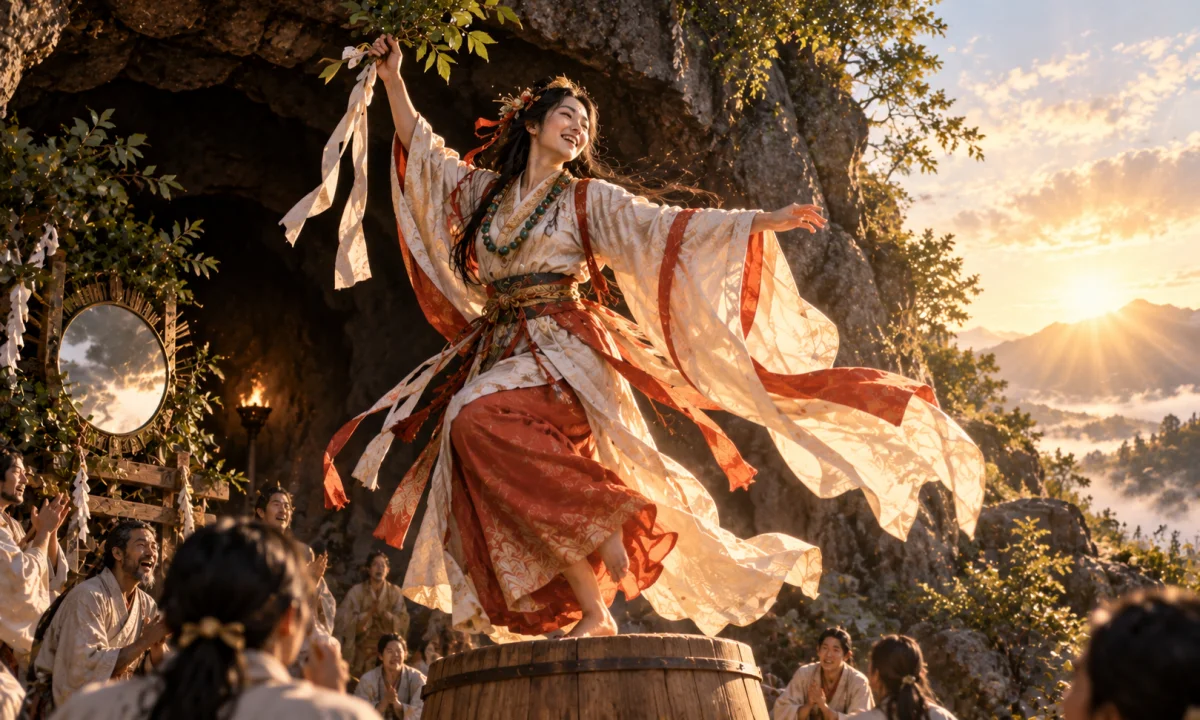
Ame-no-Uzume is a kami of Japanese mythology best known for the dance that helped bring Amaterasu out of the Heavenly Rock Cave. In the ancient myths, her boldness, laughter, theatrical skill and willingness to cross social boundaries restore light to the world. She later appears as a mediator between the heavenly gods and the earthly realm during the descent of Ninigi, linking her with transition, ritual performance and the negotiation of dangerous boundaries.
Name and identity
Ame-no-Uzume’s name is written in more than one way in Japanese sources, including Ame-no-Uzume-no-Mikoto and Ame-no-Uzume. The character ame means “heaven” or “heavenly,” while the meaning of Uzume is uncertain. English-language writing may also use forms such as Ama-no-Uzume, reflecting differences in the romanisation of Japanese.
She is generally described as a kami, a divine or sacred being within the religious world of Shinto and early Japanese tradition. Modern descriptions often call her the goddess of dance, laughter, dawn, revelry or fertility. These labels can be useful shorthand, but they should not be treated as a fixed ancient classification. The surviving myths do not present a formal list of her responsibilities in the way a later encyclopaedia might. Instead, her character is revealed through particular actions: she performs, provokes laughter, speaks fearlessly to a powerful stranger and helps guide a divine mission.
The meaning of her name has been debated. Some interpretations connect it with movement, concealment or a form of ritual performance, while others propose associations with a whirl or a bodily posture. There is no universally accepted explanation. The uncertainty is important because modern interpretations sometimes present one meaning as established fact when the ancient evidence does not settle the question.
Ancient sources and religious setting
The most important written accounts of Ame-no-Uzume appear in the Kojiki, completed in 712, and the Nihon Shoki, completed in 720. Both works preserve traditions about the origins of the imperial line, the heavenly kami and the formation of the Japanese islands. They are not neutral collections of folktales. They were compiled in an early state context and arrange older oral and ritual traditions into narratives supporting a particular understanding of divine ancestry and rulership.
The two chronicles tell broadly similar stories but differ in wording, emphasis and detail. The Kojiki is especially famous for its lively description of Uzume’s performance before the cave. The Nihon Shoki contains related versions and variant traditions. These texts should therefore be read as evidence for early Japanese mythic traditions rather than as proof that a single, unchanged version of every story existed throughout Japan.
Ame-no-Uzume belongs to a mythic world in which heaven, earth and the realm of the dead or hidden can interact. Gods communicate through ritual, divination, sacred objects, formal speech and bodily performance. Disorder is not always overcome by force. It may be resolved through cleverness, cooperation, humour or the controlled breaking of ordinary rules.
The Heavenly Rock Cave
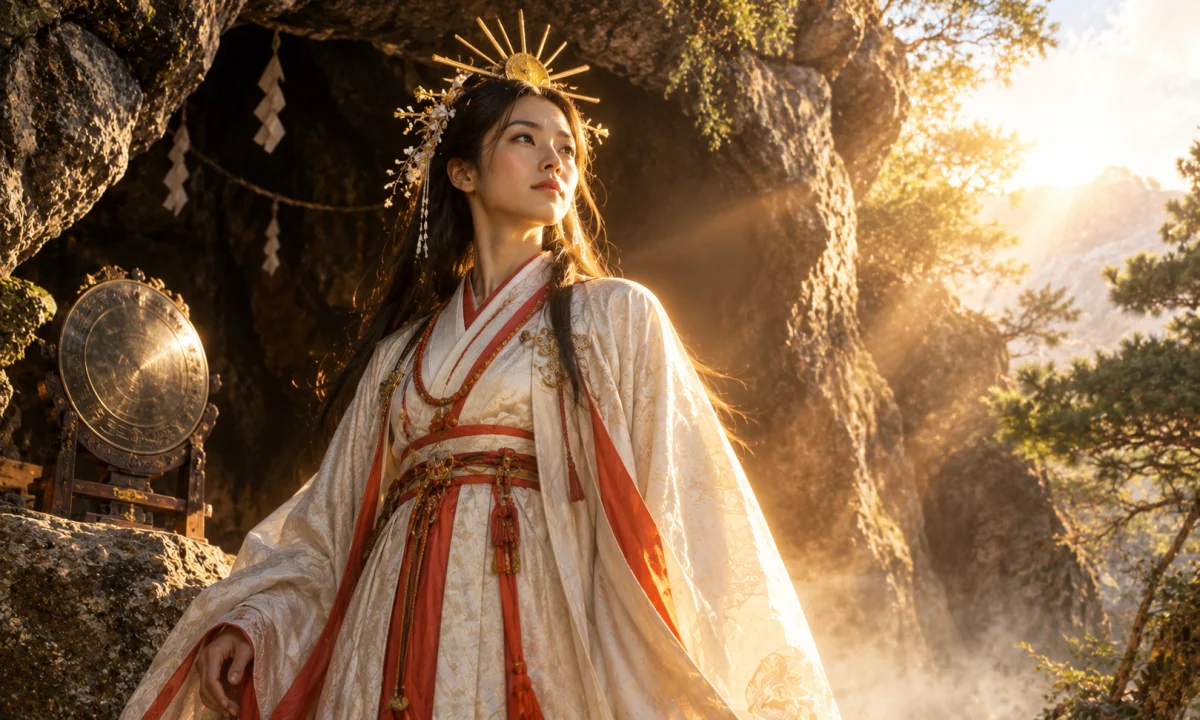
Uzume’s most famous story begins after Amaterasu, the sun kami, withdraws into the Heavenly Rock Cave. In the Kojiki, the crisis follows Susanoo’s violent and disruptive behaviour in Amaterasu’s heavenly dwelling. His actions include destroying fields, damaging sacred spaces and throwing a flayed animal into a weaving hall, causing the death of one of Amaterasu’s attendants. Amaterasu, distressed and angered, enters the cave and seals its entrance.
Her retreat plunges the world into darkness. Crops fail, harmful beings become active and disorder spreads among both the heavenly and earthly realms. The other kami gather to find a way to draw her out. Their response combines divination, sacred craftsmanship and ritual display. They consult the gods of ritual knowledge, prepare a great mirror, gather jewels and place a sacred evergreen tree near the cave. Roosters are also used in the ritual preparations, their crowing signalling the approach of dawn.
Uzume is given the task of creating a disturbance outside the cave. She overturns a vessel or tub and dances upon it. The ancient descriptions are intentionally provocative: she loosens or exposes parts of her clothing and performs in a manner that causes the assembled gods to laugh loudly. In some translations, the episode is described as partial nakedness or the exposure of her breasts. The point is not simply comic entertainment. Her dance is a ritual act that breaks the deadlock created by Amaterasu’s withdrawal.
Amaterasu hears the laughter and wonders how the other kami can rejoice while the world remains without sunlight. She opens the cave slightly and asks what has happened. The gods answer that a deity greater or more splendid than she has appeared. As Amaterasu looks out, she sees her reflection in the mirror. The ritual specialist Ame-no-Koyane and the divine ritual object or officiant Futodama draw her farther from the entrance, while another deity prevents the cave from being closed again.
Once Amaterasu emerges, light returns to the world. The story does not portray Uzume as defeating her or overpowering the sun kami. Instead, she helps create the conditions under which Amaterasu chooses to look outward. Her performance transforms fear and darkness into curiosity, social attention and renewed connection.
Dance, laughter and ritual disruption
Uzume’s dance is often treated as the mythical origin of kagura, a major form of sacred music and dance associated with Shinto worship. Kagura traditions developed in many regional forms, and their historical development cannot be reduced to a single event in myth. Nevertheless, the cave story provides a powerful mythic model for sacred performance: music, movement, costume, humour and embodiment can invite a hidden kami into the human community.
The performance is also an example of ritual inversion. Uzume behaves in a way that would be improper or shocking in ordinary circumstances, yet the disruption is purposeful and sacred. Her exposure, laughter and ecstatic movement challenge the silence surrounding the cave. Rather than treating disorder as purely destructive, the myth shows that carefully directed disorder can restore a larger order.
Scholars and interpreters have read the scene in several ways. It may preserve elements of possession ritual, in which a performer enters an altered or divinely inspired state. It may reflect fertility symbolism, since sexual display and comic indecency can be connected with life, reproduction and the overcoming of sterility. It may also dramatise the social power of performance, showing how a skilled ritual actor can influence even the most powerful deity. None of these interpretations completely replaces the others, and the ancient texts do not provide a single explicit explanation.
Uzume is therefore more than a personification of cheerful entertainment. Her laughter is strategic, her sexuality is performative and her courage is political as well as religious. She understands that Amaterasu’s isolation cannot be ended through solemn commands alone. By making the gods laugh, she creates a public event that draws the hidden deity back into relationship with the community.
The encounter with Sarutahiko
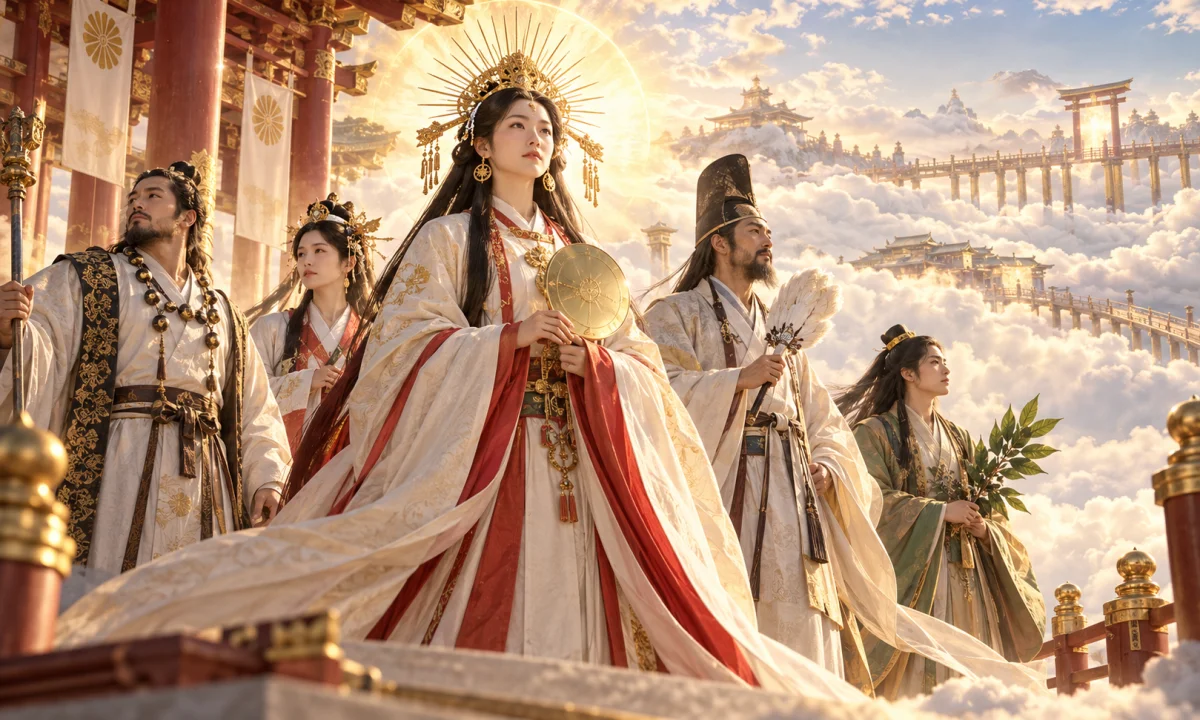
Ame-no-Uzume appears again during the descent of Ninigi, the grandson or descendant of Amaterasu, from the heavenly realm to the earthly realm. Ninigi is sent to govern the land, an episode associated with the establishment of the divine ancestry of the Japanese imperial line. On the way, the heavenly party encounters Sarutahiko, a powerful earthly kami who stands at a crossroads or passage between heaven and earth.
Sarutahiko is described as a striking and intimidating figure, with a brilliant radiance and an imposing physical appearance. His presence blocks the route, and the heavenly gods are uncertain whether he is hostile. Uzume is selected to approach him and ask who he is and why he has come. This is a revealing assignment. She is not merely a dancer summoned for amusement; she is trusted to face a potentially dangerous being and obtain the information necessary for the mission.
Uzume speaks to Sarutahiko directly, and he explains that he has come to guide Ninigi. The encounter becomes an act of communication between the heavenly and earthly sides of the mythic universe. Sarutahiko’s role as a guide and guardian of crossings complements Uzume’s ability to negotiate boundaries. In later tradition, the two figures become closely associated, and some accounts describe Uzume as accompanying Sarutahiko or becoming his consort. The precise details vary between texts and later interpretations.
The meeting also connects Uzume with roads, thresholds and the safe passage of travellers. This connection should not be exaggerated into a universal ancient title as “goddess of roads,” but it helps explain why later religious traditions may place her near ideas of travel, transition and protection at boundaries.
Relationships with other kami
Amaterasu: Uzume serves Amaterasu during the cave crisis, but the two are not interchangeable. Amaterasu is the central solar kami of the imperial mythic genealogy, while Uzume is the performer and negotiator whose actions help restore Amaterasu’s presence. Their relationship in the cave story is one of ritual assistance rather than simple rivalry.
Susanoo: Susanoo’s disruptive actions precipitate Amaterasu’s withdrawal, although the cave episode itself focuses on Uzume and the other gods’ response. Uzume does not defeat Susanoo, punish him or replace him. His conflict with Amaterasu belongs to a separate part of the wider narrative sequence.
Ame-no-Koyane and Futodama: These kami are associated with ritual expertise in the cave episode. Ame-no-Koyane performs divination, while Futodama is connected with ritual implements and the handling of sacred objects. Uzume’s dance is one part of a collective ceremony rather than a solitary act that succeeds without assistance.
Sarutahiko: Sarutahiko and Uzume are linked through the descent of Ninigi. Their association is especially important in later religious traditions, but the surviving early narratives do not give a single fully developed account of their relationship. The idea that they are married is widespread, yet the form and significance of that relationship vary.
Symbols and interpretation
Several themes recur in interpretations of Ame-no-Uzume.
- Performance: She uses dance, gesture, costume and laughter as forms of religious action. Her body becomes an instrument through which the crisis is addressed.
- Thresholds: She helps open the boundary of the cave and later engages a guardian of the passage between heaven and earth.
- Revelation: The cave story moves from hiddenness to appearance. The mirror allows Amaterasu to see a divine presence, while Uzume’s performance makes the hidden world socially visible.
- Humour: Laughter interrupts fear and rigidity. It is not presented as meaningless amusement but as a force capable of changing divine behaviour.
- Sexual and generative imagery: Her provocative dance has often been associated with fertility and the renewal of life. Such interpretations are plausible but remain interpretive rather than a complete definition of her character.
- Intercession: Uzume acts between parties that cannot or do not communicate directly. She helps the gods reach Amaterasu and speaks with Sarutahiko when the heavenly party needs a safe passage.
Modern summaries sometimes describe her simply as a “goddess of dance and laughter.” That description reflects important elements of her stories, but it can flatten a more complex figure. In the myths, her dance is not an isolated art form detached from religion. It is a ritual intervention that restores cosmic balance and supports the movement of divine authority from one realm to another.
Worship and later religious tradition
Ame-no-Uzume is venerated at shrines connected with the Heavenly Rock Cave story, the descent of Ninigi and the traditions of kagura. The shrine known as Amano Iwato in Miyazaki is strongly associated with the cave narrative and with the landscape of the Takachiho region, although the identification of mythic places with physical locations belongs to religious and local tradition rather than verifiable historical geography.
She may also appear in shrine traditions alongside Sarutahiko. Their pairing has encouraged associations with safe travel, crossroads, marriage and the successful negotiation of life’s transitions. Regional practices differ, and not every shrine devoted to Sarutahiko or to kagura treats Uzume in exactly the same way.
Her influence can also be seen in the continuing importance of dance and theatrical performance in Shinto festivals. Kagura performers do not simply reproduce one ancient choreography. Local communities have developed distinct music, masks, stories and ritual sequences. The connection to Uzume is therefore best understood as a shared mythic framework for sacred performance rather than as evidence of an unbroken, uniform dance preserved unchanged from antiquity.
Uzume and the Okame figure
Ame-no-Uzume is sometimes identified with Okame, also called Otafuku, a round-faced female figure in later Japanese folk and performing traditions. The association is understandable because both can represent humour, abundance, sexuality or comic performance. However, they are not simply the same figure in every context.
Okame developed as a later popular and theatrical image, with regional variations and changing meanings. Some religious and artistic traditions connect her with Uzume, while others treat her as an independent folk or comic character. A depiction of a smiling, full-cheeked woman should therefore not automatically be labelled Ame-no-Uzume without attention to its setting.
Modern representations
Contemporary fiction, manga, anime, games and popular retellings often portray Uzume as an energetic dancer, a seductive trickster or a cheerful goddess of celebration. These images draw on genuine features of the ancient narratives, especially her confidence, sensuality and theatrical power. They may also add weapons, supernatural abilities, elaborate costumes or personality traits that do not belong to the early texts.
Modern portrayals frequently make her a symbol of female independence and creative resistance. This is a meaningful contemporary interpretation of a figure who acts decisively in a male-dominated divine assembly, but it should be distinguished from claims about what ancient worshippers “really believed.” The early myths do show Uzume exercising unusual agency, yet they do not present a modern theory of gender equality or individual self-expression.
At the heart of her traditional stories, Ame-no-Uzume is a sacred performer and mediator. She uses laughter where force would fail, crosses boundaries that others fear and turns embodied spectacle into a religious act. Her importance lies not only in what she represents, but in what she does: she brings the hidden into view, makes communication possible and helps restore a world thrown into darkness.