WORLD
WORLD
Kagutsuchi
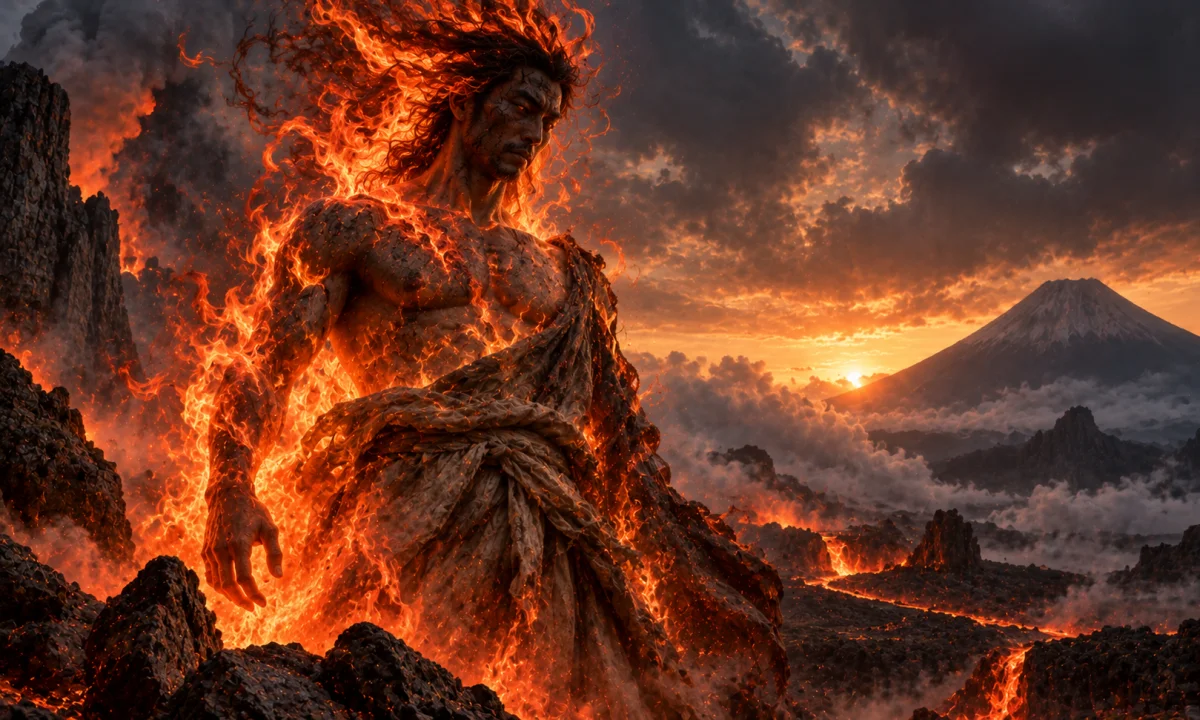
Kagutsuchi is a Japanese kami of fire, best known from the creation myths preserved in the Kojiki and the Nihon Shoki. He is also called Hi-no-Kagutsuchi, “Kagutsuchi of Fire,” and is associated in later religious traditions with the name Homusubi or Ho-musubi. His birth is both a creative and destructive event: fire enters the world through the birth of a divine child, but its heat fatally burns his mother, Izanami. Kagutsuchi’s death at the hands of his father, Izanagi, then produces further kami from his blood and dismembered body.
Origins in Japanese mythology
Kagutsuchi belongs to the generation of kami created during the early formation of the Japanese cosmos. The central narrative appears in two major early Japanese works: the Kojiki, compiled in 712, and the Nihon Shoki, completed in 720. These works are not identical versions of a single fixed mythology. They preserve related traditions, court-era interpretations and variant accounts, so Kagutsuchi’s name, birth and descendants can differ according to the passage being followed.
His parents are Izanagi and Izanami, the divine pair who create islands, natural features and numerous kami. In the creation sequence, Izanami gives birth to many aspects of the world, including wind, trees, mountains and bodies of water. Her final child is the fire kami. Because fire is dangerous to the mother who gives birth to him, Kagutsuchi’s arrival brings the creation episode to a tragic end.
In the Kojiki, the child is named Hi-no-Kagutsuchi. The flames of his body burn Izanami’s genitals, causing severe illness. Even while dying, she produces further kami from the substances of her sickness and from her bodily excretions. Her death marks a major change in the mythic order. The creative work of the divine couple becomes entangled with mortality, pollution, separation and the need to control dangerous forces.
The Nihon Shoki contains a broadly similar account but preserves several variant traditions. Kagutsuchi may appear under forms such as Kagu-tsuchi or Homusubi, and the details surrounding Izanami’s death and the child’s destruction are not uniform. These variations are important: there was no single universally standardized ancient biography of Kagutsuchi comparable to a modern character profile.
The name Kagutsuchi and related titles
The spelling Kagutsuchi is a common modern romanization, but the name is also written Kagu-tsuchi, Kagutsuchi-no-kami or Hi-no-Kagutsuchi-no-kami. Japanese mythological names often combine a descriptive element with kami, meaning a divine or spiritually powerful being. The element hi means fire, while the precise meaning of kagu and tsuchi has been interpreted in different ways.
Some explanations connect kagu with shining, glowing or radiance. Others understand the name through older linguistic and religious associations that do not translate neatly into a single English phrase. The second element should not automatically be treated as the ordinary modern word for “earth” or “soil.” The etymology remains a matter of interpretation, and translations such as “shining fire” or “shining earth” should not be presented as certain literal definitions.
Homusubi, often written Ho-musubi, is another important name associated with the fire kami. It is commonly explained in relation to kindling, joining or producing fire, although the exact force of the name is also discussed by scholars. In some contexts Homusubi functions as an alternative name for Kagutsuchi; in others, names for fire deities reflect distinct local or ritual traditions. It is therefore safer to say that Kagutsuchi and Homusubi are frequently identified with one another rather than assuming that every historical use treated them as precisely the same figure.
Fire as both creation and danger
Kagutsuchi represents one of the fundamental tensions in the Japanese mythic imagination: fire sustains life, but it can also destroy, injure and pollute. Fire cooks food, warms people, hardens tools and supports craft. At the same time, uncontrolled fire threatens houses, fields, forests and settlements. Kagutsuchi’s birth expresses this ambivalence in an especially dramatic form. He is not simply an evil being who chooses to harm his mother. His dangerous nature is intrinsic to what he is: fire cannot be brought forth without heat.
The myth also links fire with the limits of divine fertility. Izanami has given birth repeatedly, but the birth of fire injures the generative part of her body and kills her. The story does not treat creation as an uncomplicated blessing. New forms of life and power emerge through physical cost, and the appearance of fire introduces death into the divine world.
For this reason, Kagutsuchi is not best classified as a demon. In later Japanese religious life, dangerous kami could be feared, appeased, purified and worshipped without being placed in a simple opposition between “good gods” and “evil spirits.” Kagutsuchi is a powerful kami whose nature requires ritual management. His worship seeks protection from destructive fire while also acknowledging fire’s essential usefulness.
The death of Kagutsuchi
In the Kojiki, Izanagi is devastated by Izanami’s death. In grief and anger, he draws a sword and cuts off Kagutsuchi’s head. The weapon is described as a ten-grasp sword, a standard expression for a long divine sword in the mythic tradition. The act is both a revenge against the child associated with Izanami’s death and an attempt to eliminate the immediate source of danger.
Kagutsuchi’s destruction does not end his mythic significance. Blood from the sword and from Kagutsuchi’s body produces new kami. The exact sequence and names vary in translation and between textual traditions, but the resulting deities include beings connected with rocks, mountains, water and martial power. In the Kojiki, blood striking a rocky surface gives rise to thunderous or fierce deities, while blood near the sword’s hilt produces water-related kami. His body then gives rise to a group of mountain deities.
Among the figures associated with this episode is Takemikazuchi, a powerful kami later linked with thunder, swords and martial authority. The Kojiki gives him alternative names, including Takefutsu and Toyofutsu. His connection with Kagutsuchi is genealogical within the creation episode, but the two are not the same deity. Takemikazuchi later plays a major role in the myth of the pacification and transfer of the land, whereas Kagutsuchi remains primarily associated with fire and its dangerous generative force.
The body of Kagutsuchi is also related to mountain kami. The names in the relevant passage contain the element yama, “mountain,” and the story turns a violent act into another act of creation. This pattern is characteristic of Japanese origin mythology: the death, blood or bodily substance of one divine being becomes the source of other natural powers. Kagutsuchi’s death therefore transforms fire into a network of mountain, water, stone and martial associations.
Variants in the early texts
The Kojiki and Nihon Shoki should be read as related but independent witnesses to early Japanese myth. The Nihon Shoki often gives several variant accounts after presenting a principal narrative. In these accounts, the name of the fire deity and the consequences of his birth can differ. Some versions emphasize Homusubi, while others use Kagu-tsuchi or describe additional divine offspring.
The circumstances of Izanami’s death also receive different treatment. The broad theme remains stable: the fire child harms his mother, and her death leads to conflict with Izanagi. However, the precise details of the cutting, the divine beings generated afterward and the distribution of natural powers are not identical in every version. Lists of offspring can also vary in spelling and interpretation because the ancient texts were written with Chinese characters used to represent Japanese names.
These differences do not necessarily indicate separate “characters” in the modern sense. They reflect the coexistence of regional, ritual and literary traditions. The name Kagutsuchi may describe a broad fire deity whose identity was expressed differently by different communities and compilers. Claims that one version is the only authentic account overlook the plural nature of the surviving mythology.
Kagutsuchi in religious practice
Fire protection became a significant concern in Japanese religious life, particularly in densely settled communities where wooden buildings made urban fires highly destructive. Kami identified as Kagutsuchi or Homusubi were invoked in rituals intended to prevent accidental fires, restrain flames and protect houses, workshops and communities.
One important example is the tradition surrounding Atago, a mountain and shrine cult strongly associated with protection from fire. Atago Shrine in Kyoto is traditionally connected with a fire deity commonly identified as Homusubi-no-Mikoto, and Atago worship spread to branch shrines in many parts of Japan. The exact historical development of the cult involved more than the ancient creation myth: mountain worship, Buddhist-Shinto religious combinations and local protective practices all contributed to the form of Atago devotion seen in later periods.
Other shrines and regional traditions also enshrine fire kami under names such as Kagutsuchi, Homusubi or related titles. Akiba-based fire cults, for example, developed their own histories and ritual settings. It would be inaccurate to treat every Japanese fire-protection tradition as a direct continuation of one unchanged Kagutsuchi cult. The same divine name could function differently in court mythology, shrine worship, household practice and local religious life.
Fire rituals often express a double purpose. Worshippers ask for protection from unwanted flames, but they may also honour the beneficial fire used in cooking, metallurgy, pottery, agriculture and religious ceremony. The deity is approached not merely as an enemy to be subdued but as a power whose proper place must be maintained. Purification, offerings and controlled flame help establish that relationship.
Symbolism and interpretation
Kagutsuchi’s story has attracted several kinds of interpretation. At a straightforward religious level, it explains why fire is both necessary and perilous. At a social level, it reflects the threat of household and settlement fires in a largely wooden built environment. At a symbolic level, the myth connects fire with birth, death, technological power, bodily danger and the transformation of natural forces.
The story also presents a striking connection between fire and the sword. Izanagi’s blade kills the fire kami, yet the sword’s blood becomes the source of additional divine beings. This relationship between flame, metalworking and weapons may be especially suggestive, although particular historical interpretations should be stated cautiously. The early texts themselves do not provide a single explanatory statement saying that Kagutsuchi was created specifically as a god of smithing or warfare.
Likewise, Kagutsuchi is sometimes described in modern writing as a volcano deity. That description captures part of his association with heat, mountains and destructive natural force, especially because the creation story produces mountain kami from his body. However, the ancient narratives do not present him simply as the personification of one volcano or as a clearly defined god of volcanic eruptions. He is more securely identified as a fire kami whose mythic consequences include mountain and water deities.
Distinctions from other Japanese fire beings
Kagutsuchi should not be confused with every Japanese spirit or deity connected with fire. Konohanasakuya-hime, for example, is associated with blossoms, volcanoes and a famous fire ordeal, but she is not another name for Kagutsuchi. Her story concerns the birth of her sons within a burning hut and has a different narrative and symbolic focus.
Nor should Kagutsuchi be merged with Fudō Myōō, the Buddhist Wisdom King often shown surrounded by flames. Fudō’s fire represents wisdom, purification and the destruction of delusion within Buddhist iconography. His identity, scriptures and ritual context are distinct from those of the Shinto fire kami, even though Japanese religious history brought Buddhist and kami traditions into close contact.
Similarly, a shrine using the name Homusubi does not automatically preserve every detail of the Kagutsuchi myth. Shrine identities developed through local history, institutional change and combinations of religious traditions. Names can overlap while ritual emphasis differs.
Later reception and modern culture
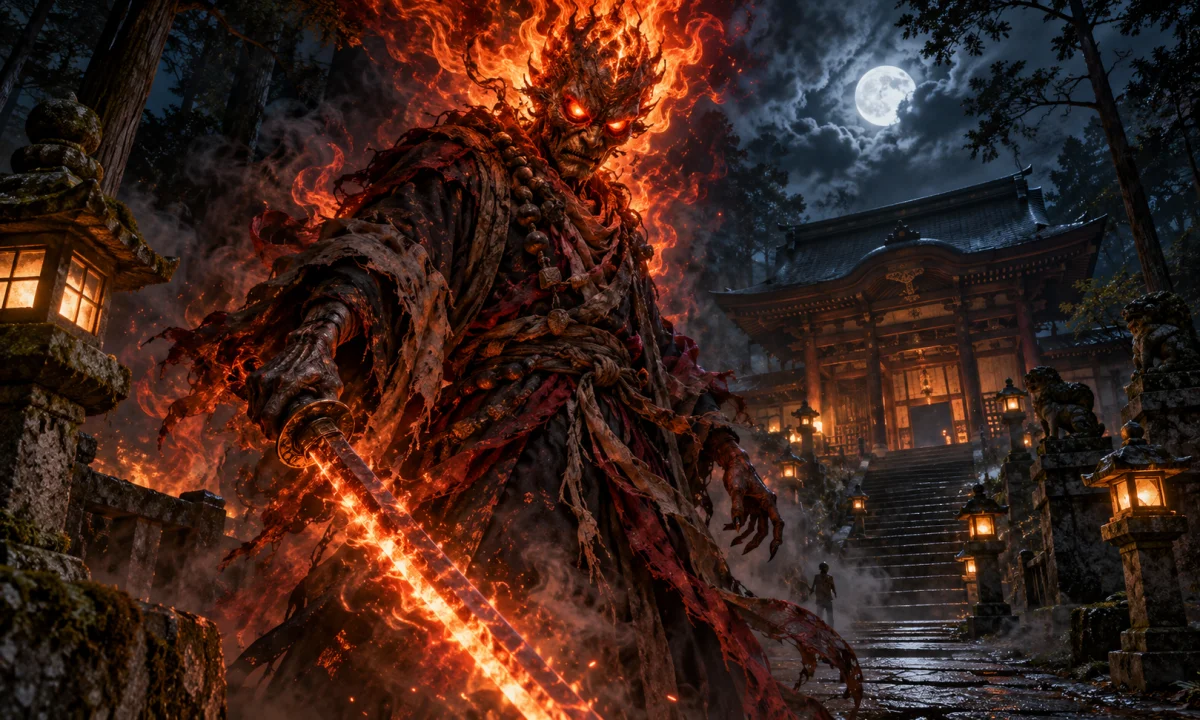
Kagutsuchi continues to appear in Japanese religious and cultural contexts, especially where fire prevention, mountain worship and Shinto mythology are relevant. His name has also been adopted in modern fiction, including manga, anime, video games and fantasy novels. In these works he may be portrayed as a humanoid warrior, a gigantic monster, a weapon, a flame-based attack or a volcanic ruler.
Such portrayals usually expand only one aspect of the traditional figure. A modern character named Kagutsuchi may have invented powers, relationships or visual features that are not found in the Kojiki, the Nihon Shoki or shrine tradition. The ancient Kagutsuchi is principally a kami whose birth, death and bodily transformation explain the dangerous and productive place of fire in the divine world. He is not originally presented as a standardized fire-element character with a fixed appearance, personality or catalogue of supernatural abilities.
His enduring importance lies in that tension. Kagutsuchi is born from the creative activity of the first divine couple, yet his heat ends Izanami’s life. He is killed as a threat, yet his remains generate further kami. Fire in his story is therefore never merely destructive or beneficial. It is a power that creates, consumes, transforms and demands respect.