WORLD
WORLD
In
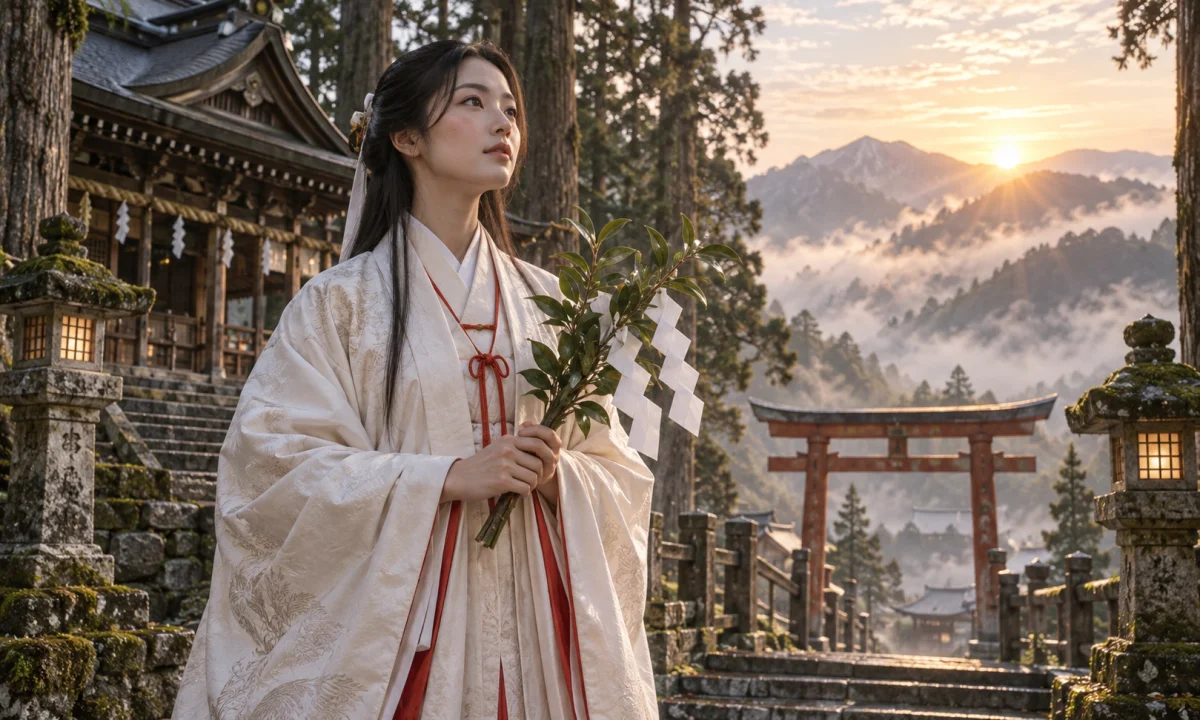
In is not a clearly identifiable, independently attested deity, spirit or legendary creature in the principal traditions of Japanese mythology. As a name written only in Roman letters, “In” is highly ambiguous: it may represent several different Japanese words, readings or shortened forms of longer names. Without the original Japanese characters or a specific source, assigning a single identity to In would be unreliable.
The problem of the name “In”
Japanese names are normally distinguished by their written characters as well as by pronunciation. The sound in can correspond to different kanji, each with a different meaning. It may also be an incomplete romanization of a longer name, a shortened form used in a modern database, or a transcription error. English-language lists sometimes reduce names to a single syllable, even when the original Japanese term contains important prefixes, suffixes or honorifics.
This matters especially in mythology. Japanese religious and folkloric names can refer to a deity, a local spirit, a ritual object, a social title or a descriptive category. Two terms that sound similar in English may have no historical relationship in Japanese. “In” should therefore not automatically be treated as another spelling of Inari, inu (“dog”), inugami (“dog spirit”), or yin and yang.
No major mythological narrative presents a universally recognized Japanese being whose complete and standard name is simply In. The Kojiki and Nihon Shoki, the most important early written records of Japanese mythology, do not establish a prominent figure under that bare name. Nor is “In” a standard category in the best-known classifications of yōkai, kami or Buddhist protective beings.
Possible meanings in Japanese religious language
In as 陰
One possible reading is in, written 陰. In traditional East Asian thought, this is the Japanese reading associated with the principle commonly known in English as yin. Yin is paired with yō, corresponding to yang. The pair describes complementary qualities such as darkness and light, receptivity and activity, coolness and warmth, inwardness and outwardness.
In Japan, yin-yang theory became especially influential through Onmyōdō, a system combining elements of Chinese cosmology, calendrical calculation, divination and ritual practice. Specialists in this tradition were called onmyōji. They interpreted auspicious and inauspicious conditions, observed directions and times, and performed rites intended to manage spiritual or cosmological impurity.
In this context, in is a cosmological principle, not the name of a god or monster. It may appear in discussions of balance, elemental correspondences, ritual directions and the movement of hidden forces. Treating 陰 as a personal being would confuse a philosophical and ritual concept with a mythological character.
In as 印
Another possible form is 印, also read in. In Buddhist and esoteric contexts, this character can refer to a seal, sign or symbolic hand gesture. Such gestures are often called mudrā in Sanskrit-based terminology and in or innen in Japanese Buddhist usage, depending on the context.
Hand seals are associated with Buddhist images, ritual specialists and esoteric ceremonies. Their meanings vary according to the school, deity, text and ritual setting. A seal may express a vow, identify a particular Buddha or bodhisattva, or form part of a rite intended to invoke protection, purification or spiritual transformation.
Here again, “In” describes a religious symbol or ritual action rather than a supernatural individual. A database that lists In among mythological “names” may have misunderstood a technical religious term, omitted the character that would clarify its meaning, or confused a ritual designation with the name of a being.
In as a title or institutional term
The sound in can also occur in historical and religious titles. The character 院, for example, may refer to an institution, religious establishment or courtly residence. In medieval Japan, compounds containing in could be connected with Buddhist temples, imperial residences or retired emperors. Such usage belongs to political, institutional or religious history and does not by itself indicate a god or spirit.
Japanese personal names and titles may also end in sounds that are romanized as -in. Removing the rest of the name can create an apparent mythological figure that never existed as an independent character. This is one reason that an original spelling is essential when evaluating a short name such as In.
Relationship to Inari
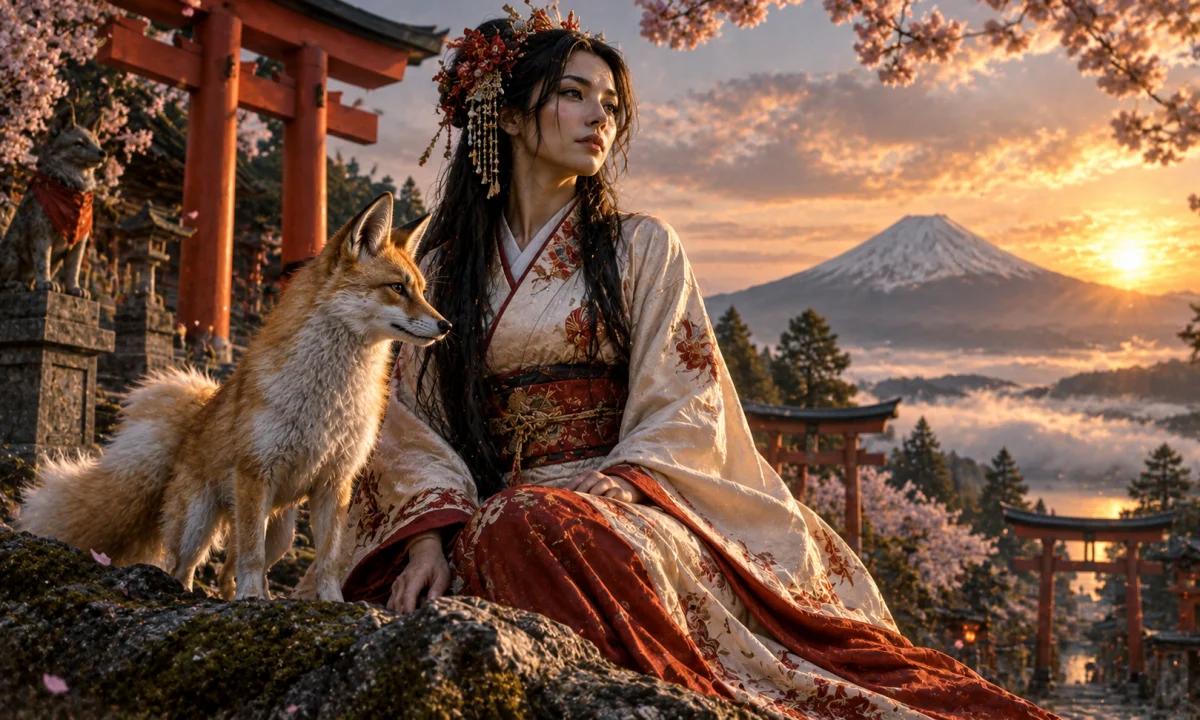
The most likely confusion is with Inari Ōkami, one of Japan’s best-known kami. Inari is associated especially with rice, agriculture, prosperity, commerce and productive abundance. Inari worship has developed through a long interaction among local kami traditions, Buddhist institutions, shrine practices and regional customs.
Foxes are strongly associated with Inari shrines, where they are commonly understood as messengers or sacred attendants rather than simply as the deity itself. Their presence contributed to a widespread popular image of Inari as a fox deity, but Inari’s identity is more complex and varies among communities. The name Inari should not be shortened to “In” in careful writing, because the shortened form conceals the identity and history of the kami.
Inari also illustrates why Japanese religious figures cannot always be assigned a single fixed appearance or function. Shrine traditions may emphasize rice, food, fertility, trade, swordsmithing, household protection or other forms of prosperity. These local expressions do not turn Inari into a figure called In; they demonstrate the diversity of Japanese kami worship.
Relationship to inu and inugami
Another possible source of confusion is inu, the Japanese word for “dog.” A dog may appear in Japanese folklore as an ordinary animal, a guardian, a sacred creature or a transformed being. The term inugami refers to a dog spirit traditionally associated in some regional accounts with sorcery, household protection and dangerous supernatural power.
Stories about inugami vary considerably. Some describe them as spirits created or controlled by a family; others connect them with possession, jealousy, illness or inherited magical practices. These accounts belong to Japanese folklore and local belief, not to a single uniform national mythology. Nevertheless, the name is inugami, not “In.” The first part derives from inu, but it is not an independent being called In.
Dogs also appear in broader Japanese religious culture as protective animals and as symbols of loyalty or safe childbirth in certain local traditions. These associations should not be used as evidence for a separate deity named In.
Sources and the absence of a fixed myth
Japanese mythology is preserved through several different kinds of material. Early court chronicles, shrine genealogies, Buddhist legends, medieval setsuwa tales, local traditions, ritual records and early-modern collections do not always describe the same beings in the same way. A figure may be important in one province or religious institution without appearing in the national creation narratives.
The Kojiki, compiled in the early eighth century, contains stories about the creation of the islands, the birth of the kami, the deeds of Susanoo, the descent of Ninigi and the ancestry of the imperial line. The Nihon Shoki, completed soon afterward, presents related traditions alongside alternative versions and historical material. Neither work gives “In” the status of a major named kami.
Later sources greatly expand the range of supernatural beings associated with Japan. Buddhist miracle tales, shrine records and collections of strange stories introduce local spirits, restless ghosts, animal transformations and yōkai. Even in these materials, a bare Romanized label is not enough to establish identity. A reliable interpretation requires the Japanese spelling, the region, the period and the type of source in which the name occurs.
For that reason, an entry titled simply “In” should be treated as uncertain rather than authoritative. It may preserve a fragment of a longer name, a transliteration of a non-personal term, or a modern label created by a cataloguer. The uncertainty is part of the available evidence and should not be filled with invented attributes, stories or relationships.
Symbolic interpretation
If “In” is intended as 陰, its symbolic significance lies in the idea of hidden, receptive or inward force within a complementary cosmology. It does not mean evil. In yin-yang thought, yin and yang are interdependent and constantly changing; neither is simply morally good or bad. A ritual or cosmological interpretation of in must therefore avoid translating it as darkness in the sense of wickedness.
If it is intended as 印, its significance lies in ritual form, embodied symbolism and the transmission of sacred authority. A hand seal can make an invisible religious relationship visible through gesture. Its meaning depends on the tradition using it, so no single “power of In” can be assigned without identifying the relevant Buddhist school or ritual.
If the term is an incomplete form of a proper name, its symbolism cannot be determined from the syllable alone. The same sound may occur in names connected with entirely different beings, places or institutions.
Modern use and popular culture
Modern games, novels, films, comics and online mythology databases often use short labels for convenience. They may also draw on Japanese words without reproducing the original kanji or explaining whether a term is a deity, a yōkai, a ritual concept or a historical title. A character called “In” in a modern work is therefore not evidence that an ancient Japanese mythological being had that name.
Contemporary fantasy may combine traits associated with Inari, fox spirits, yin-yang cosmology, Buddhist hand seals and dog familiars. Such combinations can be imaginative and meaningful within fiction, but they should be described as modern adaptation rather than traditional Japanese mythology. In the absence of a fuller name or a specific attested tradition, the most accurate classification of In is an unresolved or incomplete mythological label, not a defined Japanese god or legendary creature.