WORLD
WORLD
Shichi Fukujin
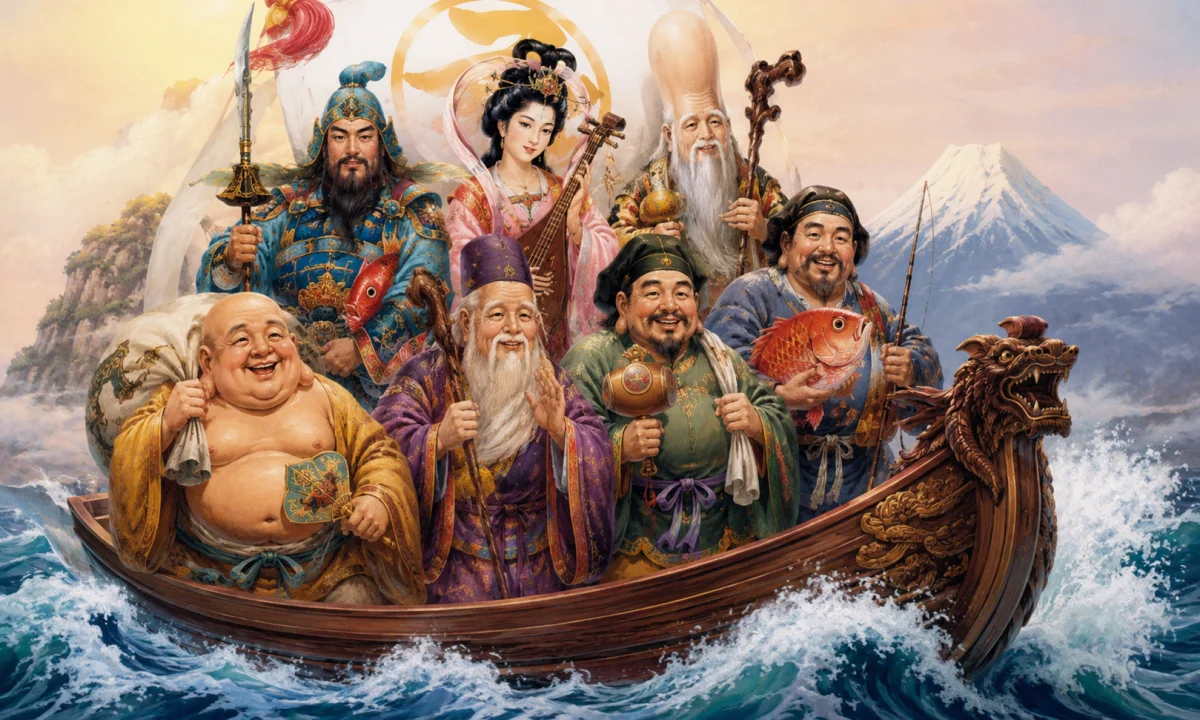
Shichi Fukujin, also written Shichifukujin, are the “Seven Lucky Gods” of Japan. They are a group of seven deities and legendary holy figures associated with happiness, prosperity, longevity, protection, wisdom and success. Although commonly treated as a distinctive feature of Japanese mythology, the group is a product of cultural exchange: its members include figures with Japanese, Buddhist, Hindu, Chinese and Daoist backgrounds.
The Shichi Fukujin are not a single family of gods with one shared origin myth. Rather, they form a syncretic group whose members were gradually brought together in Japanese religious and popular culture. Their identities, attributes and stories developed through interaction between Shinto, Buddhism, Chinese religious traditions and local folklore. By the early modern period, they had become especially popular as auspicious figures connected with the New Year, commerce, travel and everyday hopes for good fortune.
Origins and cultural setting
The idea of grouping seven fortunate figures probably took shape in medieval Japan, although the exact origin of the complete group is uncertain. Earlier Japanese religious life already included many local kami, Buddhist deities and protective figures associated with prosperity or good harvests. Chinese traditions also supplied models of groups of auspicious beings, including the “Seven Sages” and other sets of seven. In Japan, the number seven was considered fortunate partly because of the prestige of the Buddhist Seven Treasures and the traditional association of seven with blessings and completeness.
The Seven Gods did not all become members at the same time, and the membership was not always entirely fixed. The familiar group of Ebisu, Daikokuten, Bishamonten, Benzaiten, Fukurokuju, Jurōjin and Hotei became established during the late medieval and early modern periods. In some contexts, Kichijōten, a goddess of beauty and prosperity, appears in place of one of the usual members, especially when the group is being interpreted through particular Buddhist traditions.
The group became especially prominent during the Edo period, from the seventeenth to the nineteenth century. Urban growth, commercial prosperity, illustrated books, popular religious prints and pilgrimage routes helped spread their imagery. Merchants and householders could appeal to the Seven Gods without necessarily belonging to one exclusive religious institution. Their worship shows how Japanese religious practice often allowed Shinto kami, Buddhist deities, imported religious figures and folklore beings to exist together within the same devotional world.
The name and identity of the group
Shichi Fukujin means “Seven Fortune-Bringing Persons” or “Seven Lucky Gods.” The word fuku means good fortune or blessing, while jin or kami can refer to divine or sacred beings depending on the context. The English expression “Seven Lucky Gods” is convenient, but it can give the impression that all seven are gods in the same theological sense. They are not.
Ebisu is generally understood as a Japanese kami. Benzaiten derives from the Indian goddess Sarasvati through Buddhism, although her Japanese form acquired associations with Shinto water deities and local traditions. Daikokuten developed through the transformation of the Buddhist and Hindu figure Mahākāla into a Japanese deity linked with Ōkuninushi. Bishamonten is the Japanese form of the Buddhist guardian Vaiśravaṇa. Fukurokuju and Jurōjin are strongly connected with Chinese ideas of longevity and Daoist immortals. Hotei is based on the historical Chinese Buddhist monk Budai, who became a popular sacred figure in Japan.
These varied origins are not a contradiction. Japanese religious history frequently involved honji-suijaku, the interpretation of Buddhist figures and local kami as different manifestations of sacred reality. Even after modern religious categories became more sharply separated, the traditional images of the Seven Gods continued to preserve traces of that older blending.
The seven members
Ebisu
Ebisu is the most clearly indigenous Japanese member of the group. He is associated with fishing, the sea, commerce, food and prosperous business. He is usually shown smiling, wearing courtly clothing and a tall cap, while holding a fishing rod and a large sea bream. The fish is called tai in Japanese, and its name forms part of the auspicious expression medetai, meaning fortunate or celebratory.
Ebisu is especially important to merchants, fishermen and shopkeepers. His connection with the sea reflects the importance of fishing and maritime trade, while his role as a bringer of commercial success made him a major figure in urban popular religion. Many businesses maintain images of Ebisu or celebrate festivals dedicated to him.
His precise mythological identity varies. Some traditions identify him with Hiruko, a child associated with Izanagi and Izanami in the Kojiki, who was cast away because of physical weakness or imperfection. Other traditions connect Ebisu with Kotoshironushi, a son of Ōkuninushi. These identifications are influential but are not universally treated as identical in every shrine tradition. Ebisu also has local forms that cannot be reduced to one single genealogy.
Daikokuten
Daikokuten, often called Daikoku, is a god of food, agriculture, household prosperity and wealth. He is commonly depicted with a broad smiling face, a black or dark cap, a large sack over his shoulder and a wooden mallet associated with the granting of riches. He often stands on or near two rice bales, emphasizing the importance of grain and material sustenance.
Daikokuten’s name is connected with Mahākāla, a fierce form of the Hindu god Shiva that entered Buddhist traditions. In Japan, the imported figure was transformed into a more benevolent provider of household abundance. Over time, Daikokuten was also identified or associated with the Shinto kami Ōkuninushi, whose name can be interpreted through the character dai-koku and whose myths concern the establishment and ordering of the land.
The connection between Daikokuten and Ōkuninushi is an example of religious identification rather than proof that the two figures were originally the same. Their combined imagery helped create Daikokuten’s distinctive Japanese character: a deity who could be understood simultaneously through Buddhist iconography, Shinto mythology and popular hopes for a full storehouse.
Bishamonten
Bishamonten is the Japanese form of Vaiśravaṇa, one of the Four Heavenly Kings who protect the directions in Buddhist cosmology. He is traditionally associated with the north and with the defense of Buddhist law. In Japan, he is also known as a powerful guardian of warriors, rulers and temples.
Bishamonten is usually represented in armor, holding a spear, a trident-like weapon or a pagoda-shaped treasure tower. Unlike the relaxed and jovial images of several other members, he has a commanding and martial appearance. His weapons and armor signify the defeat of evil and the safeguarding of the righteous. The treasure tower expresses both spiritual authority and material abundance.
As one of the Seven Lucky Gods, Bishamonten brings victory, courage and protection rather than merely financial luck. He has also been revered independently from the group as a Buddhist guardian. In some traditions, he is connected with the protection of the nation and the success of military leaders, although his role in the Seven Gods is generally presented in a more broadly auspicious form.
Benzaiten
Benzaiten, also called Benten, derives from the Indian goddess Sarasvati through Buddhist transmission. Sarasvati was associated with rivers, learning, speech, music and the arts. In Japan, Benzaiten retains many of these associations and is especially revered as a goddess of eloquence, intelligence, music, artistic ability and flowing water.
She is commonly shown playing a biwa, a traditional Japanese lute. Other images depict her with multiple arms, reflecting aspects of Buddhist iconography. Snakes and dragons may also appear in her legends and shrine imagery because of her connection with water. Famous sites dedicated to Benzaiten are often located on islands, beside springs or near lakes and the sea.
Benzaiten’s place among the Seven Gods gives her an additional association with wealth and good fortune. This is partly connected with the value of her gifts: education, persuasive speech, artistic skill and success in performance can bring social and material prosperity. Her character also demonstrates how an originally Indian goddess became deeply rooted in Japanese religious landscapes and local legends.
Fukurokuju
Fukurokuju is a deity of happiness, wealth and long life. His name is formed from three auspicious qualities: fuku, good fortune; roku, prosperity or material success; and ju, longevity. He is generally shown as an elderly man with an unusually elongated forehead, white hair and a long beard. He may carry a staff, a scroll or a fan, and is sometimes accompanied by a crane or tortoise.
Fukurokuju’s appearance and attributes reflect Chinese traditions concerning long-lived sages and Daoist immortals. He is often understood as a Japanese development of ideas surrounding a star deity or an old man who possesses extraordinary longevity. The exact historical pathway by which these traditions entered his Japanese form is not entirely certain.
His long head is one of his most recognizable features. It represents exceptional wisdom and longevity rather than a medical or biological claim. Fukurokuju is frequently paired with symbols of long life, including cranes, tortoises, pine trees and sacred writings. His blessings encompass not only survival into old age but also the prosperity and dignity associated with a long, successful life.
Jurōjin
Jurōjin is another member associated with longevity. He is usually portrayed as an elderly man with a long white beard, a staff and a scroll. A deer, regarded as a symbol of long life in East Asian tradition, may accompany him. His name includes the character for longevity, and his principal blessing is a long and healthy life.
Jurōjin is closely related in appearance and meaning to Fukurokuju, and the two are sometimes difficult to distinguish. Both draw on Chinese traditions of old men who embody long life and wisdom. Some interpretations connect Jurōjin with the Star of the Old Man, often identified with Canopus, a star that was regarded in Chinese tradition as an omen or source of longevity. The precise relationship between this celestial figure, Chinese longevity traditions and the Japanese deity is interpreted differently across sources.
Because Fukurokuju and Jurōjin overlap so strongly, some traditions have treated them as interchangeable or have replaced one with another. Their inclusion as separate members of the standard group reflects the way popular religious imagery can preserve related figures as distinct while giving each a recognizable place.
Hotei
Hotei is based on Budai, a Chinese Buddhist monk who is traditionally described as a wandering holy man carrying a cloth sack. His name in Japanese is derived from the sack, which is called a hotei. Budai was remembered in Chinese popular religion as cheerful, generous and unpredictable, and legends credited him with spiritual insight and the ability to foretell events.
Japanese images of Hotei show a large-bellied, smiling man with a bald head, loose robes and a sack. He may be surrounded by children, who symbolize joy, generosity and the openness of his character. His large stomach is not simply a sign of gluttony; it conveys abundance, contentment and a generous spirit.
Hotei is sometimes mistakenly called “the Laughing Buddha.” He is not the historical Gautama Buddha, and the two figures should be distinguished. Hotei is a later Chinese Buddhist holy figure who became a popular embodiment of happiness and abundance. In some East Asian traditions, Budai was also interpreted as a manifestation or future form of Maitreya, the Buddha expected in the future. That association does not make him identical with the historical Buddha.
The treasure boat and New Year customs
The Seven Gods are often shown together aboard the takara-bune, or “Treasure Ship.” The boat carries treasures such as the inexhaustible bag, the wish-granting mallet, precious objects and sometimes the sacred texts or emblems of the individual deities. It sails from a mythic realm of fortune toward the human world.
Images of the treasure ship are especially associated with the New Year. A traditional custom involves placing a picture of the ship beneath one’s pillow on the first night of the year, because dreams at this time were considered significant. The practice is connected with the interpretation of the first dream of the year, known as hatsuyume. Customs vary, and the treasure ship is not a universal requirement of New Year observance, but its image remains one of the most recognizable symbols of seasonal good fortune.
The ship also expresses the group’s collective character. The seven figures do not merely duplicate one blessing. Together they represent a broad range of desired conditions: food, wealth, artistic talent, victory, wisdom, happiness, security and long life. Their journey by sea recalls the maritime setting of many Japanese communities while also presenting fortune as something that arrives from a sacred and distant realm.
Pilgrimages, festivals and popular devotion
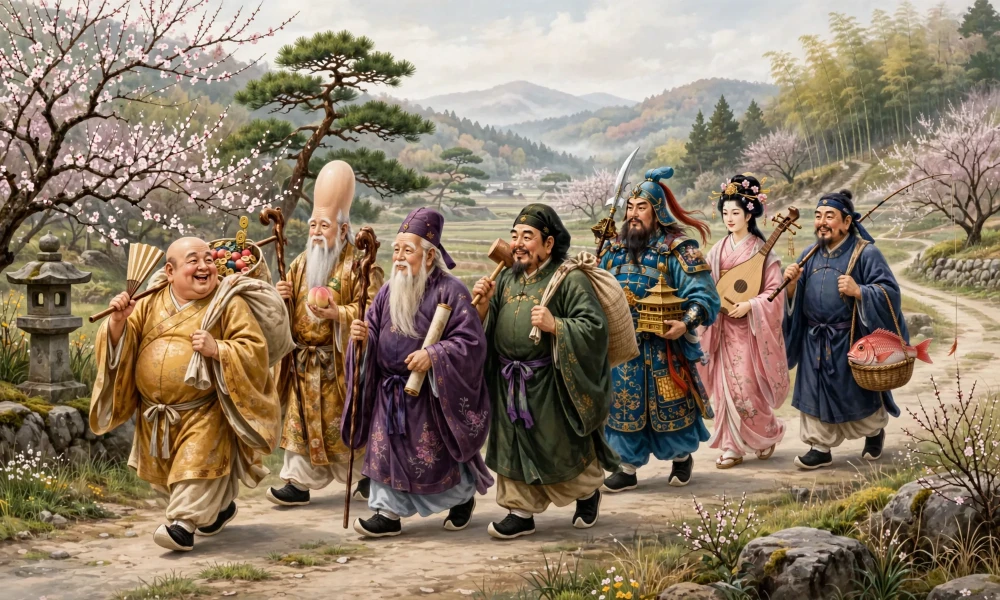
Devotion to the Shichi Fukujin often takes the form of a pilgrimage to seven temples or shrines, with one site dedicated to each member. These routes became especially popular in urban areas during the Edo period and remain active in several parts of Japan. Participants may collect stamps, seals or written records at each location, turning the journey into both a religious observance and a social or cultural excursion.
Such pilgrimages do not follow one single national route. Local communities have created their own versions, and the identity of the temple or shrine associated with a particular deity can vary. Some routes are connected with New Year visits, while others operate throughout the year. Their continuing popularity reflects the flexibility of the Seven Gods: they can be approached through formal temple or shrine worship, folk custom, tourism, family practice or personal hopes for the future.
Festivals dedicated to individual members also remain important. Ebisu festivals, for example, are particularly prominent among merchants and business communities. Benzaiten is honored at places associated with water and music, while Bishamonten may receive offerings in settings emphasizing protection and martial power. These local practices preserve differences among the seven instead of reducing them to interchangeable symbols of luck.
Meaning and interpretation
The Shichi Fukujin are best understood as a popular religious constellation rather than a fixed pantheon in the classical sense. Their appeal lies partly in the way they make complex religious ideas accessible through familiar visual signs. A fishing rod, rice bales, a lute, a treasure tower, a long beard or a bulging sack immediately communicates a particular kind of blessing.
They also reflect the social concerns of early modern Japan. Farmers valued abundant food and favorable harvests; merchants sought commercial success; travelers desired protection; artists and performers appealed to Benzaiten; warriors honored Bishamonten; and families hoped for health and longevity. The group could therefore serve many communities without requiring them to share exactly the same theology.
At the same time, “luck” does not fully describe their traditional significance. Their blessings include skill, discipline, protection, generosity and wisdom. Hotei’s contentment, Benzaiten’s eloquence and Bishamonten’s defense of justice are not simply random fortune. The group expresses an ideal life in which material prosperity is joined to social well-being, cultural accomplishment and spiritual protection.
Modern representations
The Seven Lucky Gods continue to appear in New Year decorations, shop signs, amulets, paintings, sculptures, toys and commercial designs. Their images are widely recognizable in Japan, and the treasure ship remains a common auspicious motif. Modern representations sometimes simplify the figures into a cheerful ensemble of mascots, but their visual forms still depend on the older religious traditions.
They also appear in manga, anime, video games and other popular media. Such works may portray the seven as superheroes, supernatural companions or comic characters, often assigning them powers that are not part of traditional worship. These adaptations should be distinguished from the religious and folkloric figures themselves. The enduring presence of the Shichi Fukujin in popular culture is significant, but it does not erase the group’s layered history as a meeting point of Japanese kami, Buddhist guardians, Hindu-derived deities, Chinese holy figures and local beliefs about prosperity.