WORLD
WORLD
Benzaiten
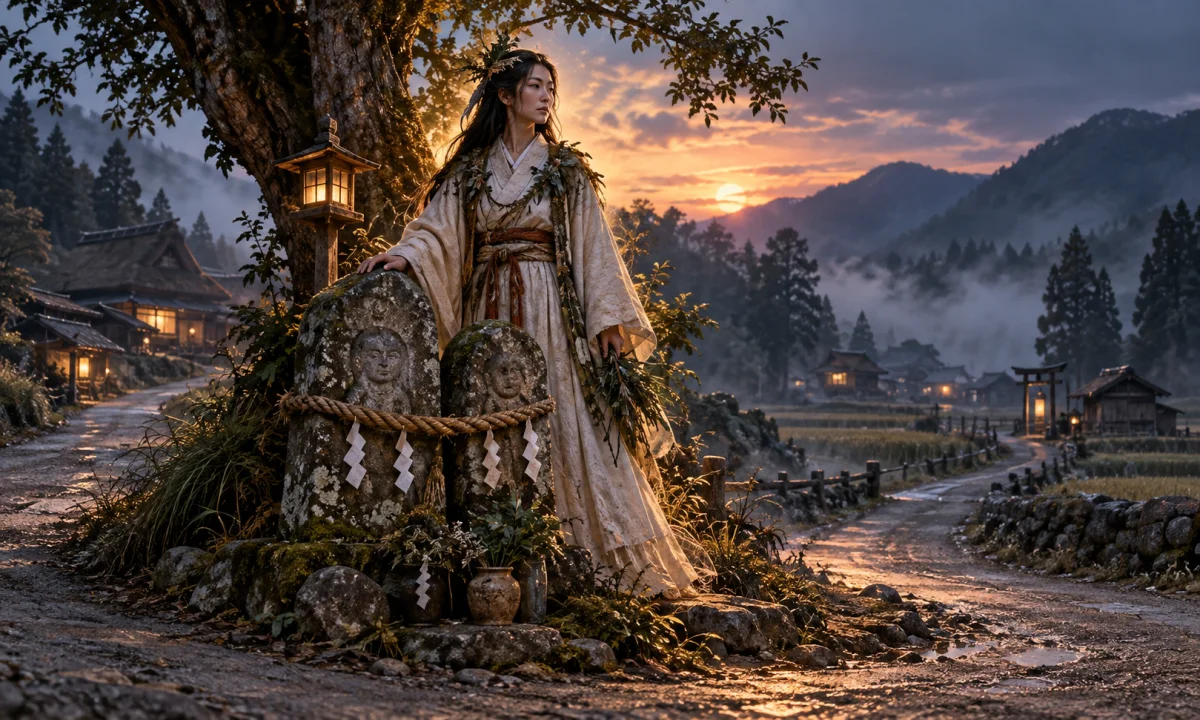
Benzaiten, also called Benten, is a Japanese Buddhist and Shinto-associated deity of music, eloquence, learning, water and, in later traditions, wealth. She originated in Japan through the transmission of the Indian goddess Sarasvatī into East Asian Buddhism, but Japanese worship gave her distinctive identities, stories and forms. She is especially associated with islands, springs, rivers, lakes and the sea, and is one of the Seven Lucky Gods commonly honoured in Japan.
Origins in Indian and East Asian religion
Benzaiten’s earliest religious background lies with Sarasvatī, a goddess of a river in ancient India who became associated with speech, knowledge, eloquence, music and the arts. In Hindu traditions, Sarasvatī is generally treated as a goddess in her own right. Buddhism also adopted her as a protective deity, particularly in traditions concerned with learning, ritual speech and the recitation of sacred texts.
As Buddhism spread through Central Asia and China, Sarasvatī entered Chinese Buddhist literature under names that could be translated as the “heavenly goddess of eloquence” or the “heavenly goddess of wealth and eloquence.” Chinese Buddhist forms of her name were transmitted to Japan, where they became Benzaiten and Benten. The Japanese pronunciation reflects the reading of Chinese characters rather than a direct pronunciation of the Sanskrit name.
The characters used for her name are significant. One form, 辨才天 or 辯才天, emphasizes eloquence, intelligence and the ability to speak well. Another, 弁財天 or 辨財天, emphasizes wealth and treasure. The change does not necessarily indicate two completely separate deities. It reflects the expansion of Benzaiten’s religious functions from speech and learning to prosperity, good fortune and material success.
Benzaiten’s presence in Japan is connected with the wider arrival of Buddhist scriptures, images and ritual traditions from the Asian mainland. Texts associated with the Golden Light Sutra and other Buddhist traditions helped establish Sarasvatī-like deities as protectors of religion, rulers and sacred learning. Japanese worshippers subsequently connected this imported figure with local water spirits, kami and legends.
Name, identity and religious classification
Benzaiten is not easily classified as exclusively a Buddhist deity or exclusively a Shinto kami. For much of Japanese history, Buddhist and kami traditions were closely interwoven. Buddhist temples could worship kami as local manifestations of Buddhist principles, while kami shrines could be interpreted through Buddhist doctrines. Benzaiten developed within this shared religious environment.
In Buddhist contexts, she may be presented as a heavenly deity who protects the teaching, grants eloquence and supports the arts. In local Japanese practice, she may be revered at a shrine or sacred island alongside water kami and other native divine figures. Her identification with local kami was not uniform, and the same name or image could carry different meanings from one sanctuary to another.
One especially important association is with Ichikishimahime-no-Mikoto, a female kami named in the Kojiki and Nihon Shoki among the three Munakata deities. Ichikishimahime is connected with sea travel and maritime protection. At places such as Itsukushima, she was historically identified or closely associated with Benzaiten through the Buddhist-Shinto system of interpretation. This does not mean that every tradition treats the two figures as identical. Their relationship is a product of religious syncretism and local history rather than a simple equation accepted everywhere.
The term Benten is a familiar shortened form of Benzaiten. It is common in the names of temples, shrines, festivals and sacred sites. The abbreviated name should not be confused with a separate goddess. Variations in spelling, pronunciation and iconography often reflect different periods and religious institutions.
Attributes and appearance
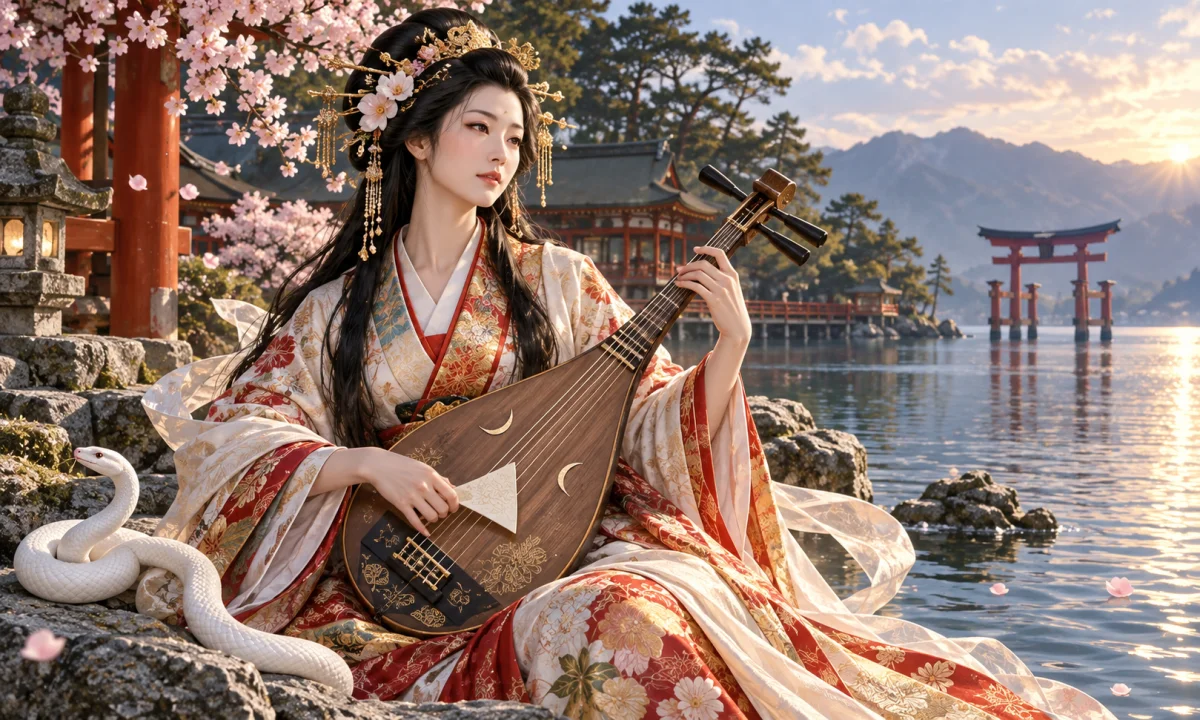
The most recognizable attribute of Benzaiten is the biwa, a Japanese lute. She is frequently shown seated while playing it, or holding it as a sign of music, refinement and cultivated expression. The biwa connects her with music in a broad sense, but also with poetry, performance, rhetoric and the disciplined arts of the mind.
Many images depict her as a graceful woman in flowing robes, sometimes with a crown or elaborate head ornament. Her appearance can resemble that of a Buddhist heavenly being, a courtly musician or a local sacred woman associated with water. The details vary according to the temple, period and iconographic tradition.
Benzaiten commonly appears with two arms, holding or playing the biwa. Other forms have eight arms and carry a range of ritual or military objects. These may include weapons, a jewel, a bow, arrows and other attributes. The eight-armed form presents her as a powerful protector as well as a patron of art and learning. There is no single universally fixed set of objects for every image, so individual statues should be interpreted in relation to their specific temple tradition.
Water is among her most persistent symbols. Rivers, springs, islands and lakes were important settings for Benzaiten worship. Water could represent the flow of speech and music, the fertility of the land, purification, maritime safety and the hidden wealth of the earth. Her water associations also helped connect her with dragons and serpents, which were widely regarded in Japanese religious traditions as guardians of rain, waterways and subterranean treasure.
Serpents, dragons and Uga Benzaiten
Serpents and dragons frequently accompany Benzaiten in Japanese art and legend. These creatures do not simply serve as monsters for her to defeat. They can be guardians, local water powers or symbols of abundance. A dragon’s control of rain and waterways made it a natural companion to a goddess associated with lakes, islands and springs.
Uga Benzaiten is a particularly important syncretic form. In this tradition, Benzaiten is combined with Ugajin, a deity or sacred figure associated with prosperity, food and abundance. Ugajin is often represented in serpentine form, and images of Uga Benzaiten may show a human form of Benzaiten with a small serpent or an elderly, serpent-linked figure placed above or behind the head. Iconography differs considerably between sites.
Uga Benzaiten became especially influential in medieval and early modern religious practice. The combination strengthened associations among water, rice, treasure, fertility and financial fortune. Worshippers might visit an image of Benzaiten to pray not only for musical ability or eloquence but also for successful trade, household prosperity and the increase of wealth.
Important sacred places
Benzaiten is worshipped at many temples and shrines throughout Japan, but several island sanctuaries are particularly famous. Enoshima, near modern-day Fujisawa in Kanagawa Prefecture, is one of the best-known centres of her worship. The island’s caves, springs and coastal setting supported a strong connection between Benzaiten, water and the sea.
Chikubushima in Lake Biwa is another major sacred site. The island’s Buddhist and Shinto institutions have long been associated with Benzaiten, and its position within Japan’s largest lake reinforces her role as a deity of inland waters as well as the ocean. The island is also connected with traditions of sacred treasure and miraculous protection.
Itsukushima, now widely known for the great shrine on Miyajima, has a complex history involving the Munakata goddesses, Buddhist worship and Benzaiten traditions. The identification of Benzaiten with Ichikishimahime was especially important in the religious interpretation of the shrine before the modern separation of Buddhist and Shinto institutions. The site therefore illustrates how one sacred place could contain several overlapping layers of identity.
These locations are sometimes described as the principal “Three Benten” sites, although lists and terminology can vary. Other temples and shrines may claim equal importance within particular regional traditions. Their significance comes not only from the deity’s name but also from local legends, pilgrimage routes, ritual practices and the natural landscape.
Legends of Benzaiten
One of the best-known legends connected with Enoshima tells of a dangerous dragon that tormented the surrounding area and harmed children. In the medieval version of the story, Benzaiten appeared before the dragon. Rather than merely destroying it, she confronted its violence and brought about its conversion or submission. The dragon then became associated with her and, in some tellings, became her consort or protector.
The story survives as part of the legendary history of Enoshima and should not be treated as a historical account of the island’s origins. Its details differ between versions, including the nature of the dragon and the manner of Benzaiten’s appearance. Its religious meaning is more important than its factual status: a destructive local water power is brought into a sacred relationship with Benzaiten and becomes a guardian of the community.
Other legends emphasize miraculous music, eloquence, healing, the discovery of sacred springs or the protection of travellers at sea. Such stories often develop around individual temples and are preserved in local records, oral traditions, festival performances and pilgrimage customs. Benzaiten’s identity is therefore shaped not by one universally authoritative myth but by a network of regional traditions.
The Seven Lucky Gods
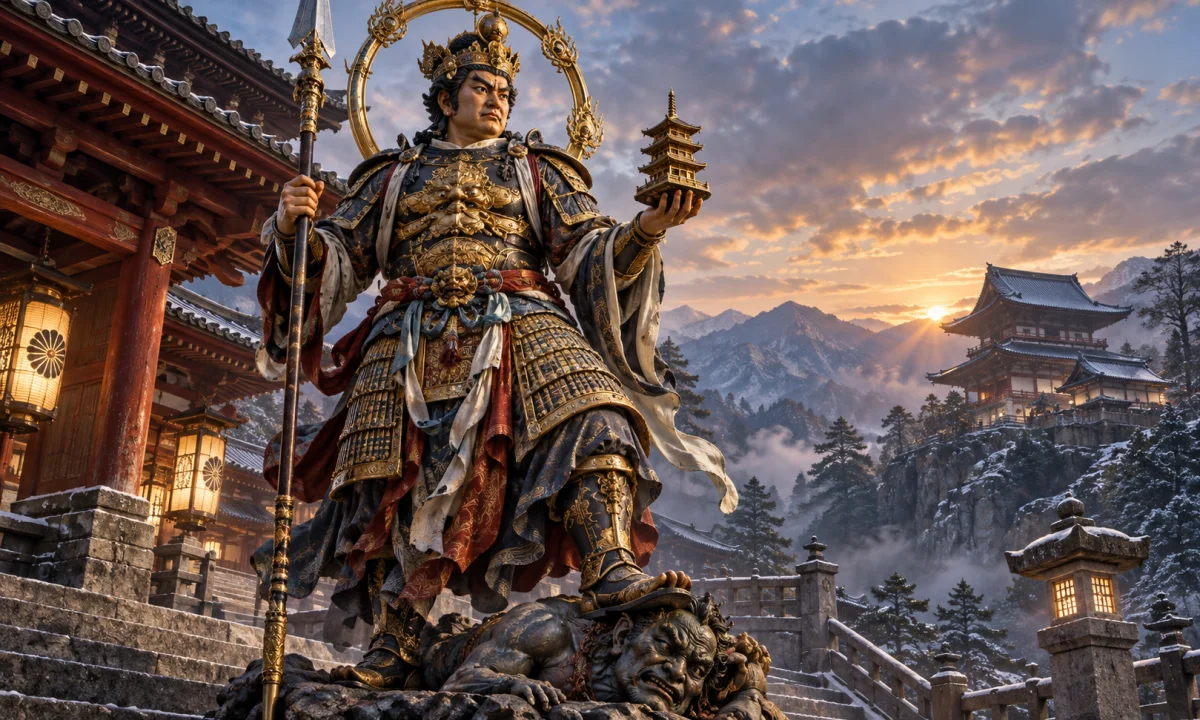
Benzaiten is the only woman in the standard group of the Seven Lucky Gods, known as the Shichifukujin. The other commonly listed members are Ebisu, Daikokuten, Bishamonten, Fukurokuju, Jurojin and Hotei. The grouping developed over time and brings together figures with different origins, including Buddhist, Shinto, Daoist and folk-religious backgrounds.
Within the Seven Lucky Gods, Benzaiten represents music, beauty, intelligence, eloquence and artistic accomplishment, while also granting good fortune and prosperity. Her inclusion helped make her familiar beyond specialist Buddhist institutions. Images of the Seven Lucky Gods often show her with the biwa, making her immediately distinguishable from the male deities around her.
The Seven Lucky Gods tradition is not an ancient Indian or pan-Buddhist classification. It is a Japanese religious and cultural formation that became particularly popular in the medieval and early modern periods. In some expanded or regional groupings, other female Buddhist figures, including Kisshōten, may also appear, but Kisshōten and Benzaiten are distinct figures and should not automatically be treated as the same deity.
Meaning and cultural significance
Benzaiten’s symbolism rests on the connection between flowing water and flowing expression. A river moves through the landscape just as music, poetry and persuasive speech move through the mind and community. Her association with eloquence made her relevant to priests, scholars, performers and people seeking success in communication. Her association with water made her important to farmers, sailors and communities dependent on springs, lakes and coastal routes.
Her transformation into a goddess of wealth also reflects changing patterns of worship. In earlier Buddhist contexts, prosperity could mean the protection of the religious community, the flourishing of learning or the abundance required to sustain temples. Later popular worship more directly connected Benzaiten with business success, money and personal fortune. These meanings coexist rather than forming a single fixed doctrine.
Gender also contributes to her cultural image. As a female deity associated with music, beauty and intelligence, Benzaiten has sometimes been compared with other goddesses of art and learning. Such comparisons can be useful, but they should not erase the specific Japanese history through which Sarasvatī became Benzaiten. She is neither simply an unchanged Hindu goddess nor merely a generic Japanese goddess of luck.
Benzaiten after the separation of Buddhist and Shinto institutions
During the Meiji period, government policies required a formal separation between Buddhist institutions and Shinto shrines. This disrupted many older forms of syncretic worship. Some Benzaiten temples retained their traditional identity, while other sites reassigned, renamed or reinterpreted their principal deity as a kami. In places where Benzaiten had been identified with Ichikishimahime, the official religious presentation could change even when local customs continued.
This history explains why Benzaiten may be encountered at a Buddhist temple, a shrine, a small island sanctuary or a site described using both Buddhist and Shinto vocabulary. Modern labels do not always reveal the full history of a place. Statues, festivals and pilgrimage practices can preserve elements of older traditions that once crossed the boundary between the two religions.
Benzaiten in modern Japan
Benzaiten remains a living presence in Japanese religious culture. People visit her sanctuaries to pray for success in music, education, public speaking, artistic work, business and financial affairs. Festivals may include musical performances, processions, purification rites or ceremonies involving water and sacred images. White snakes and dragons continue to appear in popular devotional symbolism because of their connection with her older water and treasure associations.
Modern popular culture sometimes presents Benzaiten as a beautiful, musically gifted goddess with supernatural powers, often emphasizing the biwa, her status as a member of the Seven Lucky Gods or her relationship with dragons and serpents. These portrayals draw on genuine traditional motifs, but they may simplify the complex history of her Indian, Chinese, Buddhist, Shinto and local Japanese identities. The traditional Benzaiten is best understood as a deity whose meaning developed through centuries of religious exchange rather than as a figure with one fixed appearance or role.