WORLD
WORLD
Ebisu
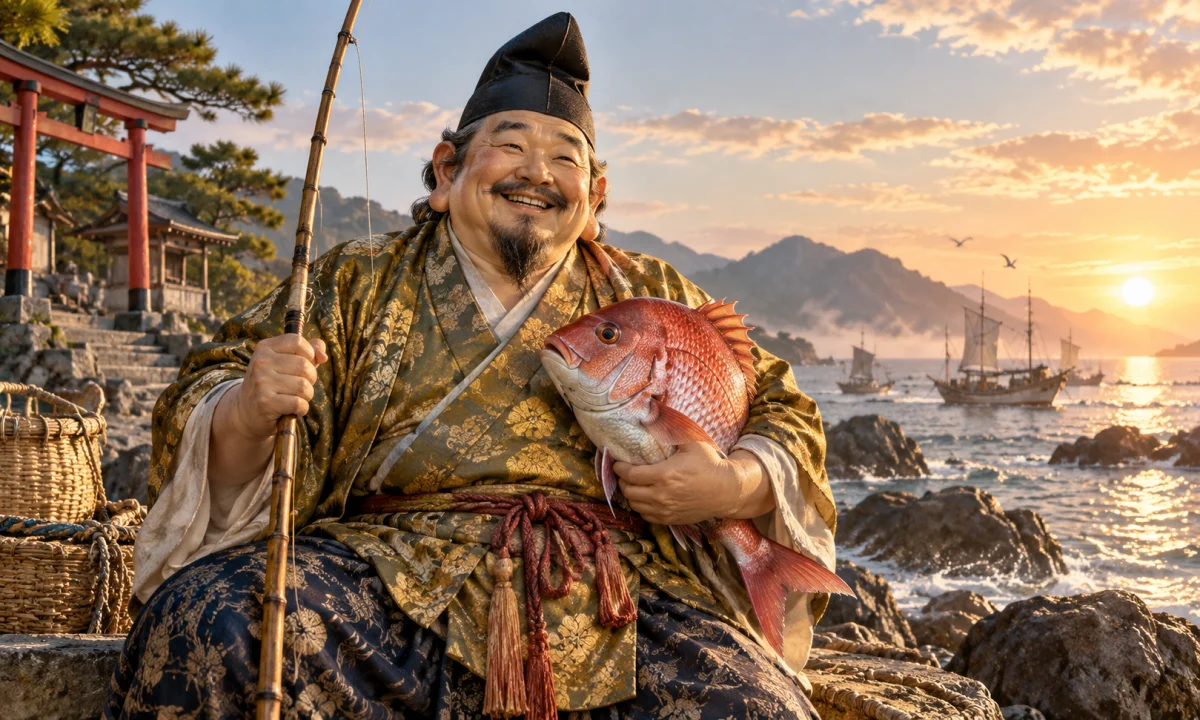
Ebisu is a Japanese kami associated with the sea, fishing, trade, prosperity and good fortune. He is best known as one of the Seven Lucky Gods (Shichifukujin), usually shown smiling, carrying a fishing rod and holding a large sea bream. His image appears in shrines, household decorations, shop signs, festival banners and commercial art throughout Japan.
Ebisu is not a single, uniformly defined figure in every tradition. His identity developed through the interaction of local Japanese sea cults, Shinto traditions, Buddhist-influenced religious practice, medieval legends and early modern popular religion. In some contexts he is identified with Hiruko, a child mentioned in the Kojiki and Nihon shoki; in others he is associated with Kotoshironushi, a deity connected with the mythology of Izumo. These identifications are influential, but they should not be treated as an uncontested description of Ebisu's original identity.
Origins and religious setting
Ebisu's earliest background is difficult to isolate because the name came to be used for more than one kind of sacred being. In Japanese religious history, coastal communities often venerated deities connected with fishing, safe travel, abundant catches and the unpredictable power of the sea. A god who provided fish could also become a protector of markets and a bringer of economic well-being. Over time, local sea kami, shrine deities and imported religious ideas were drawn into broader patterns of worship.
The name Ebisu is written in several ways, including 恵比寿, 恵比須, 夷 and 戎. The different spellings reflect changing religious and cultural associations rather than a single ancient orthography. The characters 夷 and 戎 could refer to people regarded in older usage as outsiders or people from beyond the political centre. This contributed to interpretations of Ebisu as a deity of the margins, the shore and the unfamiliar. It does not, however, prove that Ebisu was originally a foreign god.
Ebisu's religious character also reflects the close relationship between Shinto and Buddhism in premodern Japan. Before the separation of the two traditions in the nineteenth century, kami were frequently understood alongside buddhas, bodhisattvas and Buddhist protective beings. The Seven Lucky Gods themselves developed within this mixed religious environment. Their worship does not represent a single ancient pantheon; it is a later combination of figures with different origins and histories.
Ebisu and Hiruko
One of the best-known explanations identifies Ebisu with Hiruko. In the creation narratives of the Kojiki, completed in the early eighth century, and the Nihon shoki, compiled soon afterwards, Izanagi and Izanami begin producing the islands and deities of Japan. In the Kojiki, their first child is Hiruko, whose body is described as insufficiently formed. The parents place the child in a boat and set him adrift.
This story does not call Hiruko “Ebisu,” nor does it describe him as a god of fishing, commerce or good fortune. The link between the two figures emerged later through religious interpretation and regional tradition. Because a child cast out to sea could be imagined as returning as a powerful marine deity, the myth offered a compelling explanation for Ebisu's connection with the ocean and with things that arrive unexpectedly from the sea.
In some later accounts, Hiruko survives his abandonment and becomes Ebisu. Other traditions associate the castaway child with a shrine or local sacred site, while still others do not make the identification central at all. The Hiruko explanation is therefore an important strand of Ebisu tradition, not a complete account of every Ebisu cult.
Ebisu and Kotoshironushi
Another major identification connects Ebisu with Kotoshironushi, a son of the powerful deity Ōkuninushi in the myths associated with Izumo. Kotoshironushi appears in stories concerning the transfer of rule over the land to the descendants of the heavenly kami. In these narratives, he accepts the authority of the heavenly lineage and withdraws from political rule. His later worship became especially important at shrines connected with the Izumo tradition.
The connection between Kotoshironushi and Ebisu is especially prominent in some shrine traditions and regional interpretations. Both figures could be associated with fishing, the sea and the protection of communities. Yet the ancient mythological texts do not simply state that Kotoshironushi is Ebisu. The identification developed through later religious practice, genealogies, shrine traditions and efforts to relate local deities to widely recognized kami.
As a result, Ebisu may be understood as a composite religious identity. Hiruko, Kotoshironushi and local marine kami were not necessarily identical in their original settings, but later worshippers sometimes brought them together under the name Ebisu. This kind of overlapping identity is common in the history of Japanese religion, where a deity's meaning can change as a cult moves between villages, shrines, social groups and religious institutions.
Appearance and traditional attributes
Ebisu is generally portrayed as a cheerful, bearded fisherman wearing courtly or hunting-style clothing and a tall black cap. He holds a fishing rod in one hand and a sea bream in the other. The fish is usually a tai, a red sea bream whose name forms a pun with medetai, meaning auspicious or felicitous. The image therefore combines a real object of economic value with a visual expression of good fortune.
His fishing rod is often interpreted as a sign that prosperity should be gained without unnecessary harm or greed. A common saying describes Ebisu as catching the fish rather than taking the whole sea, expressing an ideal of modest, legitimate success. This interpretation is part of later popular moral symbolism rather than a fixed doctrine found in the oldest myths.
Ebisu's broad smile and relaxed posture distinguish him from more distant or terrifying representations of divine power. He is approachable, sociable and particularly suited to the practical concerns of households and businesses. Worshippers may ask him for a good catch, successful trade, thriving commerce, protection for a shop or household prosperity. His blessings are material, but they are not limited to wealth: they also concern livelihood, food and the stability of the community.
Ebisu is sometimes shown with a physical irregularity or is described in regional traditions as deaf, lame or otherwise different from ordinary people. These details are not universal and should not be treated as standard attributes. They reflect particular local legends and the broader theme of the outsider or marginal figure who possesses unusual sacred power.
Ebisu among the Seven Lucky Gods
Ebisu is one of the Seven Lucky Gods, a group whose familiar form took shape largely during the medieval and early modern periods. The group commonly includes Daikokuten, Bishamonten, Benzaiten, Fukurokuju, Jurōjin, Hotei and Ebisu. Their backgrounds are diverse. Some derive from Indian religious figures transmitted through Buddhism, while others reflect Chinese traditions or Japanese kami worship.
Ebisu is often described as the only member of the group who is distinctly Japanese in origin. This statement is useful as a broad contrast with figures whose identities derive from India or China, but it simplifies a complicated history. Ebisu himself has multiple, disputed origins, and his familiar form was shaped through religious exchange. He became part of the Seven Lucky Gods after the group had already begun to develop, and his role within it was not identical in all periods or regions.
In popular representations, the Seven Lucky Gods travel together in the Takarabune, the Treasure Ship, especially in New Year imagery. Ebisu's role in this group is that of the provider of food, fish and commercial success. His presence helps connect the abstract idea of good fortune with the concrete activities of fishing, buying, selling and earning a living.
Fishing, trade and the life of the marketplace
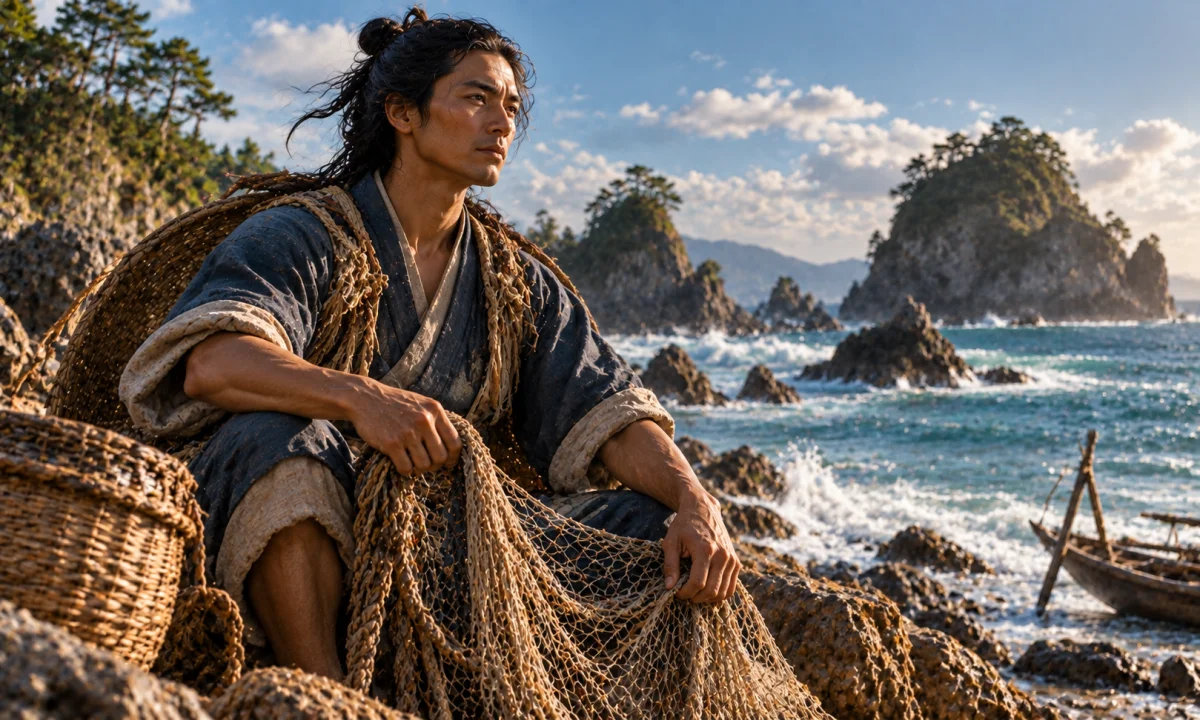
Ebisu's strongest traditional associations are with fishing communities and commercial activity. Coastal villages might honour him as a protector of fishermen and boats, while towns and market districts could worship him as a patron of merchants. The same deity could therefore stand for both the natural resources of the sea and the human systems that distribute those resources.
This connection explains why Ebisu became particularly prominent in western Japan, including the Kansai region. The port city of Osaka was historically one of Japan's major centres of trade, and Ebisu worship became closely associated with merchants and urban prosperity. In commercial settings, his image could appear at a shop entrance or on a festival banner as a sign of hoped-for success.
Ebisu was not simply a god of unlimited wealth. Traditional prosperity depended on the continued generosity of the sea, the health of the community and the proper observance of local customs. His worship reflects the risks of fishing and trade as much as their rewards. A good catch could be followed by storms, poor seasons or dangerous voyages, so offerings and festivals also expressed respect for forces beyond human control.
Shrines and festivals
One of the most important centres of Ebisu worship is Nishinomiya Shrine in Hyōgo Prefecture, known as the head shrine of the Nishinomiya Ebisu tradition. Its Ebisu has been revered as a deity of fishing, commerce and prosperity. The shrine's traditions have helped spread forms of Ebisu worship far beyond the local area, although individual shrines may preserve their own stories and ritual emphases.
The most famous festival associated with Ebisu is Tōka Ebisu, held in the Kansai region around 9–11 January. The name means “Tenth-day Ebisu,” and the festival is linked with prayers for business success and prosperity during the coming year. Worshippers often purchase decorated bamboo branches called fukusa or fuku-zasa, to which auspicious ornaments may be attached. The bamboo represents resilience and continued growth, while the decorations symbolize success in trade and livelihood.
At Nishinomiya Shrine, the opening of the shrine gates and the race to the main sanctuary on the morning of 10 January are associated with the Fuku Otoko, or “Lucky Men.” Participants compete to reach the sanctuary, and the first arrivals receive special recognition. This is a particular shrine custom rather than a universal feature of Ebisu worship.
Other communities hold Ebisu festivals at different times, often according to local agricultural, fishing or commercial calendars. In some regions, Ebisu may be honoured during periods when other kami are believed to be away from their shrines. Such beliefs vary considerably, and there is no single nationwide calendar or ritual system governing all Ebisu observance.
Ebisu as an outsider and a returning presence
The figure of Ebisu has often been interpreted through the idea of the outsider. His possible connection with a child cast into the sea, his names associated in some historical usage with people beyond the centre, and his close relationship with shores and ports all support this interpretation. The stranger who arrives from the sea may bring danger, wealth, knowledge or divine power.
In Japanese folklore, objects or beings that wash ashore can have special significance. They may be treated as gifts from the other world, known in some contexts as yorishiro or manifestations of an otherworldly presence. Ebisu's marine associations fit this wider pattern, although not every story about a beachcombed object or an arrival from the sea concerns Ebisu.
His outsider quality does not make him an enemy. Instead, Ebisu often transforms marginality into blessing. The deity who is different, displaced or difficult to classify becomes the protector of people whose livelihoods also depend on uncertain boundaries: fishermen crossing between land and sea, merchants moving goods between regions, and travellers entering busy ports.
Distinctions from similar figures
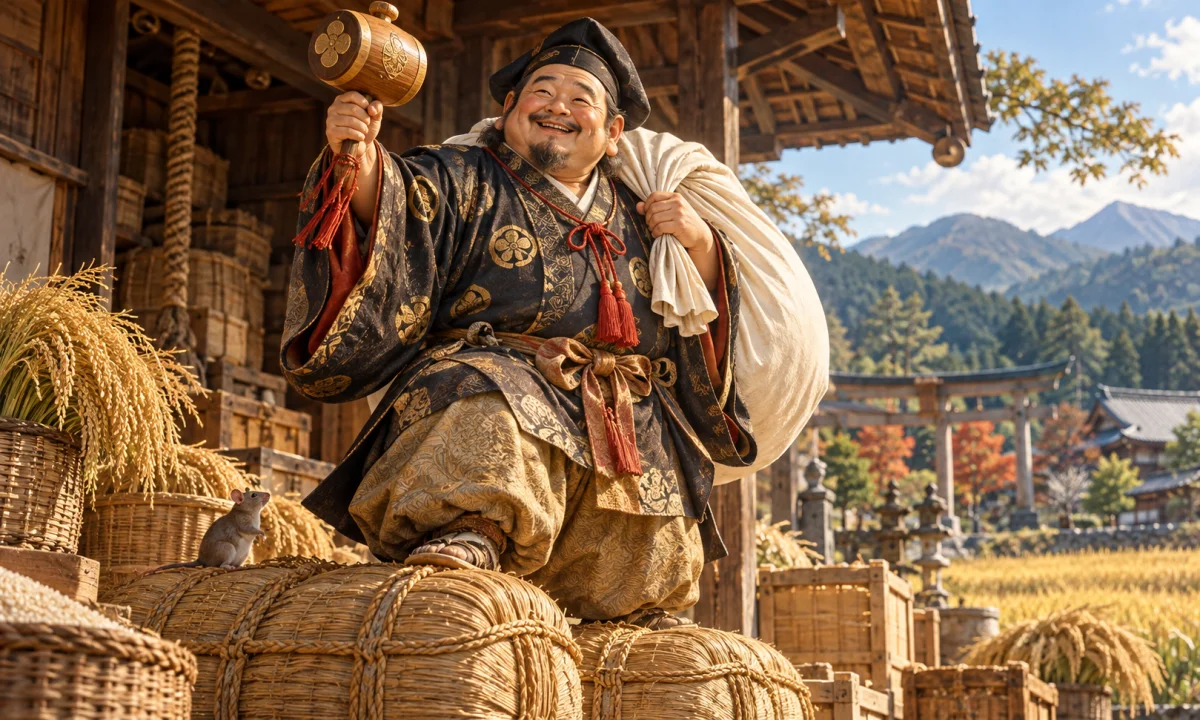
Ebisu is sometimes confused with several other Japanese religious figures. Daikokuten, another member of the Seven Lucky Gods, is associated with abundance, rice, the household and wealth. He is commonly shown with a sack and a large mallet, whereas Ebisu carries a fishing rod and sea bream. The two are frequently worshipped together, but they are not the same deity.
Ebisu should also be distinguished from Ōkuninushi. Ōkuninushi is a major deity in the mythology of Izumo, associated with the creation and governance of the land, relationships and the transfer of authority. Kotoshironushi is his son in the classical myths, and some later traditions identify Kotoshironushi with Ebisu. That relationship does not make Ebisu identical with Ōkuninushi.
Nor is Ebisu simply another name for the sea dragon or dragon king figures found in Japanese and East Asian religious traditions. Dragons may govern rain, rivers, oceans or treasure, but Ebisu's standard imagery and social roles are those of the fisherman, provider and patron of commerce. Local traditions can bring marine deities into contact, but they should not automatically be merged.
Modern cultural presence
Ebisu remains a living religious figure rather than merely a character from mythology. Shrines continue to receive prayers for business success, and his festivals attract merchants, workers, families and visitors. His image is also used in calendars, shop decorations, talismans and New Year displays, where religious devotion and popular custom may overlap.
The name Yebisu is also familiar through a Japanese beer brand whose name and label draw on the figure's traditional image. The brand is a commercial adaptation, not evidence that Ebisu is primarily a beer deity. Its use of the fisherman with a sea bream depends on the pre-existing association between Ebisu, prosperity and a successful catch.
In contemporary Japan, Ebisu can therefore appear in several settings at once: as a kami honoured at a shrine, a member of a popular group of lucky deities, a symbol of the fishing and merchant classes, a festival figure and a commercial emblem. These forms are related, but they belong to different historical layers. Understanding Ebisu requires keeping the ancient myths of Hiruko and Kotoshironushi distinct from the later development of Ebisu worship and from modern branding.