WORLD
WORLD
Hotei
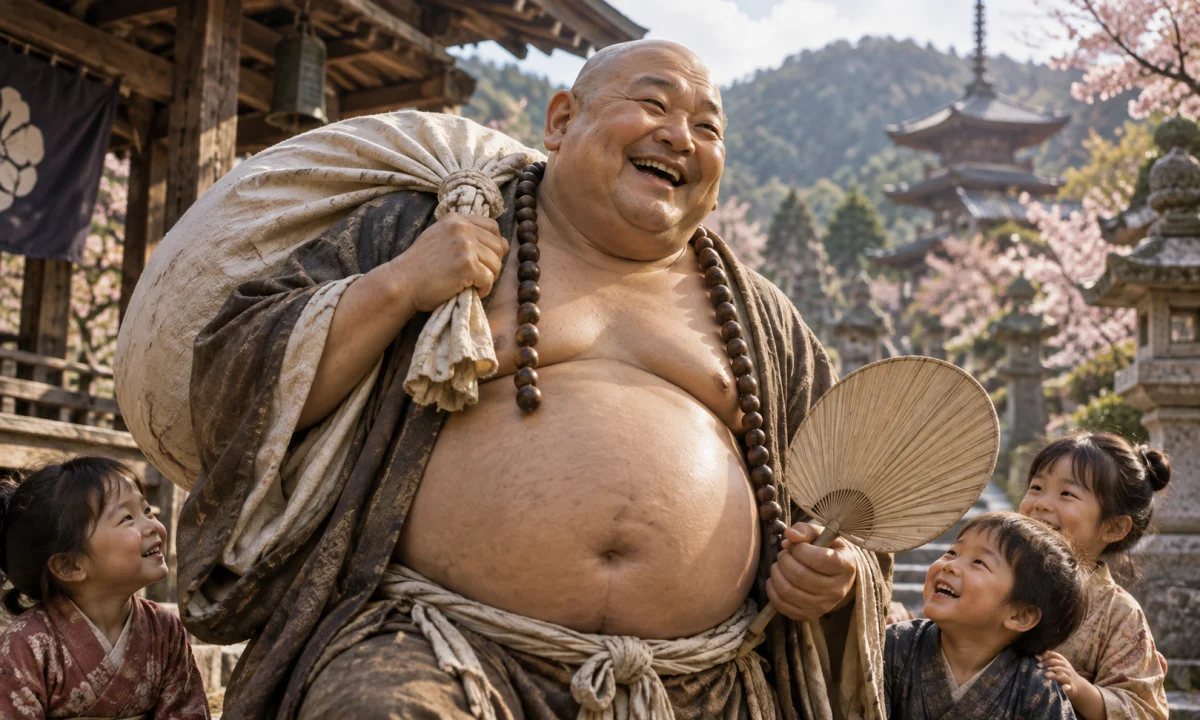
Hotei is a cheerful, large-bellied figure in Japanese religious culture, usually shown carrying a cloth sack and smiling broadly. He is counted among the Seven Lucky Gods (Shichifukujin) and is associated with happiness, contentment, generosity and material well-being. Although often described as a figure from Japanese mythology, Hotei originated in Chinese Buddhist tradition. He is the Japanese form of Budai, a legendary wandering monk who became associated with the future Buddha Maitreya.
Hotei is therefore not simply a Japanese invention, nor is he identical to the historical Buddha. His identity developed through several layers of tradition: a possibly historical Chinese monk, Buddhist miracle stories, popular religious devotion, Japanese interpretations of Chinese culture and later associations with luck and prosperity. The familiar statue with a round stomach and overflowing sack represents only one stage in this long development.
Origins in Chinese Buddhist Tradition
The figure later known in Japan as Hotei first appears in Chinese tradition as Budai, a name meaning “cloth sack” or “cloth bag.” Budai is commonly identified with a wandering monk called Qici, though the historical evidence for his life is limited and mixed with legend. He is traditionally said to have lived in the late Tang or early Five Dynasties period, around the ninth or tenth century, in the region of Mingzhou in southeastern China, particularly the area later associated with Fenghua.
Stories describe Qici as an unconventional monk who travelled from place to place carrying a large sack over his shoulder. He accepted offerings, gave away simple gifts and attracted children wherever he went. He was considered eccentric because he did not resemble the disciplined, secluded image of an ideal monk. Instead, he slept in the open, laughed loudly, ate freely and seemed unconcerned with social expectations.
Written accounts of Budai became prominent in later Buddhist collections, especially records connected with the Chan tradition. These texts present him as a mysterious holy man whose seemingly foolish behaviour concealed spiritual insight. He was said to possess unusual knowledge, including the ability to predict weather or foresee events. Such stories belong to hagiography and religious folklore rather than securely documented biography. It is difficult to separate any historical person named Qici from the legendary Budai who developed around him.
The Meaning of the Cloth Sack
The sack is Budai’s defining attribute and remains Hotei’s most recognisable object. In traditional stories, it may contain food, clothing, toys or gifts for children. Its contents can also represent the abundance of the world: the ability to give freely, the endless variety of experience and the generosity expected from a compassionate religious figure.
The sack does not have one fixed meaning in every context. In some depictions, it suggests a wandering monk’s possessions. In others, it becomes a symbol of wealth, good fortune or a storehouse that never seems to empty. Japanese images often emphasise this prosperous interpretation, particularly when Hotei is displayed in shops, homes and businesses.
His laughter and relaxed manner are equally important. Budai’s body and behaviour challenge conventional ideas about holiness. Rather than appearing austere, thin or remote, he is presented as approachable and emotionally open. His large belly is commonly interpreted as a sign of generosity, tolerance and satisfaction rather than gluttony alone. Some later popular explanations connect it with a saying that a person should have a large heart or a generous spirit, but such interpretations are moral symbolism rather than a single ancient doctrine.
Budai and Maitreya
One of the most important developments in Budai’s religious identity was his association with Maitreya, the Buddha expected to appear in the future. In Chinese Buddhism, Maitreya is known as Mile, while in Japan he is called Miroku. Maitreya is traditionally believed to reside in the Tuṣita heaven before descending into the human world to renew the Buddhist teaching.
According to a well-known tradition, Budai revealed himself as Maitreya shortly before his death. A verse attributed to him declares that he is the “true Maitreya,” though the wording differs among translations and versions. The story helped explain why an apparently ordinary and eccentric monk should be treated as a sacred manifestation. It also allowed local devotion to Budai to connect with the wider Buddhist expectation of a future Buddha.
This identification should be treated as a religious interpretation, not as established historical fact. The sources that preserve the story were written after the period in which Qici is supposed to have lived, and the verse itself may have developed or been edited over time. Not every image of Budai in China was necessarily intended to portray Maitreya, and the identification became especially influential in East Asian popular Buddhism rather than representing a universally shared Buddhist teaching.
Hotei in Japan
The figure entered Japan through the transmission of Chinese Buddhism, art and cultural practices. Japanese monks, artists and devotees encountered images and stories of Budai through Chinese religious traditions, including Chan Buddhism, which developed into Japanese Zen schools. In Japanese, the name Hotei is written with the same characters as Budai, 布袋, and retains the meaning associated with the cloth sack.
In Japan, Hotei gradually acquired a broader popular identity. He was not confined to temples or to a single Buddhist school. His image circulated in paintings, sculptures, household objects and religious prints. He became a figure of good humour, good fortune and social harmony, especially because his appearance was easy to recognise and his symbolism could be understood outside specialist Buddhist teaching.
Hotei’s inclusion among the Seven Lucky Gods was part of the wider development of the Shichifukujin tradition. The group brings together deities and sacred figures from Buddhist, Shinto, Hindu-derived and Chinese traditions. Its present form developed gradually, particularly from the medieval and early modern periods, rather than descending unchanged from one ancient source. Hotei represents contentment, happiness and the generous distribution of good fortune within this group.
The Seven Lucky Gods are often displayed together during the New Year period. People may visit temples and shrines associated with the deities, purchase images or take part in local pilgrimage customs. Hotei’s inclusion gives the group a distinctly human and humorous presence. He is not normally approached as a remote creator deity or a ruler of the cosmos, but as a benevolent figure whose appearance promises cheerfulness and material security.
Appearance and Attributes
Hotei is usually portrayed as a bald, smiling or laughing man with a large bare belly. He often has elongated earlobes, a feature that can suggest wisdom, spiritual merit or the visual language of Buddhist imagery. His clothing is commonly a loose monastic robe, though artistic styles vary widely. He may be shown seated, standing, reclining or walking with his sack over one shoulder.
Common attributes include:
- The cloth sack: a sign of his identity, generosity and abundance.
- The round belly: often associated with contentment, tolerance and prosperity.
- A broad smile or laughter: expressing joy, friendliness and freedom from anxiety.
- Children: recalling stories in which Budai attracted and entertained children.
- A fan, staff or beads: objects that may appear in particular artistic and religious settings.
- Gold ingots, coins or other auspicious objects: later symbols connecting Hotei with wealth and business success.
Not every representation includes all these features. Older Buddhist images may place greater emphasis on the monk’s sack and wandering appearance, while later commercial or decorative images may exaggerate his belly, laughter and association with wealth. The surrounding objects often indicate the image’s intended meaning.
Stories of the Wandering Monk
Legends about Budai commonly describe him as unpredictable but compassionate. He might appear in a village, accept food from residents, laugh at their concerns or distribute gifts to children. His apparent lack of concern for ordinary rules could be interpreted as evidence that he had moved beyond attachment to status and possessions. At other times, his behaviour was said to contain a hidden warning or prophecy.
Some stories portray him as a diviner who could predict whether the weather would be dry or rainy. If he wore particular footwear or behaved in a certain way, people supposedly interpreted this as a sign of coming conditions. These tales reflect the popular image of the wandering holy person as someone able to read hidden forces in nature. They are part of the legend surrounding Budai and should not be treated as reliable meteorological or historical accounts.
His interactions with children are especially significant. Children might follow him through the streets, amused by his laughter and fascinated by the sack. In this respect, he differs from many austere religious sages. His wisdom is communicated through play, generosity and unexpected behaviour rather than through elaborate sermons. The stories suggest that spiritual value can be found in kindness, openness and freedom from social vanity.
Religious and Cultural Interpretation
Hotei’s religious meaning depends on the setting in which he appears. In a Buddhist context, he may recall Budai’s connection with Chan or Zen ideals, including the possibility that enlightenment does not always look solemn or conventional. His eccentricity can be understood as a challenge to attachment to appearances. The laughing monk also reflects a theme found in East Asian religious culture: a holy person may disguise wisdom beneath ordinary, comic or even absurd behaviour.
In popular devotion, Hotei is more often connected with the practical blessings of daily life. He may be invoked or displayed as a bringer of good luck, prosperity, peace in the household and success in business. This does not mean that all Japanese Buddhists interpret him in the same way. Some regard him primarily as a Buddhist image, some as one of the Seven Lucky Gods and others as an auspicious decorative figure with little formal religious commitment.
His symbolism combines material and emotional well-being. The sack suggests that there is enough to share, while the smile suggests that happiness is not reducible to possessions. Hotei’s generous appearance can therefore express both prosperity and the social duty to use prosperity kindly. His popularity rests partly on this flexibility: he can represent wealth without being only a god of wealth.
Hotei and Similar Figures
Hotei is frequently confused with the historical Buddha, with Maitreya or with a generic “laughing Buddha.” These identifications are related but not interchangeable.
Hotei and the historical Buddha: Hotei is not Siddhartha Gautama, the Buddha who taught in ancient India. Images of Gautama Buddha usually show a more restrained figure in a meditative or teaching pose. The large belly and sack belong to the Budai-Hotei tradition, not to the standard historical portrayal of Gautama.
Hotei and Maitreya: Maitreya is the future Buddha in Buddhist belief. Budai became identified with Maitreya in some Chinese and East Asian traditions, but Hotei is not simply another name for every representation of Maitreya. The connection is historical and devotional, and its strength varies according to period and context.
Hotei and Daikoku: Daikoku is another member of the Japanese Seven Lucky Gods. He is often shown with a sack and a large mallet, but he is not Hotei. Daikoku’s imagery is associated with prosperity, agriculture and household abundance, while Hotei is distinguished by his exposed belly, laughter and wandering monk’s appearance. Their sacks can cause confusion, especially in commercial illustrations.
Hotei and the “Laughing Buddha”: “Laughing Buddha” is a common modern English label for images based on Budai or Hotei. It is convenient but imprecise because it can make the figure sound like a standard representation of the Buddha himself. In a Japanese context, Hotei is the more accurate name; in a Chinese context, Budai is generally preferred.
Later Reception and Modern Use
Hotei remains visible in Japan during New Year celebrations, temple visits, household displays and businesses. His image appears on figurines, prints, ceramics, shop decorations and good-luck objects. Restaurants and commercial establishments may display him because his expression is thought to suggest welcome, success and abundance. These uses continue older associations, although they do not necessarily imply a formal religious act.
Outside East Asia, Hotei is often marketed under the label “Laughing Buddha” and used in interiors, gardens, restaurants and wellness settings. International popular culture frequently treats him as a universal symbol of happiness or financial prosperity. Such uses draw on genuine elements of the Budai-Hotei tradition but may remove the Buddhist history, the connection with Maitreya and the specifically Japanese role within the Seven Lucky Gods.
Understanding Hotei requires keeping these layers distinct. He is linked to a legendary Chinese monk, interpreted in some traditions as an embodiment of Maitreya, adopted into Japanese Buddhist and popular culture, and eventually established as one of Japan’s most recognisable lucky figures. His enduring appeal lies in the combination of religious ambiguity and immediate visual warmth: a wandering holy man whose sack is full, whose laughter is public and whose generosity makes spiritual good fortune seem approachable.