WORLD
WORLD
Fukurokuju
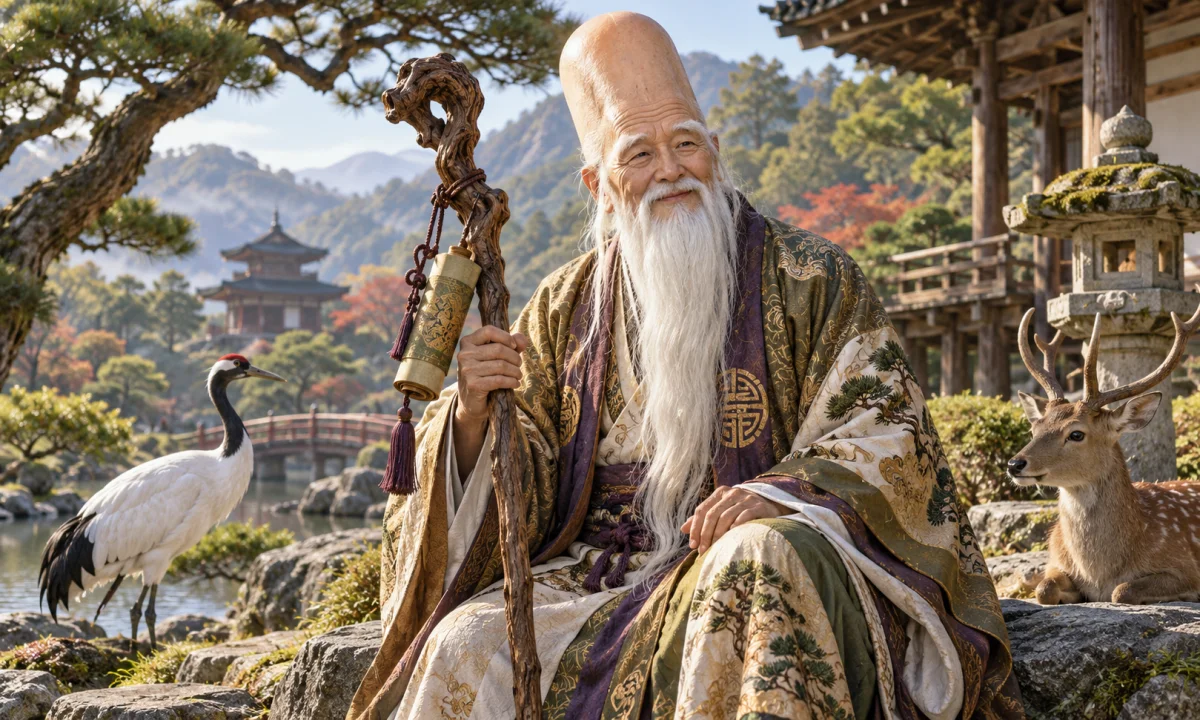
Fukurokuju is a Japanese deity of good fortune associated especially with longevity, wisdom and prosperity. He is best known as one of the Seven Lucky Gods (Shichifukujin), a popular group of benevolent figures honoured in Japan. His familiar image is that of an elderly man with an exceptionally tall, domed or elongated forehead, a long white beard, and a staff or scroll. Although Fukurokuju belongs to Japanese religious and cultural tradition, his identity developed through the interaction of Japanese Buddhism, Chinese religious imagery, Taoist ideas and local popular devotion rather than through one single ancient Japanese myth.
Name and identity
The name Fukurokuju is usually written with characters meaning happiness or good fortune (fuku), wealth or prosperity (roku), and longevity (ju). The character for longevity may appear in the traditional form 壽 as well as the modern form 寿. The three terms express the blessings for which the deity is invoked, but they do not necessarily describe a fully separate personality in the way that the names of many mythological gods do.
Fukurokuju is sometimes called Fukurokujin, with an additional character meaning “deity” or “spirit.” English-language references may therefore use both forms, although Fukurokuju is the most common short name. His identity is not completely uniform across Japanese sources. In some traditions he is treated as a distinct member of the Seven Lucky Gods; in others, he overlaps strongly with Jurojin, another elderly deity of longevity. The two figures can be difficult to distinguish, and historical images sometimes give them similar attributes.
Origins and cultural setting
Fukurokuju does not belong to a clearly defined pantheon found in an ancient Japanese creation myth. His character emerged in the medieval and early modern religious environment of Japan, where Buddhist institutions, imported Chinese ideas, local kami traditions and popular beliefs frequently interacted. Japanese religious life did not always draw a strict boundary between these categories. A figure might be understood at once as a deity, a Buddhist-associated being, a manifestation of a Chinese immortal, or an auspicious emblem used in everyday life.
The imagery connected with Fukurokuju is closely related to Chinese traditions of long-lived sages and immortals. One important background figure is the Old Man of the Southern Polestar, a stellar deity associated in Chinese tradition with longevity. Japanese interpretations sometimes connect Fukurokuju with this figure, but the identification is not universal or always historically precise. Similar associations may also be made for Jurojin, which is one reason the two Japanese deities have often been confused.
Fukurokuju’s development is generally associated with the culture of medieval Japan and the growing popularity of auspicious figures in the Muromachi period, followed by wider dissemination during the Edo period. The Seven Lucky Gods became especially prominent in urban popular culture, painting, printed books, household objects and pilgrimage practices. The precise chronology and origin of the group remain matters of historical interpretation, since there was no single founding text that established the seven figures once and for all.
Fukurokuju and the Seven Lucky Gods
The usual group of Seven Lucky Gods consists of:
- Ebisu, a Japanese deity of fishing, maritime prosperity and commerce;
- Daikokuten, a Japanese form of the Buddhist and Hindu-associated figure Mahākāla, linked with food, household abundance and wealth;
- Bishamonten, a guardian deity associated with protection and military power;
- Benzaiten, a goddess of music, eloquence, learning and flowing water, ultimately connected with the Indian Saraswati;
- Fukurokuju, associated with longevity, wisdom, happiness and prosperity;
- Jurojin, another elderly figure associated chiefly with long life and often shown with a deer;
- Hotei, the cheerful, large-bellied figure derived from the Chinese Buddhist monk Budai.
This list is customary rather than an unchanging theological canon. Some traditions substitute Kichijōten, a goddess of beauty, good fortune and prosperity, for one of the more commonly listed members. Local shrines and pilgrimage routes may also emphasize different combinations or interpretations. The group itself is a striking example of Japanese religious syncretism: its members come from different cultural and doctrinal backgrounds, yet they are presented together as bringers of practical blessings.
Fukurokuju is particularly prominent in New Year customs and in pilgrimages to sites dedicated to the Seven Lucky Gods. Visitors may seek blessings for a long life, intellectual ability, household well-being and material success. The deities are also associated with the treasure ship, or takarabune, which is said in popular imagery to carry the Seven Lucky Gods during the New Year season. The treasure ship is an auspicious motif rather than the setting of a single authoritative myth about Fukurokuju.
Appearance and attributes
Fukurokuju’s most recognizable feature is his unusually high, elongated forehead. It may rise into a tall, rounded shape that dominates the upper part of his body. Artists have treated this feature in different ways: it can look like an exaggerated bald head, a high forehead, or a compact, almost comical cranium. The image is commonly understood as suggesting exceptional intelligence, spiritual insight or accumulated wisdom, although no single canonical explanation fixes its meaning.
He is normally portrayed as an elderly man with a white beard and long robes. In many representations he carries a staff, sometimes with a scroll attached to it, or holds a scroll in his hand. The scroll may evoke learning, records of destiny or the wisdom of a long life. It is not always possible to identify every object in an image with certainty, because artists have varied the details and borrowed motifs from other long-lived sages.
Animals associated with Fukurokuju can include the crane, the tortoise and sometimes the deer. In East Asian symbolism, cranes and tortoises are famous emblems of long life. The deer is also a symbol of longevity and auspiciousness, but it is especially common in images of Jurojin. These animals should therefore be treated as recurring associations rather than exclusive attributes. Some depictions show Fukurokuju alone, while others place him among several auspicious animals or beside the other Lucky Gods.
His body is sometimes drawn as short or compact in comparison with the remarkable height of his head. This proportion gives him a distinctive, even humorous appearance. The visual exaggeration belongs to the tradition of auspicious popular art and should not be mistaken for evidence of a separate race or supernatural species. Fukurokuju is generally an old human-like sage or deity, not a monster, giant or ancestral spirit in the usual folkloric sense.
Qualities and powers
Fukurokuju represents a cluster of blessings expressed in his name. Longevity is his most consistent association. He is invoked for a long and healthy life, although the traditional ideal is broader than mere survival: it includes the dignity, experience and wisdom expected to accompany old age.
He is also linked with wisdom and learning. The tall forehead, scroll and venerable appearance all contribute to this interpretation. Fukurokuju may therefore symbolize sound judgment, intellectual attainment and the benefits of accumulated knowledge. In household art, his image could express a wish for capable leadership, success in study or the well-being of older family members.
The element of wealth in his name does not make him simply a god of money. His prosperity is usually understood as part of a larger set of worldly blessings, including happiness, social success and security. In the Seven Lucky Gods tradition, practical fortune and spiritual or moral qualities often coexist. A person might honour Fukurokuju for health and wisdom while also hoping for financial stability.
Some accounts credit him with the ability to grant an especially long life or to reveal hidden knowledge. Such claims should be understood as devotional and symbolic traditions rather than as elements of a single standardized mythology. Fukurokuju has no universally recognized cycle of adventures, battles or genealogical relationships comparable to those of major figures in the Kojiki or Nihon Shoki.
Stories and relationships
There is no one canonical story explaining Fukurokuju’s birth, family or deeds. His importance lies primarily in his iconography and the blessings he embodies. Stories connected with the Seven Lucky Gods usually concern the group as a whole: their presence on the treasure ship, their appearance in New Year imagery, or their role in granting good fortune. These narratives are popular and devotional rather than part of a single ancient mythological scripture.
The closest and most important relationship is his connection with Jurojin. Both figures are old men associated with longevity, and both can carry a staff or appear with animals linked to long life. In some interpretations they may represent different Japanese developments of related Chinese models, while in others they are treated as alternate forms or near-duplicates. The distinction between them became more important as artists and popular traditions established separate members for the Seven Lucky Gods.
Jurojin is often identified by a deer, a symbol that may accompany him in paintings. Fukurokuju is more likely to be recognized by his exceptionally high forehead and by a scroll or staff. These clues are useful but not absolute. An image with an old man, a crane or a tortoise cannot always be assigned confidently without an inscription, surrounding figures or knowledge of the object’s original context.
Fukurokuju also shares features with Chinese longevity figures, especially the Southern Polestar Old Man and other depictions of Daoist or Taoist immortals. “Taoist” is the more common spelling in some English contexts, while “Daoist” follows modern pinyin-based usage. The resemblance reflects the movement of religious images and ideas across East Asia, not proof that Fukurokuju is simply an unchanged Chinese deity under a Japanese name.
Religious and cultural significance
Fukurokuju illustrates how Japanese popular religion can combine imported and local elements without requiring one exclusive origin. His name is Japanese, his place among the Seven Lucky Gods belongs to Japanese tradition, and his worship developed in Japanese social and religious settings. At the same time, his appearance and associations draw heavily on Chinese concepts of longevity, auspicious stars, sages and immortals.
The figure also reflects the importance of the three wishes suggested by his name: happiness, wealth and long life. These are ordinary human hopes rather than abstract theological doctrines. Fukurokuju’s appeal has consequently extended beyond formal religious institutions. His image has appeared on household furnishings, ceramics, woodblock prints, toys, netsuke, shop decorations and New Year objects. In these settings he may function simultaneously as a religious emblem, a good-luck charm and a subject of humorous or decorative art.
The Seven Lucky Gods became particularly suitable for pilgrimage because each figure could be associated with a shrine, temple or local sacred site. A visit to several places offered an accessible form of devotion centred on practical blessings. Such pilgrimages could involve Buddhist temples, Shinto shrines or institutions shaped by the long history of interaction between the two traditions. The presence of Fukurokuju in these settings should not be interpreted as evidence that he belongs exclusively to either Buddhism or Shinto.
His unusual head also gives him an important place in Japanese visual culture. It makes him immediately identifiable and permits artists to convey wisdom through caricature and exaggeration. Like Hotei’s large belly or Daikokuten’s sack and mallet, Fukurokuju’s head transforms an abstract blessing into a memorable human figure. The image can be solemn, comic or warmly domestic depending on the medium and period.
Distinguishing Fukurokuju from similar figures
Fukurokuju is most often confused with Jurojin. Both are elderly male deities of longevity and both belong to the standard Seven Lucky Gods. Fukurokuju’s defining visual sign is usually the extremely tall forehead, while Jurojin is commonly shown with a more ordinary head and a deer. These conventions are not perfectly reliable, especially in small objects, worn images or works with missing attributes.
He should also be distinguished from Hotei. Hotei is a smiling, usually bald and large-bellied figure based on Budai, a Chinese Chan or Zen-associated monk who became a popular deity of contentment and abundance. Hotei may also carry a sack and appear among the Seven Lucky Gods, but his body shape and jovial expression separate him from the slender, long-bearded Fukurokuju.
Fukurokuju is not identical to the Indian or Buddhist deity of longevity known in different traditions by names such as Amitāyus or Uṣṇīṣavijayā. Japanese religious art contains many figures associated with long life, and later interpretations may compare them, but comparison does not erase their different histories. Fukurokuju is specifically a Japanese Lucky God whose form arose from a mixture of East Asian religious and auspicious imagery.
Later reception
Fukurokuju remains recognizable in Japan through New Year displays, local festivals, shrine and temple events, tourist souvenirs, decorative prints and collections of traditional craft objects. His image may be used in commercial settings to suggest prosperity or longevity, while still retaining associations with pilgrimage and household devotion. Contemporary audiences do not necessarily interpret every depiction as an act of worship, but the traditional symbolism remains readily understood.
He also appears occasionally in modern novels, manga, animation, games and other fantasy works that draw on the Seven Lucky Gods. Such appearances may turn him into a magical character, a comic elder or a member of a larger supernatural cast. These portrayals are modern adaptations and should be separated from the older tradition, in which Fukurokuju is principally an auspicious deity of long life, wisdom, happiness and prosperity rather than a character with a fixed set of dramatic adventures.