WORLD
WORLD
Hiruko
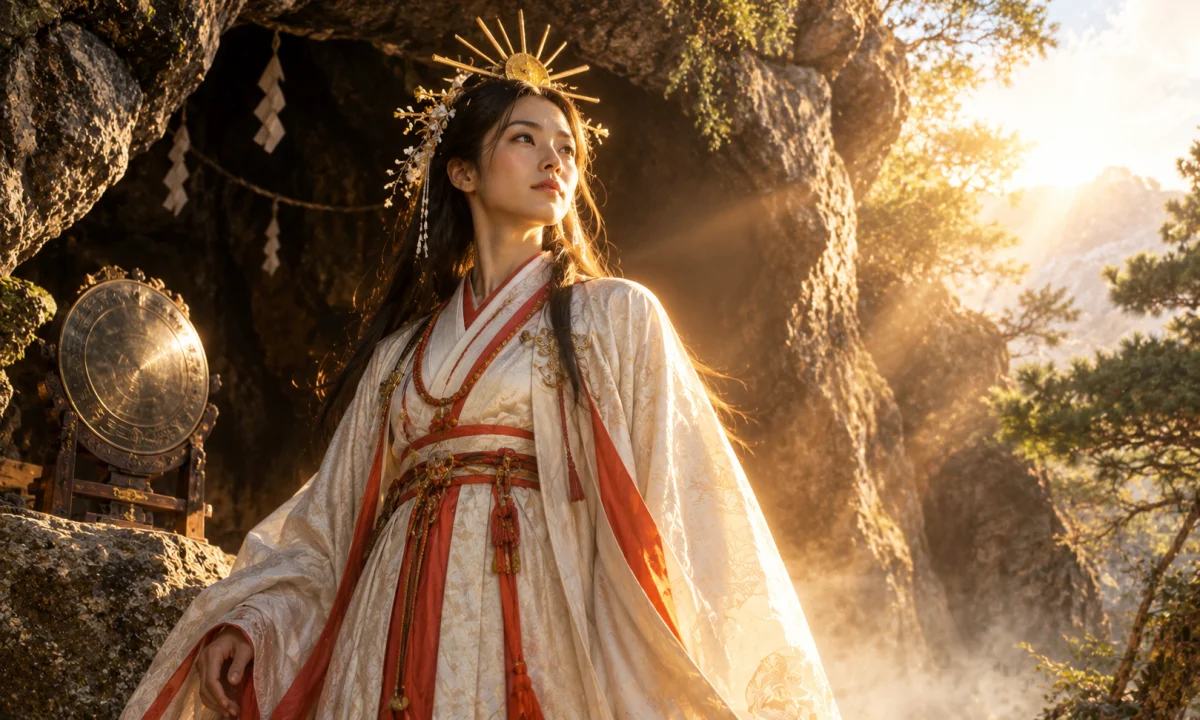
Hiruko is a mysterious figure in early Japanese mythology, best known as the first child of the creator deities Izanagi and Izanami. In the creation narratives preserved in the Kojiki and Nihon shoki, Hiruko is described as a malformed or incomplete child who cannot stand and is placed in a reed boat and set adrift. Later religious and popular traditions sometimes identify Hiruko with Ebisu, the beloved deity of fishermen, merchants and prosperous households, but this association developed over time and should not be assumed to be part of the earliest myth.
Hiruko in the Japanese creation myths
The oldest surviving written accounts of Hiruko appear in Japan’s early court chronicles. The Kojiki, completed in 712, and the Nihon shoki, completed in 720, present related but not identical versions of the creation of the Japanese islands and the divine world. Both works draw on older oral traditions and ritual narratives, and neither is a single, perfectly unified account of Japanese mythology.
In these stories, Izanagi and Izanami are divine partners who receive the task of creating the lands of Japan. They stand on the Heavenly Floating Bridge and circle around a heavenly pillar before joining as husband and wife. Their first union does not proceed correctly according to the ritual order described in the myth. In the most familiar version, Izanami speaks first when the couple meets, although the proper order requires Izanagi to speak first.
Their first child is Hiruko. The child is described as being unable to stand, and in the Kojiki is placed in a reed boat and abandoned to the sea. The narrative then explains that the couple consults the gods, learns that the ritual order was incorrect, and repeats the marriage ceremony. After this correction, they produce the islands of Japan and continue the work of generating further gods.
The Nihon shoki also includes Hiruko in its main creation account, while presenting several alternative versions of the origin story. These variants differ in details concerning the first children, the ritual error and the sequence of events. Such differences are important: they show that the early Japanese mythological tradition contained multiple narratives rather than one universally fixed version.
The meaning of Hiruko’s name
The name Hiruko is commonly connected with the Japanese word hiru, meaning “leech,” together with ko, meaning “child” or “offspring.” On that reading, Hiruko can be understood as “Leech Child.” The name suits the description of a weak or incomplete child who cannot stand, although the exact history and implications of the name are not entirely certain.
The early texts do not provide a long explanation of Hiruko’s physical form. They do not describe a recognizable face, clothing, weapons or supernatural abilities. The most important features are the child’s abnormal condition, inability to stand and subsequent removal by boat. Interpretations that give Hiruko a detailed appearance or a defined set of powers usually come from later religious tradition, artistic imagination or modern fiction rather than from the creation myths themselves.
Some modern discussions propose alternative interpretations of the name or connect it with ideas such as the sun, but these suggestions are not equally well supported. The most straightforward reading of the early textual evidence is the association with a leech-like child. The uncertainty should be retained rather than treating one speculative etymology as established fact.
What happens to Hiruko?
The earliest narratives leave Hiruko’s fate unresolved. Izanagi and Izanami place the child in a reed boat and allow the current to carry the boat away. The text does not clearly say that Hiruko dies, returns to the divine realm or becomes another deity. This open ending has allowed later traditions to develop different explanations.
The reed boat is significant within the story because it removes Hiruko from the household and from the sequence of successful divine births. The child is not simply healed or raised by the parents. Instead, Hiruko becomes a figure associated with the boundary between home and wilderness, land and sea, birth and exclusion. The myth does not present this event as a heroic voyage, and it does not describe an intentional mission. Any interpretation of Hiruko as a wandering saviour or sea adventurer belongs to later elaboration.
In the creation narrative, Hiruko’s removal is followed by a correction of the parents’ marriage ritual. Once Izanagi and Izanami perform the ceremony in the prescribed order, their later offspring include the Japanese islands and numerous deities. Hiruko therefore occupies a place at the troubled beginning of creation, before the divine family and the geography of Japan take their expected form.
Hiruko and the ritual order of marriage
One major function of the story is to emphasize the importance of ritual and social order. The first union of Izanagi and Izanami is not portrayed as successful because Izanami speaks first. The resulting child is Hiruko, whose condition is described as defective or incomplete. After the couple consults the gods and corrects the procedure, creation proceeds successfully.
This pattern reflects concerns found in many mythological traditions, where the correct performance of a rite affects fertility, legitimacy and the stability of the world. The story should not be treated as a simple statement about the value of one gender over another. It is a mythic account shaped by the ritual and social assumptions of the early court society that preserved it, and it contains tensions that later readers have interpreted in different ways.
Hiruko’s birth may also be read as a narrative explanation for the failure of an initial creation attempt. Rather than beginning with a perfect divine world, the myth begins with uncertainty, error and rejection. The first child does not fit the expected pattern of divine generation, and the creation process must be repeated. This makes Hiruko a liminal figure: he stands at the edge of several categories without being fully integrated into the divine genealogy that follows.
Hiruko and Awashima
The early creation accounts also mention Awashima, usually translated as “Foam Island” or “Island of Foam,” although the interpretation of the name and passage varies. Awashima is not counted among the proper children of Izanagi and Izanami. In the Kojiki, Hiruko and Awashima appear near the beginning of the creation sequence, but they are not identical figures.
This distinction matters because later summaries sometimes compress the opening events or describe both as unsuccessful first offspring. Hiruko is a child or deity associated with a leech-like, unsteady body; Awashima is an island. The two belong to the same problematic phase of the creation story, but the early texts do not make them the same being.
Hiruko as a god or mythic child
Calling Hiruko a “god” is reasonable in the broad sense used for many figures in Japanese mythology, but the early narratives do not treat Hiruko like a major ruling deity. Hiruko has no independent domain, shrine network or cycle of adventures in the oldest accounts. The figure appears primarily as an offspring in the creation story.
Unlike Amaterasu, Susanoo or Tsukuyomi, Hiruko does not receive a developed biography in the Kojiki or the main creation narrative of the Nihon shoki. There is no early account of Hiruko controlling the sea, bringing prosperity or fighting enemies. Such qualities are associated with Hiruko in later worship because of the developing relationship between Hiruko and Ebisu, not because they are clearly stated in the original birth myth.
The child’s connection with water is nevertheless central. Hiruko is sent away by sea in a boat, and later worship traditions often preserve an image of a deity arriving from the sea or emerging from an unknown maritime distance. This helped make Hiruko a suitable figure for coastal communities, although the precise path from the mythic child to later local worship is not documented in one simple, continuous story.
Hiruko and Ebisu
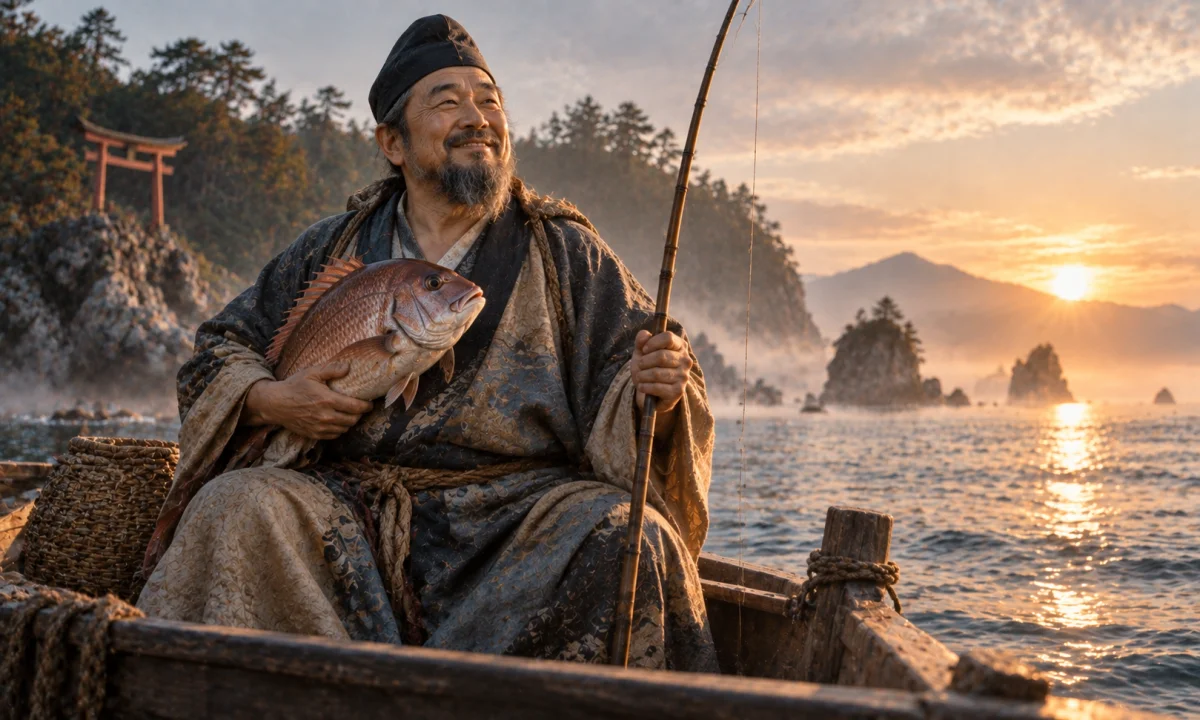
The most important later development is the identification of Hiruko with Ebisu. Ebisu is one of Japan’s Seven Lucky Gods and is widely associated with fishing, maritime livelihood, commercial success, food and good fortune. In familiar images, Ebisu is a cheerful fisherman carrying a sea bream and holding a fishing rod. This prosperous, smiling figure is very different from the helpless child described in the early creation myth.
The connection between Hiruko and Ebisu became especially prominent in medieval and early modern religious culture. One explanation holds that Hiruko, set adrift as an infant, survived and eventually returned as a powerful sea deity. In this interpretation, an abandoned child becomes a protective god whose arrival from the sea brings blessing. Stories of this kind help explain why some shrines and communities regarded Hiruko as a deity of fishing, trade and prosperity.
However, Hiruko and Ebisu were not always understood as the same deity. The name Ebisu has been applied to more than one divine figure, and different shrine traditions have connected Ebisu with different mythological identities. In some contexts Ebisu is identified with Kotoshironushi, a son of Ōkuninushi, rather than with Hiruko. Regional practice, shrine history and changing patterns of worship all influenced these identifications.
The Hiruko-Ebisu relationship is therefore best described as a later religious association or syncretic identification, not as an unquestioned fact of the earliest mythology. A shrine dedicated to Ebisu may use Hiruko as its central identity, while another may understand Ebisu through Kotoshironushi or through a broader, less genealogical tradition. The two figures overlap in some religious settings but should not automatically be merged.
Religious and cultural significance
Hiruko’s story has several layers of meaning. At the most basic level, it explains a failed beginning in the creation of the world. The child born from an improperly completed ritual is separated from the parents, after which the divine couple corrects its action and produces the lands and gods in proper sequence.
At a symbolic level, Hiruko represents an unsettling form of birth: an offspring that exists but does not fit the expected structure of family, body or divine succession. The myth does not resolve the discomfort through a transformation within the narrative itself. Hiruko is removed, and the later world is built without the child being counted among its central divine generations.
Later worship gave this rejected and sea-borne figure a more positive role. Hiruko could be approached as a protector of fishermen and coastal communities, a source of prosperity, or a deity whose difficult beginning made him capable of receiving the prayers of people living with uncertainty. This does not erase the older story; it shows how religious traditions can reinterpret a troubling mythic figure through local devotion.
The tradition also illustrates the importance of the sea in Japanese religious imagination. The sea was a source of food, travel and wealth, but also a dangerous border associated with storms, disappearance and the unknown. A deity who arrives from or is carried across the sea can be understood as both foreign and protective, bringing gifts from beyond the settled community.
Appearance and attributes
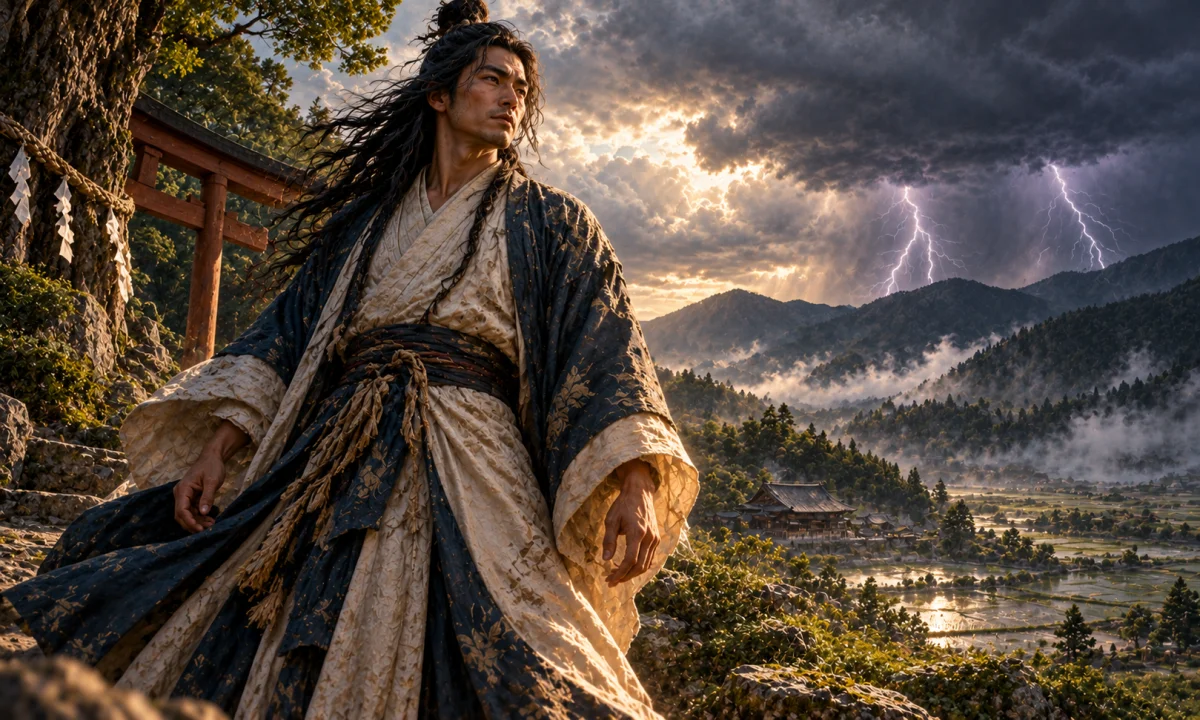
Hiruko has no single traditional appearance. In the early texts, the figure is an infant or young child who cannot stand. Beyond that, the descriptions are brief. A leech-like form may be inferred from the name, but the texts do not clearly state that Hiruko literally has the body of a leech.
When Hiruko is identified with Ebisu, artists and worshippers may portray the figure in Ebisu’s familiar form: a smiling man in traditional clothing, carrying a fishing rod and a sea bream. That image belongs primarily to the later Ebisu tradition. It should not be projected backward as the original appearance of the child in the Kojiki or Nihon shoki.
Similarly, claims that Hiruko possesses a fixed set of magical powers, commands sea creatures or controls storms are not securely grounded in the earliest accounts. Such abilities may appear in local legends, religious interpretations or modern fictional works, but they should be identified as later developments rather than universal attributes.
Hiruko in modern culture
Hiruko appears occasionally in modern manga, anime, novels, games and other fantasy media inspired by Japanese mythology. Modern creators may portray Hiruko as a sea spirit, a cursed child, a powerful deity or a character linked to Ebisu. These portrayals often expand the sparse traditional material and create personal histories, rivalries and powers that are not found in the early chronicles.
Modern adaptations can make Hiruko more recognizable, but they should be distinguished from religious tradition. The historically attested core is relatively limited: Hiruko is the first child of Izanagi and Izanami in early creation narratives, is unable to stand, is placed in a reed boat and is set adrift. The later identification with Ebisu is culturally important, yet it developed through subsequent worship and interpretation rather than appearing as a complete identity in the earliest surviving myth.