WORLD
WORLD
Oyamatsumi
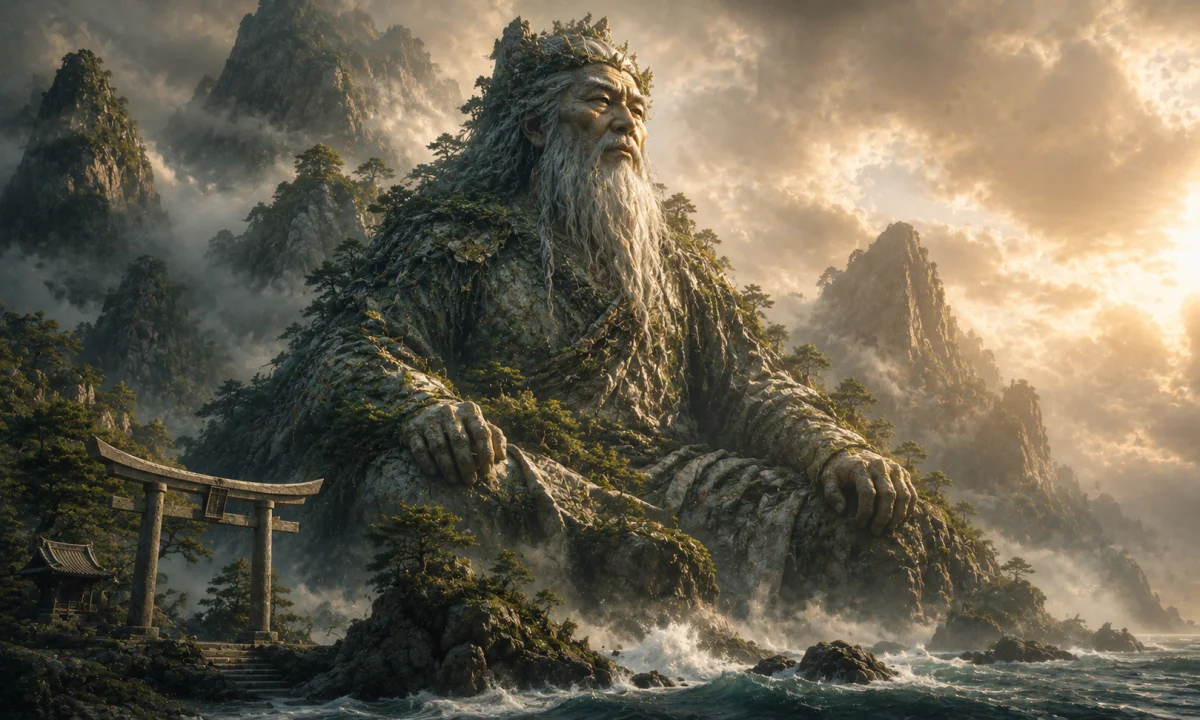
Oyamatsumi, also written Ōyamatsumi or Ōyamatsumi-no-kami, is a kami of mountains in Japanese mythology. He appears most prominently in the Kojiki and in related accounts preserved by the Nihon Shoki, where he belongs to the generation of deities associated with the formation of the Japanese land. Oyamatsumi is especially important as the father of the sisters Konohanasakuya-hime and Iwanaga-hime, whose marriage story explains, in mythic terms, why human life is beautiful but short rather than as enduring as stone.
Origins in Japanese myth
Oyamatsumi belongs to the ancient Japanese tradition of kami, a broad category that includes divine beings, ancestral powers, spirits of natural features and sacred presences. Calling him a “mountain god” is useful in English, but it can make his role seem narrower than it is. In early Japanese religious thought, mountains were not merely geographical formations. They were sources of water, forests, game, minerals and protective boundaries, as well as places where the human and divine worlds could meet.
The best-known account of Oyamatsumi’s origin occurs in the Kojiki, compiled in the early eighth century. The text describes the procreative work of Izanagi and Izanami, the divine pair associated with the creation of the islands and many natural features. After giving birth to parts of the world, they produce deities connected with mountains and the landscape. Oyamatsumi emerges from this sequence as a great personification of mountainous nature.
The Nihon Shoki, another early historical and mythological compilation, preserves several creation traditions rather than a single uniform narrative. Its accounts do not always arrange the deities in precisely the same way as the Kojiki. Some versions place Oyamatsumi among the beings produced when the creator deities bring forth the mountains, while other details of his genealogy and associations vary. These differences are characteristic of early Japanese mythology, which preserved regional and priestly traditions instead of reducing them to one standardized system.
Name and identity
The name is commonly written 大山津見神. The first element, ō, means “great,” and yama means “mountain.” The final element, usually represented in English as tsumi or tsu-mi, has been interpreted in different ways. It may suggest a mountain’s presence, substance or lordship, but its exact historical meaning is uncertain. The name should not automatically be translated as “Great Mountain Lord” as though that were a confirmed literal rendering.
English-language works use several spellings, including Oyamatsumi, Ōyamatsumi, Ooyamatsumi and Oyamazumi. The variation reflects different systems for representing long vowels and Japanese pronunciation. Ōyamatsumi-no-kami is a more formal romanization of the divine name, while Oyamatsumi is convenient in general writing.
Oyamatsumi should also be distinguished from the many local yama no kami, or mountain kami, worshipped throughout Japan. Mountain deities in local religious traditions may be unnamed, have different names or be connected with agriculture, hunting, forestry and seasonal movements. Oyamatsumi is a major mythological figure whose name appears in classical texts, but he is not simply another name for every mountain spirit in Japanese folklore.
Nature and attributes
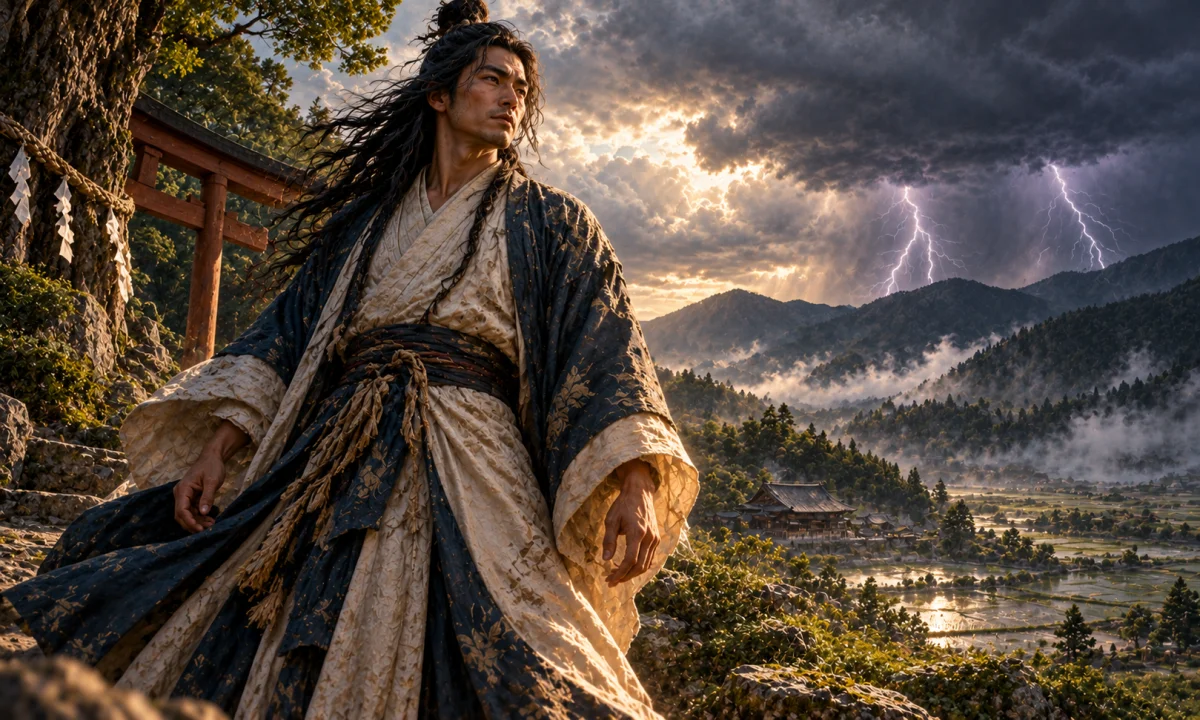
Unlike some later artistic depictions of Japanese deities, the early literary sources do not provide a detailed physical portrait of Oyamatsumi. He is not consistently described with a particular costume, weapon, animal companion or distinctive bodily form. His character is conveyed primarily through his position in the divine genealogy and through the actions of his daughters.
His central attribute is the mountain itself: massive, enduring, elevated and rooted in the earth. Mountains can be both life-giving and dangerous. They gather rain and feed rivers, shelter forests and provide materials, but they also mark remote territory and expose people to landslides, storms, cold and difficult travel. A mountain kami therefore represents more than scenic beauty. Oyamatsumi can be understood as a personification of the power and resources of the mountainous landscape.
The meaning of his name and his role as a father also connect him with permanence, fertility and continuity. His daughter Iwanaga-hime is associated with rock and enduring stability, while Konohanasakuya-hime is associated with blossoms, especially the brief and radiant flowering of the tree known as sakura in modern Japanese. Through them, Oyamatsumi’s family becomes central to a contrast between lasting existence and transient beauty.
Oyamatsumi and Ninigi
Oyamatsumi’s most important mythological episode concerns his daughters and Ninigi-no-Mikoto. Ninigi is the grandson of Amaterasu and the deity whom she sends down from the heavenly realm to rule on earth. In the imperial genealogy presented by the early chronicles, Ninigi is an ancestor of the Japanese imperial line through his son Hoori.
According to the Kojiki, Oyamatsumi offers his two daughters to Ninigi. The elder is Iwanaga-hime, whose name combines iwa, “rock” or “stone,” with a term suggesting enduring strength. The younger is Konohanasakuya-hime, often translated as “Princess Blossoming Like the Flowers of the Trees.” Ninigi is struck by Konohanasakuya-hime’s beauty and accepts her, but he rejects Iwanaga-hime and sends her back to her father.
Oyamatsumi is distressed by this refusal. He explains that he offered both daughters for a reason. Through Iwanaga-hime, Ninigi and his descendants would have possessed the permanence of rock. Through Konohanasakuya-hime, they would have enjoyed a life that flourished like blossoms. Because Ninigi accepted only the beautiful but temporary daughter, his descendants would be splendid yet mortal, subject to a human lifespan rather than possessing unchanging divine longevity.
This episode is an etiological myth: it explains a condition of the world by means of a story about divine relationships. It does not function as a biological account of mortality. Its imagery contrasts the durability of stone with the short-lived brilliance of flowers. The story also reflects a recurring theme in Japanese literature and religion: mono no aware, the poignant awareness that beautiful things are impermanent. The phrase belongs especially to later Japanese aesthetic and literary interpretation, so it should not be treated as a direct label used by the Kojiki itself, but the emotional pattern is highly compatible with the myth.
The story also gives Oyamatsumi a role beyond that of a natural force. He is a father and a negotiator whose proposed marriage contains a cosmic arrangement. His daughters are not interchangeable brides. Each embodies a different principle, and the rejection of Iwanaga-hime disrupts the balance that Oyamatsumi intended.
The two daughters
Iwanaga-hime
Iwanaga-hime represents rock, endurance and continuity. Her name is sometimes rendered as “Princess Rock-Longevity” or “Princess of the Eternal Rock,” although translations differ because the name is interpreted in more than one way. Her brief appearance in the myth has major consequences: her rejection helps explain why Ninigi’s descendants, including human rulers, do not live forever.
In later religious and literary traditions, Iwanaga-hime has sometimes been treated as a figure of stability, long life or unfulfilled dignity. These associations are developments of the myth rather than a fully described personal cult in the earliest surviving text. The classical narrative gives her symbolic importance without presenting an extensive biography.
Konohanasakuya-hime
Konohanasakuya-hime is one of the best-known female kami in Japanese tradition. Her name evokes flowers blooming on trees, and she is commonly associated with cherry blossoms in later interpretation. In the early myth, however, the important contrast is between blossoming beauty and permanence; the text does not reduce her to a simple goddess of cherry trees.
She is also involved in a difficult birth story. After Ninigi doubts her fidelity because she becomes pregnant soon after their union, she enters a sealed hut and declares that the birth will prove her innocence. If the children are truly Ninigi’s, she says, they will be born safely despite the fire. She gives birth to three sons, including Hoori, the grandfather of the first legendary emperor in the traditional genealogy. The episode reinforces her association with fire, childbirth, proof and extraordinary vitality.
Because Konohanasakuya-hime is Oyamatsumi’s daughter, the mountain kami is connected indirectly with the imperial origin narratives. That connection should be understood as part of the political and sacred genealogies of the early chronicles, not as historical evidence that a human imperial line literally descended from a mountain deity.
Religious and cultural setting
Mountains have held a powerful place in Japanese religious life. They may be regarded as homes or dwelling places of kami, sources of streams and agricultural fertility, burial landscapes, and routes into sacred wilderness. Practices later associated with Shugendō developed around mountain asceticism, pilgrimage and ritual training, although Oyamatsumi should not be identified exclusively with that later movement.
In local Shinto practice, mountain deities have often been approached for protection, good harvests, rainfall, safe travel, forestry and the well-being of communities. The particular functions vary by region and shrine. Oyamatsumi’s classical status as a great mountain kami allowed later communities to connect him with these broader concerns, but not every local practice involving a mountain kami should be attributed specifically to him.
One prominent centre associated with his worship is Ōyamazumi Shrine on the island of Ōmishima in present-day Ehime Prefecture. The shrine venerates Oyamatsumi and has long been an important religious institution in the Inland Sea region. Its historical reputation is strongly connected with warrior devotion and the dedication of arms and armour. This does not mean that Oyamatsumi began as a war god in the early myths. Rather, a powerful mountain kami could acquire additional roles as communities, military families and regional institutions sought his protection.
The shrine’s associations illustrate how Japanese kami traditions developed over time. A deity known from ancient mythology could be worshipped in settings shaped by local geography, pilgrimage, political authority and the needs of later devotees. Mythological identity and lived religious practice overlap, but they are not identical.
Interpretation of the mountain kami
Oyamatsumi can be interpreted on several levels. At the most immediate level, he is the divine personification of mountains. At the genealogical level, he is a father whose daughters embody contrasting forms of existence. At the level of political mythology, his family becomes linked to Ninigi and the ancestral line of the imperial house. At the level of religious history, his name became available for local worship and regional forms of devotion.
The marriage story has sometimes been read as an explanation for the Japanese preference for beauty, renewal and seasonal awareness over abstract permanence. Such readings can be illuminating, but they are interpretations rather than statements made explicitly by the ancient compilers. The Kojiki presents the narrative as an explanation of mortality and descent from the divine realm; later readers have drawn wider aesthetic and philosophical meanings from it.
The contrast between rock and flowers should also not be mistaken for a simple opposition between good and bad. Iwanaga-hime is not portrayed as morally inferior because she is rejected, and Konohanasakuya-hime is not merely a decorative beauty. The story gives both sisters a necessary symbolic force. The tragedy arises because Ninigi chooses one principle while refusing the other.
Variants and limits of the evidence
The surviving early sources do not offer a complete, consistent biography of Oyamatsumi. His genealogy, the order in which mountain deities are produced and details of related episodes differ between textual traditions. Later shrine records and local beliefs add further associations, but these should not automatically be projected backward into the oldest myths.
It is therefore safest to describe Oyamatsumi as a major mountain kami in the classical mythology of Japan, rather than assigning him a rigid list of universally recognized powers. His most secure literary roles are his connection with the mountains, his place among the deities generated in the creation narratives, and his fatherhood of Iwanaga-hime and Konohanasakuya-hime.
Modern portrayals may turn Oyamatsumi into a warrior, a giant, an elemental lord or a fantasy character with powers defined by a particular game, manga, novel or film. Such images can draw on his name while departing substantially from the ancient sources. Traditional Oyamatsumi is not defined by a single standardized appearance or by a fixed catalogue of supernatural abilities. His importance lies in the sacred presence of mountains and in the mythic family whose story links permanence, beauty and human mortality.