WORLD
WORLD
Konohanasakuya-hime
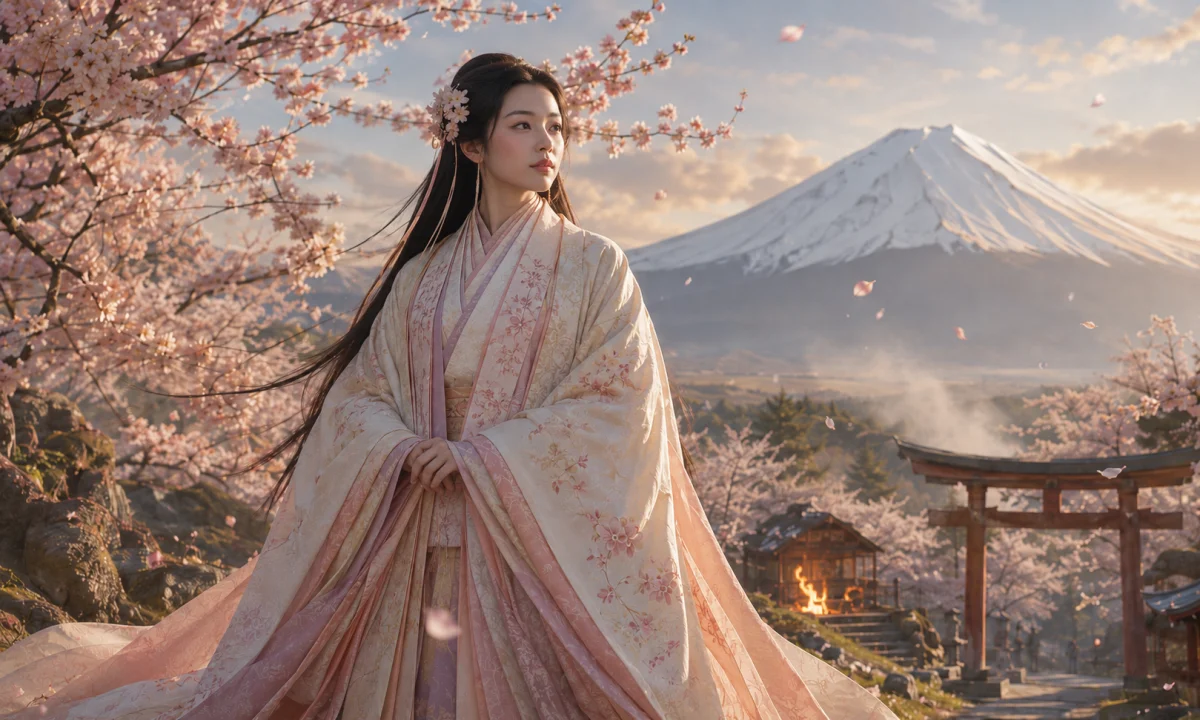
Konohanasakuya-hime is a prominent kami in Japanese mythology, best known as the beautiful daughter of the mountain deity Ōyamatsumi and the wife of Ninigi-no-Mikoto, the heavenly descendant sent to rule the Japanese islands. Her name is associated with flowering trees, especially cherry blossoms in later interpretation, while her most important myth concerns pregnancy, suspicion, and a childbirth ordeal inside a burning building. She is also widely venerated in Shinto as a deity connected with Mount Fuji, volcanoes, fertility, childbirth, and protection from fire.
Name and identity
The name Konohanasakuya-hime is written in several ways, including 木花之佐久夜毘売 in the Kojiki and forms such as 木花開耶姫 in later religious and literary usage. The elements of the name are commonly understood as referring to the blooming of trees. Hime means a princess or noble woman, and the full name can be translated approximately as “Princess of the Blossoming Trees” or “Princess who makes the trees bloom.” English spellings vary, including Konohanasakuya-hime, Konohanasakuya-hime-no-Mikoto, and Konohanasakuya-hime-no-Mikoto.
The name does not, in its oldest forms, unambiguously identify one particular species of tree. In modern Japanese religious and cultural contexts, she is strongly associated with cherry blossoms, but the broader image is that of flowering vegetation and the beauty of natural renewal. Her name therefore carries both a literal botanical association and a symbolic one: life appears suddenly in splendour, but blossoms are delicate and short-lived.
Konohanasakuya-hime is usually called a kami rather than a goddess in the strict sense. “Goddess” is a useful translation in some contexts, but kami is a broader Japanese category that includes divine beings, powerful spirits, natural forces, ancestors, and sacred presences. Her identity is shaped by mythology, shrine worship, local traditions, and later interpretation rather than by a single uniform theological system.
Origins in early Japanese mythology
The earliest extended account of Konohanasakuya-hime appears in the Kojiki, compiled in 712. A related account appears in the Nihon Shoki, completed in 720. These works preserve myths concerning the origins of the imperial line, the formation of the land, and the relationships between heavenly and earthly kami. They were compiled in early imperial Japan and should not be treated as neutral records of a single, unchanged popular religion. They contain regional traditions, court perspectives, variant narratives, and attempts to organize diverse myths into a larger sacred history.
In the Kojiki, Konohanasakuya-hime is the daughter of Ōyamatsumi-no-Kami, a major mountain deity. Her sister is Iwanaga-hime, whose name means something like “Princess of the Rock.” The contrast between the sisters is central to the myth. Konohanasakuya-hime represents flowering beauty and the brief splendour of living things, while Iwanaga-hime is connected by name with rock, endurance, and permanence.
Konohanasakuya-hime meets Ninigi-no-Mikoto after he descends from the heavenly realm. Ninigi is the grandson of Amaterasu through the lineage of her son Ame-no-Oshihomimi. In the imperial origin narratives, he is sent to govern the land, and his descendants eventually include the first emperor of Japan. The marriage of Ninigi and Konohanasakuya-hime therefore links a heavenly lineage with mountain and earthly powers.
The marriage of Ninigi and the two sisters
According to the Kojiki, Ninigi encounters Konohanasakuya-hime and asks her father for permission to marry her. Ōyamatsumi is pleased and offers not only Konohanasakuya-hime but also her elder sister Iwanaga-hime. Ninigi accepts the younger sister but rejects Iwanaga-hime because he finds her unattractive.
Ōyamatsumi then explains the meaning of the two daughters. If Ninigi had accepted both, his descendants would have enjoyed a condition associated with the durability of rock as well as the beauty of blossoms. Because he accepted only Konohanasakuya-hime, his descendants would be brilliant and beautiful like flowers but mortal and short-lived. This explanation connects the sisters symbolically with two different forms of existence: permanence and transience.
The episode is not simply a romantic tale about beauty. It offers a mythic explanation for why the imperial descendants, despite their divine ancestry, are subject to mortality. It also reflects a recurring pattern in mythology in which a marriage carries consequences for the nature of an entire people or dynasty. Iwanaga-hime’s rejection is treated as a decisive event in the condition of human life.
The story can also be read as a contrast between social and natural values. Ninigi chooses visible beauty, while the rejected sister embodies a less attractive but more enduring quality. The myth does not present this choice as without consequence. The splendour of blossoms is inseparable from their impermanence, an idea that later became especially influential in Japanese aesthetic thought, although the early myth itself is not identical to the later literary concept of mono no aware.
Pregnancy, doubt, and the fire ordeal
Konohanasakuya-hime becomes pregnant soon after her marriage to Ninigi. Because the pregnancy begins so quickly, Ninigi doubts whether the child is truly his. In the Kojiki, he suggests that the pregnancy might have been caused by an earthly male rather than by him. This accusation threatens Konohanasakuya-hime’s honour and the legitimacy of her unborn children.
She responds by declaring that the outcome will prove the children’s parentage. She enters a palace or hut that has no ordinary exit and sets it on fire. If the children are Ninigi’s offspring, she says, they will be born safely despite the flames. She then gives birth within the burning structure.
The Kojiki names three sons: Hoderi-no-Mikoto, Hosuseri-no-Mikoto, and Hoori-no-Mikoto. The exact order, names, and details differ among versions of the story preserved in the Nihon Shoki. Some variants include different names or emphasize different aspects of the birth. Hoori, also known as Yamasachi-hiko, later becomes the father of Ugayafukiaezu, whose son is said to be Kamu-Yamato-Iware-hiko, the legendary first emperor Jimmu.
The fire ordeal has several meanings. It is a test of legitimacy, but it also demonstrates Konohanasakuya-hime’s extraordinary power and resolve. She does not wait for Ninigi to settle the question through ordinary judgment. Instead, she creates a divine ordeal in which fire becomes both danger and witness. Her safe delivery establishes the divine status of the children and presents her as a mother capable of enduring a supernatural trial.
Fire is not merely destructive in this episode. It reveals truth, marks a passage, and accompanies birth. This association helps explain why later worship has connected Konohanasakuya-hime with protection against fire, although the early myth does not provide a complete doctrine of fire prevention or a detailed account of shrine practice.
Family and mythological relationships
- Ōyamatsumi-no-Kami: Her father, a major mountain kami whose name is commonly translated as Great Mountain Deity or Great Deity of Mountains.
- Iwanaga-hime: Her elder sister, associated by name with rock and enduring existence. Her rejection by Ninigi is central to the explanation of human mortality.
- Ninigi-no-Mikoto: Her husband and a descendant of Amaterasu in the imperial origin tradition.
- Hoderi-no-Mikoto: One of her sons, later known in the tale of the sea and the lost fishhook as the elder brother of Hoori.
- Hosuseri-no-Mikoto: Another son named in the Kojiki, though his role is less developed in many later retellings.
- Hoori-no-Mikoto: Her son who becomes the father of Ugayafukiaezu and an ancestor of the imperial line in the mythology of the Kojiki and Nihon Shoki.
The relationship between Konohanasakuya-hime and Iwanaga-hime is particularly important. They should not be merged into a single nature goddess or treated as interchangeable versions of one figure. Their names and roles create a deliberate contrast between flowers and rock. In some retellings, this contrast is simplified into “beauty versus ugliness,” but the myth’s wider significance concerns fleeting life and enduring permanence.
Attributes and symbolism
Konohanasakuya-hime is conventionally represented as a beautiful young woman, reflecting the meaning and imagery of her name. Traditional myth does not provide a single authoritative physical description, and artistic depictions vary according to period, shrine, and religious setting. Her visual association with cherry blossoms is especially strong in later art and popular religious imagery.
Blossoms represent beauty, renewal, fertility, and the limited duration of life. Cherry blossoms in particular have become a powerful symbol of transience in Japanese culture, but the identification of Konohanasakuya-hime with cherry trees is a development of religious and cultural tradition rather than a complete description supplied by the earliest myths.
Mountains are part of her inherited identity through her father Ōyamatsumi. She is not simply a personification of flowers detached from the landscape. Her traditions bring together mountain worship, vegetation, fertility, volcanic danger, and the sacred authority of the imperial genealogy.
Fire is the defining element of her birth story. The burning palace demonstrates her courage and divine power, and it has contributed to her reputation as a protector against fire. The connection between fire and volcanic mountains also makes her especially suitable for worship in regions exposed to eruptions and other mountain hazards.
Childbirth and fertility are central to her religious significance. Her own pregnancy is threatened by suspicion, yet she gives birth safely under extreme conditions. As a result, she may be invoked in traditions concerned with safe childbirth, healthy children, marriage, and the flourishing of families. The exact prayers and practices vary by shrine and locality.
Konohanasakuya-hime and Mount Fuji
Konohanasakuya-hime is widely associated with Mount Fuji and is the principal kami of important Fuji-related shrines, including Fujisan Hongū Sengen Taisha. Shrines dedicated to Asama or Sengen worship often place her at the centre of religious traditions concerning the mountain. These institutions have played a major role in shaping her modern religious identity.
The association with Mount Fuji is culturally powerful, but Mount Fuji is not explicitly the setting of the early Kojiki account of her marriage and the fire birth. The oldest myth presents her as the daughter of a mountain deity and as a woman connected with blossoms and fire; it does not clearly say that she is the spirit of Mount Fuji. The Fuji connection belongs to later religious development, regional worship, and the identification of particular mountain shrines with her.
Asama and Sengen traditions developed in relation to the dangers and sacred power of volcanic mountains. Worshippers sought protection from eruptions and other disasters, while the mountain itself was approached as a divine presence. In this setting, Konohanasakuya-hime’s beauty, mountain ancestry, fiery ordeal, and fertility symbolism could be brought together in a coherent form. This does not mean that every local tradition understands her in exactly the same way.
Some modern explanations describe her as a volcano goddess or as the direct personification of Mount Fuji. Such descriptions can be useful summaries of contemporary shrine devotion, but they should not be presented as the only meaning of the figure or as a literal statement found in the earliest texts. Her identity is better understood as layered: early mythic princess, daughter of a mountain kami, mother in the imperial genealogy, and later guardian associated with Fuji and volcanic protection.
Religious and cultural significance
Konohanasakuya-hime occupies an unusual position because her myth combines vulnerability with authority. She is accused by her husband, yet she answers the accusation through an ordeal that no ordinary human could survive. She is associated with the fragility of blossoms, yet she is also the mother of a powerful lineage. Her story therefore resists a simple interpretation as either a passive bride or a gentle flower spirit.
Her myth has also been used to reflect on the impermanence of life. The rejection of Iwanaga-hime explains why descendants of the heavenly line do not possess the everlasting durability of stone. Konohanasakuya-hime’s beauty is inseparable from change and mortality. In religious practice, this symbolism may coexist with prayers for fertility, safe birth, protection, and continued prosperity.
The story contains difficult themes, including suspicion of a pregnant wife and the demand that a woman prove sexual fidelity through a life-threatening test. Modern readers may view the episode critically rather than treating it as a straightforward moral model. The narrative can be interpreted as an assertion of Konohanasakuya-hime’s agency, but it also reflects patriarchal concerns about legitimacy and descent in the society that preserved and organized these myths.
Later reception and modern representations
Konohanasakuya-hime remains an important figure in Shinto shrine worship, especially in communities connected with Mount Fuji, mountain pilgrimage, childbirth, and protection from fire. Festivals, shrine art, votive objects, and local legends may emphasize different parts of her identity. In some settings, cherry blossoms dominate the imagery; in others, the mountain, volcano, or maternal role is more important.
She also appears in modern Japanese fiction, games, manga, animation, and other popular media. These works may portray her as a magical princess, a nature spirit, a volcano deity, or a combat-oriented supernatural character. Such depictions often borrow her name and a few recognizable symbols while adding powers, personalities, and relationships that belong to the individual fictional work rather than to traditional mythology.
In particular, a modern portrayal of Konohanasakuya-hime as a character with elaborate supernatural abilities should not automatically be treated as evidence for ancient belief. The traditional figure is known primarily through her family relationships, her connection with blossoms and mountains, her marriage to Ninigi, and the dramatic fire birth of her sons. Later religious and popular traditions have expanded those themes in different directions.