WORLD
WORLD
Ninigi-no-mikoto

Ninigi-no-mikoto is a kami of Japanese mythology who is presented as the grandson of Amaterasu Ōmikami and the ancestor of Japan’s imperial line. In the mythic genealogies preserved in the Kojiki and Nihon Shoki, he descends from the Plain of High Heaven to rule the earthly land of Ashihara no Nakatsukuni. His descent, marriage to the blossom goddess Konohanasakuya-hime, and role in the ancestry of the first emperor give him a central place in traditions concerning divine authority, the Japanese landscape and the origins of the imperial house.
Origins in Japanese myth
Ninigi belongs to the generation of kami that connects the heavenly realm with the human world. Japanese creation traditions often describe several overlapping realms rather than a single universe arranged according to one consistent system. The heavenly realm is commonly called Takamagahara, or the Plain of High Heaven. The earthly realm is described in the Kojiki as Ashihara no Nakatsukuni, “the Central Land of Reed Plains.” The sea, mountains and underworld form additional important regions in the mythic geography.
The earliest surviving extended accounts of Ninigi’s story appear in two early Japanese chronicles. The Kojiki, compiled in 712, presents myths, genealogies and narratives associated with the ruling house and the religious traditions of the court. The Nihon Shoki, completed in 720, gives a more chronicle-like account and includes several alternative versions of important myths. These works are not neutral records of prehistoric events. They were produced in a historical setting in which the Yamato court was defining its political legitimacy, ancestry and relationship with regional traditions.
In both works, Ninigi’s descent follows the heavenly kami’s efforts to establish rule over the earthly land. The precise sequence and emphasis vary. In the Kojiki, Amaterasu and the heavenly deities send Ninigi after a series of attempts to bring the earthly realm under heavenly authority. In the Nihon Shoki, different versions attribute a particularly important role to Takamimusubi, a powerful heavenly deity who is closely involved in the decision to dispatch Ninigi. These variations show that early Japanese mythology was preserved through related traditions rather than through one completely fixed narrative.
Name and identity
The name is commonly written in English as Ninigi-no-mikoto. In Japanese, mikoto is an honorific used in the names of many kami and legendary rulers. Ninigi’s full name is considerably longer in the classical texts. The Kojiki, for example, gives a form that can be romanized as Ame-ni-kishi-kuni-ni-kishi-amatsuhiko-hiko-ho-no-ninigi-no-mikoto, although romanization and the division of the name can vary. Shorter forms, including Hikoho-no-ninigi-no-mikoto, also occur in discussion and translation.
The meaning of every element in the long name is not certain. Some parts seem to emphasize his heavenly nature, his status as a male divine being or his relationship to the land. The final element, Ninigi, has been interpreted in different ways, but no single translation is universally accepted. Popular explanations sometimes connect the name with ripening grain or rice, reflecting his agricultural and royal associations, yet such interpretations should be treated as scholarly or traditional readings rather than as an unquestionable literal translation.
Ninigi is classified as a kami, but he is not simply a nature spirit in the narrow modern sense. The word kami encompasses gods, sacred forces, powerful ancestral beings, unusual natural presences and other beings worthy of reverence. Ninigi combines several roles: he is a heavenly descendant, a ruler, a culture-bearing ancestor and a link in the genealogy leading to the imperial sovereign.
The heavenly descent
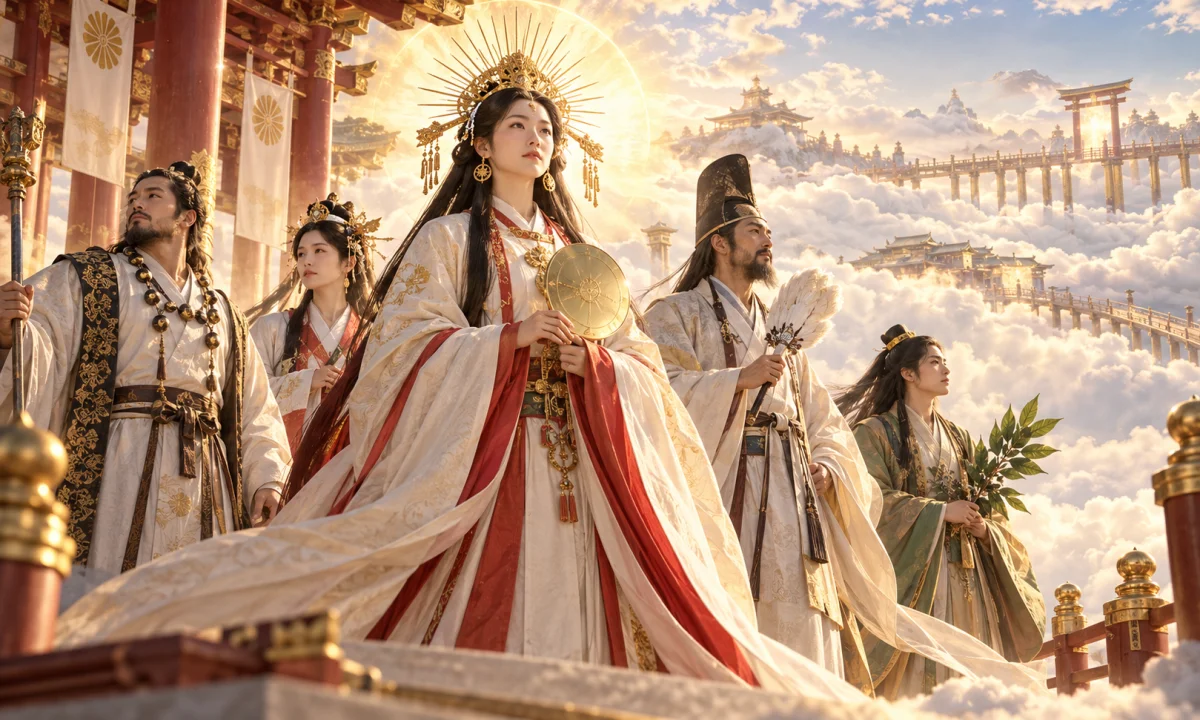
The principal episode associated with Ninigi is his descent from Takamagahara to the earthly realm. The heavenly kami determine that he should govern Ashihara no Nakatsukuni and send him toward the land below. This is often called tenson kōrin, the “descent of the heavenly grandchild.” The expression remains important in Japanese religious and cultural vocabulary, although the details of the story differ between texts and later traditions.
Ninigi is given sacred objects associated with heavenly authority. These include the mirror, jewel and sword that later become known as the Three Sacred Treasures of Japan. In the Kojiki, Amaterasu entrusts the mirror and jewel to Ninigi and commands him to regard the mirror as though it were her own presence. The sword, called Ame-no-Murakumo-no-Tsurugi in parts of the tradition and later widely known as Kusanagi-no-Tsurugi, is also included among the objects accompanying him.
The three treasures are not merely weapons or ornaments. In later interpretation, they represent the authority and continuity of the imperial office. The mirror is associated with Amaterasu and truthful reflection; the jewel can suggest generosity, dignity or sacred abundance; and the sword is linked with courage and martial power. The surviving myths do not present one simple, systematic explanation of the three symbols, so their meanings have been developed through religious interpretation, court ritual and later political thought.
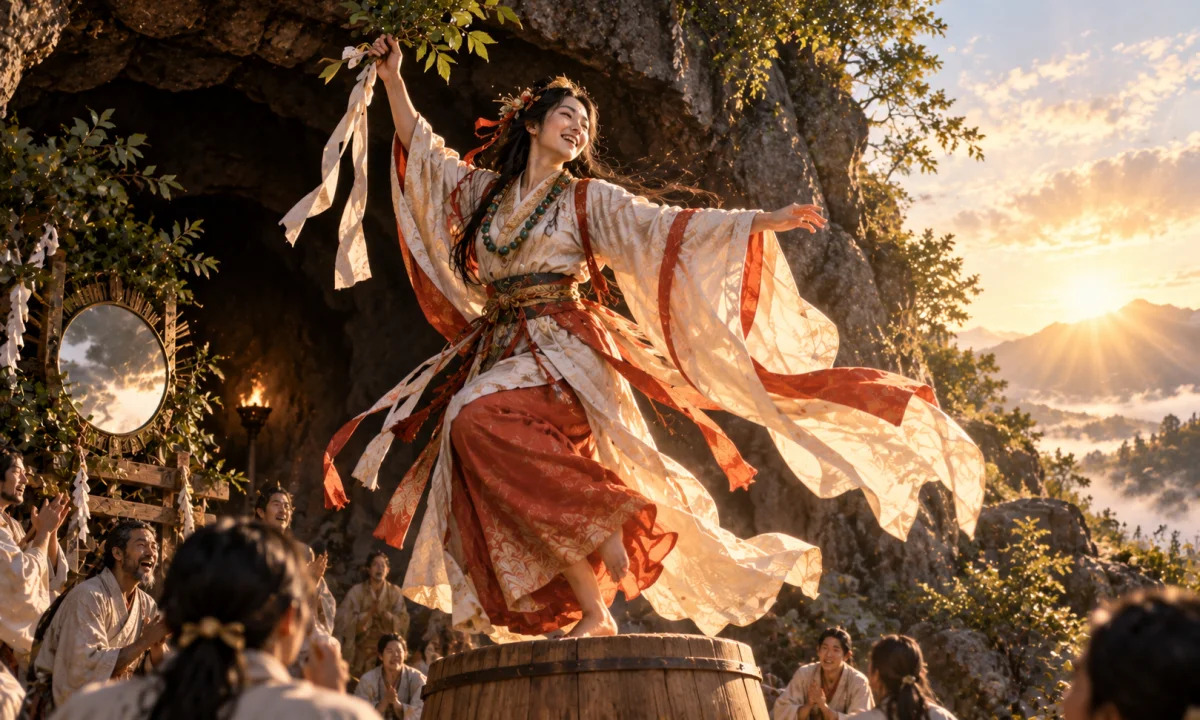
Ninigi’s heavenly mission is accompanied by other divine figures. In the Kojiki, the group includes Ame-no-Koyane, ancestor of the Nakatomi and later Fujiwara ritual lineages; Futodama, associated with ritual performance; Ishikoridome, connected with the making of the sacred mirror; Tamano-oya, associated with the sacred jewel; and Ame-no-Uzume, the goddess whose earlier actions helped draw Amaterasu from her cave. The lists and roles vary in the early sources, and later retellings may simplify the group.
Sarutahiko and the road to earth
During the descent, Ninigi encounters Sarutahiko Ōkami, a powerful earthly kami who stands at the crossroads between heaven and earth. Sarutahiko is described as an imposing figure whose appearance makes him seem capable of blocking the heavenly party’s route. In the Kojiki, he has a brilliant, frightening presence, including a nose of remarkable length and eyes that shine like mirrors or blazing lights, though translations differ in their wording.
Ame-no-Uzume approaches Sarutahiko and asks who he is and why he has come. Her successful negotiation allows Ninigi to continue his journey. Sarutahiko then guides him toward the earthly realm. Afterward, Uzume is associated with Sarutahiko, and the two become connected in later tradition with boundary-crossing, roads and the safe passage between places. Their encounter also explains the name “Sarume,” used in traditions associated with Uzume.
The episode has more than one possible significance. It can be read as a meeting between heavenly and earthly authorities, a mythic explanation for the integration of local sacred powers into a new political order, or a ritual story about crossing thresholds. Sarutahiko is not simply a subordinate servant. His independent power and his role as guide make the descent a negotiated encounter rather than an effortless occupation of the land.
Marriage to Konohanasakuya-hime
After reaching the earthly realm, Ninigi meets Konohanasakuya-hime, also called Kono-hana-saku-ya-hime, the goddess associated with flowering trees, especially the cherry blossom. She is the daughter of Ōyamatsumi, a great mountain kami. Ninigi asks to marry her, but Ōyamatsumi also offers her elder sister, Iwanaga-hime, whose name means “Princess Rock-Longevity” or “Princess of the Eternal Rock,” depending on the translation.
Ninigi accepts Konohanasakuya-hime but rejects Iwanaga-hime because of her appearance. Ōyamatsumi then explains that the two sisters had different symbolic purposes. Iwanaga-hime would have given Ninigi and his descendants endurance as lasting as stone, while Konohanasakuya-hime would have brought a beautiful and flourishing existence like flowers. Because Ninigi rejected Iwanaga-hime, human life became beautiful but short-lived rather than enduring like rock.
This story is one of the best-known mythic explanations for human mortality in Japanese tradition. It contrasts permanence with beauty and stability with seasonal flourishing. Cherry blossoms later became especially powerful symbols of transience, but the connection between this particular myth and all later cherry-blossom symbolism should not be treated as a simple, unchanged continuity. The meaning of blossoms has developed through court culture, poetry, Buddhism, local custom and modern national symbolism as well as through the story of Konohanasakuya-hime.
The marriage also connects Ninigi, a heavenly descendant, with a mountain deity rooted in the earthly landscape. Their union is therefore important genealogically and symbolically. It joins the heavenly line to the mountains, fertility and the local sacred geography of Japan.
The birth of the ancestral line
Konohanasakuya-hime becomes pregnant soon after the marriage. Ninigi doubts that the children are his, suggesting that the pregnancy may have resulted from another man. To prove her fidelity, she enters a doorless or enclosed birthing hut and sets it on fire, declaring that she will survive if the children are truly Ninigi’s. The episode is dramatic and has several textual variations.
She gives birth to sons whose names differ between the Kojiki and Nihon Shoki. They include Hoderi, often called the “Fire-Shine” or “Fire-Glittering” one; Hosuseri, associated with fire or flame; and Hoori, also known as Hikohohodemi. In some versions the naming and order are not identical. Hoori is the most important for the later imperial genealogy, because his son is Ugayafukiaezu, and Ugayafukiaezu becomes the father of Kamu-Yamato-Iware-Hiko-no-mikoto, the figure traditionally identified as Emperor Jimmu.
Through this line, Ninigi is placed several generations before the legendary first emperor. The genealogy should be understood as part of the mythic and political history constructed by the early court chronicles, not as independently verified evidence for a historical Ninigi or for the events of the descent. The chronicles present the genealogy as a foundation for imperial legitimacy, while modern historians distinguish these ideological traditions from what can be established through archaeology and contemporary records.
Relationship to the imperial tradition
Ninigi’s significance is closely tied to the idea that the Japanese imperial line descends from the kami. Amaterasu stands at the highest point of this genealogy, while Ninigi serves as the immediate heavenly ancestor who carries divine authority into the earthly realm. The first emperor’s ancestry therefore joins the imperial house to both the heavenly world and the land of Japan.
From the early court period onward, these traditions supported rituals and political claims associated with the sovereign. In the modern period, especially during the formation of the Japanese nation-state in the nineteenth and early twentieth centuries, imperial descent from Amaterasu and Ninigi was treated in official ideology as a basis for the emperor’s sacred status. The post-1945 constitutional order rejected the emperor’s divine status as a political principle. The myths nevertheless remain important in Shinto history, imperial ceremonies and the study of Japanese religious culture.
The stories do not provide a straightforward description of “Japanese religion” as a single uniform system. Shinto developed through local shrine traditions, court rites, regional cults and interaction with Buddhism and other intellectual traditions. Some shrines venerate Ninigi directly, while others emphasize Amaterasu, Konohanasakuya-hime, Sarutahiko or different local kami. The importance assigned to Ninigi therefore varies by institution and historical context.
Places and regional traditions
The descent is traditionally connected with the region of southern Kyushu, especially ancient Hyūga, corresponding broadly to present-day Miyazaki Prefecture. Takachiho is famous for sites associated with the descent, and the area preserves shrine traditions, sacred caves, mountains and ritual performances linked to the heavenly kami. The precise location intended by the early texts is not certain, however. Several places in Kyushu have claimed connections with Ninigi’s descent, and the identification of the mythic landscape with a specific modern site is a matter of tradition rather than an established historical fact.
Takachiho is also known for Yokagura, a cycle of nighttime Shinto dances performed in the region. Kagura traditions differ from community to community, and not every performance is a direct dramatization of Ninigi’s descent. Many include episodes concerning Amaterasu’s cave, the heavenly kami and other myths from the classical tradition. Such performances demonstrate how myth can remain part of living local culture without being preserved in exactly the form found in the ancient chronicles.
Distinctions from similar figures
Ninigi should not be confused with Hoori, his son. Hoori is the protagonist of the famous sea-crossing story in which he visits the palace of the sea kami Watatsumi and becomes involved in the conflict between himself and his elder brother Hoderi. Hoori is also called Hikohohodemi, a name that can resemble the long names associated with Ninigi in translation.
Nor is Ninigi the same figure as Amaterasu. Amaterasu is his grandmother and the principal heavenly kami who sends him toward the earthly realm. Ninigi receives authority from her, but the texts give them distinct identities and roles. He should also be distinguished from Takamimusubi, another major heavenly deity who participates in the planning of the descent and is presented in some versions as Ninigi’s maternal grandfather.
Finally, Ninigi is not identical with the later legendary emperor Jimmu. Ninigi belongs to the divine ancestry preceding the imperial line’s earthly rulers, while Jimmu is the founding emperor in the traditional chronology. Their relationship is genealogical within the mythology, not one of interchangeable names or titles.
Interpretation and continuing significance
Ninigi’s myth brings together several themes: the descent of heavenly authority, the ordering of territory, the negotiation between outside and local powers, the sacred legitimacy of rulership, and the fragility of human life. His possession of the sacred treasures makes him a bearer of inherited authority, while his marriage to Konohanasakuya-hime connects that authority to mountains, fertility and the seasonal world.
The story has also been interpreted as a mythic reflection of political integration. Heavenly descendants arrive in a land already inhabited by powerful earthly kami, and their rule is established through a combination of command, ritual, marriage and alliance. This does not prove that the narrative records one specific historical conquest. It does show how early court traditions could express ideas about sovereignty and the incorporation of regional religious powers.
In contemporary Japan, Ninigi is most visible in Shinto contexts, regional traditions, studies of the Kojiki and Nihon Shoki, and discussions of imperial mythology. He appears less frequently than Amaterasu or Susanoo in globally marketed popular culture, although games, manga, novels and other modern works sometimes draw on the descent of the heavenly grandchild or on the Three Sacred Treasures. Such adaptations may rearrange relationships, grant Ninigi new powers or combine him with other mythic figures. Those creative treatments belong to modern storytelling and should be distinguished from the more variable but historically attested traditions preserved in Japan’s early chronicles.