WORLD
WORLD
Hoori
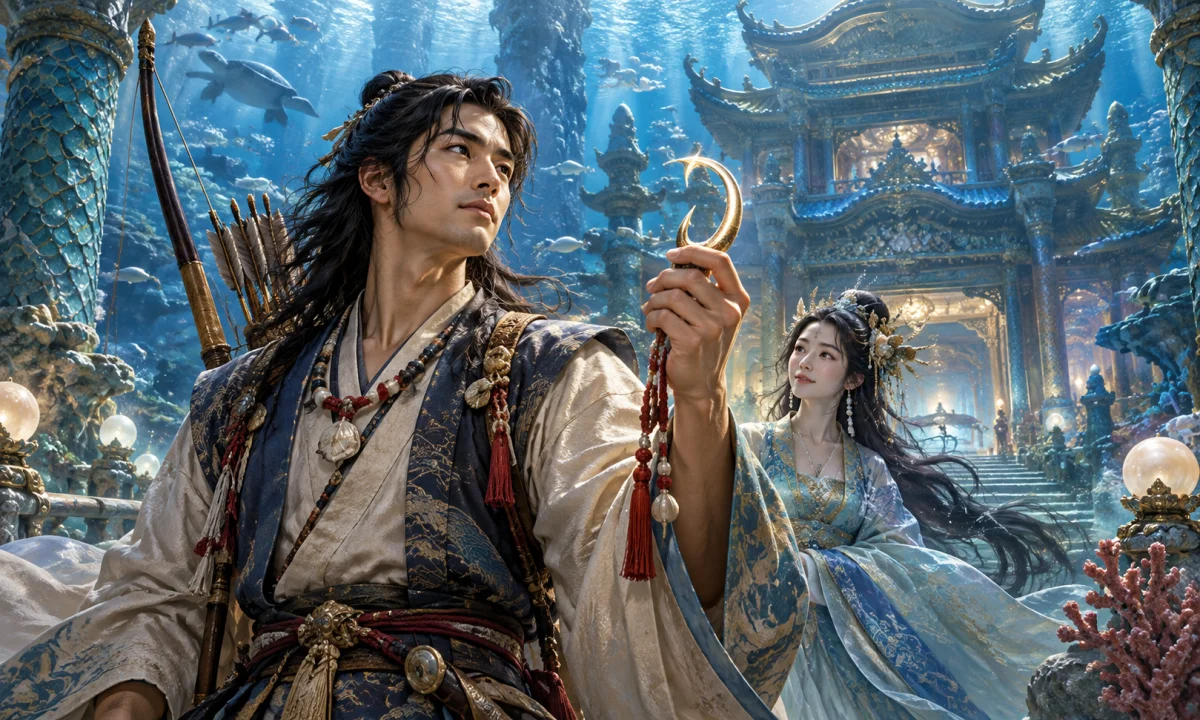
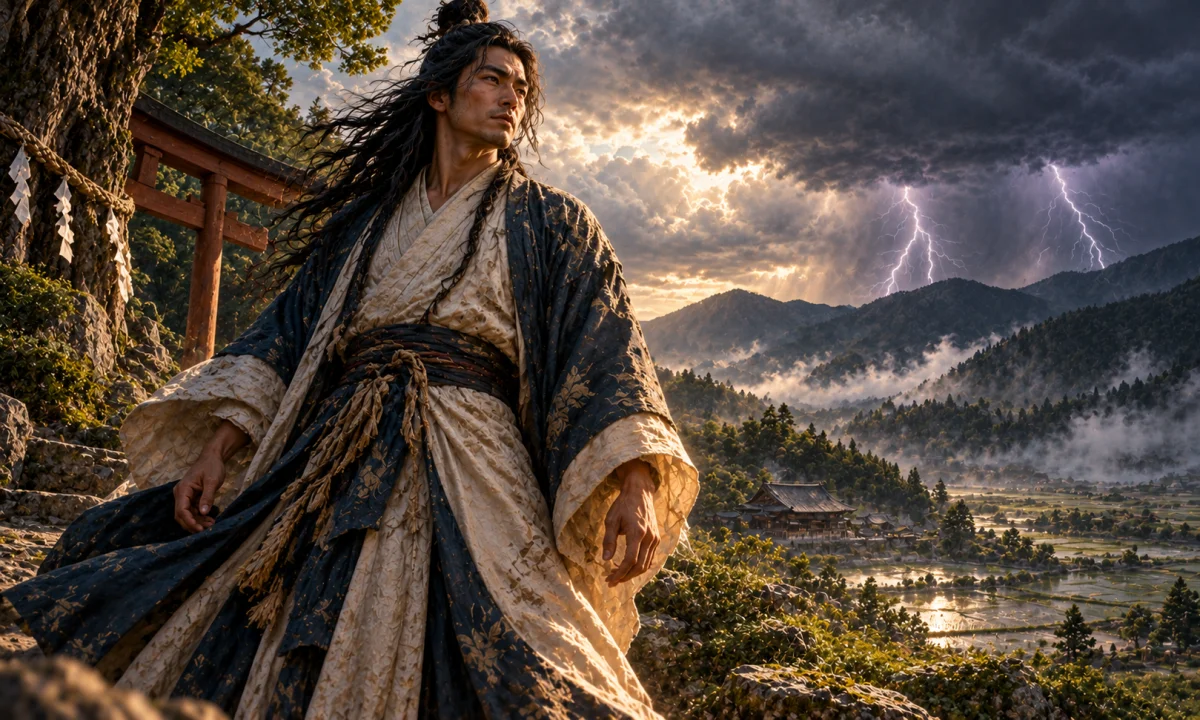
Hoori is a figure in Japanese mythology who belongs to the divine genealogy leading to the imperial ancestors. He is best known as the mountain hunter who loses his brother’s fishing hook, enters the underwater palace of the sea god Watatsumi, and marries Watatsumi’s daughter Toyotama-hime. His story connects the mountains, the sea, royal ancestry, and the transition from the age of the gods to the legendary beginnings of Japan.
Origins and surviving traditions
Hoori’s story is preserved chiefly in the Kojiki, compiled in 712, and the Nihon Shoki, completed in 720. These are Japan’s earliest surviving works to present extended accounts of the country’s divine origins, sacred genealogy, and legendary early rulers. They were written in different historical and political contexts, and their versions of Hoori’s story are not identical.
Both works place Hoori within the line of heavenly and earthly deities that eventually leads to Emperor Jimmu, the legendary first emperor. Hoori is the son of the heavenly descendant Ninigi and Konohanasakuya-hime, the beautiful daughter of the mountain deity Ōyamatsumi. Ninigi had been sent from the heavenly realm to rule the land, so Hoori stands within the mythic succession from the heavenly kami to the earthly rulers of Japan.
The narratives should be understood as religious and cultural traditions rather than as ordinary historical biographies. The Kojiki and Nihon Shoki preserve myths that helped explain sacred ancestry, relationships among kami, and the legitimacy of the imperial line. Their stories also incorporate older oral traditions whose original forms cannot be reconstructed with certainty.
Name, identity and classification
Hoori is commonly written in English as Hoori, Hōori, or Ho-ori. Japanese sources give him several names and titles. One important form is Hikohohodemi no Mikoto, while another is Yamasachi-hiko, meaning approximately “mountain-luck prince” or “mountain bounty prince.” Hoori is also associated with the name Hohodemi in accounts that vary between the Kojiki and Nihon Shoki.
The names do not necessarily represent different characters. In early Japanese myth, a single kami may possess a personal name, a descriptive title, and a formal honorific name. Transliteration also differs because the ancient texts used Chinese characters to represent Japanese names, and the original pronunciation and meaning of some names remain uncertain.
The element sachi refers broadly to luck, fortune, or the productive result associated with a tool or activity. Hoori’s name as Yamasachi-hiko therefore identifies him with the mountain’s bounty and with success in hunting. His brother Hoderi is called Umisachi-hiko, the “sea-luck prince,” and is associated with fishing. These labels establish the central contrast between the brothers.
Hoori is a kami, or deity, in the broad sense used by Japanese religious tradition. He is not usually treated as a major independent object of worship in the manner of Amaterasu or Susanoo. His importance lies primarily in the myths that place him between the earlier generations of divine beings and the ancestors of the imperial house.
Family and divine genealogy
Hoori is the son of Ninigi no Mikoto and Konohanasakuya-hime. Ninigi is the grandson of Amaterasu, the sun deity and central ancestral figure of the imperial mythology. Through Ninigi, Hoori is connected to the heavenly lineage. Through his mother, he is connected to Ōyamatsumi and the sacred power of mountains.
The number and names of Hoori’s brothers vary in the surviving accounts. The best-known brother is Hoderi, the sea-luck prince. Some versions also name Hosuseri or other closely related figures. Because the genealogies differ, it is safer not to treat every named sibling in later retellings as part of one uniform family tree.
Hoori’s most important relationship is with Toyotama-hime, the daughter of Watatsumi, the great sea deity. Their marriage joins the heavenly and mountain-linked lineage of Hoori with the ancient power of the sea. Their son, Ugayafukiaezu no Mikoto, becomes the father of Jimmu in the mythic genealogy. Hoori is therefore an ancestor of the imperial line through his son and grandson.
The contrast between Hoori and Hoderi
At the beginning of the central story, the brothers receive different kinds of prosperity. Hoderi is given the power or equipment connected with fishing, while Hoori receives the equipment of a hunter. The brothers later exchange their tools, apparently to test whether each can succeed in the other’s domain.
Hoori is unable to use Hoderi’s fishing equipment successfully. Worse, he loses Hoderi’s treasured fishhook in the sea. Hoderi demands the return of the original hook rather than accepting replacements. In the Kojiki, Hoori attempts to make many substitute hooks, but Hoderi rejects them because the lost object is not merely an ordinary tool. It is a possession tied to his fortune and identity.
This dispute sets the story in motion. Hoori’s failure is not resolved by ordinary craftsmanship or negotiation. He must leave the human world of the shore and travel into the realm beneath the sea. The episode also reverses the brothers’ apparent positions: the mountain hunter enters the sea and ultimately gains powers that allow him to overcome the sea-luck brother.
The journey to Watatsumi’s palace
A sea-associated kami named Shiotsuchi no Kami, often understood as a deity connected with tides and seawater, advises Hoori to travel across the sea in a small boat. Hoori eventually reaches the palace of Watatsumi. The palace is presented as a magnificent dwelling in the underwater realm, a place outside ordinary human society and time.
At the palace, Hoori meets Toyotama-hime. She is struck by his appearance and reports him to her father. Watatsumi recognizes that the visitor is not an ordinary human and welcomes him. Hoori marries Toyotama-hime and remains in the sea deity’s realm for a considerable period. The precise duration and details differ among the textual versions, but the story emphasizes that his stay is long enough for him to become integrated into the household of the sea god.
Hoori eventually explains the reason for his journey. Watatsumi gathers the creatures of the sea and asks whether any of them has seen the missing hook. A fish, usually identified as a sea bream or porgy, is found to have swallowed it. The hook is recovered and returned to Hoori, allowing him to go back to the land.
The recovery of the hook is not the end of the conflict. Watatsumi gives Hoori two powerful jewels associated with the rising and falling of the tide. Their names are often translated as the tide-flowing jewel and the tide-ebbing jewel. The terminology and details vary, but their function is clear: Hoori can use them to cause the sea to rise or retreat.
Hoori and the subduing of Hoderi
When Hoori returns, he uses the recovered hook according to instructions given by Watatsumi. The instructions include a formula or statement that reminds Hoderi of the hook’s unfortunate condition. The exact wording differs in translation and between the ancient texts, but the act places responsibility for the lost object back upon Hoderi.
Hoderi becomes hostile, and Hoori uses the tide jewels against him. By causing the water to rise, Hoori places his brother in danger. When Hoderi submits, Hoori causes the water to recede. The power of the sea, once the source of Hoori’s difficulty, is now under his control.
The brothers eventually reach an agreement, although the traditions differ over the precise terms. One version presents Hoderi as promising lasting service or loyalty to Hoori. The episode can be read as a mythic explanation of the subordination of one form of sacred power to another, but the texts do not offer a single explicit interpretation. It is also a story about restoring order after a broken exchange: the proper tool is returned, the debt is settled, and the brothers’ relationship is reorganized.
Toyotama-hime and the birth of Ugayafukiaezu
After Hoori has returned to the land, Toyotama-hime follows him because she is pregnant with their child. She asks Hoori not to look at her while she gives birth. This prohibition is a familiar pattern in mythology: a supernatural spouse sets a condition that must be respected if the relationship between the human and divine worlds is to continue.
Hoori looks despite the warning. He sees Toyotama-hime in her true form, described in the Kojiki as a great wani. The word is often translated as “crocodile,” but its mythological meaning is not certain. Japan has no native crocodile tradition comparable to that of tropical regions, and the wani may represent a large sea creature, dragon-like being, shark, or other supernatural marine animal. Translators therefore handle the term in different ways.
Embarrassed or angered that her true form has been witnessed, Toyotama-hime leaves Hoori and returns to the sea. She does not entirely abandon her child. She sends her younger sister, Tamayori-hime, to care for the infant. The child is named Ugayafukiaezu, a name traditionally connected with the unfinished or incomplete construction of a hut prepared for the birth.
Tamayori-hime later becomes important in the genealogy. In the mythic tradition, she marries Ugayafukiaezu and becomes the mother of four sons, including Kamuyamato Iwarehiko, later known as Emperor Jimmu. This relationship may seem unusual by modern standards, but it belongs to the genealogical and divine world of the ancient narratives. It also preserves the sea lineage after Toyotama-hime’s departure.
Symbols and interpretation
Hoori’s story brings together several symbolic oppositions. The most obvious is the contrast between mountain and sea. Hoori begins as a mountain hunter, while Hoderi represents fishing and marine abundance. Yet Hoori must enter the sea to recover what he has lost, and his eventual authority depends on knowledge and gifts obtained from the sea god.
The story also contrasts ordinary skill with supernatural legitimacy. Hoori cannot simply replace the hook or defeat Hoderi through physical strength. His success comes through a passage into another realm, a marriage with a powerful sea deity’s daughter, and the acquisition of tide-controlling jewels. His authority is therefore constructed through relationships among divine houses rather than through personal prowess alone.
The marriage to Toyotama-hime creates a connection between the heavenly descent of Hoori and the ancient sacred power of the ocean. The birth of Ugayafukiaezu then carries that combined ancestry into the line of Jimmu. The myth may thus be read as part of a broader attempt to unite different regional or ritual traditions within a single sacred genealogy.
Scholars have offered various interpretations of the tale, including readings focused on fertility, maritime trade, initiation, political alliance, and the relationship between hunting and fishing communities. No single interpretation is established as the definitive meaning. The ancient texts themselves emphasize genealogy, divine authority, taboo, and the restoration of social order more clearly than they provide an explicit explanation of the story’s symbolism.
Differences between the Kojiki and Nihon Shoki
The Kojiki presents the best-known form of the tale, including the lost hook, the sea palace, Toyotama-hime’s transformed body, and the tide jewels. The Nihon Shoki preserves a related narrative but includes variant accounts and differences in names, sequence, and emphasis. Some episodes are shorter or arranged differently, and the treatment of the brothers is not completely uniform.
These differences are important because Hoori is not the product of one fixed canonical story. Japanese mythology was transmitted through multiple traditions, and the court compilations selected and organized material from those traditions. Later retellings often smooth out the discrepancies, but the ancient sources preserve a more varied picture.
The name Hikohohodemi is particularly significant in comparing the versions. Some accounts use it as the principal name of the figure commonly called Hoori, while other names appear in related genealogical contexts. Hohodemi should not automatically be treated as a separate deity simply because spelling and transcription vary. At the same time, the differences should not be ignored: the precise identity of every name in every passage is a matter of textual interpretation.
Distinguishing Hoori from similar figures
Hoori should not be confused with Hoderi, his sea-associated brother. Their names and roles are deliberately paired, and both appear in the same narrative. Hoori is the mountain-luck hunter; Hoderi is the sea-luck fisherman. Later summaries sometimes reduce their conflict to a simple rivalry, but the story is also concerned with sacred tools, inheritance, and the transfer of power between domains.
Hoori is also distinct from Ugayafukiaezu, his son, and from Jimmu, his grandson. The family connection can make the names difficult to follow, especially because the stories move quickly from divine genealogy to legendary imperial history. Hoori belongs to the generation before Ugayafukiaezu and two generations before Jimmu.
He should likewise not be identified with figures from unrelated mythologies whose names happen to resemble Hoori in English spelling. “Hoori” is a romanization of a Japanese mythological name and has no traditional connection with Egyptian Horus or other similarly spelled divine figures.
Hoori in later cultural memory
Hoori remains relevant primarily through the continuing study and retelling of the Kojiki and Nihon Shoki, as well as through the broader Shinto understanding of divine ancestry. His story is especially important when discussing the genealogy linking Amaterasu, Ninigi, Hoori, Ugayafukiaezu, and Jimmu.
Modern books, educational materials, manga, games, and fantasy fiction may present Hoori as a heroic hunter, a prince of the sea, or a combatant who wields the tide jewels. Such portrayals often expand his personality and powers beyond what the ancient texts describe. In the traditional sources, his significance does not rest on a detailed physical appearance or a catalogue of supernatural abilities. It rests on his place within a sacred genealogy and on the transformation brought about by his journey between mountain, land, and sea.