WORLD
WORLD
Hosuseri
Hosuseri is a minor but significant figure in Japanese mythology, known chiefly from the genealogy of the gods and heroes descended from the heavenly kami. In the Kojiki, Japan’s oldest surviving written record of myths, Hosuseri-no-Mikoto is one of the children of the heavenly ruler Ninigi-no-Mikoto and the blossom deity Konohanasakuya-hime. He is the brother of Hoderi and Hoori, two figures who play much larger roles in the stories of fishing, hunting, the sea god Watatsumi, and the ancestry of Japan’s imperial line.
Hosuseri is unusual because his name is preserved in an important myth, yet the surviving narrative gives him little independent action. His identity is also complicated by variations between the Kojiki, the Nihon Shoki, and later interpretations. In some traditions, a similarly named figure, often written as Hono-susori or Hono-susori-no-Mikoto, is associated with the sea and with the elder brother who quarrels with Hoori. These versions should not be treated as perfectly identical without qualification.
Origins in the heavenly genealogy
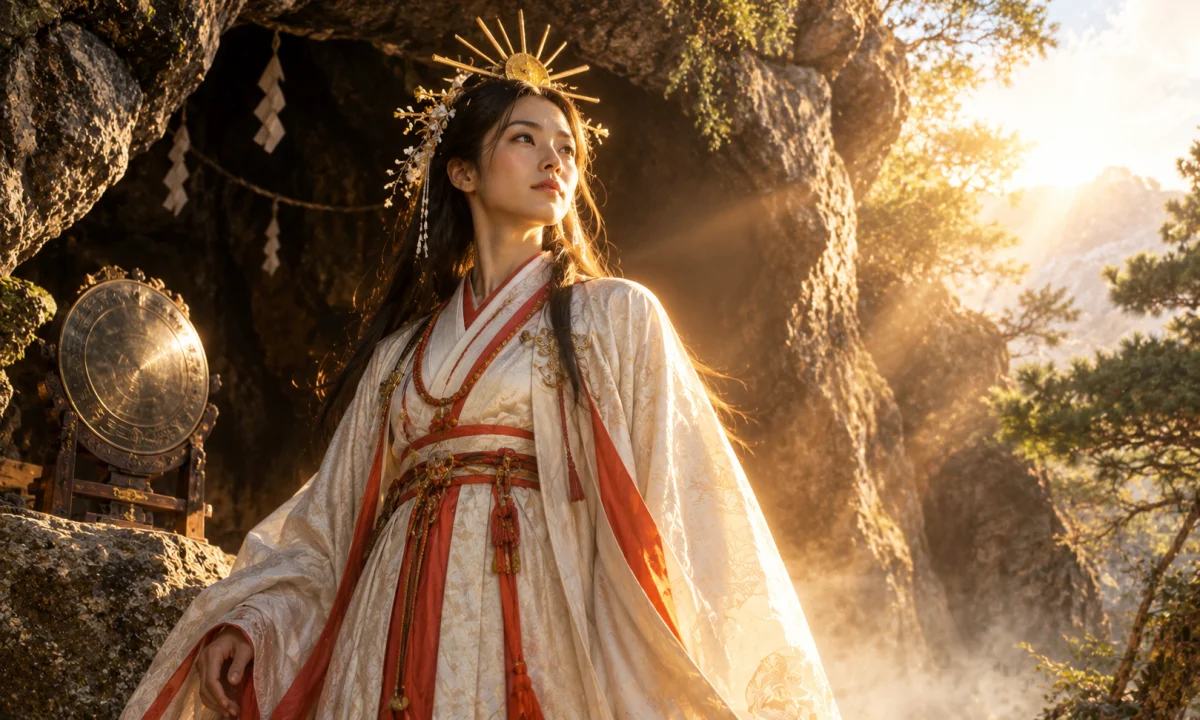
Hosuseri belongs to the generation that connects the heavenly kami with the early rulers of Japan. His father, Ninigi-no-Mikoto, is said to have descended from the Plain of High Heaven to govern the Central Land of Reed Plains, a mythic expression for Japan. This descent is commonly called tenson kōrin, or the “descent of the heavenly grandson.” It is one of the central movements in Japanese myth, linking the heavenly deities to the earthly world and, through later descendants, to the imperial lineage.
Ninigi married Konohanasakuya-hime, daughter of the mountain deity Ōyamatsumi. Her name is usually understood in relation to flowering trees, especially the short-lived beauty of cherry blossoms, although the precise history of her name and symbolism is more complex than a simple identification with one modern flower. She represents beauty, seasonal flowering, and the fragile life of the natural world, while her father belongs to the realm of mountains and terrestrial power.
The marriage between Ninigi and Konohanasakuya-hime brings together heavenly authority, mountain divinity, and the future human world. Their children therefore occupy an important place in the transition from the age of gods to the age of legendary rulers. Hosuseri is part of this transition even though the myths do not give him a developed personal narrative.
The birth in the burning house
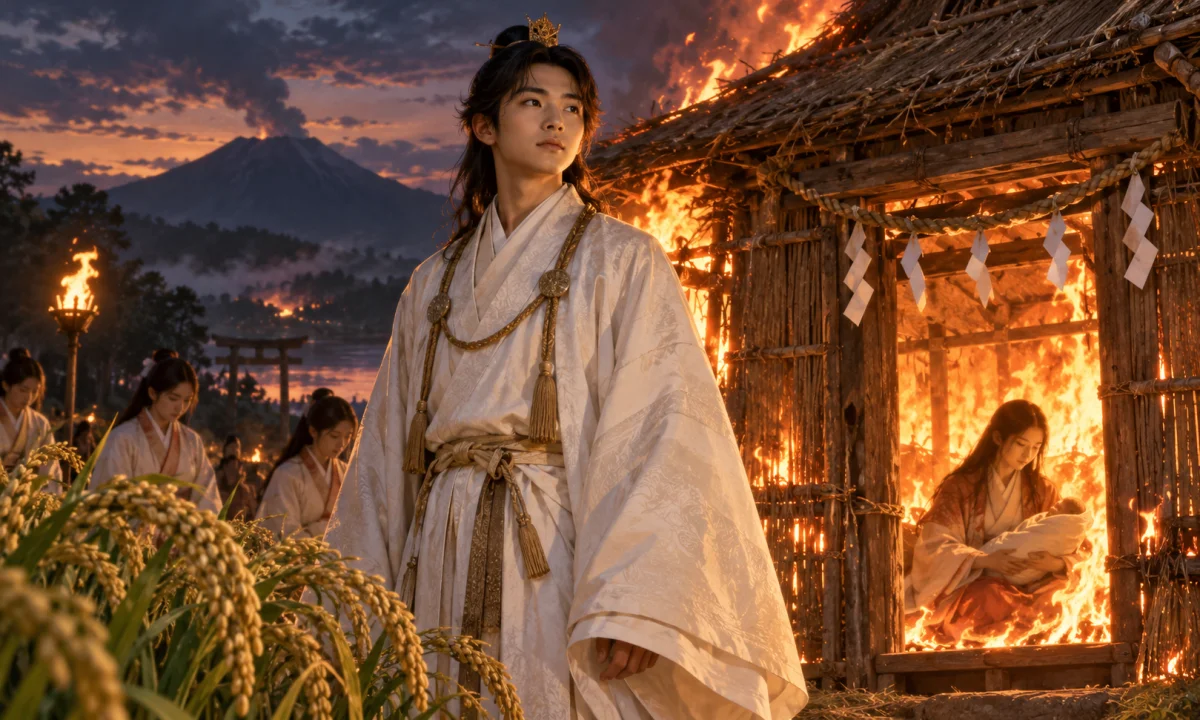
The circumstances of Hosuseri’s birth are connected with one of the best-known episodes concerning his mother. After Konohanasakuya-hime became pregnant soon after her marriage, Ninigi questioned whether the children could truly be his. His suspicion was offensive because she was a daughter of a powerful kami, and because the pregnancy had occurred so quickly.
To prove the legitimacy of the unborn children, Konohanasakuya-hime entered a newly built dwelling and set it on fire. She declared that if the children belonged to an earthly father rather than to Ninigi, they would not survive the flames. If they were truly the offspring of the heavenly deity, they would be born safely. The story presents her as both vulnerable and formidable: she is accused by her husband, yet answers the accusation through a dangerous ritual act.
According to the Kojiki, several sons were born during the progress of the fire. Their names include Hoderi, Hosuseri, Hoori, and Hohodemi. The exact ordering and interpretation of the names are subjects of philological and comparative discussion, but the story clearly connects their birth with fire. The element is not merely destructive. It acts as a test, a purifier, and a sign of divine legitimacy.
Hosuseri’s name is commonly written with characters that include ho, a term associated with fire or flame in this group of names. The second element is less certain. Interpretations have connected it with blazing, flaming, or a movement of fire, but the written characters do not by themselves settle the original meaning. As with many names in early Japanese mythology, later orthography may preserve sound imperfectly and can encourage interpretations that were not necessarily intended by the original storytellers.
Name and identity
The form Hosuseri-no-Mikoto is a conventional romanization of the name. English-language works may also use forms such as Hosuseri, Hosuseri-no-Mikoto, Hososeri, or other spellings based on different readings of the Japanese characters. The variation is partly the result of differences in romanization and partly the result of uncertainty about how early names were pronounced.
Hosuseri should not automatically be equated with every deity whose name contains elements meaning “fire,” “flame,” or “shining.” Japanese mythology includes many fire-related kami, and similar-looking names can belong to different figures. Nor should Hosuseri be confused with Hoderi, Hoori, or Hohodemi. These brothers share a family and a fire-associated birth, but they do not have the same narrative roles.
The precise classification of Hosuseri is also uncertain. He is often called a god or kami in modern reference works, but the early texts do not always describe their figures through a fixed system comparable to later theological categories. “Kami” is therefore a useful broad term, while descriptions such as fire deity, sea deity, or ancestral god should be used carefully and with attention to the particular source.
Hosuseri in the Kojiki
In the Kojiki, completed in 712, Hosuseri appears primarily in the account of Konohanasakuya-hime’s miraculous birth. He is named as one of her sons, but the later narrative focuses on Hoderi and Hoori. Hoderi is associated with the fortune of the sea, while Hoori is associated with the fortune of the mountains. The story of their conflict, Hoori’s loss of a fishhook, and his journey to the palace beneath the sea belongs mainly to these two brothers.
Hosuseri does not receive an equally developed role in that episode. The text does not clearly give him a separate domain, a distinctive physical appearance, or a sequence of deeds. This limited treatment is important. Later writers and modern summaries sometimes assign him powers or occupations that are inferred from related names and variants rather than directly stated in the Kojiki.
His presence in the genealogy nevertheless has meaning. He stands among the children born through the fire ordeal, embodying the continuation of the divine family. The story does not require every child to become an active protagonist. Genealogical lists in early Japanese mythology often preserve names that may once have represented local traditions, ritual groups, ancestral lines, or alternative versions of a larger myth.
The Hono-susori tradition and the sea-fortune story
The Nihon Shoki, compiled in 720, preserves several versions of myths that overlap with the Kojiki but do not always agree with it. In traditions associated with the name Hono-susori-no-Mikoto, the similarly named figure may take the position of the elder brother connected with the sea and fishing. He is then placed in a narrative role resembling that assigned to Hoderi in the Kojiki.
In the best-known form of the brother story, the sea-oriented elder brother possesses the ability or fortune to catch fish, while the younger Hoori is successful in hunting on land. The brothers exchange their tools in an attempt to experience one another’s skills. Hoori loses the elder brother’s fishhook, searches unsuccessfully for it, and eventually receives guidance that takes him to the dwelling of Watatsumi, the great sea kami.
Hoori’s journey leads to his marriage with Toyotama-hime, daughter of Watatsumi, and to a series of events involving the recovered fishhook and the growing hostility between the brothers. In the Kojiki, the sea-oriented brother in this story is Hoderi. In other textual traditions, the name Hono-susori appears in a comparable position. Scholars therefore discuss whether these are variant names for one older mythic role, separate traditions later placed within the same genealogy, or figures whose identities became partially merged during the transmission of the chronicles.
It is safer to say that Hosuseri is sometimes connected with a variant sea-brother tradition than to state that he is unambiguously the sea god of the story. The evidence does not support a single universally accepted interpretation. The difference between Hosuseri in the Kojiki and Hono-susori in related traditions is one of the most important points when describing the figure accurately.
Family relationships
- Father: Ninigi-no-Mikoto, the heavenly grandson who descends to the earthly realm.
- Mother: Konohanasakuya-hime, a daughter of the mountain kami Ōyamatsumi.
- Brothers: Hoderi, Hoori, and, in the Kojiki genealogy, Hohodemi.
- Important related figures: Watatsumi, the great sea kami, and Toyotama-hime, Watatsumi’s daughter and the wife of Hoori.
- Later ancestral connection: Hoori and Toyotama-hime are associated with Ugayafukiaezu, who in turn becomes the father of the legendary first emperor, Jimmu.
The family structure is not identical in every early source. Some accounts list different numbers of children or arrange their names differently. The names Hoori and Hohodemi can also overlap in descriptions of the same mythic figure, especially when comparing the Kojiki with the Nihon Shoki. These differences reflect the layered nature of the chronicles rather than a fully standardized mythology.
Fire, legitimacy and transformation
Hosuseri’s most secure symbolic setting is the fire surrounding his birth. Fire in Japanese religious and mythic traditions can purify, protect, destroy, illuminate, and mark a boundary between ordinary and sacred conditions. The burning birth chamber transforms a disputed pregnancy into a public demonstration of divine status. It also resembles an ordeal in which truth is revealed through survival.
The fire imagery has another function within the genealogy. The children of Ninigi and Konohanasakuya-hime are born from a dangerous elemental environment, but the descendants of this union become connected with the establishment of rule on earth. Their birth therefore helps move the myth from heavenly descent toward dynastic ancestry.
Hosuseri’s limited narrative may suggest that his primary importance is genealogical rather than dramatic. He is a link in a sacred family line and a participant in a story about the testing of divine legitimacy. Attempts to give him a complete personality, fixed occupation, or elaborate mythology go beyond what the oldest surviving accounts clearly preserve.
Distinguishing Hosuseri from related figures
Hoderi is the brother most directly associated with sea fortune in the Kojiki. He is often called Umisachi-biko, “the boy of the sea’s fortune,” in contrast with Hoori, the mountain hunter or Yamasachi-biko. Hosuseri is a separate named figure in the Kojiki genealogy, even though later variants can place a Hono-susori figure in Hoderi’s narrative position.
Hoori is the younger brother whose lost fishhook leads him to the sea palace of Watatsumi. He is also called Hikohohodemi or referred to through related name forms in the chronicles. His story has major consequences for the ancestry of the imperial line, but he should not be identified with Hosuseri.
Hohodemi appears as another son in the Kojiki account and may overlap in some traditions with names used for Hoori. This variation can make family trees appear inconsistent. It does not justify treating Hohodemi, Hoori, and Hosuseri as interchangeable figures.
Konohanasakuya-hime is Hosuseri’s mother, not a fire goddess in the narrow sense. Her connection with fire comes from the ordeal surrounding her children’s birth, while her broader identity is associated with flowering, mountains, fertility, and the brief beauty of life.
Religious and cultural significance
Hosuseri is not generally the focus of a large, independent cult in the way that more prominent kami such as Amaterasu, Inari, or Hachiman are. His importance lies chiefly within the mythic genealogy preserved by the classical chronicles. These texts were compiled in the early eighth century in a court setting, where stories of the gods, ancient rulers, regional traditions, and political legitimacy were brought into a connected historical-mythic narrative.
That setting matters when interpreting Hosuseri. The chronicles are not neutral collections of folklore, nor are they systematic theological treatises. They preserve older oral and regional material while arranging it into genealogies that support a vision of Japan’s sacred past. A minor figure such as Hosuseri may therefore represent a tradition that once had greater local or ritual significance but was retained mainly as a name within the imperial genealogy.
Later reception
Hosuseri has had little presence in modern popular culture compared with Amaterasu, Susanoo, Hoori, or Konohanasakuya-hime. When he appears in contemporary retellings, games, novels, or illustrated mythologies, creators may expand his role as a fire-born prince, sea-related brother, or elemental deity. Such portrayals are modern interpretations unless they can be tied to a particular classical variant.
The most responsible way to present Hosuseri is therefore to preserve the uncertainty. He is securely attested as a son of Ninigi and Konohanasakuya-hime in the Kojiki, and his birth belongs to the fire ordeal that establishes the children’s divine legitimacy. His independent character and sphere of power remain unclear, while his possible relationship to the sea-oriented Hono-susori tradition reflects the variation of early Japanese myth rather than a settled biography.