WORLD
WORLD
Hoderi
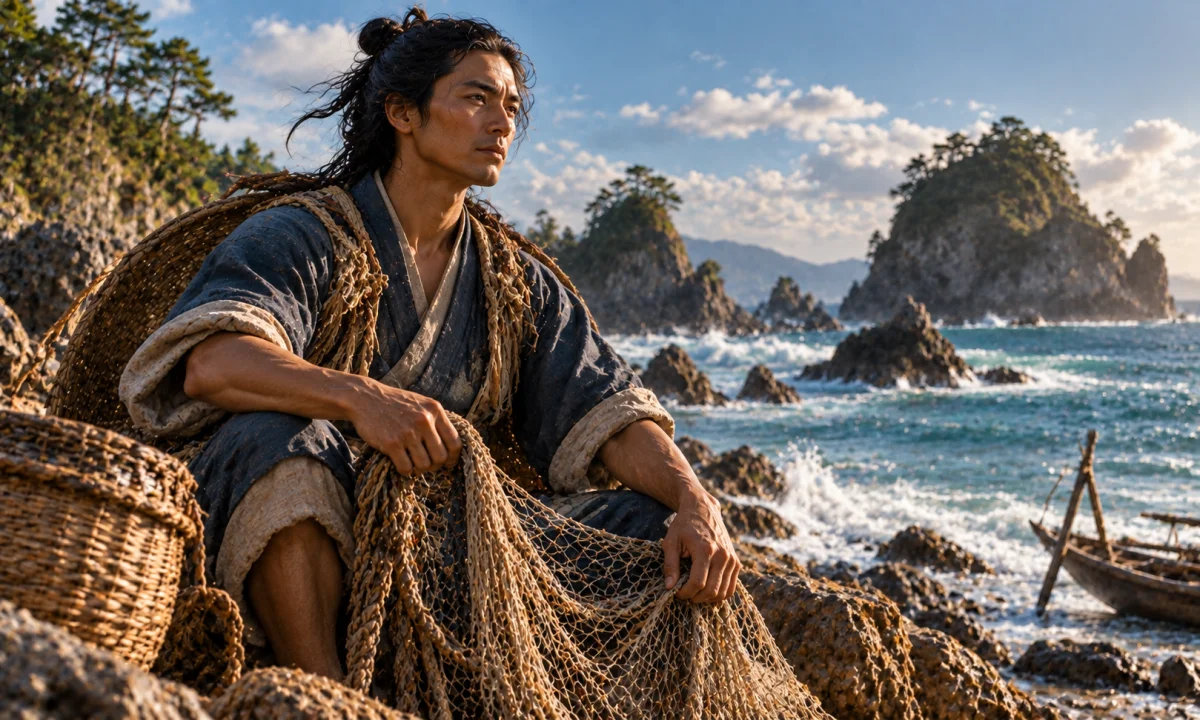
Hoderi is a figure in early Japanese mythology, best known from the Kojiki and Nihon Shoki as the elder brother of Hoori. He is associated with the sea, fishing, and the inherited “luck” of the ocean. In the central story involving the two brothers, Hoderi possesses the skill called umisachi, or sea fortune, while Hoori possesses yamasachi, the fortune of the mountains. Their rivalry leads Hoori to the underwater palace of the sea deity Watatsumi and becomes part of a larger myth explaining the ancestry of the Japanese imperial line and the Hayato people.
Origins in Japanese mythological tradition
Hoderi appears chiefly in the genealogical and mythological narratives preserved in the Kojiki, compiled in 712, and the Nihon Shoki, completed in 720. These works were produced at the early Japanese imperial court and combine origin stories, genealogies, ritual traditions, political legitimisation, and accounts of the relationships among powerful clans and sacred beings.
Neither text presents mythology as a separate category in the modern sense. Divine ancestors, legendary rulers, local traditions, and accounts of the imperial lineage are woven together. Hoderi therefore belongs both to the world of Japanese kami and to a genealogical narrative concerned with the ancestry of important human groups.
Hoderi is the son of Ninigi, the heavenly descendant sent to rule the land, and Konohanasakuya-hime, the blossom-associated deity of Mount Fuji and a symbol of flowering life. His brothers include Hoori, who is also called Hikohohodemi in important passages. The accounts differ in the number, names, and ordering of the sons, however. The Kojiki gives a group of three sons, including Hoderi, Hosuseri, and Hoori, while versions in the Nihon Shoki use somewhat different names and arrangements. These variations are part of the early tradition rather than evidence that every name refers to exactly the same figure in every passage.
The meaning and forms of Hoderi’s name
Hoderi is commonly written 火照命, often interpreted as “Fire-Shine” or “Fire-Bright.” The element associated with fire links his name to the circumstances of his birth, when his mother enters a burning delivery hut to prove that the children are truly Ninigi’s offspring. If the hut burns without harming her or the children, she argues, their birth must be governed by divine power rather than by human suspicion.
The name should not be taken to mean that Hoderi is simply a Japanese fire god. His principal role in the surviving myths is not control of flame but participation in the sea-and-mountain rivalry with Hoori. The fire element is important within his birth narrative and symbolic name, yet Hoderi’s characteristic occupation is fishing.
Hoderi is also called Umisachi-hiko, meaning approximately “the prince of sea fortune” or “the sea-luck man.” This is better understood as a title or descriptive name than as an entirely separate deity. It identifies his special success in obtaining the products of the sea. His younger brother Hoori is correspondingly associated with yamasachi, the fortune or abundance of the mountains.
Birth and divine family
Hoderi’s mother, Konohanasakuya-hime, becomes pregnant soon after marrying Ninigi. Ninigi doubts that the children are his because the pregnancy occurs unusually quickly. Konohanasakuya-hime responds by declaring that, if the children are not Ninigi’s, the fire of a sealed hut will destroy them; if they are truly his sons, fire will not harm them.
She enters the burning structure and gives birth there. In the Kojiki, the children include Hoderi, Hosuseri, and Hoori. The fiery setting accounts for the names and gives the brothers a connection with supernatural birth, danger, and proof of legitimate descent. The episode also places Hoderi within the line descending from Ninigi, who in the mythic genealogy leads eventually to the first emperor, Jinmu.
Konohanasakuya-hime’s story has its own rich symbolism involving blossoms, mortality, fertility, and the contrast between short-lived flowers and enduring stones. Hoderi’s role in that story is limited, but his birth establishes the divine ancestry from which his later relationship with Hoori develops.
Hoderi as the sea-luck brother
Hoderi is described as a successful fisherman. His brother Hoori is a hunter who relies on mountain animals and weapons. The brothers possess different forms of prosperity, and the contrast initially appears complementary: Hoderi knows the sea, while Hoori knows the mountains.
At one point, however, Hoori asks Hoderi to exchange their tools. Hoori wishes to try fishing, and Hoderi agrees to use his brother’s hunting equipment. The exchange does not go well. Hoori fails to catch anything and loses Hoderi’s fishhook in the sea.
Hoori attempts to replace the hook with another one, then another, but Hoderi refuses the substitutes. He insists on receiving the original hook, giving the dispute a seriousness beyond the value of an ordinary fishing tool. The lost hook becomes the object that drives Hoori from the human world into the realm of the sea deity.
The lost fishhook and the sea palace
Unable to recover the hook, Hoori goes to the shore in distress. There he encounters Shiotsuchi-no-kami, a deity associated with tides, salt water, and the movement of the sea. Shiotsuchi advises Hoori to travel across the ocean in a specially made boat. The journey takes him to the palace of Watatsumi, the great sea kami.
Watatsumi’s palace is a liminal place: it lies beneath or beyond the ordinary human world, yet it is connected to the sea familiar to fishermen. Hoori meets Watatsumi’s daughter, Toyotama-hime, and the two marry. Through this marriage, Hoori becomes linked not only to the sea realm but also to a powerful divine family.
Watatsumi eventually discovers the missing fishhook. In the best-known version, it has been swallowed by a sea creature, often identified as a sea bream. The hook is recovered and returned to Hoori. Watatsumi also gives him magical tide jewels, which can raise or lower the sea. These objects allow Hoori to control the waters in his later confrontation with Hoderi.
The conflict between the brothers
When Hoori returns from the sea, he brings the recovered hook to Hoderi. The conflict does not end immediately. Hoderi attacks or rejects his brother, and Hoori uses the tide jewels to overwhelm him. By raising the water, he threatens to drown Hoderi; by lowering it, he allows him to survive. The repeated control of flood and ebb places Hoderi at the mercy of the sea power that had previously defined his own identity.
Hoderi finally submits and promises loyalty to Hoori. The episode reverses their original relationship. Hoderi had possessed the practical advantage as the skilled fisherman and had demanded repayment for the lost hook. Hoori, after entering the supernatural sea realm, returns with powers that surpass ordinary skill. His authority now rests on marriage, divine assistance, and possession of the tide jewels.
The story is not merely a quarrel between two brothers. It connects different forms of livelihood and different social worlds: hunting and fishing, mountains and sea, land-based communities and maritime powers. It also places Hoori, rather than Hoderi, on the line leading toward the imperial ancestors. Hoderi’s submission helps establish the hierarchy between the two branches.
Hoderi, Toyotama-hime, and the imperial genealogy
Hoori’s marriage to Toyotama-hime produces a son, usually called Ugayafukiaezu. The circumstances of the child’s birth introduce another important episode. Toyotama-hime asks Hoori not to look at her while she is giving birth, but he disobeys. He sees her in a nonhuman form, commonly described as a great wani.
The Japanese word wani in these early narratives does not have a single certain equivalent. It may refer to a crocodile-like sea creature, a large marine reptile in the mythic imagination, or a dragon-like being. Translating it simply as “crocodile” can therefore be misleading, especially because crocodiles are not native to the Japanese archipelago. Toyotama-hime returns to the sea after her secret has been exposed, leaving the child behind.
Ugayafukiaezu is later associated with Tamayori-hime, Toyotama-hime’s sister, and becomes the father of four sons, including Kamuyamato-Iware-hiko, the figure later known as Emperor Jinmu in the imperial tradition. Through Hoori’s marriage and descendants, the sea realm is incorporated into the genealogy of the early imperial line.
Hoderi does not stand on this principal imperial line. His significance lies partly in the alternative lineage assigned to him after his defeat by Hoori.
The Hayato and Hoderi’s descendants
The Kojiki connects Hoderi with the Hayato, a people historically associated especially with southern Kyushu. The myth presents the Hayato as descendants of Hoderi who serve the descendants of Hoori. In related traditions, their service includes guarding entrances or performing duties at the ruler’s court.
This genealogy should be understood as a mythic explanation of political and ritual relationships, not as independent historical proof that every Hayato person descended from a single legendary ancestor. Early court genealogies often expressed hierarchy through stories of descent. By making Hoderi the ancestor of a group that serves Hoori’s descendants, the narrative gives a sacred origin to a relationship between the central ruling line and a southern population.
The association is also reflected in the broader cultural memory of the Hayato as people with distinctive ritual and performance traditions. Later accounts connect them with court service and with forms of vocal or martial display. The surviving myth, however, does not provide a complete ethnographic description of the Hayato, and details should not be projected backward from much later sources without qualification.
Symbolism and interpretation
Hoderi’s story brings together several recurring themes in Japanese mythology.
- Sea and mountain: Hoderi and Hoori represent different environments and forms of subsistence. Their exchange shows that skills cannot always be transferred simply by exchanging tools.
- Loss and restitution: The fishhook is a small object with disproportionate importance. Its recovery requires a journey into a supernatural realm and establishes the conditions for a new political order.
- Control of nature: Hoderi’s sea fortune is based on practical mastery of fishing, whereas Hoori gains command over the tides through divine objects. The myth contrasts ordinary expertise with sacred authority.
- Kinship and hierarchy: The brothers’ relationship explains why one branch of the family rules while another becomes subordinate or serves the ruling line.
- Integration of local powers: Hoori’s marriage to the daughter of Watatsumi incorporates a maritime deity and his realm into the ancestry of the imperial house.
Scholars have interpreted the episode in several related ways. It can be read as a foundation myth for relations between inland and coastal communities, as an explanation of the political position of the Hayato, or as a story about the transformation of a heroic hunter into an ancestor of rulers. These interpretations are not mutually exclusive, but none should be treated as a proven historical account of the events described.
Hoderi and figures with similar names
Hoderi is easily confused with Hoori because the names are short, similar in sound, and connected within the same story. They are distinct figures. Hoderi is the sea-luck fisherman and elder brother in the principal version, while Hoori is the mountain hunter who loses the fishhook, visits Watatsumi’s palace, marries Toyotama-hime, and becomes an ancestor of the imperial line.
Hoderi should also be distinguished from Hodur, the blind god in Norse mythology. The resemblance between the names is coincidental and does not indicate a shared character or tradition. He is likewise not identical with Kagutsuchi, Ho-musubi, or other Japanese fire-associated kami. Although Hoderi’s name contains a fire-related element, his narrative identity is principally connected with fishing and the sea.
Later reception
Hoderi remains important mainly as a figure in the classical mythology of the Kojiki and Nihon Shoki, rather than as the focus of a large independent popular cult. His story continues to appear in retellings of Japanese mythology, educational materials, historical fiction, manga, anime, games, and other modern works based loosely on early Japanese traditions.
Modern adaptations may simplify the genealogy, combine variant names, turn Hoderi into a more independent sea god, or give him powers and personality traits not found in the early texts. Such portrayals belong to modern creative culture. In the older tradition, Hoderi is most precisely understood as a divine ancestor, the sea-luck brother of Hoori, and the mythic forefather assigned to the Hayato within the genealogical framework of early Japan.