WORLD
WORLD
Toyotama-hime

Toyotama-hime is a prominent woman of Japanese mythology, best known as the daughter of the sea deity Watatsumi and the wife of the divine hero Hoori. Her story belongs to the mythic genealogy that leads to Japan’s first emperor, Emperor Jimmu. She is associated with the sea, childbirth, transformation and the boundary between the human world and the realm of the gods.
Origins in Japanese myth
Toyotama-hime appears chiefly in the early Japanese chronicles known as the Kojiki and the Nihon Shoki. The Kojiki, completed in 712, is Japan’s oldest surviving major historical and mythological compilation. The Nihon Shoki, completed in 720, presents overlapping traditions with different details and narrative variations. Neither work should be treated as a single, uniform account of Japanese religion: both preserve mythic genealogies, political traditions and regional stories that were compiled in the early imperial period.
In these accounts, Toyotama-hime lives in the palace of Watatsumi, a powerful sea deity. Her name is also written as Toyotama-bime or Toyotama-hime, depending on the system used to represent Japanese names in English. The element hime can mean a princess, noble woman or female divine figure. Toyotama is commonly understood in connection with abundance and jewels or sacred treasures, although the precise religious force of the name should not be reduced to a single modern translation.
Her father’s name is written in several ways, including Watatsumi-no-kami and Watatsumi-no-kami, with differences arising from transcription and translation conventions. The name is generally interpreted as referring to a deity of the sea. In some English retellings, Watatsumi is called a dragon king, but the early Japanese texts do not present him in exactly the same way as a European-style dragon monarch. He is a sea god whose palace and authority belong to the divine ocean realm.
The sea palace and Hoori
Toyotama-hime enters the story of Hoori, also known as Yamasachi-hiko, after a conflict involving his elder brother Hoderi, or Umisachi-hiko. The brothers possess different forms of livelihood: Hoderi is associated with the sea and fishing, while Hoori is associated with the mountains and hunting. They exchange their tools, but Hoori loses his brother’s fishhook and cannot recover it.
After searching unsuccessfully, Hoori is advised to travel to the palace of the sea deity. There he meets Toyotama-hime, who is obtaining water or carrying out a household task near the palace. The two fall in love, and Hoori enters the underwater or oceanic domain. The details differ between the Kojiki and the Nihon Shoki, but both traditions connect their marriage with Hoori’s stay in the realm of Watatsumi.
Toyotama-hime’s role is not merely that of a romantic figure. Through her, Hoori gains access to the sea god’s court and eventually receives assistance in resolving the dispute over the lost hook. In versions of the story, Watatsumi discovers that a particular fish, often identified as a sea bream or red tai, has taken the hook. The sea god then helps Hoori recover it and gives him instructions or magical objects that enable him to overcome Hoderi.
The episode places Toyotama-hime between two worlds. Hoori comes from the land-based divine lineage, while she belongs to the sea deity’s household. Their marriage joins these spheres and creates a genealogical bridge between an ancient sea power and the imperial ancestors described in later sections of the chronicles.
Marriage, pregnancy and the taboo against looking
After Toyotama-hime and Hoori marry, she becomes pregnant. She tells Hoori that she will give birth in a special chamber and asks him not to look inside while she is in labour. This request reflects a recurring mythological pattern: a supernatural spouse temporarily assumes another form, and the human or earthly partner is forbidden to witness the transformation.
Hoori breaks the prohibition and looks into the birthing chamber. He sees Toyotama-hime in the form of a huge wani. The word wani is difficult to translate consistently. It may refer to a crocodile-like creature, a sea monster or a large water-associated reptilian being. In different English versions, it is rendered as “crocodile,” “shark,” “dragon” or “sea serpent.” These choices can give a misleadingly definite impression, because the original term does not map neatly onto one modern zoological category.
The Kojiki describes Toyotama-hime as taking the form of an enormous wani, often specified as eight fathoms long. The exact measurement is part of the mythic imagery rather than a realistic biological description. The creature’s immense size emphasizes her otherworldly identity and the power of the sea realm from which she comes.
When Toyotama-hime realizes that Hoori has seen her true form, she is ashamed and distressed. She leaves him and returns to the sea palace, abandoning the ordinary married life she had begun on land. Her departure is not simply the result of anger. It marks the failure of an attempted union between different realms and the restoration of a boundary that Hoori’s disobedience has violated.
The story resembles a wider family of narratives found in many cultures in which a supernatural spouse imposes a condition of secrecy or non-observation. However, Toyotama-hime’s story should be understood in its Japanese mythological context rather than treated as merely a local version of a universal folktale. Here the taboo is connected with the sea, birth, divine ancestry and the origin of an imperial genealogical line.
Her son and the continuation of the lineage
Toyotama-hime gives birth to a son named Ugayafukiaezu, whose name is written with several English spellings, including Ugayafukiaezu-no-mikoto and Hikohohodemi in related naming traditions. The name is often associated with the circumstances of his birth, although translations vary considerably.
In the mythic genealogy, Ugayafukiaezu becomes the father of four sons. The youngest is Kamuyamato-Iware-biko, later known as Emperor Jimmu, the legendary first emperor of Japan. This makes Toyotama-hime the mother of an important ancestor in the imperial origin narrative and the grandmother of Jimmu.
Because the myth has a genealogical purpose, Toyotama-hime’s departure does not erase her importance. Her son remains part of the lineage that the chronicles connect to the imperial house. In some accounts, she sends her younger sister Tamayori-hime to care for the child after she returns to the sea. Tamayori-hime later becomes Ugayafukiaezu’s wife and the mother of his sons, including the future Emperor Jimmu. Toyotama-hime and Tamayori-hime are separate figures, although their stories become closely linked.
The relationship between the two sisters can be confusing in shortened retellings. Toyotama-hime is the mother of Ugayafukiaezu, while Tamayori-hime is his maternal aunt and later wife in the mythic genealogy. Their roles must not be merged. The unusual marriage is part of a divine ancestral narrative rather than a description of ordinary social practice.
Identity, form and symbolism
Toyotama-hime is sometimes described as a sea goddess, dragon princess, mermaid or water deity. These labels can be useful shorthand, but none captures the early sources exactly. She is a daughter of a sea god and a divine woman who can assume the form of a wani. The texts do not give her a fixed visual portrait comparable to the standardized images of many later religious figures.
Her transformation is especially important. The beautiful princess encountered by Hoori and the gigantic sea creature seen in the birth chamber are not necessarily two separate beings. They are two forms of the same supernatural woman. The change reveals that her apparent human identity is incomplete and that the sea realm remains present within her.
The birth scene also connects Toyotama-hime with the mysterious and dangerous aspects of childbirth. Labour takes place in a specially prepared structure, and the mother’s body becomes a sign of her nonhuman origin. Her child is born from a union between land and sea, but the process is surrounded by secrecy, vulnerability and the possibility of rupture.
Her myth can therefore be read as a story about crossing boundaries. Hoori enters the sea palace; Toyotama-hime enters the land-based household; their child belongs to both lines of descent. Yet the marriage cannot erase the difference between the realms. The forbidden gaze exposes that difference, and Toyotama-hime returns to the ocean.
The story also gives the sea a dual character. Watatsumi’s domain is a place of wealth, hospitality and supernatural assistance, but it is not simply a peaceful paradise. It contains powerful creatures, concealed identities and rules that outsiders must respect. Toyotama-hime embodies both the generosity and the otherness of this maritime world.
Differences between the early accounts
The Kojiki and Nihon Shoki preserve broadly similar episodes, but their wording and sequence are not identical. The names of the characters may vary, and some versions provide additional details about Hoori’s journey, the sea palace, the recovery of the fishhook and Toyotama-hime’s transformation during childbirth.
Translations also create significant differences in how readers imagine her. The term wani is the most obvious example. Calling Toyotama-hime a crocodile stresses a reptilian and aquatic form; calling her a dragon emphasizes later East Asian associations with powerful water beings; calling her a sea serpent or monster leaves the creature more open-ended. None of these translations should automatically be treated as the definitive original meaning.
There is also a difference between the mythology preserved in early chronicles and later shrine or literary traditions. Later interpretations may identify Toyotama-hime more closely with a dragon princess, a protective sea kami or a figure connected with safe childbirth. Such associations can be culturally meaningful, but they should be distinguished from statements directly found in the earliest surviving narratives.
Religious and cultural significance
Toyotama-hime belongs to the network of divine ancestors through which early Japanese myth explains the origin and legitimacy of the imperial line. Her marriage to Hoori is therefore part of a larger succession of unions linking heavenly, earthly and aquatic powers. The story does not present her as an isolated goddess with a separate set of myths; her significance arises largely from her position within this genealogy.
Her connection with the sea is particularly meaningful in an island culture whose communities depended on fishing, travel and coastal exchange. The sea could provide food and wealth while also representing danger, distance and the unknown. A sea princess who becomes the mother of a foundational ancestor gives mythic form to the relationship between maritime powers and the rulers of the land.
The taboo against seeing her transformed body may also reflect the importance of concealment in sacred acts. In Japanese religious traditions, boundaries between the visible and invisible, the pure and the dangerous, and the human and the divine often require careful treatment. The myth does not offer a formal theological rule about childbirth, but it dramatizes the consequences of violating a sacred restriction.
Toyotama-hime and similar figures
Toyotama-hime should not be confused with Tamayori-hime, her sister. Tamayori-hime is the woman who raises or cares for Toyotama-hime’s son and later marries him in the ancestral narrative. The similar names and connected family roles have led to confusion in modern summaries.
She is also distinct from Otohime, another famous princess associated with an underwater palace in the Japanese tale of Urashima Taro. Both figures are linked in later imagination with beautiful women of the sea realm, but they belong to different narratives. Otohime is a character in the Urashima tradition, while Toyotama-hime is part of the Hoori and imperial-origin cycle.
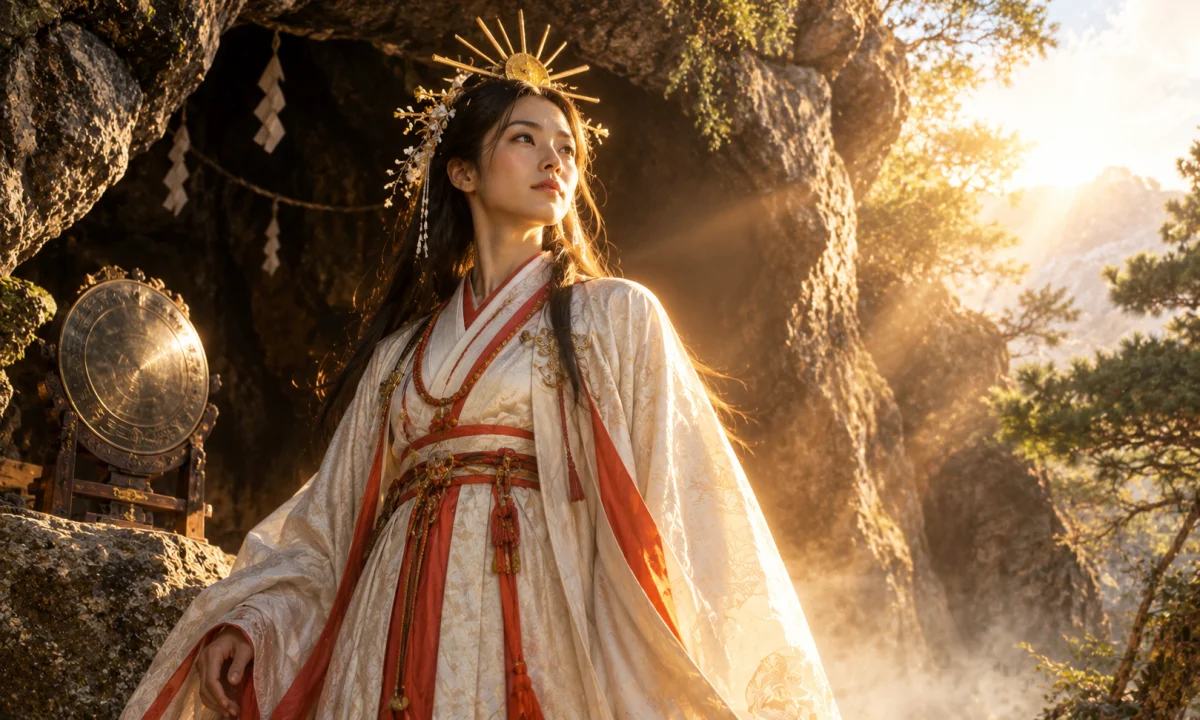
Nor should Toyotama-hime be treated as simply equivalent to a mermaid. Mermaids in European folklore usually combine a human upper body with a fish tail, whereas the early Japanese story gives Toyotama-hime a human appearance in one context and a huge wani form in another. Modern illustrations may depict her as a mermaid, dragon woman or elegant sea princess, but these are artistic adaptations rather than fixed descriptions from the Kojiki or Nihon Shoki.
Later reception
In modern retellings, Toyotama-hime is often presented as a tragic or mysterious dragon princess whose love for Hoori is broken by the revelation of her true nature. Manga, anime, games, novels and illustrated mythology books may expand her personality, give her elaborate powers or portray her as a guardian of the sea. These interpretations draw on genuine features of the traditional story, especially her oceanic origin and transformation, but they may also blend her with broader East Asian dragon lore, mermaid imagery or invented fantasy conventions.
The traditional narrative remains more focused than many modern adaptations. Toyotama-hime is a sea-born divine woman, the wife of Hoori, the mother of Ugayafukiaezu and an ancestor in the mythic line leading to Emperor Jimmu. Her departure after Hoori violates the prohibition against looking is central to her story: it preserves her identity as a being of the sea while leaving her child connected to the human world of the imperial genealogy.