WORLD
WORLD
Tamayori-hime
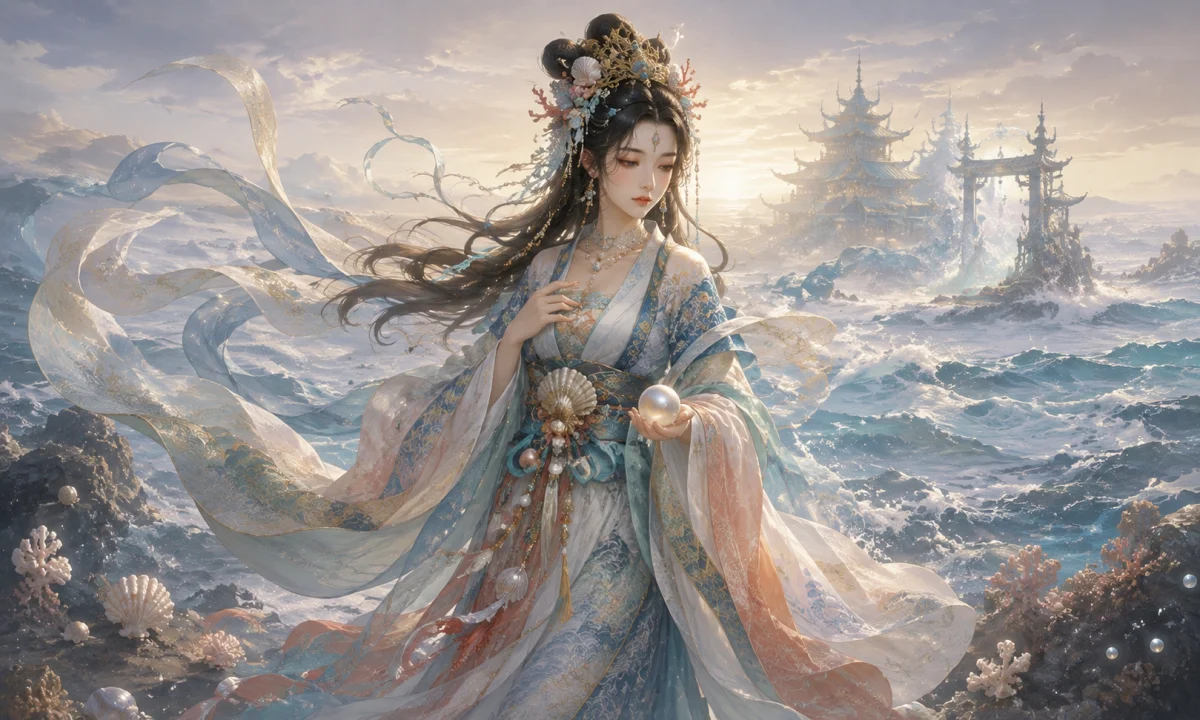
Tamayori-hime is a female kami in Japanese mythology whose name appears in more than one important tradition. The best-known Tamayori-hime is the daughter of Watatsumi, the sea kami, and the younger sister of Toyotama-hime. In the genealogical myths of the Kojiki and Nihon Shoki, she becomes the wife of Ugayafukiaezu and the mother of four sons, including Kamu-Yamato-Iware-biko, the legendary Emperor Jimmu. A separate Tamayori-hime appears in the mythology of the Kamo shrines in Kyoto, where she is the mother of the thunder kami Kamo Wakeikazuchi. These figures share a name but should not automatically be treated as the same being.
Name and identity
The name is written with characters including 玉依姫 and 玉依毘売, and is romanized as Tamayori-hime or Tamayori-bime. The elements hime and bime are honorific terms for a woman of high or sacred status. The meaning of tamayori is less certain. It has been interpreted in connection with tama, a jewel, soul, or spiritual force, and yoru, to approach, depend on, or be possessed by. Some interpretations therefore associate the name with a woman who receives or embodies a spiritual presence. Others treat it as an old personal or ritual name whose exact meaning cannot be recovered confidently.
It is consequently misleading to translate Tamayori-hime as simply “Jewel Princess” and present that as an established definition. The name may suggest sacred vitality, spiritual embodiment, or a relationship with a divine power, but the early mythological texts do not provide a clear explanation of the name.
Nor is Tamayori-hime consistently presented as a single, universally defined goddess. Japanese mythological names can occur in different local genealogies and shrine traditions. The sea-associated Tamayori-hime belongs primarily to the cycle of myths surrounding Hoori, Toyotama-hime, and the origins of the imperial line. The Kamo Tamayori-hime belongs to the sacred history of the Kamo shrines and the birth of a thunder deity.
Early sources and cultural setting
The oldest surviving literary accounts of the sea-associated Tamayori-hime are found in the Kojiki, compiled in 712, and the Nihon Shoki, completed in 720. These works record mythic genealogies, accounts of the kami, and narratives that connect the ruling dynasty with divine ancestors. They were produced in the early eighth century under the Yamato court, although many of the traditions they preserve are older and probably circulated orally in several forms.
The stories are not modern biographies or historical records in the ordinary sense. They belong to a world in which the sea, mountains, rivers, storms, agriculture, and ruling lineages are explained through relationships among kami. The early chronicles also arrange local and regional traditions into a broader genealogy centred on the imperial house. Tamayori-hime is important within that structure because her marriage and children help connect a marine divine lineage with the ancestry attributed to the first emperor.
In the Kojiki, the principal story forms part of the tale of Hoori, also called Yamasachi-hiko. Hoori is associated with hunting and is the younger brother of Hoderi, a figure associated with fishing. After losing his brother’s fishhook, Hoori travels beneath the sea and enters the palace of Watatsumi. There he meets Toyotama-hime, Watatsumi’s daughter. Their marriage produces a child, Ugayafukiaezu.
The story then turns on a boundary between the sea and the human world. When Toyotama-hime prepares to give birth, she asks Hoori not to look at her during labour. She builds a temporary birthing hut and takes the form of a sea creature, commonly described in translations as a wani. The word may refer to a crocodile-like being in the mythic imagination, although it is also often understood in relation to a large sea creature such as a shark. Hoori breaks his promise and sees her true form. Ashamed or distressed, Toyotama-hime returns to the sea, leaving her newborn child behind.
Tamayori-hime and the birth of an imperial ancestor
Before departing, Toyotama-hime entrusts the child to her younger sister Tamayori-hime. Tamayori-hime comes from the sea or from the realm of Watatsumi to nurse and care for the infant. In this role, she is first presented as an aunt and foster mother. The child she raises is Ugayafukiaezu, whose name is associated with the thatched birthing hut in which he was born.
As Ugayafukiaezu reaches adulthood, Tamayori-hime marries him. The relationship is unusual to modern readers because she is both his maternal aunt and his former caregiver. Within the logic of the myth, however, the marriage continues a divine genealogy that has already crossed the boundary between sea and land. It also makes Tamayori-hime the mother of the next generation of ancestral rulers.
The couple have four sons in the Kojiki account. They are Itsuse, Inahi, Mikenu, and Wakamikenu, also known as Kamu-Yamato-Iware-biko. The youngest son is the figure later identified with Emperor Jimmu, the legendary founder of the imperial line. The Nihon Shoki presents related material, although names, sequence, and details vary among its different accounts and parallel traditions.
Tamayori-hime therefore has a major genealogical function. Through her, the child of Toyotama-hime and Hoori reaches maturity, and through her children, the marine ancestry of Watatsumi becomes part of the lineage leading to Jimmu. Her role is not that of a warrior or culture hero. She is instead a nurturing and dynastic figure: she preserves the infant after the departure of his mother, enters the next marriage, and gives birth to the sons who continue the sacred genealogy.
Relationship with Toyotama-hime and Watatsumi
Tamayori-hime’s identity is inseparable from her relationship with Toyotama-hime. Toyotama-hime is the more prominent figure in the birth narrative because she marries Hoori, gives birth to Ugayafukiaezu, and reveals the dangerous otherness of the sea when she assumes her animal form. Tamayori-hime appears after Toyotama-hime’s departure, taking over the practical and maternal care of the child.
The two sisters represent different stages in the myth. Toyotama-hime embodies the encounter between a human or land-based hero and a woman of the sea. Tamayori-hime makes the continuation of that encounter possible after the marriage has failed. She carries the child’s lineage forward without restoring the original union between Hoori and Toyotama-hime.
Watatsumi is generally described as a powerful kami of the sea and as the father of the two sisters. Later retellings may call him a dragon king, especially under the influence of broader East Asian dragon traditions, but the early Japanese texts do not simply equate him with the dragon kings of Chinese or Buddhist literature. His realm is a marine divine residence, and his daughters are women of that otherworldly domain.
Attributes and symbolic meaning
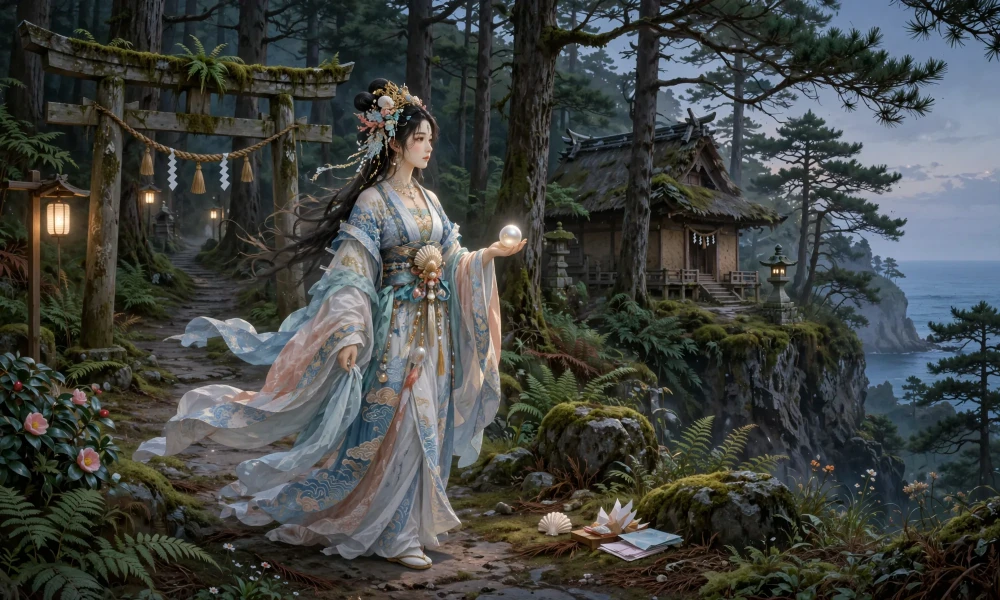
The early texts do not give Tamayori-hime a fixed physical appearance, standard costume, weapon, or list of supernatural powers. Descriptions of her are focused on kinship, nursing, marriage, and childbirth rather than on visual attributes. Later artistic representations may show her as a noble woman, a sea-associated princess, or a shrine deity, but these images should not be mistaken for a single canonical appearance.
Her most important symbolic association is the movement between sea, family, and succession. She comes from a marine realm yet becomes the mother of a lineage that belongs to the land-based political order described by the early chronicles. In this respect, she participates in a recurring pattern in Japanese mythology: a hero or ruling ancestor establishes a relationship with a being from a powerful nonhuman realm, and the resulting offspring unite different sacred domains.
Her role as a foster mother is also significant. Toyotama-hime gives birth, but Tamayori-hime raises the child and enables the lineage to continue. This distinction between biological motherhood and caregiving motherhood is explicit in the story, even though the texts do not offer a separate theological explanation of it. Tamayori-hime’s motherhood is therefore both personal and political: she protects the child and becomes an ancestor of the ruling dynasty.
The possible association of her name with spiritual receptivity has encouraged comparisons with women who serve as mediums, ritual specialists, or vessels for divine presence. Such comparisons may be useful in the study of ancient Japanese religion, but they remain interpretations rather than a securely stated attribute of the mythic character. The chronicles do not plainly identify Tamayori-hime as a shrine maiden or oracle.
The Kamo Tamayori-hime
A different Tamayori-hime appears in the origin traditions of the Kamo shrines in Kyoto. In this story, Tamayori-hime is associated with the Kamo community and becomes the mother of Kamo Wakeikazuchi, a kami connected with thunder and the sacred authority of the Kamo shrines.
According to the well-known Kamo tradition, Tamayori-hime is bathing in or near the Kamo River when she sees a red arrow floating on the water. She takes the arrow home and places it beside her sleeping place. Through contact with the arrow, she becomes pregnant and gives birth to Kamo Wakeikazuchi. The red arrow is a sign of divine power, and the unusual conception explains the child’s extraordinary nature and his connection with thunder.
The precise form and transmission of this narrative vary. It is preserved through Kamo shrine traditions and accounts associated with the sacred history of the shrine complex, rather than being identical with the sea-cycle narrative in the Kojiki. In the Kamo context, Tamayori-hime is connected with the river, ritual purity, female fertility, and the arrival of a divine force from outside ordinary human generation.
The Kamo story has sometimes been combined with the story of Watatsumi’s daughter because both women are called Tamayori-hime and both become mothers of powerful male kami. That combination is not warranted by the sources. The sea-associated figure is the sister of Toyotama-hime and the wife of Ugayafukiaezu. The Kamo figure is the mother of Kamo Wakeikazuchi, and her story centres on the red arrow and the Kamo River. Their shared name may reflect related ideas about divine conception or sacred receptivity, but it does not prove that they were originally one goddess.
Religious and cultural significance
The sea-associated Tamayori-hime is best understood within the sacred genealogy of the early Japanese court. Her story helped place the imperial ancestry within a chain of marriages linking the earthly hero Hoori to the sea kami Watatsumi. The genealogy does not function as historical evidence that a real woman named Tamayori-hime founded the imperial line. It expresses a mythic claim about the divine origins and legitimacy of the ruling house.
The Kamo Tamayori-hime has a more direct place in shrine worship and local religious identity. The Kamo shrine complex preserves traditions in which the river landscape, the birth of Wakeikazuchi, and the sacred ancestry of the Kamo community are closely connected. In this setting, Tamayori-hime is not merely a character in a story. She is part of a living religious genealogy involving the land, water, fertility, and the continued presence of the shrine kami.
Both traditions place a woman at the centre of a divine birth, but they do so in different ways. The sea Tamayori-hime raises a child born from a marriage between land and sea and then bears the ancestors of a legendary imperial founder. The Kamo Tamayori-hime conceives through contact with a red arrow from the river and gives birth to a thunder kami. Their stories share themes of extraordinary motherhood and sacred descent while retaining distinct settings, relationships, and religious purposes.
Later reception and modern understanding
Tamayori-hime is less prominent in modern popular culture than figures such as Amaterasu, Susanoo, or the dragon-like sea princesses derived from Toyotama-hime. She is nevertheless relevant in the study and practice of Japanese religion because her name remains attached to shrine traditions, mythological genealogies, and discussions of divine motherhood.
Modern retellings sometimes simplify the early narratives by calling Tamayori-hime a sea goddess, a mermaid-like princess, or a dragon king’s daughter. Such descriptions may be imaginative adaptations, but they are not equally supported by the ancient texts. In the earliest surviving accounts, she is specifically the younger sister of Toyotama-hime, a daughter of Watatsumi, a caregiver to Ugayafukiaezu, and the mother of the four sons attributed to her and Ugayafukiaezu.
Her significance lies less in a catalogue of powers than in her position at a series of boundaries: between sea and land, birth and upbringing, human marriage and divine ancestry, and local shrine tradition and court mythology. Keeping the separate Tamayori-hime traditions distinct makes those different meanings clearer.