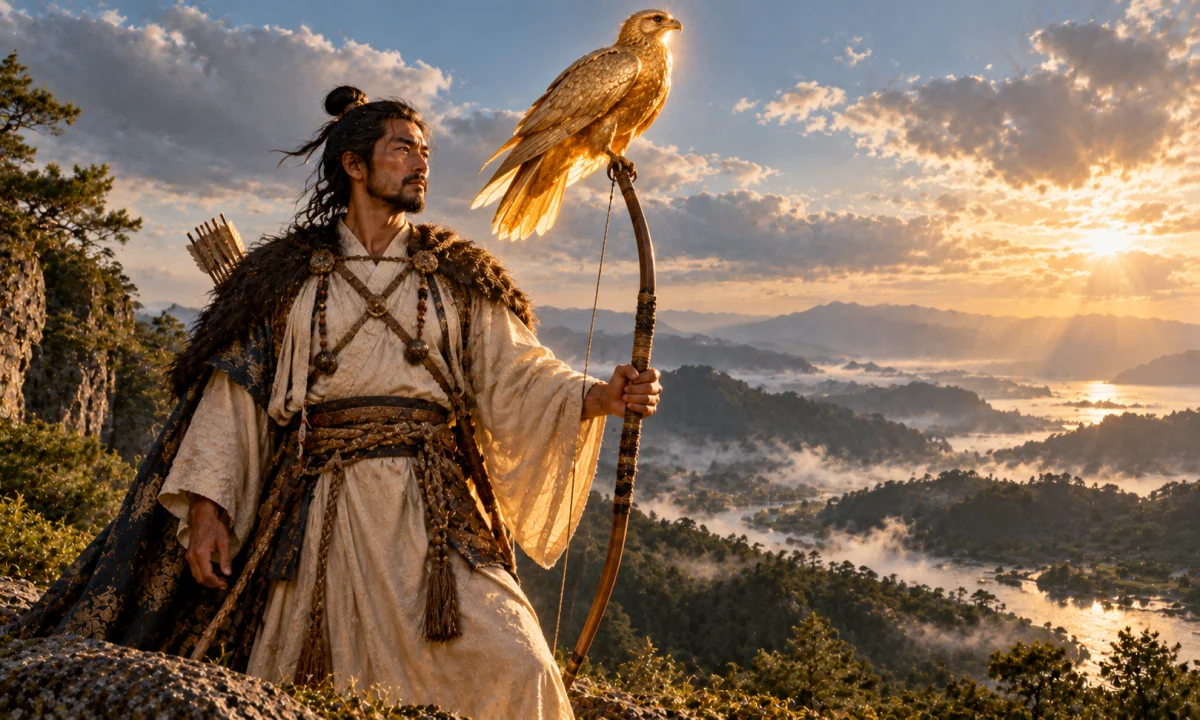
WORLD
WORLD
Izumo
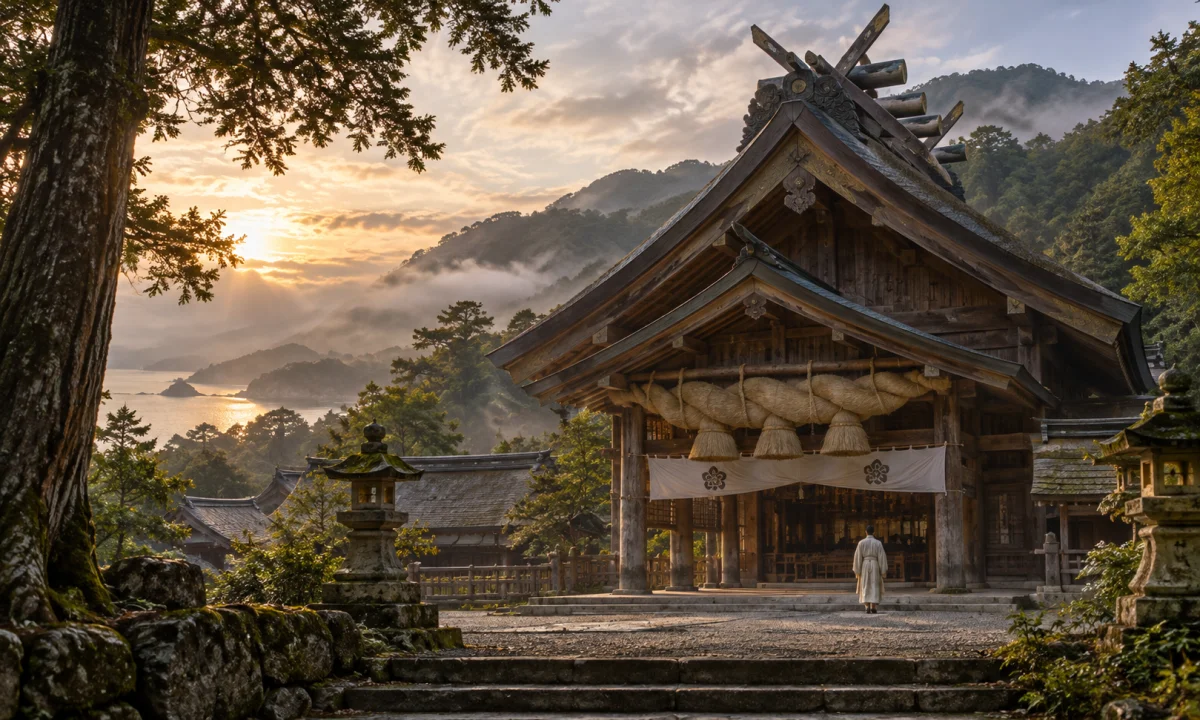
Izumo is an ancient region of Japan associated with some of the most important narratives in Japanese mythology. Located in what is now eastern Shimane Prefecture along the Sea of Japan, Izumo appears in early chronicles as a land of powerful kami, sacred mountains, unusual creatures and decisive events in the formation of the Japanese realm. It is also the home of Izumo Ōyashiro, commonly called Izumo Taisha, one of Japan’s best-known Shinto shrines.
Izumo is not a single god, monster or legendary hero. It is a geographical and cultural region whose traditions became central to the mythic history of Japan. In particular, Izumo is closely connected with Ōkuninushi, a major kami associated with the land, healing, agriculture, relationships and the ordering of society. The region is also linked with the storm deity Susanoo, the serpent Yamata no Orochi and stories about the transfer of earthly authority to the heavenly descendants of Amaterasu.
Izumo as a mythological region
In ancient Japan, places were not merely settings for religious stories. Mountains, rivers, islands and provinces could possess sacred identities and could be understood as dwelling places or manifestations of kami. Izumo developed an especially strong reputation as a land where the human, natural and divine worlds met.
The historical province of Izumo occupied much of the eastern part of present-day Shimane Prefecture. Its landscape includes the Sea of Japan coast, the Shinji Lagoon area, the Hii River and prominent mountains such as Mount Sanbe. The region’s geographical position helped connect communities along the western coast of Japan with the Korean Peninsula and other parts of East Asia. Archaeological remains indicate that Izumo was an important centre of political and ritual activity during the Yayoi and Kofun periods.
Mythic Izumo is larger and less precise than the historical province. In the early written traditions, it can refer to a particular land, a political power, a sacred homeland of certain kami or a symbolic counterpart to the heavenly realm. Its stories preserve traces of local traditions while also presenting them within narratives that support the authority of the imperial line.
Ancient sources and surviving traditions
The principal written sources for Izumo mythology are the Kojiki, completed in 712, the Nihon Shoki, completed in 720, and the Izumo Fudoki, compiled in 733. These works do not provide identical accounts. Each was produced for a particular political and religious purpose, and each represents traditions through its own literary structure.
The Kojiki contains extended episodes set in or connected with Izumo, especially the adventures of Susanoo and the life of Ōkuninushi. The Nihon Shoki includes parallel versions of some stories, sometimes with different names, details or emphases. The Izumo Fudoki is a local geographical record describing place names, landscapes, products, shrines and traditions associated with the province. It is especially valuable because it preserves local material that does not always appear in the imperial chronicles.
These texts are not neutral records in the modern historical sense. They combine oral traditions, ritual concepts, political ideas, genealogies and literary shaping. Some events may preserve memories of ancient regional relationships, but mythology alone cannot establish that a particular divine figure or episode corresponds directly to a historical person or event.
The name Izumo
The Japanese name Izumo is written 出雲, usually interpreted as “coming clouds” or “clouds appearing,” although the exact historical development of the name is not certain. The characters may represent an older spoken name rather than provide a literal explanation of its origin. Some traditional accounts connect the name with striking clouds seen over the land, while modern scholarship treats such explanations cautiously.
Izumo’s climate and geography make clouds a fitting image. The Sea of Japan coast receives substantial rainfall, and the region’s mountains and river valleys often produce dramatic weather. In mythology, however, clouds also carry religious associations. They can suggest the presence of kami, the boundary between realms or the appearance of a significant omen.
Izumo should not be confused with Izumo-no-Okuni, the historical woman traditionally associated with the origins of kabuki performance. Izumo-no-Okuni was a performer said to have come from the Izumo area, but she is a separate historical and cultural figure, not a mythological name for the region itself.
Susanoo and the land of Izumo
One of the best-known Izumo stories concerns Susanoo, the storm and sea-associated kami. In the Kojiki, Susanoo is expelled from the heavenly realm after his destructive conflict with his sister Amaterasu. He descends to a place called Torikami in the land of Izumo, near the upper reaches of the River Hi.
There he encounters an elderly couple, Ashinazuchi and Tenazuchi, and their daughter Kushinadahime. The couple tells Susanoo that an eight-headed, eight-tailed serpent called Yamata no Orochi has already devoured seven of their daughters and is coming for the eighth. Susanoo agrees to protect Kushinadahime.
Susanoo prepares a plan involving eight vessels of strong sake. When the serpent drinks and falls into a stupor, he cuts it apart with his sword. While cutting through one of the creature’s tails, he discovers the sword known as Kusanagi-no-Tsurugi. In the Kojiki, this sword is presented to Amaterasu and later becomes one of the Three Imperial Regalia. The sword is also called Ame-no-Murakumo-no-Tsurugi, often translated as the “Sword of Gathering Clouds of Heaven.”
The story connects several themes: the taming of destructive nature, marriage between a divine hero and a local woman, the recovery of a sacred weapon and the relationship between Izumo traditions and the imperial mythology of Yamato. The serpent may be interpreted in different ways, including as a symbol of dangerous rivers, floods or rival forces, but no single interpretation is universally accepted.
The precise relationship between Susanoo and Izumo varies across texts. The Kojiki presents a rich Izumo cycle, while the Nihon Shoki gives alternative accounts and sometimes places events differently. Susanoo is also connected with the Korean peninsula, the sea, storms and the heavenly realm, so reducing him to an exclusively local Izumo deity overlooks the diversity of his traditions.
Ōkuninushi and the creation of the land
The central mythological figure of Izumo is Ōkuninushi, whose name means roughly “Great Land Master” or “Great Lord of the Land.” He is also known by several other names, including Ōnamuchi and Ashihara-no-Shikoo. These names appear in different episodes and textual traditions, and their precise relationships have been discussed by scholars. They are generally treated as names or aspects of the same major kami within the Izumo cycle, rather than as entirely unrelated beings.
Ōkuninushi belongs to a large family of kami descended from Susanoo in the Kojiki’s genealogy. His early stories portray him as a vulnerable younger figure who suffers violence from his many brothers, often called the Yasotsukami or “eighty gods.” In one episode, the brothers kill him by driving him beneath a fallen tree or crushing him with a rock. His mother restores him, but the brothers kill him again. He eventually seeks help from Susanoo in the realm of Ne-no-Kuni.
In Ne-no-Kuni, Ōkuninushi undergoes trials imposed by Susanoo. He survives danger involving fire and snakes, and he escapes with Susanoo’s weapons and wife, Suseribime. Susanoo then acknowledges him as a worthy ruler, although the episode includes both approval and a challenge to Ōkuninushi’s future authority. These stories portray him as a figure who gains power through endurance, intelligence and transformation rather than through uncomplicated strength.
Ōkuninushi is also associated with Sukunabikona, a small kami who arrives across the sea on a vessel made from a plant pod. Together they establish the land, develop methods of healing and agriculture, and bring order to a world that is still incomplete. Sukunabikona later departs or disappears, and the partnership ends in an unresolved manner in the surviving traditions.
Because of these activities, Ōkuninushi is often described as a deity of nation-building. This phrase can be misleading if it is understood in a modern political sense. His “creation” of the land involves healing, cultivation, ritual knowledge and the regulation of relationships among humans and kami. He is a culture hero who makes the world inhabitable and socially ordered.
The transfer of earthly authority
The most politically significant Izumo myth is the kuniyuzuri, usually translated as the “transfer” or “cession of the land.” According to the Kojiki and related traditions, the heavenly kami decide that the earthly realm should be ruled by descendants of Amaterasu. They send several envoys to Ōkuninushi, asking him to yield authority over the land.
The negotiations are not presented identically in every source. The Kojiki introduces emissaries such as Ame-no-Hohi and Takemikazuchi, while the best-known version centres on Takemikazuchi, a powerful martial kami. Ōkuninushi’s son Kotoshironushi agrees to the transfer, but another son, Takeminakata, refuses. Takeminakata challenges Takemikazuchi and is defeated in a contest of strength. He withdraws to the region of Suwa, where he becomes associated with the deity of Suwa Taisha.
After Ōkuninushi accepts the transfer, he requests a magnificent shrine in which he may continue to govern the unseen or spiritual affairs of the land. This request is traditionally connected with the origin and status of Izumo Taisha. The story therefore does not simply depict Ōkuninushi as defeated or erased. It gives him a distinct sphere of authority, while the heavenly lineage receives control over the visible political realm.
Scholars have interpreted the kuniyuzuri in several ways. It may reflect an ideological account of the relationship between the Yamato court and powerful regional traditions, particularly those associated with Izumo. It may also encode older ideas about different forms of sovereignty: one concerned with public government and another concerned with ritual, fertility, the dead or the unseen. The myth should not be treated as a straightforward historical record of a single conquest.
Izumo Taisha and religious significance
Izumo Taisha is one of the most important centres of worship for Ōkuninushi. Its formal name, Izumo Ōyashiro, means approximately “Great Shrine of Izumo.” The shrine’s main deity is commonly identified as Ōkuninushi, though Shinto traditions can express a deity through multiple names, forms and ritual relationships.
The shrine is famous for its large-scale architecture, distinctive ritual customs and association with marriage and human relationships. The connection with relationships does not mean that Ōkuninushi is merely a deity of romance. His broader sphere includes the ties that connect people, families, communities, kami and the natural world. The Japanese word en, often translated as “connection” or “bond,” is frequently used in explanations of his role.
Izumo Taisha’s buildings have been rebuilt repeatedly over the centuries. The present structure belongs to a long architectural tradition rather than surviving unchanged from the age described in the myths. Archaeological discoveries near the shrine, including exceptionally large timber foundations found in the late twentieth century, have supported the view that the site had monumental structures in the medieval period. They do not, by themselves, prove that every detail of the mythic account reflects an ancient historical event.
Kannazuki and the gathering of the kami
A widespread later tradition says that the kami of Japan gather at Izumo Taisha during the tenth month of the traditional lunar calendar. In most of Japan, this month is called Kannazuki, “the month without gods,” because the kami are thought to have departed. In Izumo, it is called Kamiarizuki, “the month with gods,” because the deities are believed to assemble there.
The gathering is associated particularly with Ōkuninushi and the arrangement of human relationships, including marriages and other important connections. This belief is influential in modern religious practice and popular descriptions of Izumo, but it should not be presented as a universal feature of the oldest Japanese mythology. The surviving early chronicles do not give a simple, complete account of all the kami travelling to Izumo each year. The custom developed through later religious traditions, shrine practices and regional interpretation.
The annual observances at Izumo Taisha and nearby shrines demonstrate how Japanese mythology remains embedded in ritual calendars. Myths are not only stories from the past; they are also frameworks through which communities understand seasonal movement, worship, ancestry and the continuing presence of kami.
Izumo and the unseen realm
Izumo is often associated with the boundary between the visible world and a hidden or spiritual realm. Ōkuninushi’s request to govern the unseen affairs of the land, along with his connections to death, healing and fertility, contributes to this image. Yet Izumo should not be equated too simply with a single Japanese underworld.
Japanese mythology uses several terms for otherworldly places, including Yomi, Ne-no-Kuni and Tokoyo-no-Kuni. Their meanings and relationships are not entirely consistent across texts. Yomi is strongly associated with the death of Izanami in the Kojiki, while Ne-no-Kuni is the realm visited by Ōkuninushi and connected with Susanoo. Tokoyo can suggest a distant, eternal or otherworldly land. Later interpretations sometimes bring these realms together, but the ancient sources do not create one fully systematized map of the afterlife.
Cultural interpretation and historical importance
Izumo’s importance lies partly in the contrast it creates with the heavenly and Yamato-centred portions of Japanese mythology. The narratives of Amaterasu, Ninigi and the imperial descent emphasize heavenly legitimacy and dynastic succession. The Izumo stories emphasize local land, ancestral power, dangerous nature, healing, marriage and the authority of Ōkuninushi.
The relationship between these traditions is not simply one of opposition. The early chronicles incorporate Izumo’s major kami into a larger sacred history, while preserving the region as a place with its own exceptional authority. The kuniyuzuri provides a mythological explanation for this relationship: earthly power passes to the heavenly lineage, but Ōkuninushi receives continuing authority over an important unseen domain.
Modern scholarship also considers archaeology, place-name traditions and the political history of western Japan when studying Izumo. Evidence supports the existence of a substantial ancient culture in the region, but there is ongoing debate about how closely archaeological remains correspond to the political entity imagined in the chronicles. Claims that Izumo was certainly an independent “kingdom” that was later conquered in one identifiable event go beyond what the evidence can securely establish.
Izumo in modern culture
Izumo remains a major destination for Shinto pilgrimage, historical tourism and the study of Japanese mythology. Its shrines, festivals, museum collections and archaeological sites keep the regional traditions visible in contemporary Japan. The association with marriage and fortunate relationships is especially prominent in popular travel and religious practice.
Modern novels, manga, games and films may use Izumo as a setting or draw on its names and characters. Such works often combine Susanoo, Ōkuninushi, Amaterasu, Yamata no Orochi and other figures in ways that do not follow any single ancient source. These adaptations can make the myths widely known, but their invented relationships, powers or storylines should be distinguished from the traditions preserved in the Kojiki, Nihon Shoki, Izumo Fudoki and shrine practice.