WORLD
WORLD
Takami-musubi

Takami-musubi is a primordial kami of Japanese mythology, best known from the Kojiki and Nihon Shoki. His name is also written Takamimusubi, Takami-musubi-no-kami, or Takamimusuhi-no-kami. He is associated with the generative power called musubi, with the heavenly realm, and with the divine authority that directs the formation of Japan and the descent of the heavenly grandchild. Although often described as a creator deity, Takami-musubi does not have a single, simple identity. His role differs between early Japanese texts and later religious interpretations.
Origins in Japanese myth
Takami-musubi appears near the beginning of the Kojiki, Japan’s oldest surviving extended mythological and genealogical work, compiled in 712. In its opening account, the world is not created by a single craftsman-like god. Instead, the first divine presences emerge as the cosmos takes shape.
The first kami to appear are Ame-no-Minakanushi-no-kami, Takami-musubi-no-kami, and Kamimusubi-no-kami. These three are described as hitorigami, a term commonly understood as referring to deities who appear singly rather than as members of a male-and-female pair. They are also called zōka sanshin, or the “three kami of creation.” After appearing, they withdraw from visible activity. The text therefore presents them as primordial principles or powers rather than as gods who participate in long narrative adventures.
Takami-musubi’s early appearance is especially important because it places him at the threshold between unformed existence and the ordered world of later mythology. He is not introduced as a warrior, ruler, or human-like ancestor. His significance lies in the power associated with his name and in his later authority among the heavenly kami.
The Nihon Shoki, compiled in 720, preserves several accounts of the origins of the world rather than one continuous version. Its opening chapters do not always arrange the first gods in the same way as the Kojiki. In some passages, Takami-musubi is treated as an early heavenly deity who plays a more active role in cosmic and political events. These differences show that early Japanese mythology consisted of overlapping traditions, not a single fixed system of doctrine.
The meaning of the name
The name Takami-musubi is conventionally connected with the idea of musubi. The word has a wide range of meanings and associations, including joining, bringing into being, growth, generation, and the productive process by which relationships or forms come into existence. It should not be reduced to the modern idea of romantic “bonding.” In a religious context, musubi can describe a mysterious vital force that causes life, order, and transformation to arise.
The first element, taka, generally conveys height, loftiness, or exalted status. The mi may function as an honorific or intensifying element, while kami identifies the being as a deity. The name is therefore often interpreted along the lines of “the exalted deity of generative power” or “the high kami of musubi.” Exact translations vary because early Japanese divine names do not always behave like ordinary descriptive phrases.
The element musubi also appears in the name of Kamimusubi, the other major primordial kami associated with generative activity. The relationship between the two names has encouraged comparison between Takami-musubi and Kamimusubi, but the surviving texts do not provide a complete theological explanation of how the two powers differ. Some interpretations associate Takami-musubi more strongly with the heavenly realm and Kamimusubi with the earthly or nurturing side of creation. That contrast can be useful as a scholarly model, but it is not stated as a clear doctrine in the early myths.
Identity and classification
Takami-musubi is generally classified as a kami, the broad Japanese category that includes divine beings, sacred forces, ancestral presences, and powers associated with natural or social phenomena. He is not a “god of” one narrow domain in the way that later popular summaries sometimes suggest. His identity is more structural: he represents generative potency and acts as a high-ranking heavenly authority.
The Kojiki calls him a hidden or withdrawn deity after his first appearance. This does not mean that he is unimportant. In Japanese mythological writing, a deity’s withdrawal can indicate primordial status. The most ancient powers may remain outside ordinary divine society while still making the existence and authority of later kami possible.
In later episodes, Takami-musubi becomes far more active. He appears alongside Amaterasu in decisions concerning the conquest or transfer of the terrestrial land. He also occupies a prominent place in accounts of the heavenly grandchild’s descent to Japan. This movement from remote cosmic principle to active heavenly authority may reflect the merging of different religious and political traditions.
Role in the heavenly government
One of Takami-musubi’s most notable functions is his participation in the decisions of the heavenly kami concerning Ashihara-no-Nakatsukuni, usually translated as the “Central Land of Reed Plains.” This is the terrestrial world inhabited by the earthly kami and, eventually, human communities.
In the Kojiki, Amaterasu and Takami-musubi are involved in sending divine envoys to persuade or compel Ōkuninushi, the powerful ruler of the earthly land, to yield it to the heavenly lineage. Several messengers are dispatched before the heavenly side sends Takemikazuchi, a formidable warrior deity, together with the divine bird Ame-no-Torifune. The negotiations eventually result in Ōkuninushi’s withdrawal from political rule and the establishment of the heavenly descendants as the legitimate rulers of the land.
Takami-musubi’s role in this story is not that of the main combatant. Instead, he belongs to the council or authority that defines the proper order of the world. His presence gives the heavenly mission a cosmic and political legitimacy. The story is also closely connected with the mythology of imperial descent, since the heavenly rulers are presented as ancestors of the Japanese imperial line.
The Nihon Shoki preserves related episodes with different details and wording. In its versions of the pacification of the land, Takami-musubi may appear as the leading heavenly authority who issues commands and organizes the mission. Amaterasu is sometimes central to the narrative, while in other passages Takami-musubi has the more prominent position. These variations are important: they show that the relative status of major heavenly kami was not represented identically in every early tradition.
Relationship to the heavenly grandchild
Takami-musubi is strongly connected with Ninigi-no-Mikoto, the heavenly grandchild whose descent to Japan forms the mythological foundation for the later imperial genealogy. In the standard genealogical tradition, Ninigi is the child of Ame-no-Oshihomimi and a daughter of Takami-musubi. The name of this daughter varies between textual traditions and modern romanization, but she is commonly known as Takuhatachiji-hime or Yorozuhata-Toyoakitsushi-hime.
Ame-no-Oshihomimi is associated with Amaterasu, while Ninigi’s mother belongs to Takami-musubi’s lineage. Ninigi therefore links two important heavenly genealogies. His descent is not merely a journey from one place to another. It is the transfer of heavenly authority into the terrestrial world and the beginning of the line that eventually leads to Emperor Jimmu in the mythic genealogy.
Before Ninigi descends, the heavenly kami give him instructions concerning rule, ritual objects, and the ordering of the land. The precise participants and details vary between the Kojiki and Nihon Shoki, but Takami-musubi is consistently associated with the authority behind the mission. He is thus both a primordial generative power and an ancestor or senior relative within the divine genealogy of rulership.
Attributes and symbolism
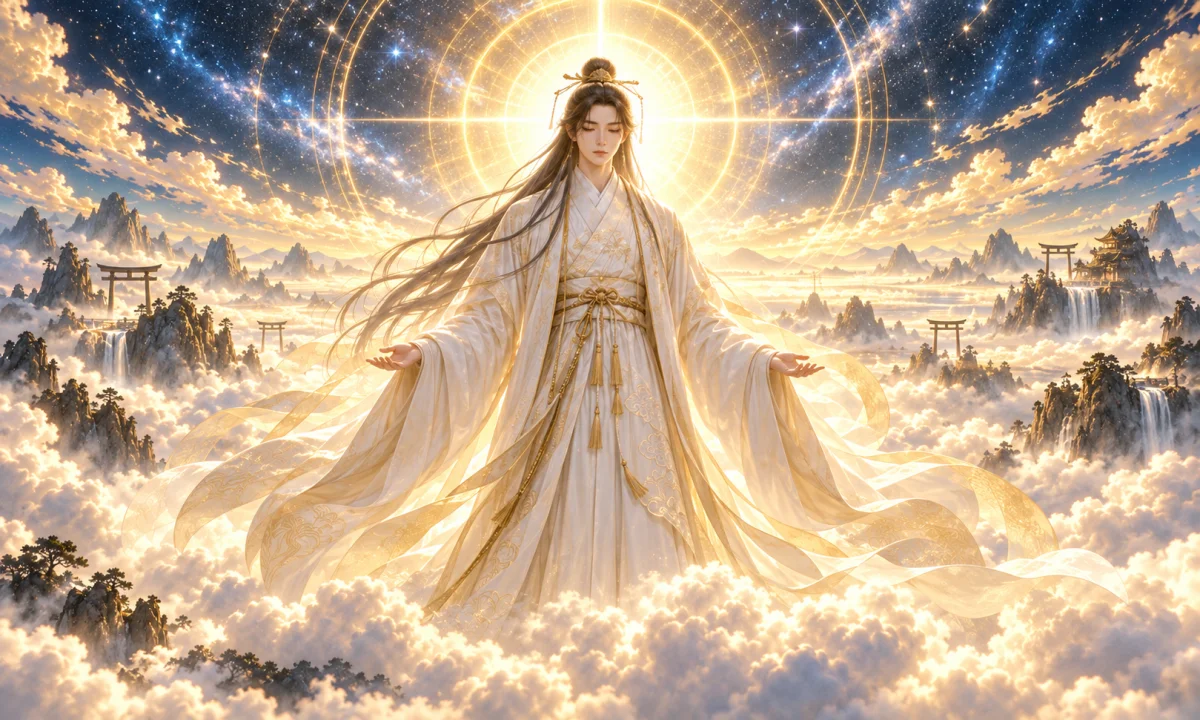
Unlike many famous kami, Takami-musubi has no standard physical appearance. The early texts do not describe him with a distinctive body, costume, weapon, animal companion, or personal emblem. Artistic representations are consequently uncommon compared with those of figures such as Amaterasu, Susanoo, or Inari.
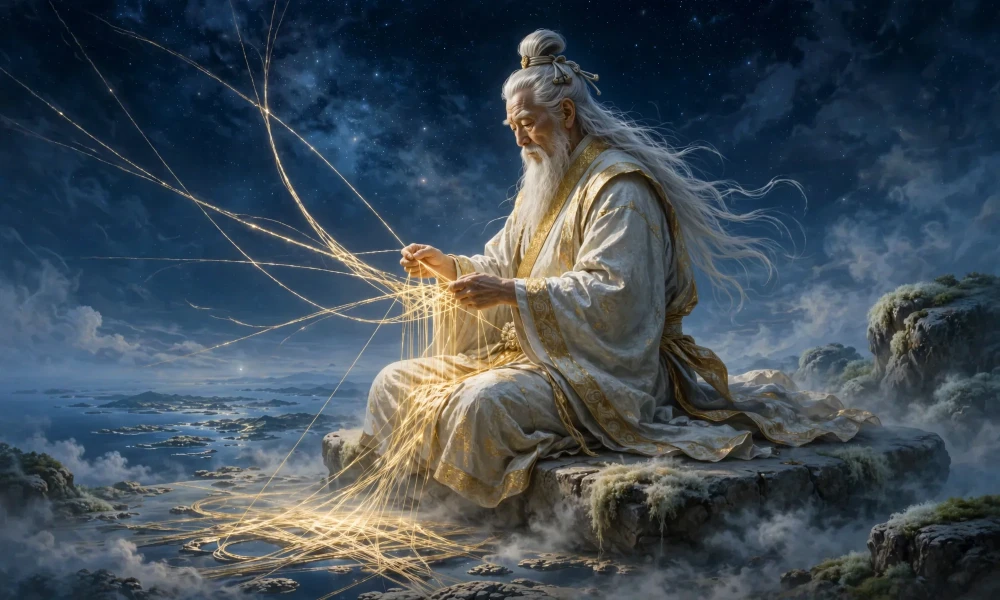
His most important “attribute” is the power of musubi. This power can be understood as the capacity to bring separate elements together and produce new life, relationships, institutions, or forms of order. In that sense, Takami-musubi belongs to a level of religious thought where creation is not necessarily a single event. It is an ongoing process of emergence and connection.
His association with the high heavenly realm adds another dimension. Takami-musubi is not simply a force of biological fertility. He is linked with the formation of a legitimate cosmic hierarchy and with the transmission of authority from heaven to earth. His generative power becomes politically meaningful in the stories of divine descent and imperial ancestry.
It is tempting to label Takami-musubi a “sky god,” but that description is incomplete. He is associated with Takamagahara, the High Plain of Heaven, and he acts among the heavenly kami, yet the early sources do not present him primarily as a personification of the physical sky. Likewise, calling him a “creator god” can obscure his distinctive role. He is one of several primordial powers and is more often shown enabling or authorizing creation than personally making every feature of the world.
Takami-musubi and Kamimusubi
Confusion between Takami-musubi and Kamimusubi is common because their names share the element musubi and because both appear among the earliest kami in the Kojiki. They are separate deities, not two names for the same figure.
Takami-musubi is commonly associated with exalted heaven, heavenly command, and the genealogical authority leading to Ninigi. Kamimusubi is also a primordial generative kami, but later stories connect Kamimusubi with Ōkuninushi and with the support of earthly or land-based divine forces. These associations may suggest a broad contrast between heavenly and terrestrial dimensions, although the texts do not present the pair as a neat, balanced opposition.
Neither deity should be automatically identified with Izanagi or Izanami. Those two are the male-and-female creator pair who produce islands and numerous kami in a later stage of the mythic sequence. Takami-musubi and Kamimusubi appear before that pair in the Kojiki and belong to a more primordial category.
Takami-musubi should also be distinguished from Amaterasu. Both can take part in heavenly decisions, and both are connected with the imperial genealogy, but they are not interchangeable. Amaterasu is the solar kami and a major figure in myths of light, ritual conflict, and royal descent. Takami-musubi is a generative and authoritative primordial kami whose narrative presence is often more institutional than personal.
Religious and historical significance
The prominence of Takami-musubi in the early chronicles reflects more than abstract theology. The Kojiki and Nihon Shoki were compiled in a courtly environment in which genealogies, myths, ritual precedence, and claims to political legitimacy were closely connected. Stories of heavenly descent provided a sacred framework for explaining the authority of the imperial house.
Takami-musubi’s role was especially suitable to this framework. He stands at the beginning of the divine order, participates in the decision to transfer rule over the land, and belongs to the ancestry of Ninigi. His generative name also supports the idea that social and political order is something brought into being through a sacred connection between heaven and earth.
At the same time, the myth of heavenly takeover does not erase the importance of earthly traditions. Ōkuninushi and other kuni-tsu-kami, or earthly kami, remain powerful figures, and the transfer of the land is presented through negotiation, ritual settlement, and the recognition of local divine authority as well as through force. Takami-musubi’s presence therefore belongs to a complex process of integrating different religious and regional traditions into a court-centered mythological structure.
Later Shinto thinkers interpreted the primordial kami in different ways. Some treated Takami-musubi as a highly abstract divine principle; others emphasized his relation to imperial ancestry, creation, or ritual order. These interpretations belong to later intellectual and religious history rather than representing a single universally accepted meaning in ancient Japan.
Later worship and modern representation
Takami-musubi has not achieved the same broad popular recognition as Amaterasu, Susanoo, or Inari. His identity is primarily preserved through classical mythology, shrine traditions, genealogical accounts, and theological interpretation. Worship practices and local associations may differ, and the existence of a shrine dedicated to a deity with a related name does not by itself establish that every such tradition preserves the same ancient figure.
In modern fiction, games, manga, and other popular media, Takami-musubi may appear as a powerful creator, a heavenly administrator, or a god connected with fate and divine ancestry. Such portrayals often expand his personality and abilities because the early sources provide few narrative details or physical characteristics. These creative versions should be regarded as modern adaptations rather than as direct descriptions from the Kojiki or Nihon Shoki.
Traditional Takami-musubi is most accurately understood as a primordial kami of generative connection and heavenly authority. His importance lies less in a catalogue of adventures than in the position he occupies between cosmic emergence, divine genealogy, and the mythological establishment of rule on earth.