WORLD
WORLD
Okuninushi
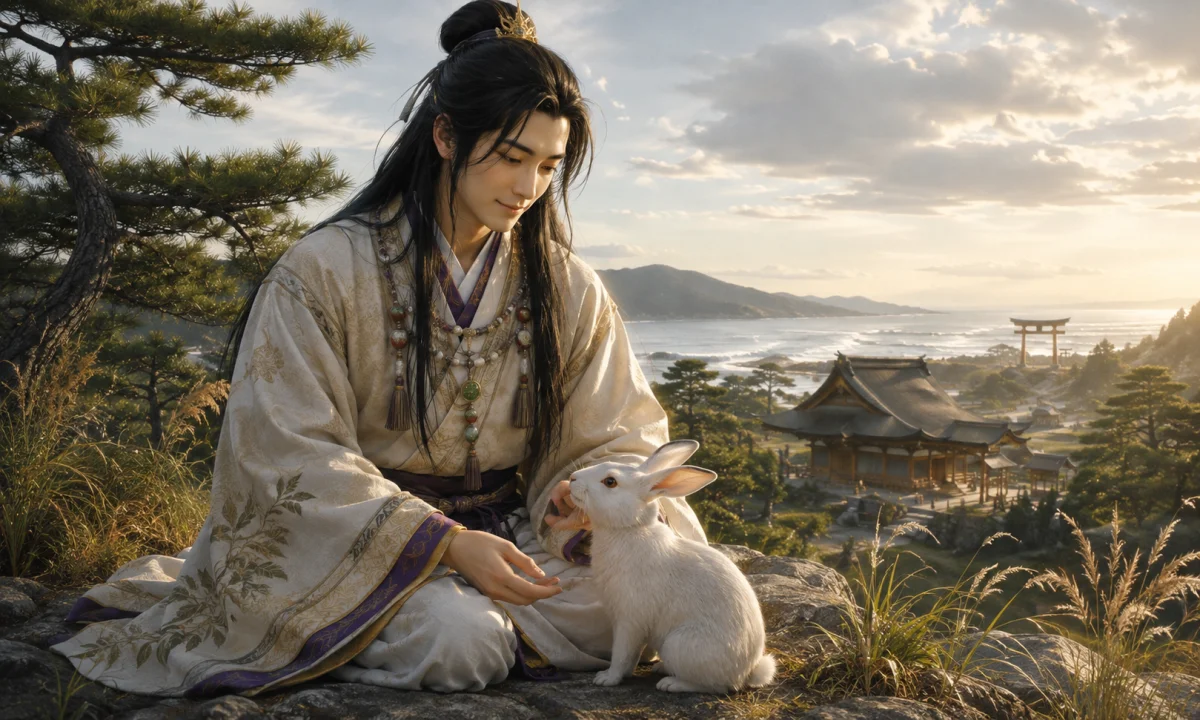
Ōkuninushi, also written Okuninushi or Ōkuninushi-no-Kami, is one of the most important deities in Japanese mythology. He belongs especially to the religious traditions of Izumo, a region on the western coast of Honshū, and is associated with the land, nation-building, healing, marriage, prosperity and the unseen forces that shape human life. In Shinto, he is usually classified as a kunitsukami, a deity connected with the land and its indigenous powers, in contrast to the amatsukami, or heavenly deities, associated with the line of the imperial ancestors.
Ōkuninushi is best known from the Kojiki, compiled in 712, and the Nihon Shoki, completed in 720. His legends also belong to the wider tradition of Izumo, including material preserved in the Izumo Fudoki of 733. These records do not present one perfectly consistent biography. They preserve different versions of myths shaped by regional traditions, court ideology and later efforts to organise the many deities of Japan into a coherent sacred history.
Origins and cultural setting
Ōkuninushi's mythology reflects the importance of Izumo as a centre of religious and political tradition. In the creation narratives of the Kojiki and Nihon Shoki, the primordial deities Izanagi and Izanami generate the islands of Japan and numerous kami. Later stories focus on the relationship between the heavenly lineage associated with Amaterasu and the earthly powers represented by Ōkuninushi.
In these narratives, Ōkuninushi is not simply a god of one narrow function. He appears as a ruler, culture hero, healer, magician, ancestor and lord of an invisible realm. His stories are concerned with the establishment of social order: the founding of settlements, the arrangement of marriages, the use of medicinal knowledge, the control of dangerous forces and the transfer of authority from one divine lineage to another.
The surviving written accounts were produced in an era when the Japanese court was consolidating political power. As a result, the stories about Ōkuninushi can be read on several levels. They are sacred traditions about the gods, records of regional religious memory and myths that explain why the heavenly descendants of Amaterasu became the ruling dynasty. Scholarly interpretations differ over how directly these narratives reflect historical events. The myths should not be treated as straightforward chronicles of an actual conquest or political agreement.
Name and identity
The name Ōkuninushi is commonly interpreted as “Great Master of the Land” or “Great Lord of the Land.” The element kuni means “land” or “country,” while nushi conveys the sense of a lord or master. His full divine name, Ōkuninushi-no-Kami, therefore expresses his role as a great lord connected with the land and its people.
The Kojiki gives him numerous other names, including Ōnamuchi, Ōmononushi, Utsushikunidama and Yachihoko. These names are not always easy to interpret, and their precise relationships vary according to the source and the tradition being considered. Some may preserve separate local identities that were later grouped together, while others describe aspects or powers of the same deity.
Ōkuninushi is sometimes identified with Ōmononushi, especially in later Shinto interpretation, but the ancient texts do not treat the two figures in an entirely uniform way. In the Nihon Shoki, Ōmononushi is strongly associated with Mount Miwa and the deity of the sacred mountain there. The relationship between Ōkuninushi and Ōmononushi is therefore a matter of textual interpretation and religious development rather than a simple fact accepted identically in every tradition.
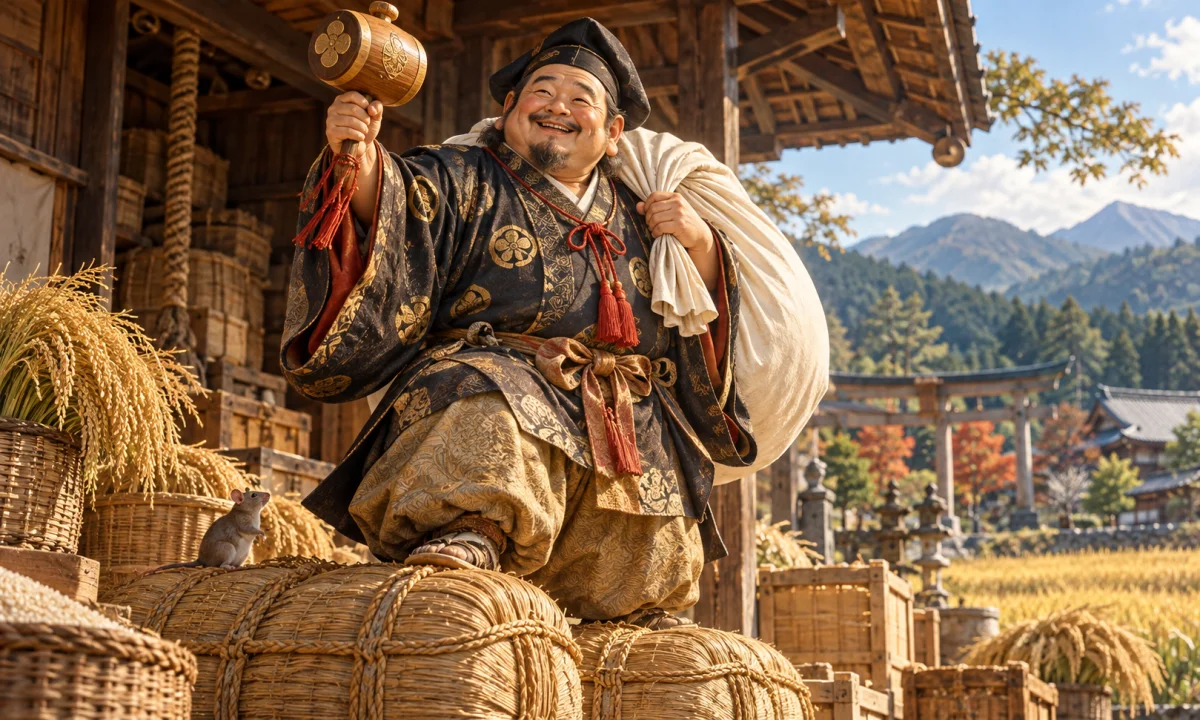
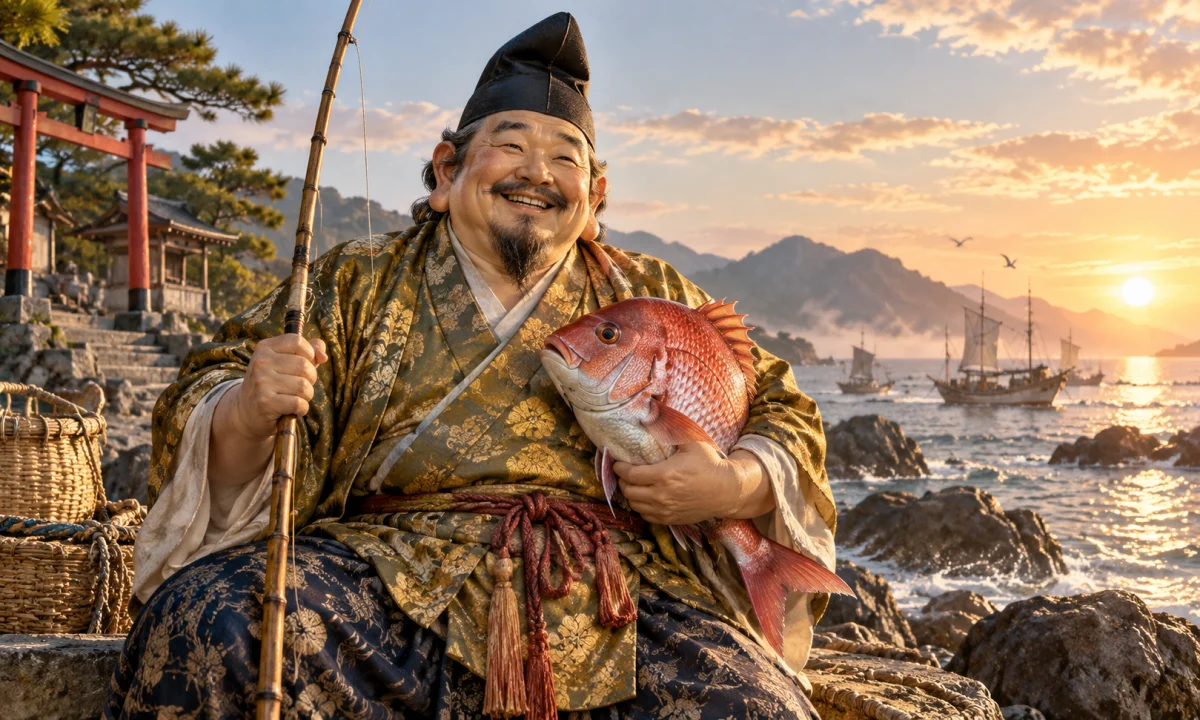
Another name, Daikoku or Daikokuten, became associated with Ōkuninushi in medieval Japan. This resulted partly from a phonetic resemblance between Ōkuninushi's name and the name of the Buddhist deity Mahākāla, known in Japan as Daikokuten. Over time, Buddhist and Shinto traditions influenced one another, and the two figures were frequently combined in popular religious practice. They were not originally the same deity. The cheerful household god often represented with a sack and a mallet belongs primarily to the later Daikokuten tradition, even though he became closely linked with Ōkuninushi.
Appearance and divine character
Ancient Japanese mythology does not provide a single standard physical description of Ōkuninushi. He is not defined by a fixed costume, weapon or monstrous form. Artistic representations vary according to the role being emphasised: a dignified ruler, a benevolent deity, a healer, a matchmaker or a figure associated with the hidden world.
His character is similarly complex. Ōkuninushi is often compassionate and generous, but his myths also portray him as vulnerable, threatened and repeatedly forced to use intelligence rather than brute strength. He suffers persecution from his older brothers, undergoes dangerous trials and must negotiate with powerful divine figures. His success depends on endurance, alliances, magical assistance and his ability to establish relationships.
Several traditions connect him with the power called chi, sometimes translated as spiritual force, life force or mysterious efficacy. This association helps explain why later worship connects him with healing, medicine, protection and the management of unseen influences. The interpretation of such terms is difficult because ancient Japanese religious concepts do not correspond exactly to modern Western categories such as “magic” or “religion.”
The white hare of Inaba
One of Ōkuninushi's most famous stories concerns the White Hare of Inaba. In the Kojiki, Ōkuninushi is initially one of many brothers, all of whom desire to marry Princess Yagami of Inaba. The brothers travel together, while Ōkuninushi follows behind carrying their baggage. This establishes his lowly and mistreated position at the beginning of the story.
On the way, the brothers encounter a white hare that has lost its fur. The hare explains that it crossed the sea by deceiving a group of crocodile-like beings, usually called sharks in some translations. It invited them to form a line so that it could count how many creatures lived in the sea. After crossing on their backs, the hare revealed that it had tricked them. One of the creatures tore away its fur in anger.
The brothers tell the suffering hare to bathe in salt water and lie in the wind. This makes its pain worse. Ōkuninushi, arriving later, advises it to wash in fresh water and cover itself with pollen or the flowers of a plant. The hare recovers and prophesies that Ōkuninushi, rather than his cruel brothers, will marry Princess Yagami.
The episode presents Ōkuninushi as compassionate and knowledgeable, in contrast with the arrogance of his brothers. The hare is also more than a helpless animal: it is a prophetic being capable of recognising the qualities of the true future ruler. The story has been interpreted as a tale about ethical conduct, healing and the reversal of social expectations. Its exact symbolic meaning is not fixed, and interpretations should not be treated as a single ancient explanation.
Persecution by his brothers
Ōkuninushi's brothers become jealous when Princess Yagami chooses him. They repeatedly try to kill him. In one episode, they crush him beneath a boulder and then revive him through the intervention of his mother. In another, they trick him into entering a forest and set it on fire. Ōkuninushi survives with help from a mouse, which shows him a path beneath the ground and provides information about the fire.
These episodes emphasise a recurring pattern in his mythology: destruction is followed by restoration. Ōkuninushi is not an invincible warrior. He is a deity who must endure death-like danger and emerge through assistance from animals, relatives or supernatural allies. His survival contributes to his later identity as a god connected with healing and the renewal of life.
His mother eventually sends him to the realm of Susanoo, the storm deity who lives in the world beneath or beyond the ordinary human realm. There, Ōkuninushi meets Susanoo's daughter, Suseribime. Their relationship becomes one of the central alliances in his rise to power.
Trials in the realm of Susanoo
Susanoo does not readily accept Ōkuninushi as a suitable partner for Suseribime. He subjects the young deity to a series of dangerous tests. In one trial, Susanoo shoots arrows into a field and orders Ōkuninushi to retrieve them. Once he is inside the field, Susanoo sets it on fire. Suseribime helps him escape, and a mouse provides crucial assistance by revealing a safe place and recovering the arrows.
In another episode, Susanoo places a centipede or similar creature in Ōkuninushi's hair, testing his courage and obedience. Suseribime secretly helps him pass the trial. The stories do not portray Ōkuninushi as winning through physical superiority. Instead, he succeeds through patience, loyalty and the aid of his future bride.
Eventually, Ōkuninushi steals Susanoo's great sword, bow and arrows, and a precious instrument associated with the older deity. He also causes Susanoo's hair to become trapped and binds him to a tree or pillar before escaping with Suseribime. From a safe distance, Susanoo recognises Ōkuninushi's achievement and grants him authority, while warning him to defeat his brothers and establish himself as ruler.
The relationship between Ōkuninushi and Susanoo varies in emphasis. In some interpretations, Susanoo is a hostile father-in-law and dangerous predecessor. In others, he is a powerful elder who tests and then authorises Ōkuninushi. Their connection also links Izumo's major divine traditions, since both figures are strongly associated with the region.
Ōkuninushi as ruler and culture hero
After overcoming his brothers, Ōkuninushi becomes the ruler of the central land, often called Ashihara no Nakatsukuni, the “Central Land of Reed Plains.” The term does not necessarily describe a clearly bounded historical nation in the modern sense. It refers to the earthly realm inhabited by human communities and earthly kami.
Ōkuninushi is credited with organising the land and making it habitable. In the Kojiki, the deity Sukunabikona arrives across the sea in a tiny boat made from a pod or plant husk. Sukunabikona becomes Ōkuninushi's companion. Together they develop the land, establish knowledge of agriculture and medicine, and deal with harmful or disorderly forces.
Sukunabikona eventually departs by travelling beyond the ordinary human world. Ōkuninushi is left to continue the work of ordering the land. This partnership is important because it presents civilisation as a cooperative achievement rather than the result of one deity's power alone. The two figures are closely associated with healing, agriculture, fertility and the management of the natural environment.
Ōkuninushi also has numerous relationships with female deities in the myths. Suseribime is his most prominent wife in the narrative of Susanoo's realm, while Princess Yagami of Inaba is connected with his early rise. Other traditions mention additional consorts and descendants. These stories reflect the importance of marriage alliances and genealogy in explaining the relationships among regional divine lineages. They should not be reduced to a simple catalogue of romantic episodes.
The transfer of the land
The most politically significant story involving Ōkuninushi is the kuniyuzuri, usually translated as the “transfer” or “relinquishment of the land.” The heavenly deities claim that the earthly realm should be ruled by descendants of Amaterasu. They send several divine envoys to ask Ōkuninushi to surrender authority.
Some envoys fail to return or become absorbed into the earthly world. Eventually, the warrior deity Takemikazuchi and the heavenly boat deity Ame-no-Torifune are sent to confront Ōkuninushi's son, Takeminakata, in one version of the story. Takeminakata challenges Takemikazuchi but is defeated and retreats to the region of Suwa. The story is especially important in the mythology of Suwa, where Takeminakata is worshipped as a major deity.
Takemikazuchi then meets Ōkuninushi and demands the transfer of authority. Ōkuninushi agrees on the condition that a grand sacred dwelling be built for him. The heavenly deities accept this request. The resulting arrangement symbolically separates political rule from control of the unseen world: the descendants of Amaterasu govern the visible realm, while Ōkuninushi retains responsibility for the spiritual or hidden dimension.
In the Kojiki, Ōkuninushi's son Kotoshironushi accepts the transfer, while Takeminakata's resistance leads to his defeat. The precise details differ between the Kojiki and the Nihon Shoki, and the political implications have been interpreted in various ways. The story can be understood as a mythic explanation of the relationship between the imperial line and powerful regional traditions, but it does not provide independent proof of a historical conquest by the Yamato court.
Ōkuninushi and the unseen world
After the transfer, Ōkuninushi is often understood as the ruler of kakureta sekai, the hidden or unseen realm. Japanese religious vocabulary does not always divide the living world and the world of the dead in the same way as later Western ideas of heaven and hell. The hidden realm may include spiritual forces, ancestors, the dead, fertility and the mysterious powers that influence human prosperity.
This role helps explain why Ōkuninushi is worshipped as a deity of relationships and marriage. In popular and shrine traditions, he is often said to bring people together through en, a bond or connection that can include marriage, friendship, family and other forms of human association. The idea that Ōkuninushi governs relationships is particularly prominent in later religious practice and should not be assumed to be the sole or original meaning of every ancient myth.
Religious worship and Izumo Taisha
Ōkuninushi is the principal deity of Izumo Taisha, one of Japan's most prominent Shinto shrines. The shrine's tradition is closely connected with the story that Ōkuninushi accepted the transfer of the land in exchange for a great sacred dwelling. Its imposing architecture and rituals express the continuing importance of the Izumo tradition.
A popular belief holds that the kami gather at Izumo during the tenth lunar month, while other regions describe that month as the time when their local deities are absent. For this reason, the month is often associated with gods being present in Izumo and absent elsewhere. The exact customs and terminology vary, and the modern calendar does not correspond directly to the ancient lunar calendar.
At Izumo Taisha and other shrines, Ōkuninushi may be approached for marriage, family harmony, good fortune, safe relationships and general prosperity. These devotional practices are living religious traditions, not merely survivals of an unchanged ancient mythology. Their meanings have developed through many centuries of Shinto, Buddhist and local cultural interaction.
Distinctions from related figures
- Susanoo: Susanoo is a separate deity, famous for his conflict with the serpent Yamata no Orochi and for his connection with Izumo. He is associated with Ōkuninushi as Suseribime's father and as a powerful predecessor, but the two are not the same figure.
- Sukunabikona: Sukunabikona is Ōkuninushi's companion in the work of developing the land, agriculture and medicine. He is an independent kami, often depicted as very small, and should not be treated as another name for Ōkuninushi.
- Ōmononushi: Ōmononushi is strongly connected with Mount Miwa and its sacred deity. Some later traditions identify him with Ōkuninushi, while the ancient sources leave room for distinction.
- Daikokuten: Daikokuten is the Japanese Buddhist form of Mahākāla. His later association with Ōkuninushi produced a major religious and artistic conflation, but their origins are different.
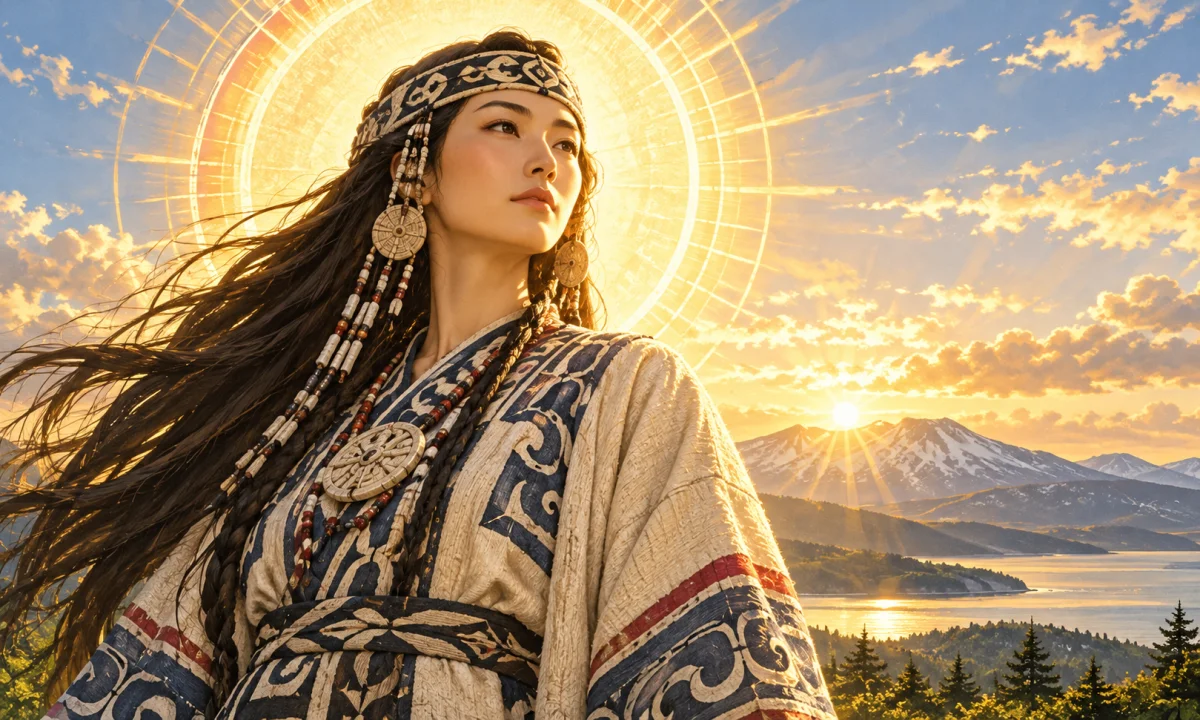
- Amaterasu: Amaterasu is the sun deity and principal ancestor of the imperial line in the classical myths. Her heavenly descendants receive authority over the visible realm after the transfer from Ōkuninushi.
Interpretations and continuing significance
Ōkuninushi's mythology has attracted interpretations focused on regional identity, political integration and the relationship between local religious traditions and the central court. The contrast between Ōkuninushi's earthly authority and Amaterasu's heavenly lineage is especially important in the written mythology. At the same time, reducing the stories to political allegory overlooks their religious dimensions, including healing, fertility, marriage, death, renewal and the power of sacred places.
His legends also differ from the image of a conquering hero. Ōkuninushi gains authority through survival, cooperation and negotiated succession. He is helped by the white hare, Suseribime, a mouse, Sukunabikona and other beings. Even when he is recognised as lord of the land, his position remains connected with obligations to the community and the unseen forces that sustain it.
In modern Japan, Ōkuninushi appears in shrine festivals, religious art, regional tourism and retellings of the Kojiki. He is frequently presented as a god of marriage and good relationships, especially in connection with Izumo Taisha. Popular culture may simplify him into a benevolent matchmaking deity or combine him with the prosperous figure of Daikoku. Those modern and devotional images are meaningful parts of his reception, but they represent only some aspects of a much older and more varied tradition.