WORLD
WORLD
Daikoku
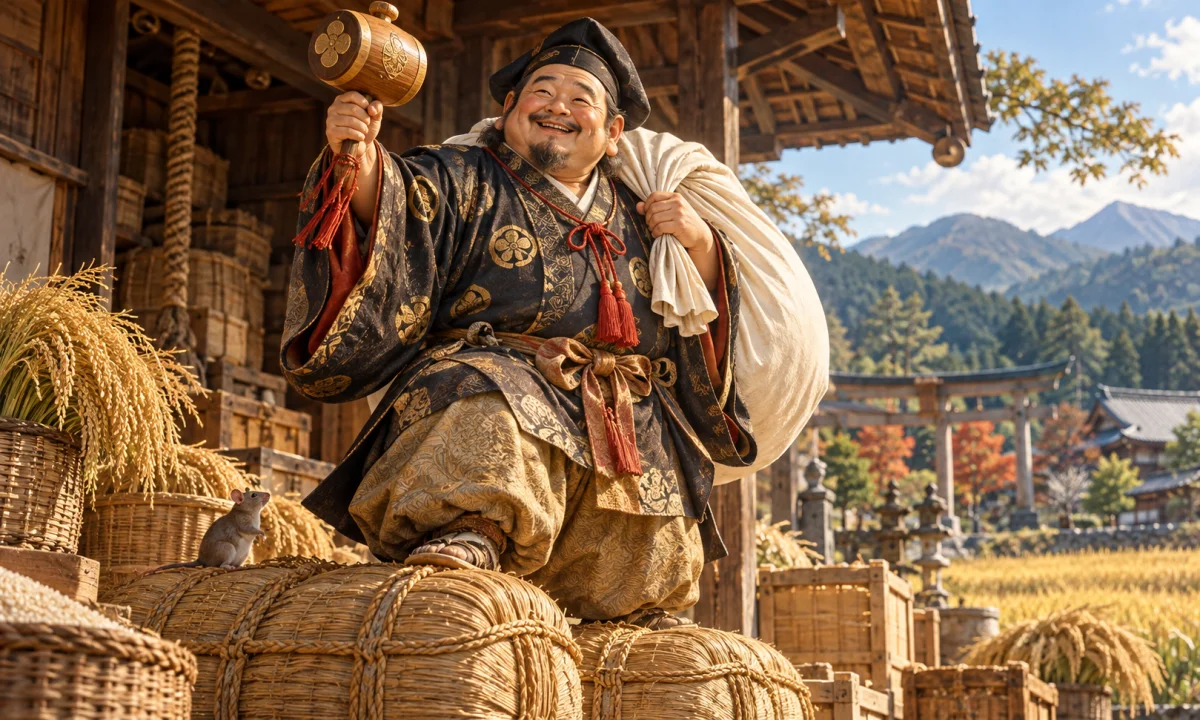
Daikoku, more fully Daikokuten (大黒天), is a Japanese Buddhist deity associated with prosperity, food, agriculture, household abundance and good fortune. He is commonly shown as a broad-faced figure standing on rice bales, carrying a large sack over one shoulder and holding a magical wooden mallet. In popular understanding, Daikoku is one of Japan’s Seven Lucky Gods (Shichifukujin), but his history is more complex than that cheerful image suggests. He developed through the interaction of Indian Buddhism, Chinese Buddhist transmission, Japanese temple traditions and the worship of native kami.
The Japanese figure known as Daikoku combines elements from several religious histories. His name and earliest Buddhist identity are connected with Mahākāla, a powerful deity of Indian origin. In Japan, however, Daikokuten gradually acquired new meanings and was also identified or associated with the native kami Ōkuninushi. The result is not simply a Japanese version of one foreign god, nor an entirely separate agricultural deity. Daikoku represents a long process of religious interpretation, visual blending and popular devotion.
Origins in Buddhist tradition
The name Daikokuten is written with characters meaning “Great Black Deity” or “Great Black Heaven.” It ultimately reflects the Buddhist transmission of the Sanskrit name Mahākāla through Chinese forms. In Indian religious traditions, Mahākāla is a dark and formidable deity whose name means “Great Black One” or “Great Time.” He is associated with power, protection and the destructive force of time. Depending on the tradition and historical period, Mahākāla can be understood as a form or manifestation connected with Śiva, or as a powerful protective being incorporated into Buddhist cosmology.
Mahākāla was not originally the smiling, prosperous figure familiar from Japanese household images. In Buddhist contexts outside Japan, related forms of Mahākāla may appear as fierce guardians, often with dark skin, threatening expressions, weapons or multiple arms. His role was commonly protective: he guarded Buddhist teachings, monasteries and practitioners against hostile forces. The Japanese Daikokuten preserved traces of this protective identity, especially in temple iconography and older ritual traditions, even as his appearance and social role changed.
Buddhism reached Japan through Korea and China, beginning in the sixth century, and brought with it a large pantheon of buddhas, bodhisattvas, guardian kings and other deities. These figures were not always treated as completely unrelated to the kami of the indigenous religious landscape. Japanese religious life often allowed different traditions to overlap, with Buddhist temples venerating kami and shrines being interpreted through Buddhist ideas. Daikoku’s later identity emerged within this environment of interaction rather than from a single founding story.
The name Daikoku and the association with Ōkuninushi
A major change in Japan was the association of Daikokuten with Ōkuninushi-no-kami, an important kami in the mythology and religious traditions of the Japanese archipelago. Ōkuninushi is associated with the land of Izumo, the establishment and ordering of the earthly realm, medicine, relationships and the welfare of communities. In the Kojiki and Nihon Shoki, he appears in stories concerning the formation and transfer of the land, as well as in tales involving Susanoo and the young hero Ōnamuchi, a name linked with Ōkuninushi in traditional interpretation.
The identification between Daikokuten and Ōkuninushi was encouraged in part by a similarity of names. Daikokuten is normally written 大黒天, “Great Black Deity,” while Ōkuninushi’s name can be written 大国主, “Master of the Great Land” or “Great Country.” The readings and meanings are not identical, but the shared character dai and the visual resemblance between koku characters helped support a religious association. This was not a simple matter of translation. It was an example of the broader Japanese practice in which Buddhist figures and native kami were understood as different appearances or manifestations of one another.
Because of this association, Daikoku could be interpreted both as a Buddhist protector and as a benevolent native deity connected with the land’s fertility. The connection with Ōkuninushi also helped explain Daikoku’s relationship to agriculture, local prosperity and human relationships. It should not be assumed, however, that every representation of Daikoku is identical to every form of Ōkuninushi. The two figures have distinct histories, and their identification varied according to temple, shrine, period and religious context.
Development as a deity of prosperity
In medieval and early modern Japan, Daikokuten increasingly became associated with abundance and material well-being. The prosperity represented by Daikoku was not originally limited to money. In an agrarian society, a full storehouse, a successful harvest, secure food supplies and the continuing strength of the household were fundamental forms of wealth. His position on rice bales therefore carries a practical meaning: rice was both food and a measure of economic security.
Daikoku was worshipped in temples, household spaces and commercial settings. In some Buddhist institutions he retained the character of a powerful guardian. In popular devotion he became a generous provider who could bless farmers, merchants and families. His image could be kept in a kitchen or another important part of the home, reflecting the belief that abundance depended on the care of the household as well as on divine favor.
His popularity also expanded through the growth of the Seven Lucky Gods. The group includes figures drawn from Buddhist, Shinto, Hindu and Chinese traditions, as well as Japanese folklore. Daikoku’s place among them is particularly significant because he often represents wealth obtained through food, work, land and household stability. In a group whose members offer different kinds of good fortune, Daikoku is commonly the provider of material abundance.
Appearance and sacred attributes
The familiar image of Daikoku is compact and cheerful, with a rounded face, a broad body and a relaxed posture. He usually wears a soft cap or hood, often called a Daikoku-zukin, and carries a large sack over his shoulder. He stands on two or more rice bales and holds a uchide no kozuchi, the “magic wishing mallet.” By striking or shaking the mallet, he is said in popular imagination to produce wealth, good fortune or whatever blessing is needed.
The sack represents a store of treasures and blessings. It is sometimes explained as containing precious goods, provisions or the accumulated resources of the household. The mallet is not merely a symbol of money. It expresses the power to bring forth prosperity, just as a blow from a tool can release hidden value or transform circumstances. Its meaning overlaps with the broader East Asian image of a magical implement that grants wishes, but in Daikoku’s hands it has become one of his most recognizable attributes.
The rice bales connect him to harvests and agricultural abundance. They also emphasize that prosperity is founded on necessities rather than luxury alone. A household with rice, shelter and productive land possessed the basis of survival. Daikoku’s prosperity therefore has a domestic and communal dimension: he protects the conditions that allow people to live securely.
Mice or rats are sometimes associated with Daikoku. In some images a small mouse appears near him, and the animal can be linked with storehouses, grain and hidden supplies. Rodents may damage food, but their presence around grain stores also indicates an abundance sufficient to attract them. In certain traditions the mouse is also connected with Ōkuninushi. The detail is not universal, and not every Daikoku image includes an animal companion.
Older or more explicitly Buddhist representations can differ sharply from the familiar lucky-god form. Daikokuten may appear dark-skinned, stern or armed, reflecting the protective and formidable aspects inherited from Mahākāla. The gentle, prosperous Daikoku and the fierce guardian are best understood as related manifestations within a changing tradition, rather than as entirely unrelated gods.
Daikoku and the Seven Lucky Gods
Daikoku’s membership in the Seven Lucky Gods became especially prominent in the early modern period. The group was associated with journeys, New Year customs, commerce and the general pursuit of good fortune. Images of the seven deities were placed on treasure ships called takarabune, which were believed in folk tradition to arrive with blessings during the New Year season.
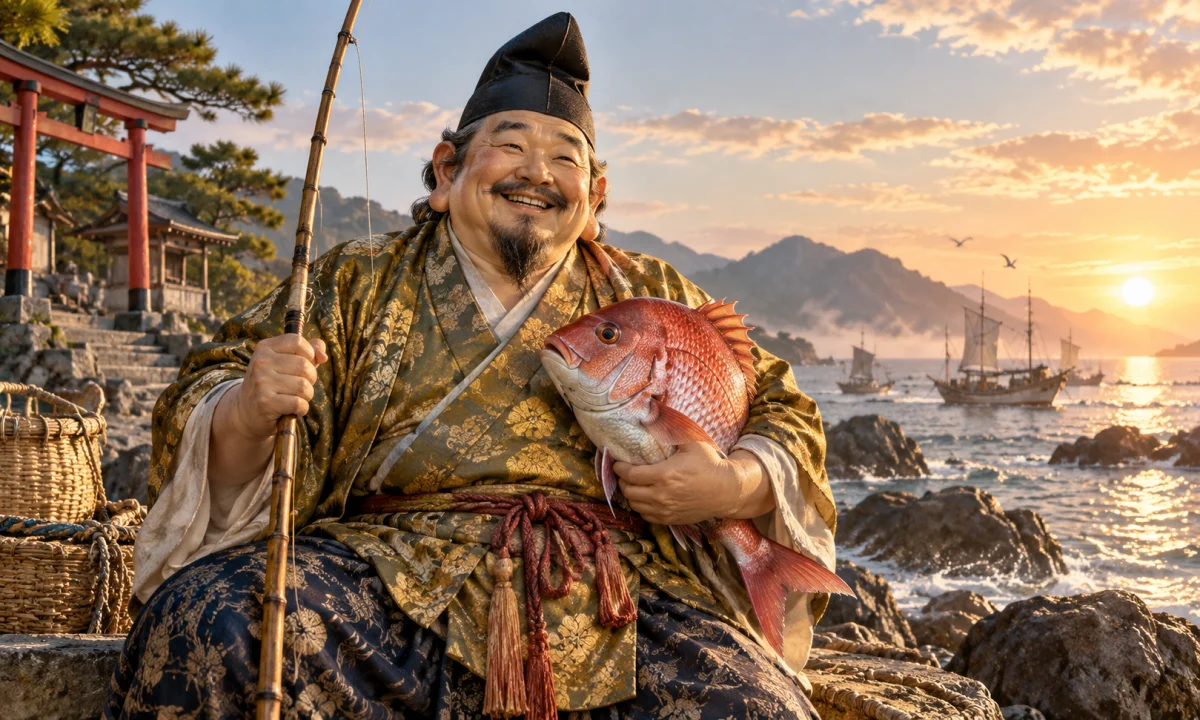
Within the group, Daikoku is frequently paired with Ebisu. Their pairing is culturally important because both are associated with prosperity, but their traditional emphases differ. Daikoku is linked with rice, the land, household wealth and the storehouse. Ebisu is strongly connected with fishing, the sea, commerce and successful catches. Together they represent complementary sources of livelihood: agricultural production and maritime or commercial exchange.
Some visual traditions present Daikoku and Ebisu as an older and younger pair, or as partners who bring prosperity to a business or household. These relationships belong mainly to popular religious imagery and should not be treated as a single fixed mythological genealogy. The Seven Lucky Gods themselves are a later devotional grouping rather than a family of deities described together in the ancient Japanese chronicles.
Religious practices and cultural significance
Daikoku has been especially important in forms of worship concerned with everyday welfare. Devotion may involve prayers for harvests, financial stability, success in business, family prosperity and the protection of food supplies. The figure’s broad appeal comes partly from his accessibility. He is not limited to the world of priests, warriors or court mythology; he appears as a deity whose blessings concern kitchens, markets, fields and ordinary work.
His connection with Ōkuninushi also gives him a place within the religious landscape of Izumo and in traditions surrounding land, community and human bonds. At the same time, his Buddhist name and imagery preserve a link to temple-based worship. The boundaries between these interpretations were not always sharply drawn in premodern Japan. A worshipper could approach Daikoku as a Buddhist deity, a local protective presence, a manifestation of Ōkuninushi or a bringer of household fortune without necessarily seeing these possibilities as contradictory.
Modern descriptions sometimes call Daikoku a “god of wealth,” but this phrase can obscure the older agricultural setting of his symbolism. His rice bales and storehouse imagery suggest productive abundance more than abstract financial success. Money is one form of prosperity, but food, labor, land, family continuity and protection from want are equally central to his traditional significance.
Distinguishing Daikoku from similar figures
Daikoku is often confused with several other figures because Japanese religious art contains many deities of prosperity and because names can be translated loosely. He should first be distinguished from Ōkuninushi, even though the two became closely associated. Ōkuninushi is a native kami with an extensive mythological and religious history tied particularly to Izumo. Daikokuten began as a Buddhist deity connected with Mahākāla. Their identification is historically important, but it does not erase the distinction between their origins.
Daikoku should also not be confused with Hotei, another member of the Seven Lucky Gods. Hotei is based on the Chinese Buddhist monk Budai, traditionally depicted as a wandering, cheerful man with a large cloth sack. Hotei’s sack and rounded body can make him resemble Daikoku, but the figures have different histories and attributes. Hotei is commonly associated with contentment, generosity, happiness and a carefree character, while Daikoku is identified by the rice bales, magical mallet and agricultural wealth.
Bishamonten, another of the Seven Lucky Gods, is a warrior-protector descended from the Buddhist guardian Vaiśravaṇa. He is generally shown in armor and carrying weapons. Although both Bishamonten and Daikoku can protect people and bring prosperity, their iconography and religious backgrounds are distinct.
Finally, the smiling Daikoku found in shops, homes and New Year decorations should not be projected backward onto every historical image. The fierce Mahākāla-derived forms, medieval temple images and early modern lucky-god figures reflect different stages and environments of worship. “Daikoku” names a tradition with several overlapping layers rather than one unchanging appearance.
Daikoku in modern culture
Daikoku remains recognizable in contemporary Japan through statues, household ornaments, business displays, festival decorations and New Year imagery. His attributes are often used in souvenirs and popular representations of Japanese good fortune. Commercial versions may emphasize the mallet, sack and smiling face while leaving aside the Buddhist history and the relationship with Ōkuninushi.
Outside religious settings, Daikoku is sometimes treated simply as a lucky mascot or a symbol of wealth. That use reflects his long development as a popular deity, but it is only one part of his identity. The figure brings together Indian Buddhist mythology, Chinese religious transmission, Japanese temple culture, native kami traditions and the agrarian values of food and household security. Understanding those layers explains why a cheerful figure standing on rice bales can also preserve the memory of a much older and more formidable protector.