WORLD
WORLD
Naka-yama-tsu-mi
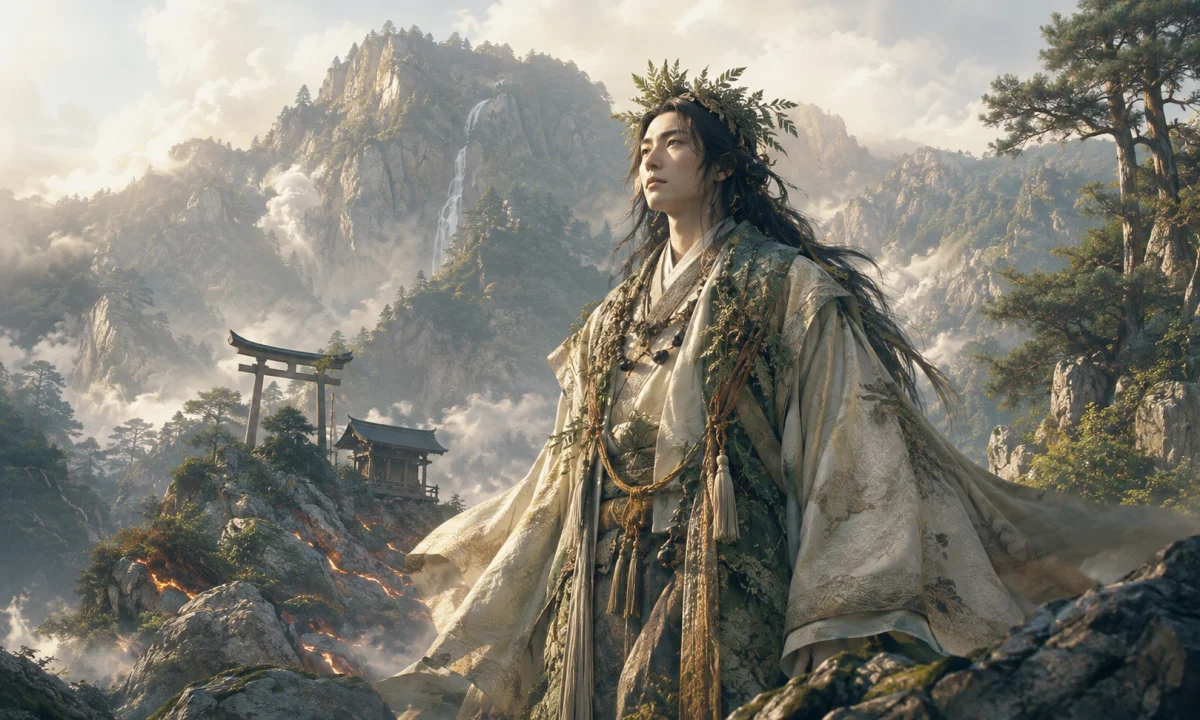
Naka-yama-tsu-mi is an obscure mountain kami associated with the mythic birth of mountain deities from the dismembered body of the fire god Kagutsuchi in Japanese mythology. The name is often written in English as Naka-yama-tsumi or Nakayama-tsumi. It is sometimes described as one of a group of eight Yama-tsumi, or mountain deities, although the exact form of the group varies between texts, translations and later reference works.
Naka-yama-tsu-mi has no substantial independent mythology, distinctive iconography or securely documented cult of its own. Its importance comes mainly from its place within a larger creation and death episode involving Izanagi, Izanami and Kagutsuchi. Because the name is not represented consistently in the earliest surviving accounts, claims about its precise identity should be treated with care.
The mythological setting
Naka-yama-tsu-mi belongs to the world of the Kojiki and related Japanese mythological traditions. These traditions describe the divine couple Izanagi and Izanami as creators of the Japanese islands and of many kami. Their story combines cosmological origins, the formation of the land, the birth of natural forces and the establishment of relationships between the living world and the realm of the dead.
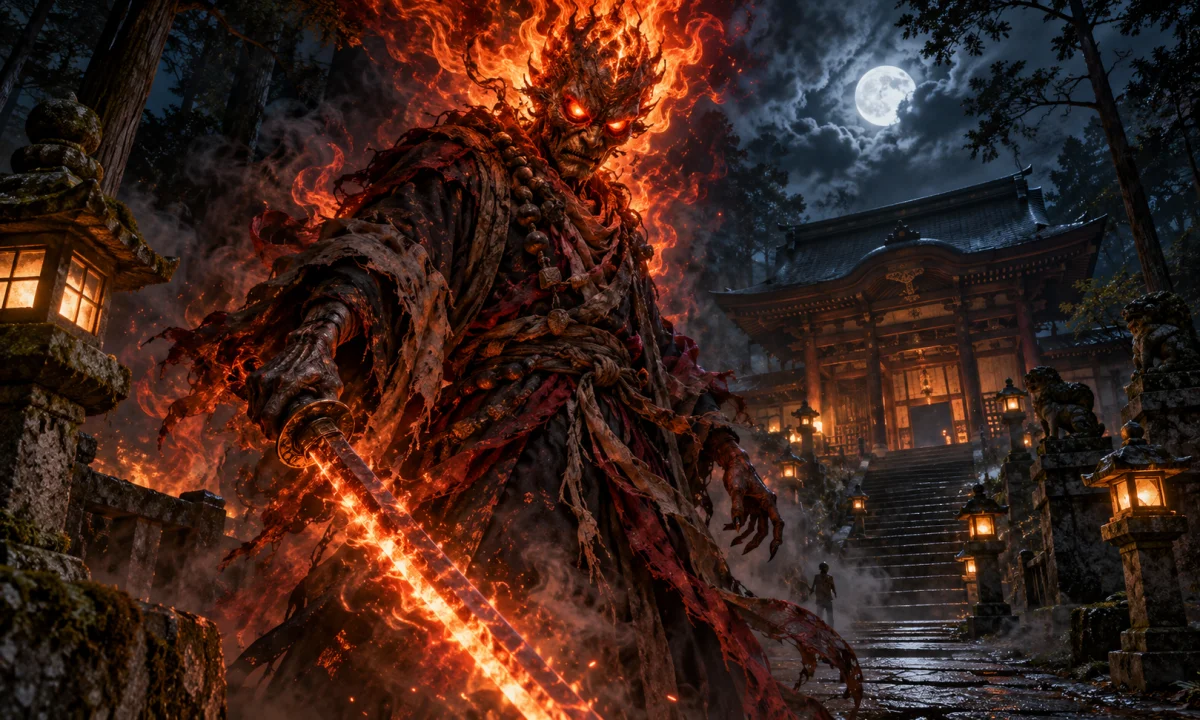
Izanami eventually gives birth to Kagutsuchi, the kami of fire. The birth burns and fatally injures her, and she dies as a result. Her death is a crucial turning point in the mythology. Izanagi, grieving and enraged, kills Kagutsuchi with his sword. From the blood of the slain fire kami, and from parts of Kagutsuchi's body, further deities come into existence.
The episode is not simply a story of destruction. It presents death and violence as processes through which new divine powers emerge. Fire produces danger and loss, but the death of the fire kami also gives rise to gods associated with mountains, rocks, forests, water and other features of the natural environment. Naka-yama-tsu-mi, where the name is included, belongs to this chain of transformations.
Origins in early Japanese texts
The most important early source for the episode is the Kojiki, compiled in the early eighth century. Its account names a sequence of mountain kami that emerge from different parts of Kagutsuchi's body after Izanagi cuts him apart. The names and their readings are difficult in places because the text uses ancient orthography, unusual character choices and names whose original meanings are not always clear.
In the commonly transmitted form of the Kojiki, the group includes deities whose names are often rendered as Masaka-yama-tsu-mi, Odori-yama-tsu-mi, Oku-yama-tsu-mi, Kura-yama-tsu-mi, Shigi-yama-tsu-mi, Haya-yama-tsu-mi, Hara-yama-tsu-mi and To-yama-tsu-mi. These figures are linked respectively with parts of Kagutsuchi's head, chest, abdomen, sexual organs, hands and feet, though translations and interpretations can differ.
Naka-yama-tsu-mi is not a universally agreed reading of one of these names. Some modern accounts list Naka-yama-tsu-mi and Shita-yama-tsu-mi among the eight mountain kami, while other editions and translations use Hara-yama-tsu-mi and To-yama-tsu-mi for the final two names. The difference may reflect variant readings, editorial traditions, or the way difficult names have been interpreted in later scholarship and popular reference material.
The Nihon Shoki, another major early source compiled in the eighth century, preserves several alternative accounts of the creation of the world and the birth of the kami. Its treatment of Kagutsuchi and the mountain deities is not identical to that of the Kojiki. Early Japanese mythological texts frequently present multiple versions of the same event rather than a single standardized narrative. As a result, the identity and position of Naka-yama-tsu-mi cannot be established with the same confidence as those of more prominent kami.
The name and its interpretation
The element yama clearly means “mountain” in Japanese. The ending -tsumi, also written in forms such as -tsu-mi, occurs in the names of several mountain-related kami. It is generally understood as a title or divine name element connected with a mountain lord, mountain spirit or mountain power. The precise historical meaning is uncertain, and it should not automatically be translated as a personal name in the modern sense.
Naka can mean “middle,” “central” or “interior,” which has led some modern descriptions to interpret Naka-yama-tsu-mi as a deity of central or middle mountains. That interpretation is linguistically plausible, but it does not by itself prove that the deity had a clearly defined jurisdiction over a particular class of mountains. The name may preserve an old geographical or symbolic distinction, or it may be the result of a variant reading of a difficult written form.
The uncertainty is increased by the use of Chinese characters to record ancient Japanese names. In early texts, characters could be selected for their sounds rather than their ordinary meanings. Later readers sometimes reassessed those characters and proposed different pronunciations. Consequently, an English spelling such as Naka-yama-tsu-mi may represent a particular reading rather than an uncontested original form.
Identity and classification
When treated as a distinct kami, Naka-yama-tsu-mi is best classified as a mountain deity within the wider category of Japanese kami. It is not normally described as a humanlike god with a developed personality, heroic career or clearly narrated adventures. Instead, it belongs to an early mythological pattern in which natural powers are generated through the bodies and actions of other deities.
The group of mountain kami born from Kagutsuchi can be understood as a mythic representation of the landscape. Mountains are not presented as inert scenery. They possess divine presence and participate in the ordering of the world. The body of the fire kami becomes a source of multiple mountain powers, linking fire, death, earth and elevation within one sacred genealogy.
It is important, however, not to assume that every named mountain kami in early mythology had a separate shrine cult or a fully developed religious function. The presence of a deity's name in a mythological genealogy does not automatically demonstrate widespread worship. For Naka-yama-tsu-mi in particular, there is little secure evidence for an independent ritual tradition or a major historical cult.
Attributes and symbolic meaning
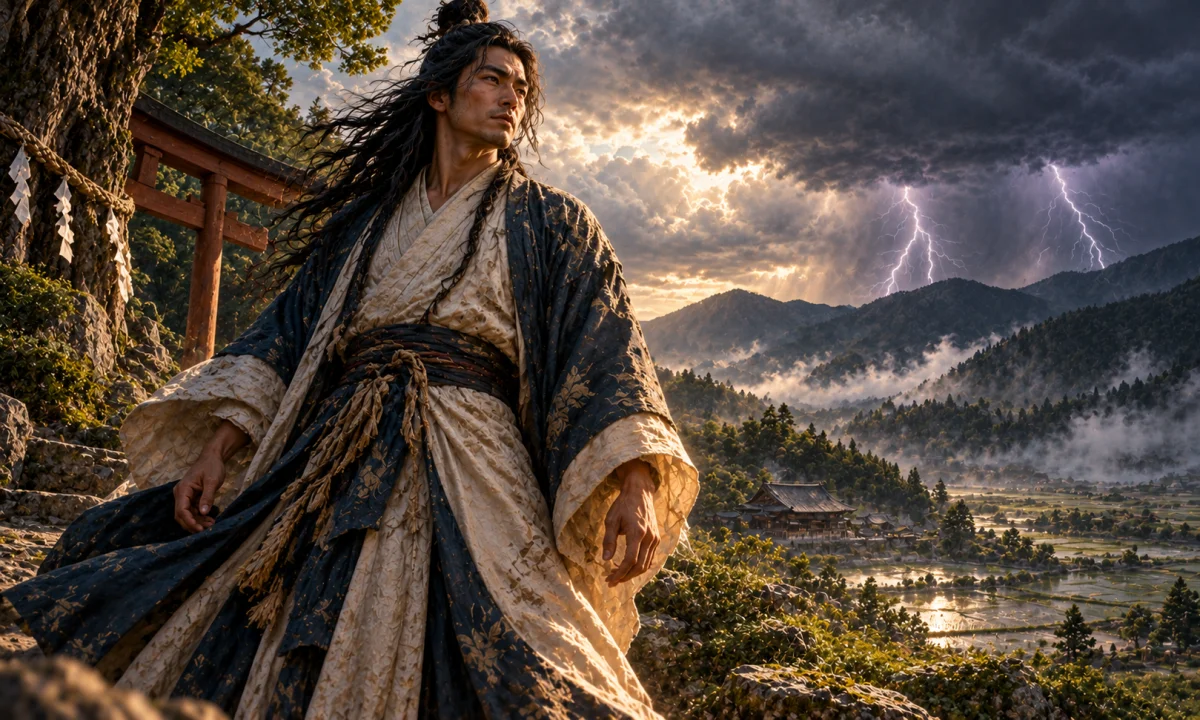
No authoritative ancient description gives Naka-yama-tsu-mi a fixed appearance. The deity is not consistently portrayed as a bearded mountain ruler, a giant, an animal or a spirit with a particular costume. Such images may appear in modern illustrations, but they are artistic interpretations rather than established features of the early tradition.
Nor is Naka-yama-tsu-mi assigned a clearly recorded weapon, sacred animal, spouse or set of supernatural powers. Descriptions that present the deity as controlling avalanches, guarding mines, causing earthquakes or ruling a particular mountain range generally go beyond what the surviving mythological material securely states.
The strongest symbolic associations arise from the deity's place in the Kagutsuchi episode:
- Mountain formation: Naka-yama-tsu-mi belongs to a group of kami that express the sacred presence of mountains within the created world.
- Transformation through death: The mountain deities emerge after Kagutsuchi is killed, showing how destruction can generate new forms of divine life.
- The body as landscape: The dismembered fire god's body becomes a map of natural powers. A divine body is transformed into features of the world.
- Connection between fire and earth: Fire, volcanic activity and the mountainous landscape are not explained scientifically in the myth, but the story symbolically places them within one sacred process.
These themes belong to the interpretation of the wider myth rather than to a set of explicit statements made by Naka-yama-tsu-mi. Since the deity has almost no individual narrative, its meaning is largely relational: it is understood through its place among the mountain kami and through the fate of Kagutsuchi.
The eight mountain kami
Later summaries often refer to the mountain deities born from Kagutsuchi as a group of eight. The number eight has broad significance in Japanese mythological language, where it can suggest abundance, multiplicity or a complete set rather than merely a numerical count. The eight mountain kami do not necessarily represent eight universally defined types of mountain.
The sequence in the Kojiki connects the deities with different portions of Kagutsuchi's body. This arrangement gives the group a structural quality: the head, trunk, sexual organs, hands and feet each become sources of natural divinity. The names may also preserve geographical or topographical ideas, but many of their original meanings are debated.
In some retellings, Naka-yama-tsu-mi is placed among the deities associated with a lower limb, while in others the name does not appear in the standard list at all. The variant is significant because it shows that the group should not be treated as though every modern list reproduces a single fixed ancient canon.
The mountain kami are also distinct from the better-known Ōyamatsumi, a major mountain deity whose name is often translated as Great Mountain Possessor or Great Mountain Lord. Ōyamatsumi appears in important genealogical and mythological episodes and is associated with the lineage of Princess Konohanasakuya-hime. Naka-yama-tsu-mi should not be casually identified with Ōyamatsumi merely because both are connected with mountains.
Relationships with other deities
Naka-yama-tsu-mi's primary mythological relationship is with Kagutsuchi, whose body provides the setting for the deity's emergence. In the broad narrative, Kagutsuchi is the child of Izanagi and Izanami, although Naka-yama-tsu-mi is not usually described as Kagutsuchi's child in an ordinary genealogical sense. It is more accurate to say that Naka-yama-tsu-mi is generated from Kagutsuchi's body after the fire kami's death.
The deity is therefore connected indirectly with Izanagi and Izanami. Izanami's death leads to Kagutsuchi's birth and the subsequent crisis; Izanagi's act of killing Kagutsuchi produces the mountain kami. This sequence makes Naka-yama-tsu-mi part of a complicated divine chain involving childbirth, fire, bereavement, violence and the creation of new natural powers.
There is no well-established story in which Naka-yama-tsu-mi meets Amaterasu, Susanoo, Ōkuninushi or other famous figures. Nor is there a securely attested marriage or descent line involving the deity. Genealogies that supply such relationships may be modern expansions or attempts to organize a sparse and variant tradition.
Distinguishing Naka-yama-tsu-mi from similar figures
Several forms of confusion are especially likely. First, Naka-yama-tsu-mi is not simply another name for every Japanese mountain kami. Japanese religious tradition includes numerous local mountain deities, many of whom are known by names that contain yama. A shared association with mountains does not establish identity.
Second, Naka-yama-tsu-mi should be kept separate from Ōyamatsumi. Ōyamatsumi is a more prominent and independently recognized figure, while Naka-yama-tsu-mi is an obscure name associated primarily with the Kagutsuchi episode and with variant lists of mountain kami.
Third, the name should not be confused with a specific historical mountain, shrine or local spirit called Nakayama unless a particular tradition provides evidence for that connection. A place-name containing Nakayama does not demonstrate worship of the mythological Naka-yama-tsu-mi.
Finally, names such as Hara-yama-tsu-mi and To-yama-tsu-mi should not automatically be treated as separate, universally accepted additions to a list that also contains Naka-yama-tsu-mi. Depending on the source and reading, these names may occupy corresponding positions in different versions of the tradition.
Religious and cultural significance
The Kagutsuchi episode reflects a characteristic feature of early Japanese religious imagination: natural phenomena are encountered as persons, powers and relationships rather than as abstract forces alone. Mountains could be places of danger, sources of water, boundaries between communities, homes of spirits and elevated sites of ritual contact. A mountain kami therefore belonged to a living landscape in which the human, divine and natural realms overlapped.
At the same time, the surviving myth does not offer a simple doctrine about “the god of the middle mountain.” It preserves a mythic genealogy in which the land's sacred powers arise from a dramatic divine event. Interpretations should respect both dimensions: the significance of mountains in Japanese religious culture and the limited evidence for Naka-yama-tsu-mi as an independently worshipped figure.
For this reason, Naka-yama-tsu-mi is most useful for understanding how Japanese mythology organizes nature through divine generation. The deity illustrates how a minor or uncertainly transmitted name can preserve an important pattern: fire is killed, the body is divided, and the landscape becomes populated by kami.
Later reception and modern representation
Naka-yama-tsu-mi has not become a major figure in internationally known Japanese popular culture. Unlike Amaterasu, Susanoo, Inari or Ōyamatsumi, the deity has little recognizable iconography and rarely appears as a central character in mainstream films, games or anime.
When the name is used in modern mythology databases, fantasy writing or video games, it may be expanded into a fully characterized mountain god with defined powers and a visual design. Such portrayals can draw inspiration from the deity's name and from the Kagutsuchi myth, but they should be distinguished from the early religious tradition. The ancient material provides a place in a group of mountain kami and a connection with the body of the fire god; it does not provide a detailed character biography.