WORLD
WORLD
Susano-wo
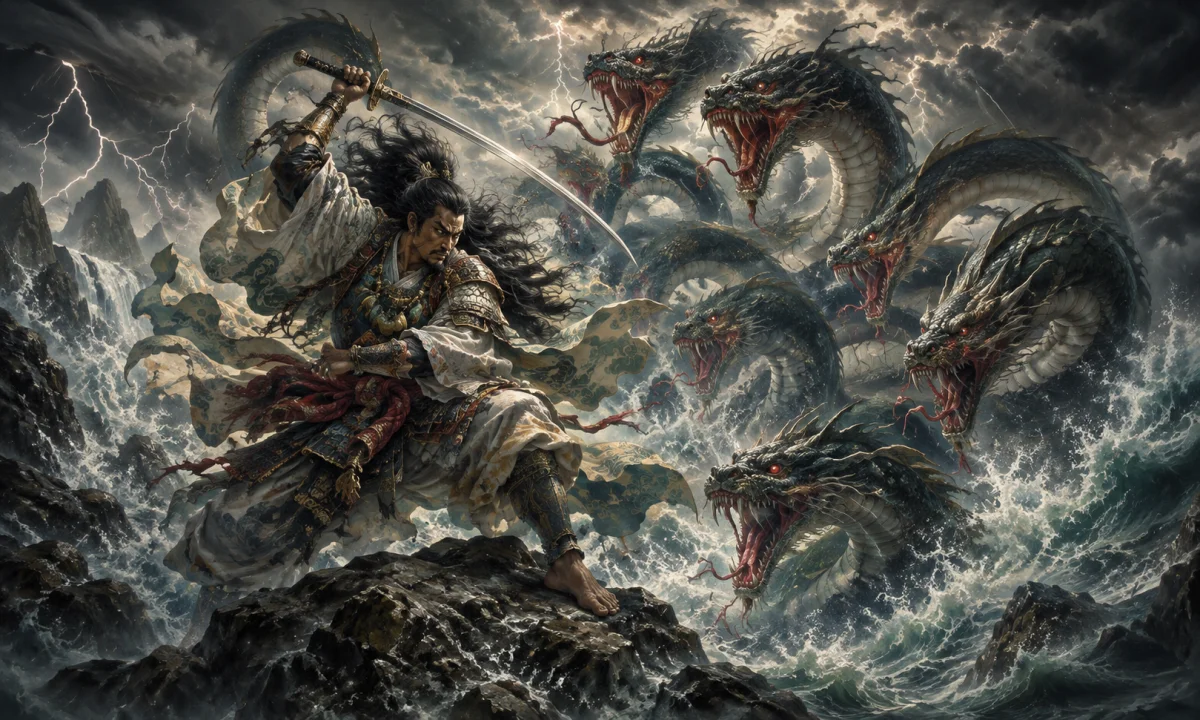
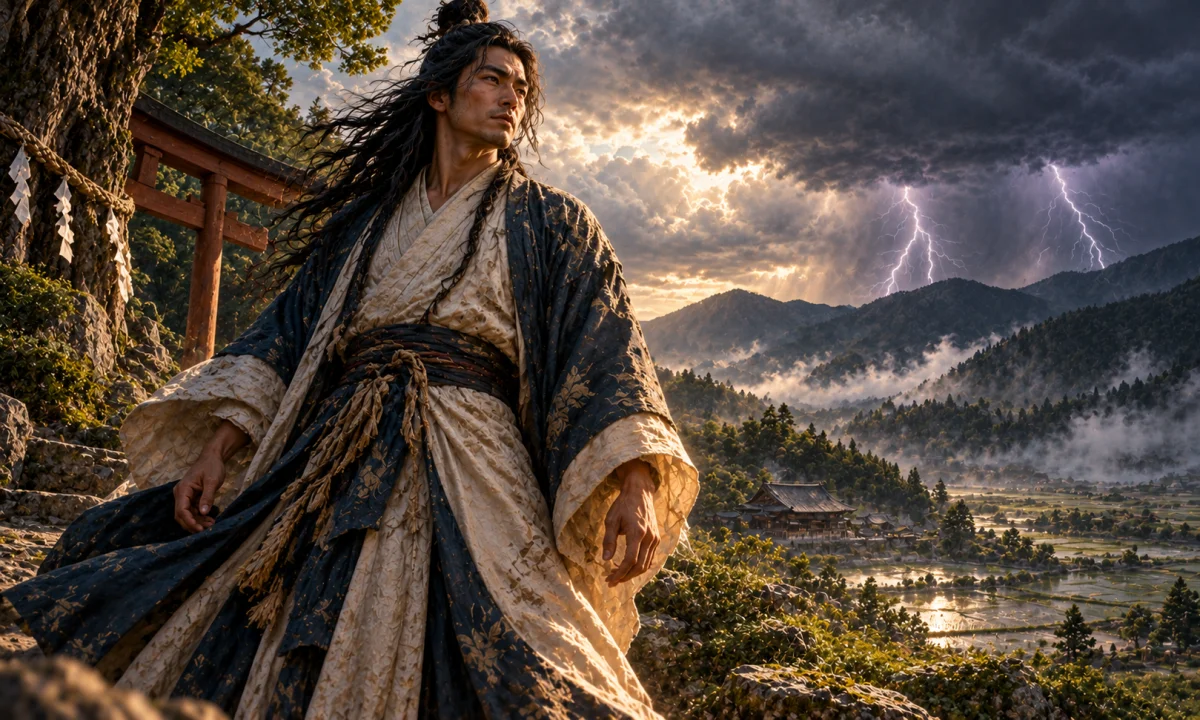
Susano-wo, more commonly written Susanoo or Susanoo-no-Mikoto, is one of the most powerful and complex figures in Japanese mythology. He is a kami associated in different traditions with storms, the sea, violence, disorder, purification, and the protection of communities. His character changes sharply between episodes: he is a disruptive and dangerous figure in the heavenly realm, yet a heroic slayer of monsters and an ancestor of important earthly rulers after his descent to Izumo.
Susanoo belongs to the religious and mythological world of Shinto, although the category “god” does not correspond exactly to the Japanese term kami. A kami may be a deity, an ancestral presence, a natural force, or a being connected with a sacred place. Susanoo’s myths were preserved in early Japanese texts, especially the Kojiki (“Records of Ancient Matters”), completed in 712, and the Nihon Shoki (“Chronicles of Japan”), completed in 720. These works contain overlapping but not identical versions of his stories.
Name and identity
The name appears in several forms, including Susanoo, Susano-ō, Susano-wo, and Takehayasusanoo-no-Mikoto. The final element -wo or -o is an old masculine element, while Mikoto is an honorific used for important mythic or ancestral figures. Spellings vary because the earliest Japanese texts used Chinese characters partly for their sound and partly for their meaning.
The meaning and origin of “Susanoo” remain uncertain. Some interpretations connect the name with rushing, violence, or turbulent movement, which would suit a storm-associated deity. Others have proposed links with particular regions or older local traditions. No single etymology is accepted as definitive. The name should therefore not be treated as having one securely established translation.
Susanoo is often called a storm god in English-language accounts, but this label describes only part of his traditional character. The early myths do not present him solely, or even consistently, as a personification of weather. He is also a sea-associated, wild, liminal, and warrior-like kami. His stories concern the tension between untamed power and ordered society, as well as the transformation of a destructive outsider into a culture hero.
Origins in the early myths
In the Kojiki, Susanoo is born when the creator deity Izanagi performs a purification after returning from the land of the dead. As Izanagi washes his face, Amaterasu, the sun kami, emerges from his left eye; Tsukuyomi, associated with the moon, emerges from his right eye; and Susanoo emerges from his nose. Izanagi assigns the three beings different realms: Amaterasu is given the High Plain of Heaven, Tsukuyomi the night, and Susanoo the sea.
Susanoo does not accept his allotted realm. Instead of ruling the sea, he weeps and rages, saying that he wishes to go to his mother, Izanami, in the land of the dead. His grief is described as so extreme that it causes widespread destruction. This episode establishes a central feature of his character: Susanoo possesses immense vitality, but he lacks the discipline expected of a ruler.
The account does not present Izanami as his mother in a straightforward genealogical sense. In the Kojiki, Susanoo is born from Izanagi’s purification, and the text does not say that Izanami gave birth to him. The mythology contains different ideas about divine generation, and later retellings sometimes simplify his family relationships. It is therefore more accurate to describe Izanagi as his immediate source of birth in the Kojiki while noting that Susanoo’s relationship to Izanami is expressed through his longing for her.
The Nihon Shoki includes variant accounts of the gods’ origins. In some versions, Susanoo is described as being born from Izanagi and Izanami together rather than from Izanagi alone. The two chronicles should not be treated as if they preserve one perfectly uniform mythology. Their differences reflect the existence of multiple regional and religious traditions.
The contest with Amaterasu
Before leaving for his appointed realm, Susanoo goes to Heaven to say farewell to his sister Amaterasu. His arrival is so violent that she fears he intends to attack her. She prepares for battle, arming herself and establishing defensive measures. Susanoo proposes a test to prove that his intentions are not hostile: each deity will produce divine beings from objects belonging to the other.
In the Kojiki, Amaterasu takes Susanoo’s sword, breaks it into pieces, and chews the fragments before breathing out three female deities. Susanoo then takes the jewels worn by Amaterasu, chews them, and produces five male deities. Because the sexes of the resulting deities are used as evidence in the contest, the episode is not simply a friendly game. It concerns possession, lineage, and the question of which deity has demonstrated greater power.
Susanoo claims victory because he has produced male deities, but the result does not end the conflict. The birth of the gods temporarily confirms his innocence, yet his behaviour soon becomes destructive. He throws a flayed horse into Amaterasu’s weaving hall. The animal’s appearance frightens the female weavers, and one of them dies after being injured by a shuttle. The Kojiki and Nihon Shoki differ in details, but both preserve the essential pattern: Susanoo violates a sacred space and causes a death connected with textile production.
Amaterasu’s retreat into the cave
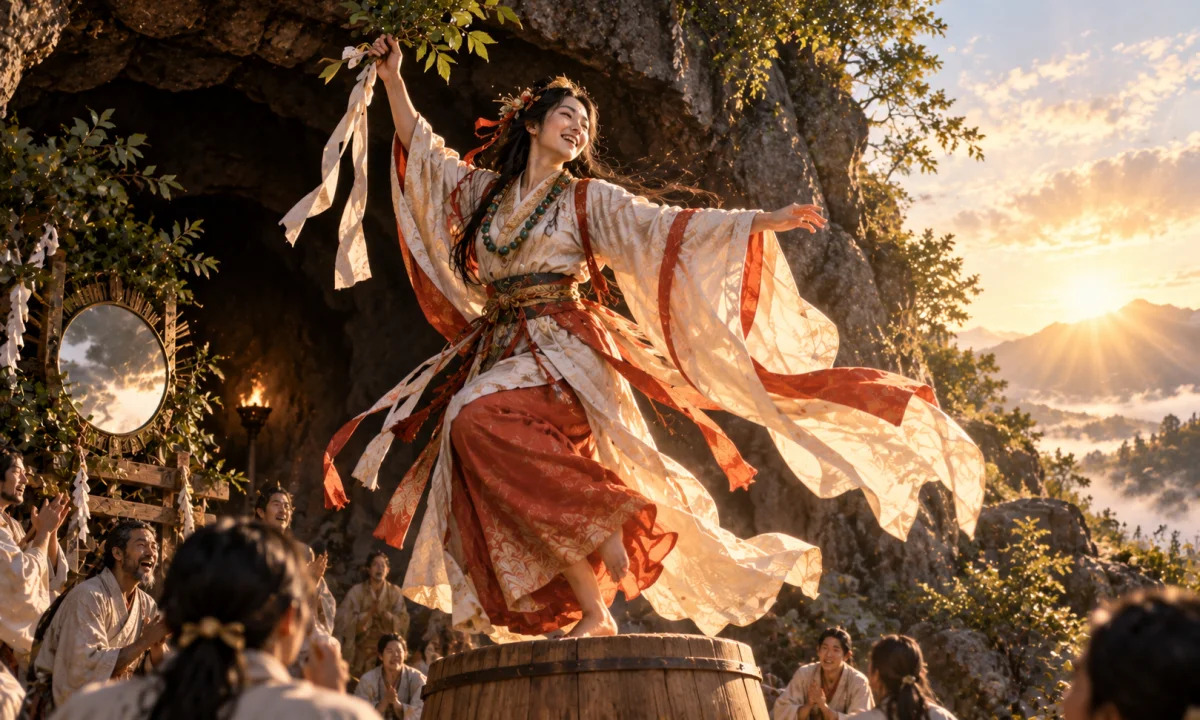
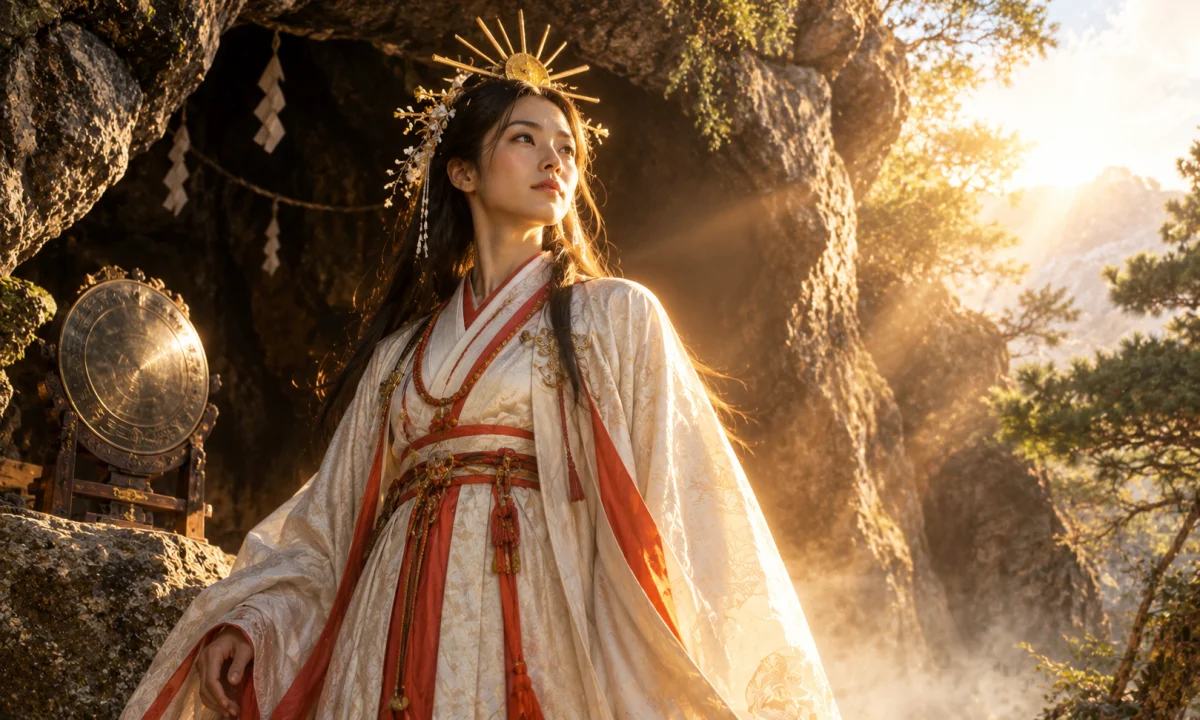
Shocked by Susanoo’s violence, Amaterasu hides in the Heavenly Rock-Cave, often called Ama-no-Iwato. Her disappearance removes the sun from the world, leaving Heaven and Earth in darkness. The gods gather to devise a way to draw her out without forcing the cave open.
The rescue combines ritual, craftsmanship, sound, and performance. The gods make a mirror and jewels, kindle fires, and arrange a celebration outside the cave. The goddess Ame-no-Uzume performs a comic and provocative dance, causing the assembled deities to laugh. Amaterasu becomes curious about the noise and asks why they are celebrating when she is absent. When she opens the cave slightly, the mirror shows her a radiant figure. The gods then draw her out, restoring light to the world.
Although Susanoo causes the crisis, the cave episode is not simply a story about an evil being defeating a good one. It dramatizes the danger of unchecked divine power and the communal rituals required to restore cosmic balance. The mirror, jewels, laughter, dance, and controlled display of sacred objects also connect the myth with important themes in Japanese ritual culture. Amaterasu’s emergence is a restoration of order, but Susanoo’s disruptive energy remains part of the larger divine world rather than being erased from it.
As punishment, the heavenly deities remove Susanoo’s beard and fingernails, strip him of his possessions, and expel him from Heaven. The details vary between accounts, but his exile marks a major change in the myths. He leaves the celestial sphere as a troublesome deity and begins the part of his story in which he becomes a heroic figure in the land of Izumo.
The descent to Izumo
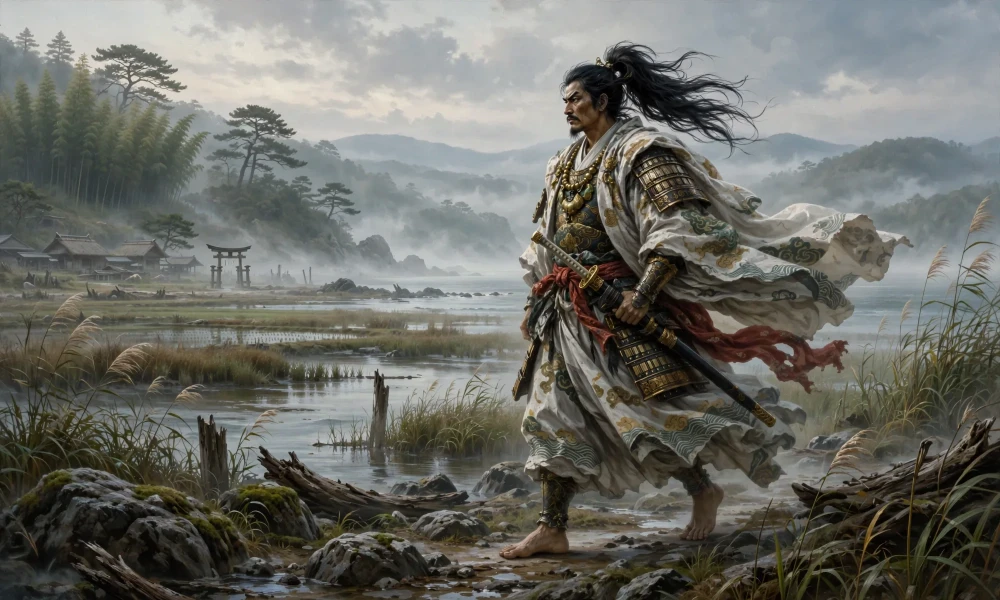
Susanoo’s best-known heroic episode begins when he reaches the region of Izumo in western Japan. There he encounters an elderly couple, Ashinazuchi and Tenazuchi, who are mourning the impending loss of their final daughter, Kushinadahime. Their other daughters have already been devoured by the monstrous serpent Yamata no Orochi.
Yamata no Orochi is described as a vast serpent or dragon with eight heads and eight tails. Its body extends across valleys and mountains, and trees grow upon it. The image presents the monster as more than an ordinary animal: it is a landscape-sized embodiment of destructive power. In some interpretations, the serpent may be connected symbolically with flooding rivers, dangerous terrain, or forces that threaten agricultural communities, although the early texts do not provide one universally accepted explanation.
Susanoo agrees to defeat the serpent in exchange for Kushinadahime’s hand in marriage. Before the monster arrives, he transforms her into a comb and places her in his hair, or otherwise protects her through transformation, depending on the version. He then orders the construction of a fence with eight openings and has eight vats filled with strong fermented drink. The serpent drinks from all eight vessels, becomes intoxicated, and falls asleep. Susanoo cuts off its heads and tails with his sword.
When he cuts into the central tail, his blade strikes another sword hidden inside it. This weapon becomes the Kusanagi-no-Tsurugi, the “Grass-Cutting Sword,” one of the Three Imperial Regalia of Japan. In the Kojiki, Susanoo sends the sword to Amaterasu as a gift or tribute. In the Nihon Shoki, details of its discovery and presentation differ. The sword later becomes associated with the imperial institution, although its sacred status belongs to Japanese imperial and Shinto tradition rather than to a simple universal mythological symbol.
After defeating Yamata no Orochi, Susanoo marries Kushinadahime and settles in Izumo. The Kojiki associates him with the place called Suga, where he composes a celebrated poem upon seeing clouds rise over his new home. The poem is traditionally regarded as the earliest example of Japanese waka poetry, although its literary history and the relationship between oral and written tradition require careful interpretation. In the myth, the poem marks a movement from violence and wandering toward residence, marriage, and the establishment of a household.
Family and connection with Ōkuninushi
Susanoo’s descendants and relationships vary across the early traditions. He is associated with a powerful lineage in Izumo, and one of his descendants is the kami Ōkuninushi, a major figure in myths concerning the formation and governance of the land. In another important episode, Ōkuninushi enters the underworld-like realm where Susanoo lives and seeks to marry Susanoo’s daughter, Suseribime.
Susanoo does not readily approve of the match. He subjects Ōkuninushi to a series of dangerous tests, including sleeping in a chamber filled with snakes and later one filled with centipedes and wasps. Suseribime secretly helps him by providing protective objects. Ōkuninushi also survives a trial involving a burning field. Eventually he escapes with Suseribime, taking Susanoo’s weapons and other possessions. Susanoo then recognizes him, though his blessing is mixed with commands and warnings.
This story presents Susanoo in a different role from the monster slayer. He is an intimidating father and lord of a dangerous domain, while Ōkuninushi is a younger hero who must prove his courage and intelligence. The relationship also links Susanoo’s family to the political and religious traditions of Izumo, especially those centred on the great shrine now known as Izumo Ōyashiro or Izumo Taisha.
Religious and cultural significance
Susanoo’s myths can be understood as stories about the management of dangerous power. He is neither a simple villain nor a consistently benevolent protector. His rage damages Heaven, but his descent also makes possible the defeat of Yamata no Orochi and the recovery of the sacred sword. Such reversals are common in mythology, where a figure’s wildness may be destructive in one setting and beneficial in another.
His connection with storms and the sea reflects the uncertainty of life in an island environment exposed to typhoons, flooding, rough waters, and changing seasons. Yet it would be too narrow to reduce him to a weather deity. His myths include ritual pollution, exile, agricultural danger, kingship, marriage, ancestry, and the recovery of order after catastrophe.
In later religious history, Susanoo was associated with disease prevention and protection from epidemics in some shrine traditions. A major development was his identification with Gozu Tennō, a powerful protective and plague-related figure worshipped in medieval and early modern Japan. This association arose through the historical interaction of Shinto and Buddhism, often described as shinbutsu shūgō, rather than being a feature of the earliest myths. The relationship between Susanoo and Gozu Tennō was influential but not identical in every region or period.
Susanoo is venerated at shrines throughout Japan, with especially strong associations in places connected to the Izumo myth cycle. His worship can involve protection from calamity, purification, community safety, and the warding off of illness. Different shrines may emphasize different aspects of his identity, and local traditions should not automatically be treated as interchangeable.
Distinctions from similar figures
Susanoo is sometimes confused with Tsukuyomi, the moon-associated kami who is also presented as a sibling of Amaterasu in the early chronicles. They are separate figures. Susanoo is associated with violent storms, the sea, exile, and the Yamata no Orochi story, while Tsukuyomi appears in a much smaller number of surviving myths and is connected principally with the moon and night.
He should also be distinguished from Raijin, the thunder kami, and Fūjin, the wind kami. Raijin and Fūjin are prominent figures in later religious art and folklore, but neither is simply another name for Susanoo. Susanoo’s storm associations overlap with their domains in modern descriptions, yet their mythological identities and iconographies developed separately.
Nor is Susanoo the same being as Gozu Tennō, even though later Japanese religious traditions frequently identified or closely connected them. Treating the two as completely unrelated ignores an important historical development, while treating them as identical in every period erases the difference between early myth and later syncretic worship.
Later reception and modern portrayals
Susanoo remains a significant figure in Japanese religious culture, literature, theatre, visual art, festivals, and popular entertainment. His battle with Yamata no Orochi is particularly adaptable to modern storytelling because it contains a threatened community, a monstrous adversary, a clever plan, a heroic transformation, and the discovery of a sacred weapon.
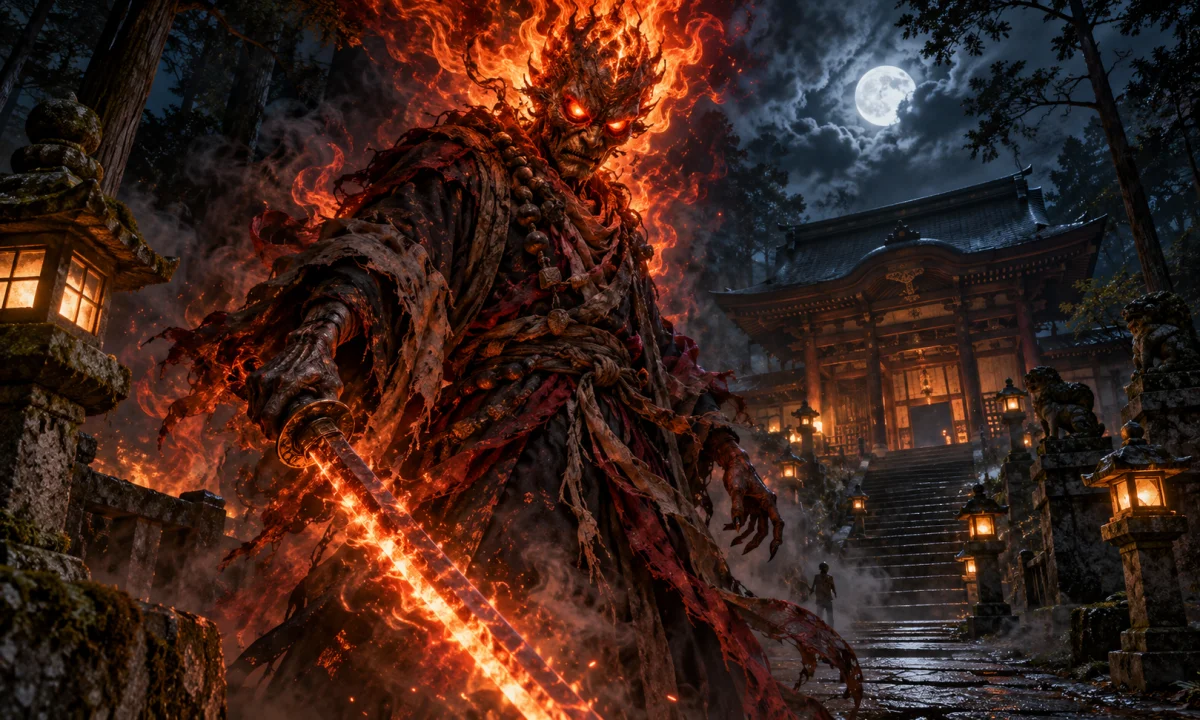
Modern manga, anime, video games, films, and fantasy fiction often present Susanoo as a sword-wielding warrior or as a personification of storms. These portrayals may combine him with thunder deities, give him invented weapons and powers, or transform the Yamata no Orochi story into an extended battle narrative. Such versions can draw inspiration from traditional material without preserving its religious context or its variations.
The traditional Susanoo is more complicated than a straightforward action hero. His mythology gives equal importance to his destructive conduct, his punishment and exile, his marriage to Kushinadahime, his defeat of the serpent, his connection with sacred authority, and his place in the ancestry of Izumo deities. His enduring importance lies precisely in this instability: Susanoo is a kami whose wildness threatens order, but whose power can also defend and renew the human world.