WORLD
WORLD
Sengen-sama
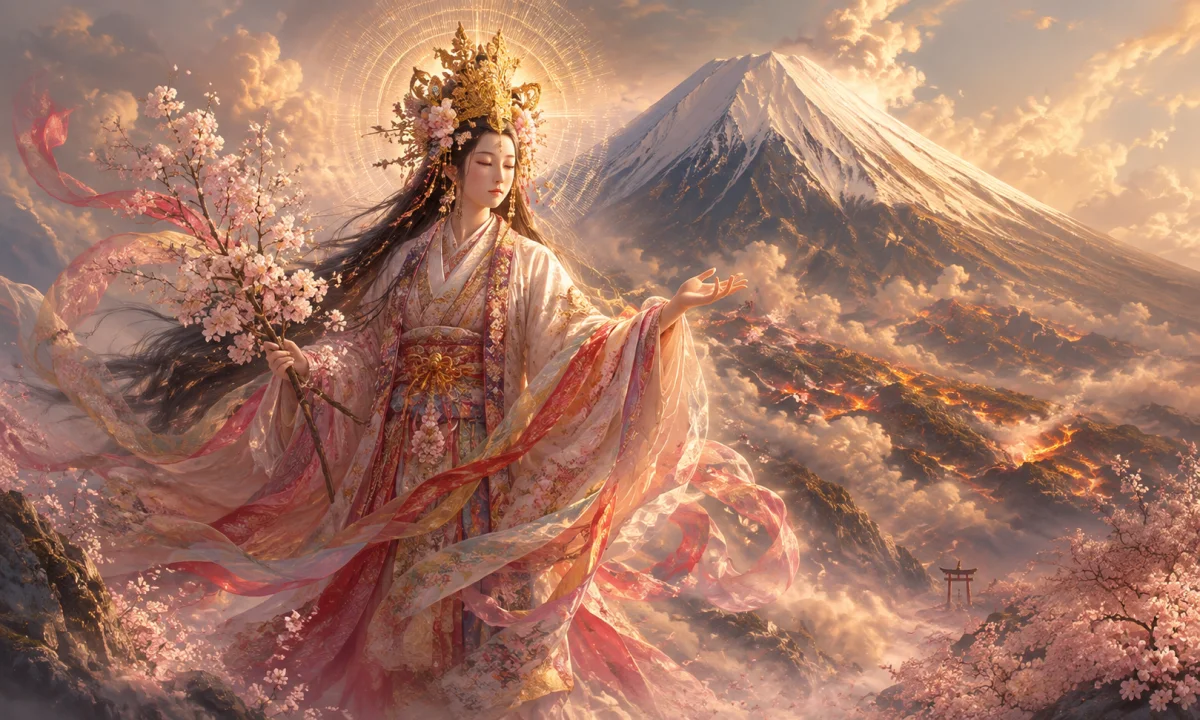
Sengen-sama is a respectful Japanese name for the deity or sacred presence associated with Sengen, also read Asama, shrines and with the worship of Mount Fuji. In many shrine traditions, Sengen-sama is identified with Konohanasakuya-hime, the goddess who appears in the Kojiki and Nihon Shoki as the wife of the heavenly ancestor Ninigi-no-Mikoto. She is associated with blossoms, fertility, childbirth and the dangerous beauty of volcanic mountains. The identification is important, but it is not a simple description of an unchanged deity from ancient mythology: the Sengen tradition developed through the interaction of mythology, mountain worship, shrine institutions and Buddhist religious practice.
Meaning of the name
-sama is an honorific meaning “revered one” or “honoured person.” It does not form part of a separate mythological name. The first element is written in more than one way. 浅間 is commonly read Asama, especially in the name of Asama shrines and Mount Asama. 浅間 can also be read Sengen in the names of many Fuji shrines, while 仙元 is another historical writing found in some religious contexts. English-language references therefore use both Asama and Sengen, and the spelling does not by itself prove that two entirely different deities are intended.
The precise origin of the word Asama or Sengen remains uncertain. Some explanations connect it with old place names, volcanic mountains or local religious vocabulary, but no single etymology is universally accepted. The name was used for more than one sacred mountain. In particular, Asama shrines exist in connection with Mount Asama in present-day Nagano and Gunma, as well as with Mount Fuji. Their traditions overlap in places but should not automatically be treated as identical.
Mountains, volcanoes and sacred presence
Japanese mountain religion commonly treats a mountain not merely as scenery but as a powerful sacred presence. Mountains can be sources of water, boundaries between human settlements and the realm of spirits, places of ancestral presence, and locations where religious practitioners seek contact with the divine. Volcanoes add another dimension: they provide fertile soils and mineral resources, but eruptions demonstrate a destructive force that communities must respect.
Mount Fuji became one of the most prominent sacred mountains in Japan. Its symmetrical form, great height and visible volcanic activity encouraged reverence long before it became a familiar symbol in modern art and tourism. Early worship could focus on the mountain itself, on a deity believed to dwell within it, or on the dangerous power manifested by eruptions. Shrine traditions later gave this sacred presence a more specific personal identity, often Konohanasakuya-hime.
The worship of Fuji was not created solely by the myths recorded in the imperial chronicles. The Kojiki, compiled in the early eighth century, and the Nihon Shoki, completed soon afterwards, tell stories about Konohanasakuya-hime, but they do not present “Sengen-sama” as a fully developed character with the later role found at Fuji shrines. The Sengen tradition belongs to a longer historical process in which local mountain practices were interpreted through classical mythology and Buddhist ideas.
Konohanasakuya-hime and Sengen-sama
At many Sengen shrines, Sengen-sama is identified with Konohanasakuya-hime, whose name is often translated as “Princess Who Makes the Tree Blossoms Bloom” or “Princess Blossoming Like the Trees.” The name associates her with flowers and the transient beauty of natural life. Cherry blossoms are particularly important in later visual and cultural associations, although the name itself is broader than a simple title meaning “cherry-blossom goddess.”
In the Kojiki, Konohanasakuya-hime is a daughter of the mountain deity Ōyamatsumi. The heavenly figure Ninigi-no-Mikoto encounters her and seeks to marry her. Ōyamatsumi offers two daughters, Konohanasakuya-hime and her older sister Iwanagahime. Ninigi accepts the younger daughter but rejects Iwanagahime because he finds her appearance less beautiful. The father then explains that the sisters had different symbolic functions: Iwanagahime represented enduring stability, while Konohanasakuya-hime represented the brief flourishing of life. Because Ninigi rejected the elder sister, human life would not possess the same enduring permanence associated with a rock.
The story is an etiological myth: it explains why human life is beautiful yet short-lived. It is not a direct account of Mount Fuji worship, and the classical texts do not make Konohanasakuya-hime the universal goddess of every volcano or flower. Her later association with Sengen shrines reflects the interpretation of a mountain and its deity through this mythological figure.
The fire-surrounded birth
Another important episode concerns Konohanasakuya-hime’s pregnancy. Ninigi doubts that the child is his because the pregnancy begins soon after their marriage. She declares that the birth will demonstrate her truth. According to the Kojiki, she enters a chamber and sets it on fire, saying that if the child is not Ninigi’s, neither she nor the child will survive. She gives birth safely amid the flames to three sons: Hoderi-no-Mikoto, often known as the sea-oriented elder brother; Hoori-no-Mikoto; and Hikohohodemi-no-Mikoto, depending on the naming details and textual version.
The story links Konohanasakuya-hime with fire, ordeal and safe childbirth. These themes help explain why shrine worship connected with her may include prayers for protection during pregnancy and birth. They also make her a fitting deity for a volcanic mountain: the same sacred power can be life-giving, fertile and beautiful while also presenting mortal danger. The fire-birth story should not be treated as a literal historical explanation of Fuji’s eruptions. It is a mythological narrative whose meaning has been extended through religious interpretation.
Konohanasakuya-hime is also part of the genealogy of important figures in Japanese mythology. Her son Hikohohodemi is associated with the traditions of the sea deity Watatsumi and with the birth of Ugayafukiaezu. In turn, Ugayafukiaezu is said to be the father of Emperor Jimmu in the imperial mythological genealogy. These relationships belong to the narratives of the classical chronicles; the later identity of Konohanasakuya-hime as Sengen-sama is a shrine and religious development rather than a name used consistently throughout those narratives.
Sengen shrines and Fuji worship
Sengen shrines, called Sengen-jinja or Asama-jinja according to local reading and tradition, are found especially around Mount Fuji and in regions connected with Fuji pilgrimage. One of the best-known institutions is Fujisan Hongū Sengen Taisha in Fujinomiya, Shizuoka Prefecture. Kitaguchi Hongū Fuji Sengen Jinja in Yamanashi is another major shrine associated with routes leading towards the mountain. Other shrines use the same characters and may preserve distinct local histories.
A shrine may face the mountain, stand at its base, or serve as a ritual gateway for ascent. Before modern transport and tourism, pilgrimage to Fuji was difficult and could be physically hazardous. Worshippers often visited a shrine in a settlement before climbing, performed purification rites, and treated the ascent as a religious journey rather than an ordinary excursion. Some local communities also established smaller representations of Fuji so that people unable to climb the mountain could participate in its worship.
The presence of a Sengen shrine does not mean that every associated practice is identical. Shrine histories vary according to local geography, patronage, institutional changes and the religious movements active in the area. Some traditions emphasize Konohanasakuya-hime; others preserve additional deities, Buddhist figures or local sacred beings connected with Fuji.
Buddhist interpretation and mountain practice
For many centuries, Japanese religious life did not sharply separate shrine worship from Buddhist worship. Sacred mountains were understood through forms of Shugendō, a tradition of ascetic mountain practice that brought together elements of Buddhism, kami worship and older local customs. Buddhist temples and Shinto shrines could share sacred sites, rituals and protective deities.
In medieval and early modern interpretations, the deity of Fuji could be understood through Buddhist concepts. One influential form identified the Fuji deity with Dainichi Nyorai, the cosmic Buddha of esoteric Buddhism, or with a manifestation of that Buddha. Such interpretations are examples of honji-suijaku, the theory that a Buddhist being could appear in Japan as a local kami for the sake of guiding people. Other traditions connected Fuji with Yakushi Nyorai, Senju Kannon or different figures, depending on the institution and period. These identifications were not universally uniform.
Accounts of early Fuji ascetics also contributed to the mountain’s religious history. The semi-legendary figure En no Gyōja was later associated with Fuji, as were other practitioners said to have climbed, purified or ritually mastered the mountain. In the early modern period, Fuji-ko confraternities organized pilgrimages, devotional gatherings and ritual instruction. Hasegawa Kakugyō, an eighteenth-century religious teacher, became especially important in the development of Fuji-based popular practice, although the movements connected with him should not be confused with the entire Sengen shrine tradition.
The Meiji government’s separation of Shinto and Buddhism in the late nineteenth century changed the appearance and administration of many sacred sites. Buddhist images, temples and interpretations were removed, relocated or reclassified in some places. As a result, modern Sengen shrines may appear more exclusively Shinto than the religious complexes that existed before the reforms. Historical descriptions of Sengen-sama need to distinguish the present shrine institution from earlier forms of combined worship.
Attributes and symbolism
Sengen-sama is most often represented through the imagery of Konohanasakuya-hime rather than through one standard physical form. Shrine iconography can depict her as a noble woman, but there is no single universally fixed appearance comparable to the standardized images of some Buddhist deities. In ordinary shrine worship, the central object is frequently a sacred mirror or another object hidden within the sanctuary, rather than an image displayed for public viewing.
Her principal symbolic associations include:
- Mount Fuji: the sacred mountain is the central geographical and religious focus of many Sengen traditions.
- Volcanic fire: fire represents both destructive danger and the ordeal through which Konohanasakuya-hime proves her innocence.
- Flowers and seasonal beauty: her name evokes blossoming vegetation and the beauty of life that does not last forever.
- Childbirth and family protection: the story of her fire-surrounded delivery supports prayers for safe birth and maternal protection.
- Water and fertility: mountains are sources of springs and rivers, and Fuji worship has often included concern for agriculture and the well-being of surrounding communities.
These associations are related but not equally prominent at every shrine. The image of Sengen-sama as a flower goddess, for example, is a modern shorthand that can obscure her more complex links with mountain power, fire, genealogy and ritual protection.
Variants and limits of identification
“Sengen-sama” can refer to different things depending on context. It may mean Konohanasakuya-hime as worshipped at a particular Sengen shrine, the kami of Mount Fuji, the sacred power of the mountain itself, or the principal deity of a shrine whose tradition includes several layers of interpretation. The name may also be used respectfully for the enshrined deity without claiming that the deity has only one form.
It is therefore inaccurate to say that Sengen-sama is simply another ancient name for Konohanasakuya-hime in every context. The classical myths name Konohanasakuya-hime, while the Sengen designation belongs largely to later shrine and mountain-worship traditions. Conversely, it is also too narrow to describe Sengen-sama only as a generic volcano spirit, because many important shrine traditions explicitly identify the figure with the mythological princess.
Sengen-sama should also be distinguished from Asama Daijin traditions associated primarily with Mount Asama. The characters and readings overlap, and both mountains have volcanic significance, but Mount Fuji and Mount Asama are separate sacred landscapes with their own shrine networks and histories. A reference to an Asama shrine cannot automatically be treated as a reference to Fuji’s Konohanasakuya-hime.
Cultural significance
The Sengen tradition brings together several Japanese ideas about the natural world. A mountain can be beautiful and threatening, distant yet intimately connected with everyday life, and both a source of blessings and a place of ritual danger. Konohanasakuya-hime gives this landscape a human and genealogical form, while the volcanic mountain preserves a sense of power that cannot be reduced to a decorative myth.
The association with blossoms also expresses the Japanese cultural theme of impermanence, often discussed through the Buddhist concept of mujō. Flowers bloom brilliantly and then fall; human life follows a similar pattern. Yet Sengen-sama is not only a symbol of transience. Through the fire-birth narrative and shrine petitions for protection, she is also connected with endurance, truth, fertility and the continuation of family life.
Mount Fuji’s status as a national and artistic symbol has increased the visibility of Sengen-sama, but the religious tradition remains rooted in particular shrines, pilgrimage routes and local communities. Paintings, prints, photography and tourism often present Fuji as a serene landscape. Shrine worship preserves another dimension: reverence for a living volcanic mountain and for the sacred powers believed to sustain, protect and endanger the human world.