WORLD
WORLD
Ryujin
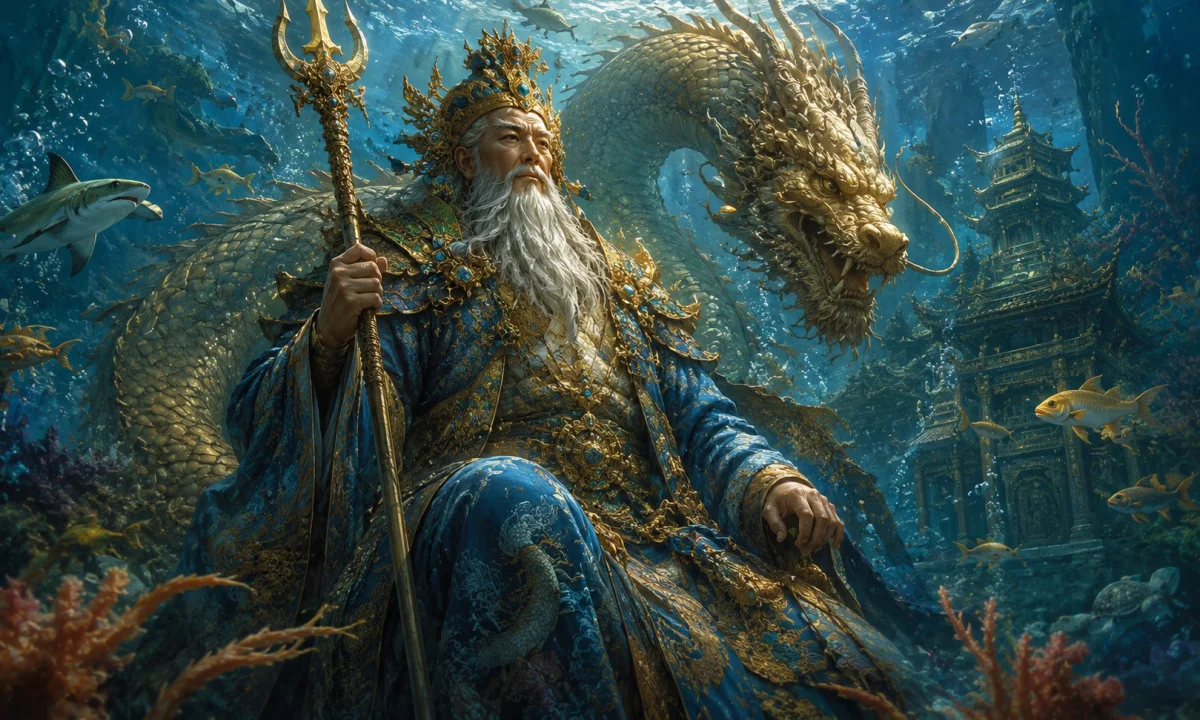
Ryujin (Japanese: 龍神, commonly written Ryūjin in romanisation) is a Japanese dragon deity associated with the sea, water, rain and the power of the tides. The name literally means “dragon god” or “dragon deity,” and it does not always refer to one single figure with a universally fixed biography. In Japanese religious tradition, Ryujin can mean a particular sea deity, a local water god, or a dragon-like divine being identified with older Shinto gods such as Watatsumi.
Ryujin belongs to a religious landscape in which the sea was both a source of food and a dangerous supernatural realm. Fishermen, sailors, farmers and communities living near rivers or springs all had reasons to honour powers controlling water. Over time, indigenous Japanese beliefs became closely connected with Buddhist ideas about dragon kings, as well as with Chinese traditions concerning dragons and rain. As a result, Ryujin is best understood as a developing religious image rather than as a character whose nature is identical in every text, shrine or period.
Name and identity
The word ryūjin combines ryū, meaning “dragon,” with kami or jin, meaning a deity or divine being. The term uses the Sino-Japanese word for dragon and reflects the influence of Chinese writing and religious vocabulary. In English, “Ryujin” is the most common spelling, while “Ryūjin” indicates the long vowel more precisely.
In many contexts, Ryujin is identified with Watatsumi no Kami, the sea deity who appears in early Japanese mythology. Watatsumi is also written and read in several forms, including Owatatsumi. The name is sometimes translated simply as “sea god,” although the exact origin and interpretation of the name have been discussed by scholars. The early myths do not consistently call this figure “Ryujin”; the dragon-god designation became especially important through later religious interpretation and the interaction of Shinto and Buddhism.
Consequently, “Ryujin” may describe:
- the ancient sea deity Watatsumi or Owatatsumi;
- a dragon-shaped or dragon-associated kami worshipped at a particular shrine;
- a water or rain deity understood through the language of dragon kings;
- a general title for a powerful dragon god in religious stories and popular storytelling.
These uses overlap, but they should not automatically be treated as evidence that all Ryujin traditions concern one identical mythological individual.
Early literary traditions
The most important early written sources for Japanese mythology are the Kojiki, completed in 712, and the Nihon Shoki, completed in 720. Both texts preserve traditions about sea deities, divine ancestry and the relationship between the imperial line and the gods. They were compiled in particular political and religious circumstances, so they do not provide a complete record of every local belief. They are also written versions of traditions that had circulated orally and in regional forms.
In the Kojiki, Watatsumi is the lord of the sea and the father of Toyotama-hime, a major figure in the story of the heavenly descendant Hoori. Hoori travels beneath the sea after losing a treasured fishhook that belonged to his elder brother Hoderi. He reaches the palace of the sea deity, where he meets Toyotama-hime. The sea god eventually helps him recover the hook and gives him magical tide jewels.
The Nihon Shoki preserves related episodes but also records variations in names and details. The sea deity’s identity, the relationships among the characters and the exact form of the story are not entirely uniform between versions. This variation is typical of early Japanese mythological literature, where different traditions were brought together rather than reduced to one standardized canon.
The sea god’s palace and the story of Hoori
The underwater palace of the sea deity is one of the most important settings connected with the later image of Ryujin. In the myth of Hoori, the palace is a place beyond ordinary human society, reached beneath or across the sea. It is associated with abundance, supernatural authority and the mysterious origins of life on land.
Hoori’s arrival begins with a dispute over a fishhook. He has borrowed the hook from his brother, lost it while fishing and is unable to replace it. A sea deity or sea-related helper directs him to Watatsumi’s palace. There he encounters Toyotama-hime, and the story develops into a marriage between a human or heavenly hero and the daughter of the sea god.
Watatsumi helps Hoori by commanding the fish of the sea to search for the missing hook. When it is recovered, the sea god gives Hoori the tide-producing jewels. One jewel causes the tide to rise, while the other makes it recede. Hoori uses them against Hoderi, forcing his brother to submit. The episode presents the sea god as a ruler of cosmic and natural forces, not merely as a monster or an animal-shaped spirit.
Toyotama-hime later follows Hoori to the land and gives birth to their child. She asks Hoori not to look at her during labour, but he disobeys. In the Kojiki, she is revealed in an animal form described with the word wani, which can refer to a crocodile-like or large sea creature in ancient Japanese usage. This is not simply the same as a European-style dragon. After her secret is exposed, Toyotama-hime returns to the sea, leaving her sister Tamayori-hime to care for the child. Through this child, the sea deity’s family becomes part of the genealogy leading to the imperial line in the mythological account.
Later retellings often present Watatsumi’s palace as Ryūgū-jō, the Dragon Palace. That expression is closely associated with Ryujin imagery, but the early texts do not always use the later popular concept of a dragon king ruling a fully developed underwater court. The dragon-palace image emerged through the continuing interpretation of sea-deity myths, Buddhist influence and folklore.
Appearance and supernatural powers
Ryujin is commonly imagined as a large Japanese dragon with a long, serpentine body, horns, claws and whiskers. Unlike the winged dragons familiar from much European fantasy, Japanese dragons are usually depicted as elongated creatures capable of moving through water, clouds and air without necessarily having wings. Artistic representations vary considerably according to period, medium and religious context.
Traditional Japanese dragons are often connected with rain and bodies of water. Their power may include control over storms, waves, rivers, springs, clouds and the tides. A dragon deity could therefore be approached both as a protector and as a dangerous force. Rain was essential for rice cultivation, but excessive rain, typhoons and flooding could destroy crops and settlements. The same divine power that brought fertility could also threaten human life.
In stories associated with the sea god, the most distinctive objects are the tide jewels. These jewels express control over the rhythm of the sea and give the deity an authority that is both magical and environmental. In later imagery, Ryujin may also be shown holding a jewel, especially a sacred pearl or luminous sphere. Such objects can represent sovereignty, abundance, the treasures of the sea or the power to command water. Their precise meaning depends on the tradition in which they appear.
Ryujin, dragons and Buddhist dragon kings
Japanese ideas about dragons developed through contact with continental traditions. Chinese dragons were powerful beings connected with rain, rivers, imperial authority and the heavens. Buddhism, entering Japan through Korea and China, also brought the idea of the nāga and the dragon kings, known in Japanese as ryūō. Buddhist scriptures describe dragon kings as supernatural beings who can protect the Buddhist teaching and control rain or water.
The Buddhist dragon kings include groups such as the eight great dragon kings, whose names and stories derive from Buddhist textual traditions rather than from the early Japanese myths of Watatsumi. In medieval Japan, Buddhist and Shinto concepts were frequently interpreted together. A local water kami could be identified with a Buddhist dragon king, while a dragon king could be honoured at a shrine or temple as a protector of the land.
Ryujin and Ryūō are related but not automatically identical terms. Ryujin is a Japanese expression for a dragon deity and is often linked with Shinto water worship. Ryūō is the standard term for a dragon king in Buddhist contexts. In practice, the two categories sometimes overlap because of religious syncretism, but their textual origins and ritual settings can differ.
Religious and cultural significance
Ryujin’s importance comes from the central role of water in Japanese life. Coastal communities depended on the sea for fishing and transport, while agricultural communities depended on predictable rainfall and irrigation. Water sources were therefore treated as places where divine power might be encountered. Shrines dedicated to water, rain or dragons could be located near the coast, beside rivers, around springs or in mountainous areas associated with cloud formation.
Devotion to dragon deities could include prayers for rain, protection at sea, safe travel, plentiful catches and relief from drought. The form of worship varied by region and historical period. There is no single nationwide ritual system that defines every Ryujin tradition. In some places the deity is treated as a guardian of a local spring or watercourse; elsewhere the emphasis is on the sea, maritime protection or the power of storms.
Ryujin also expresses a broader Japanese understanding of nature as inhabited by potent presences. A river, mountain, rock or spring could be treated as sacred without being reduced to a human-like personality. The dragon provided a visual and narrative form for water’s changing nature: hidden in deep places, appearing in clouds, descending as rain and becoming dangerous in flood or storm.
Related figures and common distinctions
Ryujin should not be confused with every dragon or serpent in Japanese mythology. Yamata no Orochi, the eight-forked serpent slain by Susanoo, is a destructive monster in the Kojiki and Nihon Shoki. It is not simply another name for Ryujin, even though both are associated with water and serpent-like forms. Yamata no Orochi belongs to a different narrative and has a different role.
Nor should Ryujin be automatically equated with every deity whose name contains taka, kura or other terms associated with rain, valleys and water. Deities such as Kuraokami and Takaokami are important rain and water kami in particular Shinto traditions. Some later interpretations connect such figures with dragon deities, but that does not erase their distinct names, myths or ritual identities.
Ryujin is also different from Suijin, a broad term for water deities or water spirits. Suijin worship may concern irrigation, wells, rivers and agricultural water management, whereas Ryujin more often evokes the dragon lord of the sea or a powerful dragon-associated kami. The boundaries between these categories can become fluid in local practice, but the terms are not interchangeable in every context.
Urashima Tarō and the Dragon Palace
The popular story of Urashima Tarō is frequently connected with Ryujin because the hero visits an underwater palace and meets the sea princess Otohime. In many later versions, Otohime is presented as the daughter of the Dragon King, and the palace is called Ryūgū. Urashima remains there for what seems to him a short time, only to discover that many years have passed when he returns to the human world.
Earlier versions of the story, including material preserved in the Man’yōshū and a fragment associated with the Tango regional tradition, differ in wording and detail. The supernatural ruler is not always presented in exactly the same way as the later popular Dragon King. The connection with Ryujin is therefore a later and widely accepted interpretation rather than proof that every early version named Ryujin directly.
The tale’s emphasis on time, separation and the danger of crossing between human and otherworldly realms complements Ryujin’s broader symbolism. The Dragon Palace is beautiful and abundant, but it is not simply a holiday paradise. Its distance from ordinary human time makes the sea realm both attractive and unsettling.
Later reception and modern representations
In later Japanese art and religious imagery, Ryujin may appear as a dignified dragon king, a dragon surrounded by waves, or a powerful deity accompanied by sea treasures. The figure has also remained relevant in shrine traditions, local festivals, legends of sacred springs and stories about rainmaking. These expressions are often regional, and the meaning of the deity may reflect the particular needs and history of the community that honours it.
Modern manga, anime, games and fantasy fiction frequently use “Ryujin” as the name of a dragon ruler, sea monster or powerful water character. Such works may combine elements from Watatsumi, Buddhist dragon kings, Chinese dragons and international fantasy. They can preserve familiar motifs such as the underwater palace, tide jewels or command of storms, but their characterisations should not be treated as direct descriptions of traditional Japanese belief.
In religious and folkloric contexts, Ryujin is better understood as a name and image at the meeting point of Japanese sea worship, dragon symbolism, Buddhist cosmology and regional water traditions. His enduring presence reflects the continuing cultural importance of the sea and rain, and the recognition that water can sustain human communities while remaining beyond human control.