WORLD
WORLD
Sarutahiko

Sarutahiko, also called Sarutahiko Ōkami or Sarutahiko-no-Kami, is a major earthly kami in Japanese mythology and Shinto tradition. He is best known as the powerful deity who stands at the boundary between the heavenly and earthly realms and guides the divine grandson Ninigi when Ninigi descends to Japan. Sarutahiko is portrayed as an imposing, radiant, and potentially dangerous figure, but also as a protector of roads, crossings, thresholds, and safe passage.
His most famous appearance is in the Kojiki, compiled in 712, and in the Nihon Shoki, completed in 720. These early chronicles preserve related but not identical accounts of the descent of the heavenly grandson. Later Shinto practice, shrine traditions, folk religion, and scholarly interpretation have added further meanings to Sarutahiko. As a result, he is not limited to a single fixed role: he can be understood as a local earth deity, a guardian of boundaries, a guide, an ancestral figure, and a symbol of the meeting between heavenly authority and the indigenous powers of the land.
Origins in early Japanese mythology
Sarutahiko appears during the mythic transition from the rule of the heavenly deities to the establishment of their authority on earth. In the Kojiki, Amaterasu and the other heavenly deities send Ninigi, her grandson, down from the High Plain of Heaven to govern the Central Land of Reed Plains, the mythological name for Japan. Ninigi's descent is commonly associated with the beginning of the divine lineage that eventually produces the imperial ancestors.
At the point where the heavenly road meets the earthly world, Ninigi encounters an extraordinary being blocking the way. Sarutahiko is described as standing at the crossroads of heaven and earth, illuminating the surroundings with the radiance of his eyes. His physical presence is immense: the Kojiki gives him an exceptionally long nose, a broad and imposing body, and eyes that shine like mirrors or reflectors. The imagery makes him appear more like a supernatural guardian or an overwhelming local power than an ordinary human-shaped god.
The heavenly deities initially do not know who he is or whether he intends to oppose Ninigi. The goddess Ame-no-Uzume is therefore sent to question him. She approaches without fear, and Sarutahiko explains that he is an earthly deity who has come to guide Ninigi. He identifies himself as Sarutahiko-no-Kami and offers to lead the heavenly grandson through the dangerous or uncertain passage between the two realms.
This encounter is important because Sarutahiko is not simply defeated or displaced by the heavenly gods. He voluntarily assists Ninigi after the two sides establish communication. The episode presents the transfer of authority as a meeting between a heavenly mission and a powerful deity already connected with the land. Sarutahiko's cooperation makes the descent possible and gives him an enduring role as a guide.
The name Sarutahiko
The name is written in different ways in early texts, including forms represented with characters meaning “monkey,” “field,” and “prince” or “male deity.” The exact interpretation of the name is uncertain. It is often rendered in English as Sarutahiko, while older romanization and translation systems may produce forms such as Sarudahiko or Sarutahiko-no-Kami.
Because the first element can be written with the character for monkey, some explanations connect Sarutahiko with monkeys or with a monkey-like appearance. This interpretation is not universally accepted as a complete explanation of his name or character. Japanese mythological names frequently preserve older linguistic elements whose original meanings are difficult to recover, and the written characters used in the chronicles do not necessarily provide a straightforward etymology.
Another approach understands Sarutahiko primarily through his setting at the meeting point of roads and realms. In this interpretation, his name and mythology may preserve traces of an older boundary deity whose functions were later incorporated into the narratives of the imperial and heavenly kami. Such explanations are scholarly interpretations rather than explicit statements made by the Kojiki or Nihon Shoki.
Appearance and supernatural presence
Sarutahiko's appearance is among the most distinctive descriptions of any figure in early Japanese mythology. He is gigantic, strongly built, and brilliantly visible. His nose is described as extending for several hand-spans, while his eyes have the appearance of shining mirrors. His size and luminosity communicate more than physical ugliness or comic exaggeration: they show that he possesses an overwhelming supernatural presence.
The long nose has often encouraged later comparisons with the tengu, the long-nosed mountain beings and supernatural figures of Japanese folklore. In some later art and popular representation, Sarutahiko may indeed look tengu-like. Historically, however, Sarutahiko and the tengu are different figures. The tengu developed through a complex mixture of Buddhist, Chinese, and Japanese traditions, while Sarutahiko belongs to the mythology of the early Shinto chronicles. A visual resemblance does not prove that Sarutahiko was originally a tengu or that the two figures are interchangeable.
His shining eyes are equally significant. Eyes that resemble mirrors suggest supernatural perception, vigilance, and the ability to illuminate or expose what lies before him. Since Sarutahiko stands at a boundary, his radiance can be read as a sign that he sees across realms and detects those who attempt to pass. The texts do not give him a standardized list of magical powers, but his scale, brightness, and authority mark him as a god of exceptional force.
Sarutahiko as a guide and boundary guardian
Sarutahiko's central mythic function is to guide Ninigi from heaven to earth. The journey is not merely geographical. It represents the movement of divine authority into the human and terrestrial world. Sarutahiko occupies the threshold where that movement must be negotiated, making him a guardian of transition.
This role helped shape his later association with roads, crossroads, mountain passes, village entrances, and boundaries. In Japanese religious life, such places have often been treated as vulnerable points through which disease, pollution, hostile spirits, or other dangers might enter. Deities connected with boundaries can protect a community by controlling passage. Sarutahiko's mythic position at the crossroads between heaven and earth made him especially suitable for this protective function.
He is also associated with safe travel and guidance. This does not mean that every traditional road guardian in Japan is Sarutahiko, or that all local boundary gods were understood as the same being. Japanese folk religion contains many overlapping categories, and local identities vary. In some places, Sarutahiko became identified with or worshipped alongside other protective deities, while elsewhere his name remained connected mainly with shrine worship and the legend of Ninigi's descent.
Ame-no-Uzume and the encounter at the crossroads
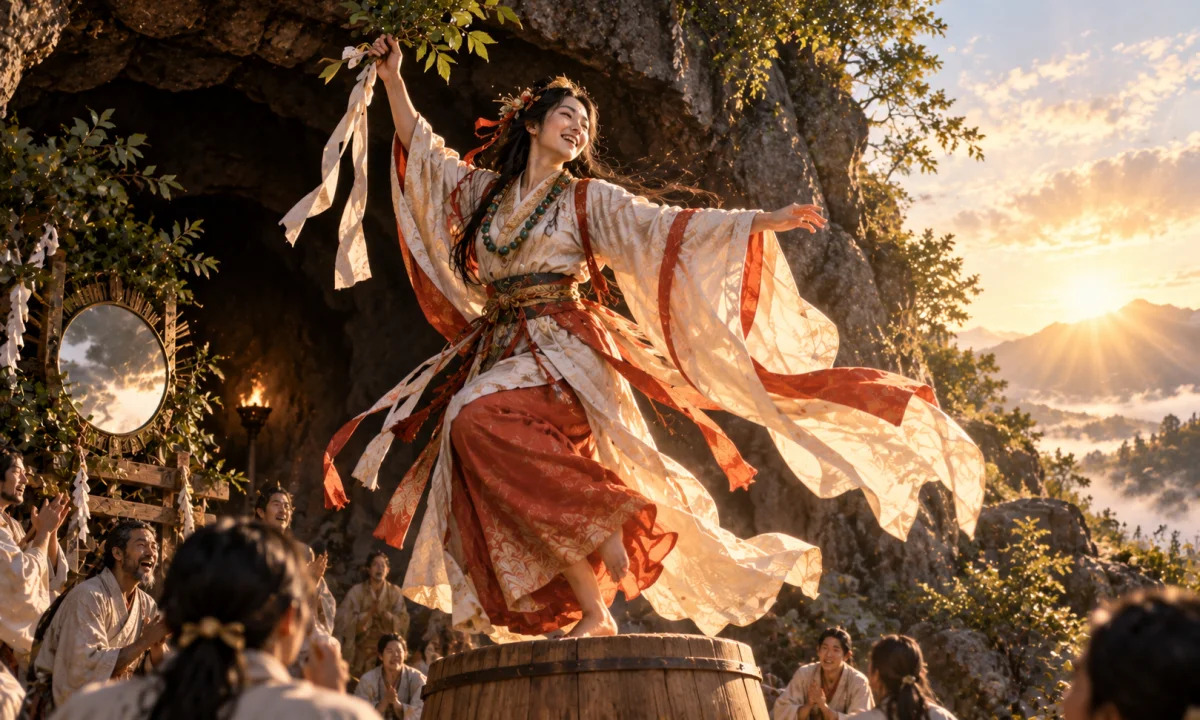
The meeting between Sarutahiko and Ame-no-Uzume is one of the most memorable divine encounters in Japanese mythology. Uzume is famous for the dance that restored laughter and light when Amaterasu hid inside the Heavenly Rock-Cave. In the Sarutahiko episode, she again acts as a bold mediator who approaches a frightening supernatural presence and obtains the information needed by the heavenly gods.
Her role is not passive. Rather than simply confronting Sarutahiko with force, she questions him and establishes an exchange between the heavenly mission and the earthly deity. This makes her particularly suited to a story about crossing boundaries and resolving uncertainty. The episode also links two deities associated with performance, vitality, exposure, and the overcoming of spiritual danger, although the early texts do not present them as a formal pair in the same detailed way found in later religious tradition.
Later accounts and shrine traditions frequently describe Ame-no-Uzume and Sarutahiko as married or joined as consorts. This relationship became especially influential in religious and artistic representations. It should be distinguished from the precise wording and emphasis of the early chronicles, where the main focus is on Uzume's questioning of Sarutahiko and his guidance of Ninigi. The idea of their marriage is an important later development, but it should not be treated as though every early source presents it identically.
What happens after Ninigi's descent?
After Sarutahiko guides Ninigi, the mythic tradition turns to his return to the earthly realm. In the Kojiki, Ame-no-Uzume is connected with Sarutahiko after his role in the encounter, and the narrative explains the origin of her name in relation to him. The episode is brief and has generated different interpretations concerning whether it describes marriage, service, ritual association, or the beginning of a particular lineage of performers and attendants.
Later tradition gives Sarutahiko a stronger connection with Ise and with the region associated with his worship. Sarutahiko shrines, including important shrines in Ise, preserve him as a central kami. Shrine traditions may emphasize him as a guide, a protector of travel, a god who brings good direction, or a guardian who removes obstacles. These living traditions are not identical to the mythological narrative recorded in the early court chronicles.
In some local and folk contexts, Sarutahiko has also been associated with figures known as dōsojin, sae no kami, or other deities of roads and borders. These traditions may involve stone markers, carved images, paired figures, or protective objects placed at village limits. Such associations reflect shared functions rather than proof that all these deities originated as one being. The boundaries among named kami, local spirits, and later interpretations can be fluid, and local practice must be considered separately.
Interpretations of his religious significance
Sarutahiko is often interpreted as a deity who mediates between heaven and earth, between outsiders and local powers, and between movement and danger. His willingness to guide Ninigi has symbolic importance in myths concerned with the establishment of divine rule. He is an earthly authority who recognizes the heavenly mission, but the story also acknowledges that passage cannot occur without his cooperation.
Some scholars see in the story a literary representation of the incorporation of regional or indigenous deities into a mythology centered on the imperial line. From this perspective, Sarutahiko may represent a powerful local god whose authority is preserved by placing him in a supporting relationship to Ninigi. This is an interpretation of the political and religious structure of the chronicles, not a historical record proving that a specific tribe or ruler was Sarutahiko's human counterpart.
Other interpretations emphasize his older boundary symbolism. The crossroads is a place of exchange and danger, and Sarutahiko's extraordinary body may express the power of a guardian figure who prevents disorder from crossing into the community. His long nose, exposed sexuality in some later imagery, and association with upright stones have sometimes led researchers to discuss phallic or fertility symbolism. These themes occur in later folk representations, but they should not be assumed to define the whole of Sarutahiko's early mythology.
His mythology also reflects an important feature of Shinto: a kami need not be morally classified as purely good or evil. Sarutahiko initially appears threatening because his appearance and position are intimidating, yet he becomes a protector and guide. His power is dangerous when misunderstood, but beneficial when properly approached and ritually integrated.
Sarutahiko in shrine tradition and visual culture
Sarutahiko is worshipped at shrines throughout Japan, although the prominence and specific functions of his cult differ by region. Some shrines identify him as their principal kami; others enshrine him with Ame-no-Uzume or with deities connected to roads, directions, agriculture, or local protection. His honorific name, Sarutahiko Ōkami, presents him not simply as a character in a story but as a powerful object of religious devotion.
Traditional images commonly show him as a large man with a conspicuously long nose and a commanding expression. He may hold a staff or appear in a posture suggesting that he is leading or directing travelers, although no single iconographic form is universal. In processions and ritual contexts, representations of Sarutahiko can mark the opening of a route or the clearing of a sacred passage. The details depend on the shrine and the local ceremony.
His association with Ame-no-Uzume has also encouraged paired imagery. Sarutahiko may be represented as a strong, imposing male figure, while Uzume appears as a lively or expressive female figure. This pairing is a product of religious and artistic development over time and should not be reduced to a simple opposition between two fixed gender roles. Both figures are connected with the successful negotiation of danger, revelation, and transition.
Distinguishing Sarutahiko from related figures
Sarutahiko is sometimes confused with several other Japanese supernatural beings. He is not the same as a tengu, despite the long nose found in later depictions. He is also not identical to a monkey deity merely because the character for “monkey” may appear in the written form of his name. Nor should he automatically be identified with every dōsojin, roadside deity, or phallic boundary stone found in Japanese folk practice.
He is likewise distinct from Ninigi. Ninigi is the heavenly grandson who descends to earth and becomes an ancestor of the imperial line in the mythic genealogy, whereas Sarutahiko is the earthly deity who guides him. Sarutahiko is also not the same as Ame-no-Uzume, although their stories and later worship are closely connected.
Later reception
Sarutahiko remains more visible in religious art, shrine practice, local festivals, and cultural history than in globally dominant modern fantasy. Contemporary depictions may emphasize his unusual face, massive body, long nose, or role as a guide. He can appear in manga, anime, games, illustrated retellings, and modern discussions of Japanese mythology, sometimes with invented powers or personalities that do not come directly from the early sources.
These adaptations often borrow the visual association between Sarutahiko and the tengu, or present him as a warrior, guardian, or comic figure. Such uses belong to modern popular culture rather than to a single continuous ancient description. The traditional Sarutahiko is most fundamentally the radiant boundary deity who meets Ninigi at the crossing of heaven and earth, speaks with Ame-no-Uzume, and turns a potentially threatening encounter into a passage under divine protection.