WORLD
WORLD
Kunitokotachi
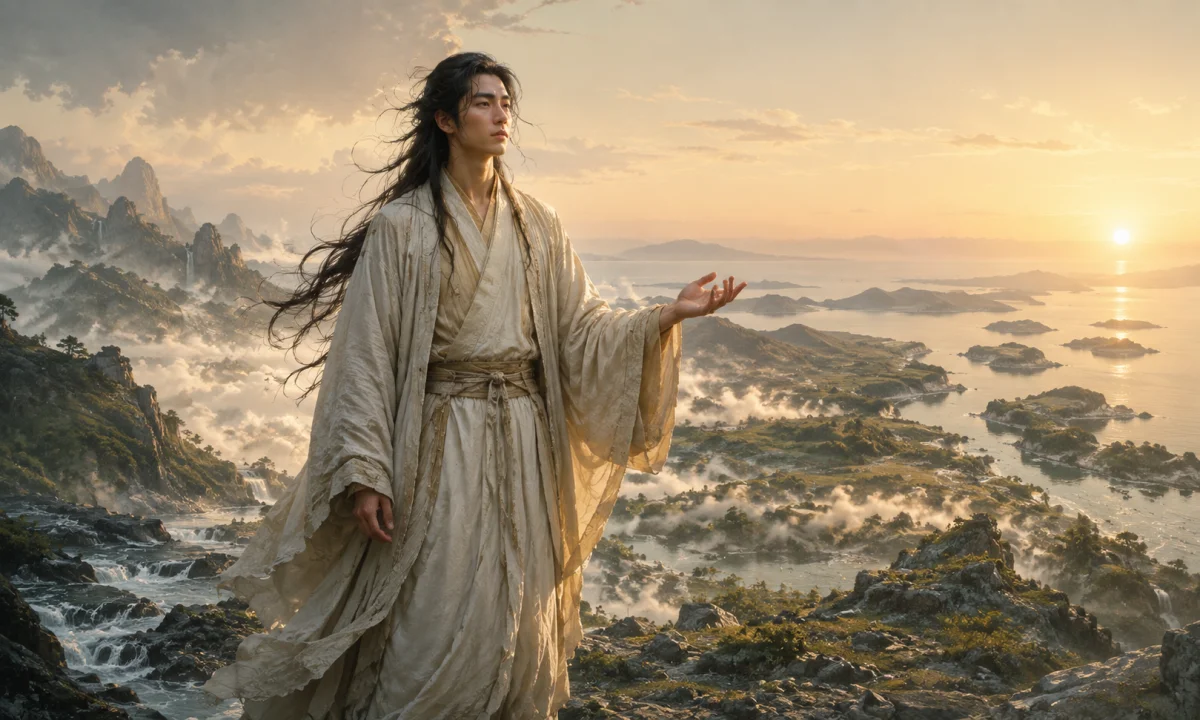
Kunitokotachi, also written Kuni no Tokotachi no Kami or Kunitokotachi-no-Mikoto, is a primordial kami in Japanese mythology. The figure appears most prominently in the Kojiki and the Nihon Shoki, the two earliest surviving major chronicles of Japan’s mythic traditions. Kunitokotachi is associated with the establishment or permanence of the land, but the ancient texts give the deity very little individual personality, appearance or mythology. Rather than a hero involved in dramatic episodes, Kunitokotachi belongs to the earliest layer of the Japanese cosmological order.
Sources and cultural setting
The main surviving accounts of Kunitokotachi occur in the Kojiki, completed in 712, and the Nihon Shoki, completed in 720. These works were produced at the imperial court during a period when rulers and scholars were organizing traditions about the origins of the Japanese islands, the divine ancestry of the imperial line and the structure of the cosmos. They are essential sources for early Japanese mythology, but they should not be treated as straightforward records of a single, uniform religious system.
Both chronicles brought together older oral traditions, regional cults, genealogies and courtly interpretations. Their accounts sometimes agree and sometimes differ considerably. The Kojiki generally presents a continuous genealogical narrative leading toward the birth of the islands and the divine ancestors of the imperial house. The Nihon Shoki includes a principal narrative as well as alternative accounts attributed to different traditions. Kunitokotachi’s position and description therefore depend partly on which text is being considered.
Early Japanese kami were not always imagined as human-like gods with detailed biographies. A kami could be a force, presence, place, ancestor, natural phenomenon or principle of order. The earliest beings in the creation passages are often presented through their names and relationships rather than through actions. Kunitokotachi belongs to this abstract and primordial category.
The name Kunitokotachi
The name is commonly written 国之常立神 in the Kojiki and 国常立尊 in the Nihon Shoki. The first element, kuni, means “land,” “country” or “realm.” The latter part is commonly connected with ideas such as permanence, stability or standing. For that reason, the name is often rendered in English as “the deity who stands eternally in the land,” “the eternally established land deity” or “the deity of the permanent land.”
These translations are useful explanations rather than universally agreed literal equivalents. The exact interpretation of tokotachi is not entirely certain, and Japanese mythological names can preserve archaic forms whose original nuance is difficult to recover. The name clearly suggests stability and the establishment of the land, but it does not prove that the deity was originally conceived as a fully developed personification of the earth in the same way that some later interpreters have presented it.
The endings -no-kami and -no-mikoto are honorific or classificatory forms used for divine figures. They do not indicate two different beings. Kunitokotachi, Kuni no Tokotachi no Kami and Kunitokotachi-no-Mikoto are variant forms of the same mythological name, although the surrounding descriptions differ between texts and later religious traditions.
Kunitokotachi in the Kojiki
In the opening creation sequence of the Kojiki, heaven and earth first emerge in an indistinct and unsettled condition. Several solitary kami appear in the High Plain of Heaven, including Amenominakanushi, Takamimusubi and Kamimusubi. Other primordial beings then arise from the developing world, including Umashiashikabihikoji and Amenotokotachi.
Kunitokotachi appears after these earliest deities as the first of the seven generations of kami. The text lists Kuni no Tokotachi no Kami followed by Toyokumono no Kami. These two are solitary deities. After them come paired generations whose names and relationships gradually lead to Izanagi and Izanami, the male and female kami who perform the famous work of creating and ordering the Japanese islands.
The Kojiki does not give Kunitokotachi a separate story. There is no account of a battle, marriage, journey or speech attributed to the deity. Its importance comes from its place in the sequence. Kunitokotachi represents an early stage in the emergence of an ordered world, before the narrative reaches the more anthropomorphic generations and the dramatic activities of Izanagi and Izanami.
The solitary status of Kunitokotachi is also significant. The early generations are not arranged according to one consistent model of sexuality or family. Some kami arise alone, while later generations are paired. The progression can be read as a movement from undifferentiated cosmic beginnings toward a world capable of reproduction, genealogy and ordered social relationships. That pattern is visible in the structure of the text, even though the Kojiki does not explicitly explain it as a philosophical system.
Kunitokotachi in the Nihon Shoki
The Nihon Shoki gives Kunitokotachi a more prominent position in its principal creation account. It begins with a description of heaven and earth in an early, formless state. A substance resembling a reed shoot appears, transforms into a kami and becomes Kuni-no-Toko-tachi no Mikoto. In this account, Kunitokotachi is the first deity to emerge in the unfolding cosmos.
The text then names additional primordial deities, including Kuni no Satsuchi no Mikoto and Toyo-kuni-nushi no Mikoto in the main version. As the divine generations continue, the account eventually reaches Izanagi and Izanami. The Nihon Shoki also preserves alternative versions of the creation story, and these do not always arrange the first kami in exactly the same order.
This difference is important. Kunitokotachi is not simply “the first god of Japan” in every ancient source. In the Nihon Shoki’s principal narrative, the deity has the earliest position, while in the Kojiki Kunitokotachi appears after several other primordial kami. The variation reflects the composite nature of early Japanese mythology rather than a simple error in one text.
Even in the Nihon Shoki, Kunitokotachi has little narrative action. The deity’s role is primarily cosmogonic: Kunitokotachi marks the beginning of a stable, named and ordered world. The name and position carry more meaning than any developed episode.
Identity and classification
Kunitokotachi is generally classified as a primordial kami or creation deity. The term “earth deity” can be appropriate when it refers to the deity’s association with the establishment of the land, but it may be misleading if it suggests a single, clearly defined goddess or god of soil and agriculture. The ancient texts do not describe Kunitokotachi as a farming deity, a ruler of the dead or a patron of a particular human community.
The deity is also commonly described as a hitorigami, a kami who appears alone rather than as part of a divine pair. This classification is especially relevant in the Kojiki, where Kunitokotachi is explicitly listed among the solitary beings of the early generations. The term does not necessarily mean that the deity was believed to have no relationships at all; it describes the manner of appearance in the creation genealogy.
Kunitokotachi should not be confused with Amenotokotachi, another primordial kami named in the Kojiki. The two names share the element tokotachi, but they are distinct figures. Amenotokotachi belongs to an earlier group of solitary kami associated with the emergence of the heavenly realm, while Kunitokotachi is a later figure associated by name and position with the land. The similarity of the names has sometimes encouraged comparisons, but the texts do not identify them as the same being.
Attributes and symbolic significance
No standard physical appearance is assigned to Kunitokotachi in the early chronicles. The deity is not described as a giant, a human-shaped ruler, an animal or a distinctive natural object. Images found in later religious settings therefore reflect artistic or sectarian interpretation rather than a fixed ancient iconography established by the Kojiki or Nihon Shoki.
The most consistent attribute is primordial permanence. The name evokes something that stands, endures or establishes the land. Kunitokotachi can therefore be understood as a marker of the transition from an unstable cosmic beginning to a world with a durable foundation. This is a symbolic role rather than a clearly narrated act of construction.
The deity’s position also helps establish the order of divine generations. Japanese creation traditions do not present one single event in which the universe is made complete. Instead, the world becomes increasingly differentiated: heaven and earth take shape, primordial kami appear, divine generations develop, and the work of creating the islands is later undertaken by Izanagi and Izanami. Kunitokotachi belongs to the stage in which the land becomes conceptually established before the more active creation of the archipelago.
Interpretations of Kunitokotachi vary. Some readers see the figure as a personification of the enduring land itself. Others treat the deity chiefly as a genealogical or cosmological name used to organize a sequence of divine origins. Both approaches are possible, but neither should be presented as the only meaning supported by the ancient texts.
Relationships and mythological variants
Kunitokotachi has no family relationships described in detail in the Kojiki. The deity is followed by Toyokumono, then by several generations of kami whose names suggest increasing differentiation and pairing. The sequence culminates in Izanagi and Izanami. Since Kunitokotachi is part of this genealogy, later traditions may describe the deity as an early predecessor of the creators of the islands, but the ancient text does not give Kunitokotachi a personal relationship with them.
The Nihon Shoki uses a somewhat different sequence and includes alternative accounts. Its first deity is followed by Kuni no Satsuchi and then by other primordial beings. Some versions name figures whose titles contain elements meaning “land,” “country” or “ruler,” but these names should not automatically be merged with Kunitokotachi. Similar wording reflects shared cosmological vocabulary, not necessarily identity.
In particular, Kunitokotachi is distinct from Ōkuninushi, whose name is often translated as “Great Master of the Land” or “Great Land Ruler.” Ōkuninushi is a major deity of the earthly realm in later portions of the mythic cycle, especially in traditions concerning the governance and transfer of the land to the descendants of Amaterasu. Although both figures have names connected with land, they have different stories, positions and identities.
Later religious interpretation
Kunitokotachi did not become as prominent in popular awareness as Amaterasu, Susanoo, Izanagi, Izanami or Ōkuninushi. Nevertheless, the deity continued to appear in later Shinto interpretations and in some religious movements that placed unusual emphasis on primordial kami. In these settings, Kunitokotachi could be elevated as a supreme or foundational deity, a source of cosmic order or a manifestation of universal life.
Such interpretations belong to later religious history and should not be read back into the brief descriptions of the early chronicles. Medieval and early modern Shinto thinkers often reinterpreted the ancient kami through Buddhist cosmology, yin-yang theory, esoteric teachings and theories about the unity or correspondence of different deities. Modern Shinto-derived movements have also developed their own hierarchies and explanations. The status assigned to Kunitokotachi in one such tradition may therefore be very different from the deity’s limited role in the Kojiki.
Some later religious writings identify Kunitokotachi with a universal principle, the earth’s enduring life or a supreme creator. These claims are meaningful within the traditions that make them, but they are not descriptions supplied by the earliest mythological narratives. Distinguishing ancient textual evidence from later theology is especially important in the case of a figure whose original record is so brief.
Presence in modern culture
Kunitokotachi occasionally appears in modern manga, anime, novels, games and esoteric fiction that draw on Japanese mythology. In these works, the name may be used for a primordial ruler, an earth-based power or an ancient supernatural antagonist. Such portrayals often expand the deity into a character with a personality, appearance and powers that are absent from the classical sources.
Modern adaptations can introduce audiences to the name, but they should not be confused with the traditional profile. The historically attested Kunitokotachi is a spare cosmological figure: a solitary primordial kami whose name and place in the divine genealogies suggest the enduring establishment of the land. The ancient narratives give no standard weapon, costume, sacred animal, dramatic quest or detailed set of supernatural abilities.