WORLD
WORLD
Jimmu-tenno
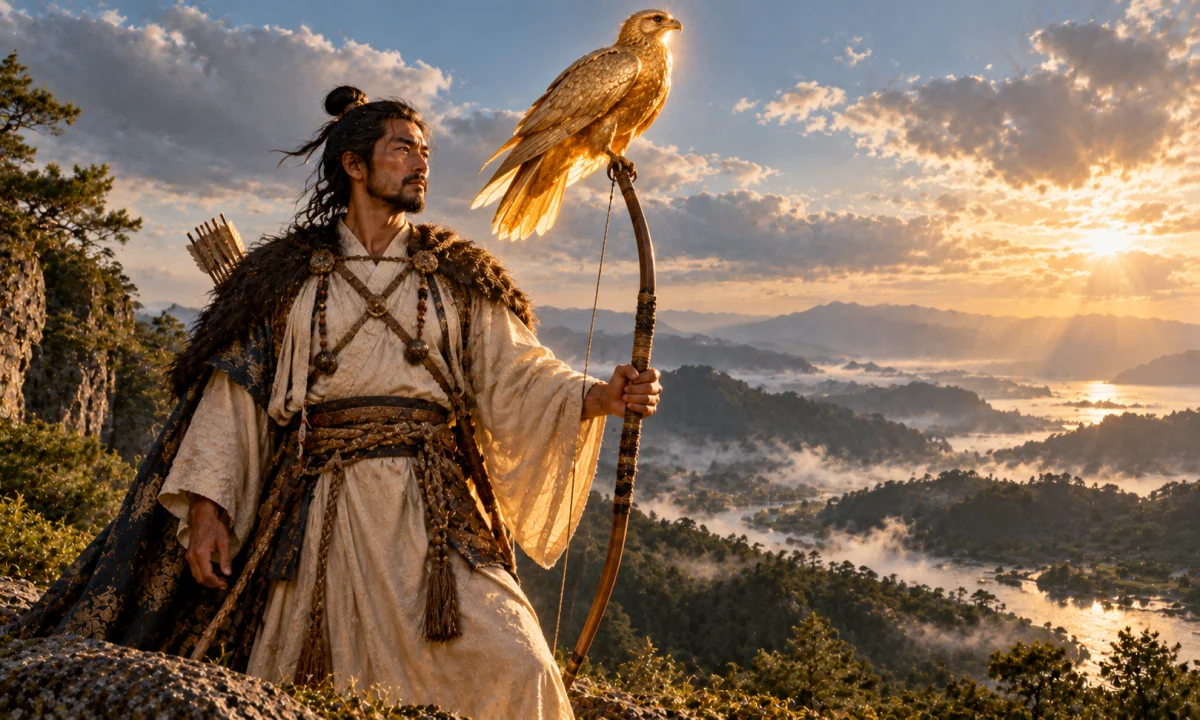
Jimmu-tennō, also written Emperor Jimmu or Jinmu-tennō, is presented in Japanese tradition as the first emperor of Japan and the founder of the imperial line. He is a legendary ruler rather than a figure whose historical existence can be securely established. His story combines divine ancestry, migration, warfare, ritual authority and the establishment of a political centre in the Yamato region of central Japan.
Jimmu belongs chiefly to the mythology and early legendary history recorded in the Kojiki and the Nihon Shoki. These works place his accession traditionally in 660 BCE, but that date is not supported by contemporary evidence. Modern historians generally treat the early imperial chronology as a later construction, while recognizing that the traditions may preserve memories of regional conflicts, political consolidation and the emergence of the Yamato court.
Origins in Japanese tradition
The story of Jimmu forms part of a long genealogy linking the imperial house to the kami, or sacred beings, of Japanese myth. The imperial line is said to descend from Amaterasu Ōmikami, the sun goddess and one of the central deities of the Shinto tradition. Amaterasu sends her grandson Ninigi-no-Mikoto to rule the earthly realm. Through several generations, this divine lineage eventually produces Jimmu.
Jimmu's father is named Ugaya-fukiaezu-no-Mikoto, a figure connected with the sea and with the divine ancestry of the southern Japanese tradition. His mother is Tamayori-bime, the younger sister of the sea deity's daughter who had earlier married Jimmu's grandfather, Hoori. The genealogies differ in detail between the Kojiki and the Nihon Shoki, and the names can appear in several romanized forms.
Before becoming emperor, Jimmu is portrayed as a prince living in the region of Takachiho or Himuka, usually associated with southeastern Kyushu. His early name is commonly given as Hikohohodemi, although the full form of his name is much longer and varies according to the source and system of transliteration. The name “Jimmu” is a posthumous title rather than the personal name used throughout the narrative.
The eastern expedition
The central episode of Jimmu's legend is his expedition from Kyushu toward the east. He is said to have decided that the eastern lands offered a better place from which to establish rule over the islands. The chronicles portray this decision not simply as a military campaign but as the fulfilment of a sacred mandate inherited from the heavenly kami.
Jimmu travels with his older brothers and a group of followers. The expedition reaches the region around present-day Osaka, where the army encounters resistance from local powers. In one famous episode, Jimmu's elder brother Itsuse-no-Mikoto is wounded by an arrow shot by the warrior Nagasunehiko. Itsuse explains that the defeat occurred because they had fought while facing toward the east, where the sun rises. Since their divine ancestor is associated with the sun, he argues that they should not attack in that direction. The army therefore retreats and travels southward around the Kii Peninsula before approaching Yamato from the east.
This episode has an important symbolic function. The change in direction is presented as a correction of ritual error, not merely a tactical retreat. The campaign succeeds only after Jimmu's forces respect the proper relationship between the ruler and the sun deity. The story thus connects military success with ritual correctness and with the idea that the ruler acts within a divinely ordered world.
Yatagarasu and divine guidance
During the difficult passage through the mountains of Kumano, Jimmu's army becomes lost or is overcome by supernatural danger. The sources describe poison or a mysterious sleep brought about by local divine beings. Assistance then arrives from the heavenly realm. A sacred sword is delivered to Jimmu in one version of the story, while the sun goddess and the storm deity Takemikazuchi are involved in the divine intervention described by the chronicles.
Jimmu is also guided through the mountains by Yatagarasu, the great three-legged crow. In the Nihon Shoki, this bird is sent by Amaterasu; in the broader tradition, it functions as a divine guide leading the expedition toward Yamato. Yatagarasu should not be confused with an ordinary crow or with a separate human hero. Its three legs are commonly interpreted in later symbolism as relating to the sun, although the ancient texts do not provide one single, definitive explanation of the three-legged form.
After crossing the mountain country, Jimmu reaches the Yamato basin. There he confronts several local rulers and supernatural beings. Some are defeated in battle, while others submit or are represented as obstacles that must be ritually overcome. The narrative presents the eventual establishment of Jimmu's court as both a conquest and a process of bringing a divided landscape under unified authority.
Nagasunehiko and Nigihayahi
One of the most significant conflicts in the Yamato section is Jimmu's encounter with Nagasunehiko, a powerful local leader. Nagasunehiko had previously supported Nigihayahi-no-Mikoto, another figure descended from the heavenly realm. This creates a complicated situation: Jimmu is not the only claimant to a sacred or heavenly mandate.
In the Nihon Shoki, Nigihayahi recognizes that Jimmu possesses the genuine signs of the heavenly ruler. He kills Nagasunehiko and submits to Jimmu. This episode allows the narrative to acknowledge an established local power while ultimately incorporating it into the imperial order. It also distinguishes Jimmu's authority from simple conquest: legitimacy is confirmed through recognition of his divine credentials.
The story can be read in several ways. At a mythic level, it dramatizes the triumph of the rightful heavenly descendant. At a historical or political level, it may reflect traditions about the absorption of regional elites into the Yamato polity. Because the chronicles were compiled long after the period they describe, it is not possible to identify the historical events behind the story with certainty.
Accession and the establishment of the court
Jimmu is said to have established his palace at Kashihara, near Mount Unebi in the Yamato region. His accession is traditionally dated to the first day of the first month of 660 BCE. This date became the basis of the traditional Japanese imperial era count, known as Kigensetsu or the “beginning of the imperial era.”
The title “emperor” is a conventional English translation of tennō. It should not be assumed that the political institution described in the chronicles existed in exactly the same form at the date assigned to Jimmu. The texts project the later imperial structure backward into a remote mythic past. Archaeological evidence indicates that large-scale political organization in the Yamato region developed over centuries, especially during the Kofun period, rather than appearing suddenly in 660 BCE.
Jimmu's accession is also associated with the founding of the Japanese imperial line. Later tradition regards all historical emperors as his descendants. The narrative therefore does more than tell of one ruler: it provides a sacred beginning for the institution of the throne and places the imperial family within a genealogy extending back to the kami.
Marriage and descendants
Jimmu's principal wife is named Himetataraisuzu-hime in the Nihon Shoki and Isukeyori-hime in the Kojiki. She is associated with the lineage of Kotoshironushi, a prominent kami connected with the Izumo tradition, though the genealogical details differ between the two chronicles. Her inclusion is important because it links Jimmu's new ruling line with an established sacred and regional ancestry.
The chronicles name several sons born from this union. The eldest, Tagishimimi, later becomes involved in a succession crisis after Jimmu's death. According to the legend, Tagishimimi attempts to seize power and marry his father's widow. His half-brother Kamununakawamimi, who later becomes Emperor Suizei, opposes him. The account explains the transfer of authority to the next ruler while also presenting the early imperial household as a place where political legitimacy must be defended against internal rivalry.
These succession stories are legendary and should not be treated as ordinary biographical records. They help explain the order of the first emperors and reinforce the notion that rulership passes through a divinely sanctioned family line.
Name and identity
The name Jimmu is based on the characters 神武, often understood as “divine valor” or “godlike martial power.” The Japanese reading is usually Jinmu, while Jimmu is a widely used English romanization. The form Jimmu-tennō combines the posthumous name with the title “emperor.” Older English-language works may use “Jinmu,” “Jimmu,” “Emperor Jinmu” or “Emperor Jimmu.” These forms refer to the same legendary ruler, not to separate figures.
His full classical name is exceptionally long. It is commonly transcribed in forms such as Kamuyamato-Iwarehiko-Hohohodemi-no-Sumera-mikoto, but spellings vary because Japanese names from the early chronicles can be represented in different ways. “Jimmu” is therefore the most practical short form for general discussion.
Attributes and symbols
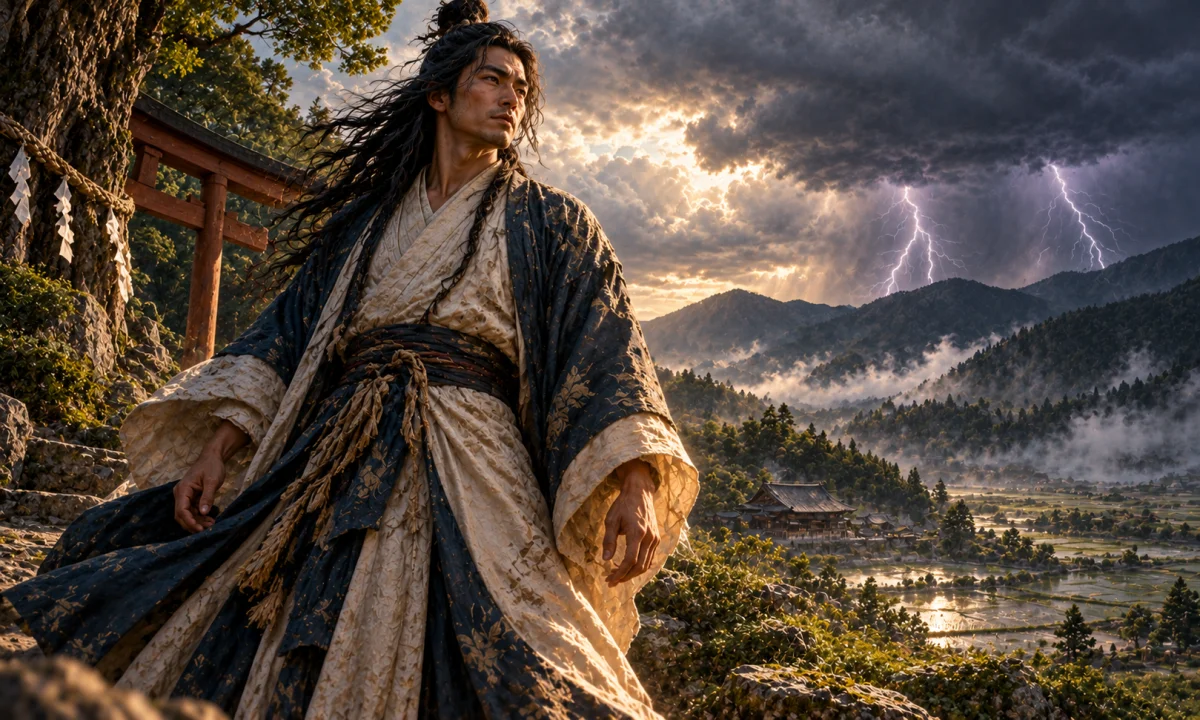
Unlike many gods or heroes, Jimmu does not have a single standardized physical appearance in ancient tradition. Artistic representations often show him as a warrior prince or early emperor, but these images are later interpretations rather than descriptions preserved in the foundational myths.
His major attributes are symbolic rather than personal. He is a founder, a sacred conqueror, an ancestor of the imperial house and the human recipient of a divine mandate. His journey from Kyushu to Yamato represents the movement of authority from a southern homeland into the region that later became the political heartland of Japan.
The sacred objects associated with the imperial line include a mirror, a sword and a jewel, often known collectively as the Three Sacred Treasures. These regalia are connected to the legitimacy of the imperial house and ultimately to Amaterasu. However, accounts of Jimmu's expedition do not present the treasures in precisely the same way as later imperial symbolism, so it is misleading to treat them as a fixed set of personal weapons or possessions belonging to Jimmu alone.
The sword delivered during the Kumano episode and the appearance of Yatagarasu are especially important symbols in his legend. The sword represents divine power made available to the rightful ruler, while the crow marks the path through a dangerous and unfamiliar landscape. Together they express the idea that Jimmu's success depends on heavenly assistance as well as human courage.
Religious and political significance
Within Shinto-related tradition, Jimmu is honoured as an ancestral ruler rather than worshipped in exactly the same manner as a primordial kami such as Amaterasu. His status reflects the close relationship between sacred ancestry and political authority in the classical Japanese chronicles. The emperor is presented as a descendant of the kami, and Jimmu stands at the point where divine genealogy becomes an earthly dynasty.
The Kojiki, completed in 712, and the Nihon Shoki, completed in 720, were compiled under the early Japanese court. Their accounts served different literary and political purposes, and they do not agree in every detail. Both, however, place the imperial institution within an ancient sacred history. The Jimmu narrative should consequently be read as mythology, court ideology and legendary history at once, rather than as a straightforward chronicle of the seventh century BCE.
There is no surviving contemporary inscription or archaeological record that independently confirms Jimmu's reign or his traditional accession date. The large tombs and political institutions associated with early Japan belong to later periods than the date assigned to him. Some scholars have proposed that traditions about Jimmu may preserve distant memories of the formation of the Yamato state, but such interpretations remain necessarily tentative.
Later reception in Japan
Jimmu's importance increased greatly in the modern period, particularly during the Meiji era, when the government promoted an imperial national ideology. In 1872, 11 February was designated as Kigensetsu, commemorating the traditional date of Jimmu's accession. The observance presented the Japanese nation as possessing an unbroken imperial history extending back to antiquity.
Kigensetsu was abolished after the Second World War because of its association with prewar imperial nationalism and State Shinto. A related national holiday, National Foundation Day, was established in 1966 and first observed in 1967. Its official meaning is less explicitly tied to the divine origin of the emperor, although the traditional date and its connection with Jimmu remain part of the cultural background.
Kashihara Jingū, a major shrine in Nara Prefecture dedicated to Jimmu, was established in 1890 near the traditional site of his palace. It is therefore a modern shrine with a strong connection to imperial and national memory, not an ancient sanctuary surviving unchanged from Jimmu's supposed reign. The mausoleum traditionally identified with him near Mount Unebi is likewise part of the later imperial system of commemoration.
Jimmu appears less often in modern popular culture than figures such as Amaterasu, Susanoo or the heroic warriors of medieval legend. When he does appear, he is usually treated as a symbolic founder of Japan rather than as a character with a fully developed personality. Modern portrayals may emphasize his military leadership, divine ancestry or role in national origins, but these emphases belong to later interpretation and should be distinguished from the varied narratives preserved in the early chronicles.