WORLD
WORLD
Hachiman
Hachiman is one of the most important kami of Japan. He is associated with warfare, archery, political authority, protection, and the prosperity of communities, but his identity has never been limited to that of a war god. Hachiman developed through the interaction of local shrine traditions, imperial mythology, Buddhism, and the institutions of the medieval warrior class. In different periods, he was understood as a kami, as the deified spirit of Emperor Ōjin, and as a Buddhist bodhisattva known as Hachiman Daibosatsu.
Hachiman is particularly associated with the Usa Hachiman-gū in Kyushu, Iwashimizu Hachimangū near Kyoto, and Tsurugaoka Hachimangū in Kamakura. His worship spread widely through branch shrines, especially during the rise of the samurai governments. Although later tradition often presents Hachiman as a single, clearly defined deity, the historical development of his cult was complex and involved several overlapping identities.
Origins and cultural setting
The earliest major centre of Hachiman worship was Usa, in present-day Ōita Prefecture on Kyushu. The shrine now known as Usa Jingū or Usa Hachiman-gū preserves traditions claiming that Hachiman appeared there during the sixth or early seventh century. The exact origin of the cult is uncertain. The surviving accounts combine local religious practices, imperial genealogy, miraculous revelations, and Buddhist ideas, so they should not be treated as a single contemporary record of Hachiman’s beginnings.
Hachiman’s development took place during a period when religious boundaries in Japan were not sharply divided between what are now called Shinto and Buddhism. Kami were worshipped alongside Buddhist figures, Buddhist temples were attached to shrines, and religious specialists interpreted kami through Buddhist doctrines. Hachiman became one of the clearest examples of this interaction. He was worshipped at shrines, yet he could also be addressed as a bodhisattva and represented in forms associated with Buddhist monastic culture.
The written mythology of early Japan does not present Hachiman as a prominent god in the same way that it presents figures such as Amaterasu, Susanoo, or Ōkuninushi. The Kojiki, compiled in 712, and the Nihon Shoki, completed in 720, describe Emperor Ōjin and his mother, Empress Jingū, but do not simply identify Ōjin as Hachiman. The connection between the emperor and the kami was formed and developed through later shrine traditions, court records, oracles, and religious interpretation.
The name Hachiman
The name Hachiman is written with characters meaning “eight banners.” It can also be associated with the readings Yawata or Yahata, which appear in place names and shrine names. The exact significance of the “eight banners” is uncertain. Some traditions connect the name with miraculous banners or with signs appearing at the birth or enthronement of Emperor Ōjin. Other interpretations treat it as an old sacred place-name or as a title whose original meaning was later explained through legend.
The spelling of the name therefore does not prove that Hachiman literally possessed eight banners as a fixed mythological attribute. Banners were important symbols of authority and military power in Japan, and their association with Hachiman helped reinforce his relationship with rulers and warriors. In many contexts, the names Hachiman, Yawata, and Yahata refer to the same religious tradition, although individual place names and local customs may preserve distinctive histories.
Hachiman and Emperor Ōjin
Hachiman is commonly identified with Emperor Ōjin, the legendary fifteenth emperor of Japan. According to the imperial chronicles, Ōjin was the son of Emperor Chūai and Empress Jingū. His birth was delayed while Jingū undertook an expedition to the Korean Peninsula, and later tradition connected his unusual birth circumstances with the sacred identity of Hachiman.
The identification of Hachiman with Ōjin is not equivalent to saying that the early chronicles explicitly call the emperor Hachiman. Rather, it reflects a later process in which a powerful kami was associated with an important imperial ancestor. The cult at Usa came to include Ōjin, Jingū, and a female deity often called Himegami. The precise identity of Himegami varies by tradition, and she should not automatically be equated with one universally agreed figure.
In religious practice, Hachiman could therefore be understood as a deified emperor, an independent kami, or a sacred presence connected with the imperial line. These interpretations were not always regarded as contradictory. Japanese religious traditions frequently allowed one sacred figure to have several names, manifestations, and levels of identity depending on the shrine, ritual setting, or theological system involved.
Attributes and representation
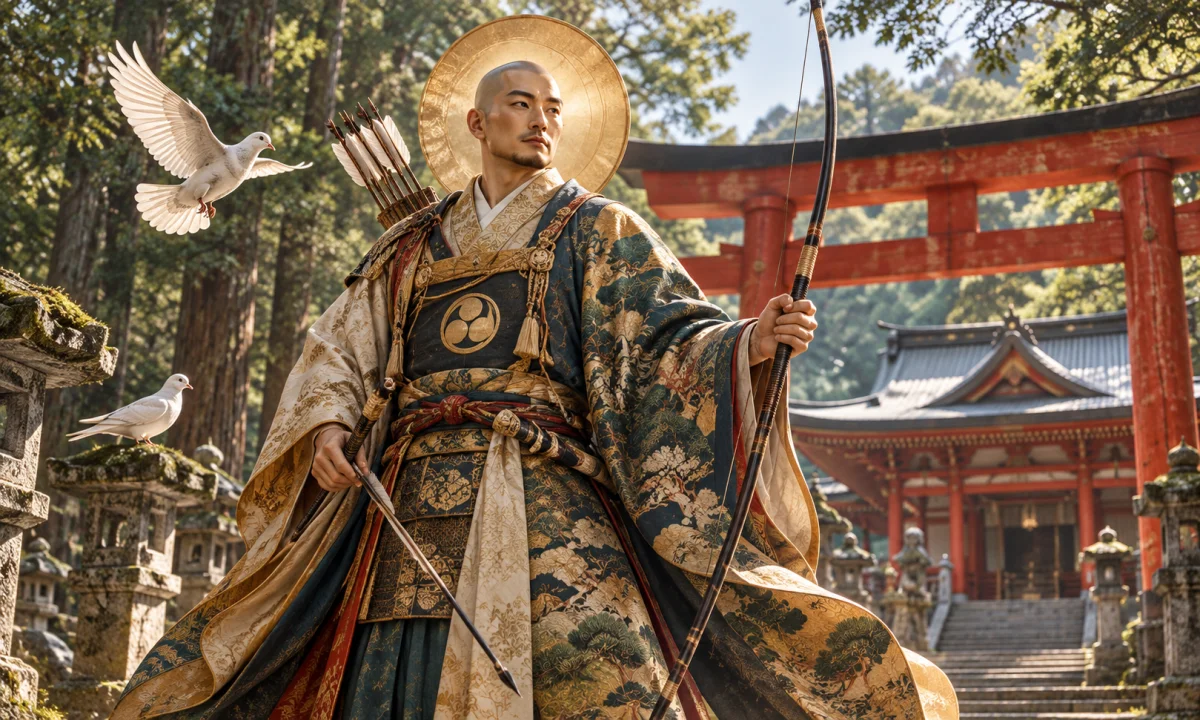
Hachiman is strongly connected with archery, weapons, military leadership, and the protection of warriors. His association with the bow reflects both the importance of archery in the culture of the medieval warrior and the religious role of weapons as signs of authority. Samurai prayed to Hachiman before campaigns, dedicated armour and weapons to his shrines, and treated him as a guardian of legitimate rule rather than merely a supernatural source of victory.
In visual art, Hachiman may appear as a warrior, but one of his most distinctive forms is that of a Buddhist monk. He is frequently shown wearing monastic robes, sometimes with a shaved head or a crown, and sometimes accompanied by figures connected with Buddhist worship. Such representations are evidence of the medieval understanding of Hachiman as Hachiman Daibosatsu, a bodhisattva-like protector. His monk-like appearance can seem surprising if he is viewed only as a god of war, but it reflects the deeply integrated religious culture of premodern Japan.
Hachiman’s symbols may include bows, arrows, banners, armour, and shrine emblems. White doves are also associated with Hachiman shrines. They have been interpreted as sacred messengers or manifestations of the kami, although the exact significance of the dove varies among local traditions. A dove should not be treated as an exclusive universal emblem of every form of Hachiman worship.
Hachiman as a protector and war deity
Hachiman’s reputation as a military deity grew especially during the Heian and Kamakura periods. Warrior families sought the favour of Hachiman because he was believed to defend the state, uphold righteous authority, and guide those who fought under a legitimate cause. His protection was not necessarily understood as permission for unrestricted violence. The ideal of Hachiman included order, loyalty, justice, and the defence of the realm.
The Minamoto clan adopted Hachiman as its principal guardian. Minamoto no Yoshiie, a major warrior of the eleventh century, was associated with the shrine at Iwashimizu Hachimangū and received the name Hachimantarō, meaning “Hachiman’s first son.” The name expressed his devotion and military identity rather than a literal divine parentage.
When Minamoto no Yoritomo established his headquarters at Kamakura in 1180, he founded or developed the shrine that became Tsurugaoka Hachimangū. The shrine became a central religious institution of the Kamakura shogunate. Through the influence of the Minamoto and their successors, Hachiman worship spread among warrior houses throughout Japan. His cult was also adopted by other families, so Hachiman was not exclusively a Minamoto deity.
Hachiman’s military role is sometimes simplified as if he were merely the Japanese equivalent of a classical war god. That comparison is misleading. He was also a guardian of the state, a protector of shrines and communities, a patron of agriculture and prosperity in some local traditions, and a figure linked with imperial descent. His authority came from the combination of these roles rather than from warfare alone.
Oracles and the imperial state
Hachiman was famous for delivering sacred messages through oracles, especially through ritual specialists connected with the Usa shrine. One important tradition concerns Emperor Shōmu’s project to construct the Great Buddha at Tōdaiji in Nara during the eighth century. According to court records and later religious accounts, an oracle from Hachiman supported the project and helped resolve doubts about whether the immense image could be completed.
The event demonstrates Hachiman’s significance beyond the warrior class. He could act as a protector of the entire state and as a divine authority consulted by the imperial government. His connection with Buddhism was also explicit: the Hachiman of the oracle traditions supported the construction of a major Buddhist image, rather than standing as an opponent of Buddhist worship.
Another famous episode concerns the court official Dōkyō in the eighth century. A reported oracle from Usa allegedly declared that Dōkyō should become emperor. Wake no Kiyomaro was sent to consult the shrine and returned with a contrary message affirming the imperial succession. The story became an important account of Hachiman as a defender of the proper imperial order. Because the episode survives through politically shaped historical and religious records, it should be treated as a tradition about authority and legitimacy, not as independently verifiable evidence that a supernatural message occurred.
Hachiman and the Mongol invasions
During the Mongol invasions of Japan in 1274 and 1281, warriors and religious institutions prayed to Hachiman and other kami for protection. Later memory connected the storms that damaged the invading fleets with divine intervention. The expression kamikaze, meaning “divine wind,” is associated with this interpretation, although the historical weather events and their religious explanations are separate matters.
Hachiman was one of several protective kami invoked during these crises. He was not the only figure credited with defending Japan, and the idea that he alone created the storms oversimplifies the religious response. The invasions strengthened the image of Japan as a land under divine protection, while Hachiman’s established association with the warrior class made him especially important in the prayers and commemorations surrounding the conflicts.
Shinto, Buddhism, and Hachiman Daibosatsu
Before the modern separation of Shinto and Buddhism, Hachiman was often worshipped as a shinbutsu shūgō figure, meaning one whose kami and Buddhist identities were understood together. The title “Daibosatsu,” or “great bodhisattva,” placed Hachiman within a Buddhist framework. A bodhisattva is a being who seeks awakening while assisting other beings, and the title presented Hachiman as a compassionate protector rather than simply an armed deity.
Different Buddhist institutions interpreted Hachiman in different ways. He could be associated with the protection of the Buddhist teaching, the welfare of the state, or the salvation of worshippers. The connection was not always expressed through a single doctrine. Instead, it appeared in shrine-temple complexes, ritual texts, images, vows, and local practices.
The government reforms of the Meiji period led to the formal policy known as shinbutsu bunri, which required the administrative separation of kami worship and Buddhism. Hachiman shrines were consequently reorganised as Shinto institutions, and Buddhist titles or objects were sometimes removed or reclassified. The older combined identity did not disappear from history, however, and many Hachiman traditions cannot be understood without recognising their Buddhist context.
Major shrines and local traditions
Usa Jingū remains the principal centre of Hachiman worship and is traditionally regarded as the place where his cult first emerged. Its religious history includes Hachiman, Himegami, and Emperor Ōjin, with rituals shaped by both shrine and Buddhist traditions.
Iwashimizu Hachimangū was established near Kyoto in the ninth century and became one of the most influential Hachiman shrines in the medieval and early modern periods. Its location allowed Hachiman worship to become closely connected with the imperial capital and the protection of the court.
Tsurugaoka Hachimangū in Kamakura became the major Hachiman shrine of the Kamakura warrior government. It remains an important site of religious observance, public festivals, and historical memory. Numerous other Hachiman shrines exist throughout Japan, but each may preserve its own foundation story, associated deities, and ritual emphasis.
Distinguishing Hachiman from similar figures
Hachiman should not be confused with Hachiman Tarō, a title associated with Minamoto no Yoshiie. Yoshiie was a historical warrior, not a separate version of the kami. Likewise, Emperor Ōjin is a figure of imperial tradition who became identified with Hachiman in later religious history; the two names should not be treated as interchangeable in every early source.
Hachiman is also distinct from Bishamonten, the Buddhist guardian associated with warfare and protection, and from Futsunushi and Takemikazuchi, kami connected with swords, conquest, and the establishment of political order. These figures may appear in related religious contexts, but they have different mythological histories and cults.
Nor is Hachiman simply the Japanese counterpart of a single Greek, Roman, or Norse war god. His identity combines imperial ancestry, local shrine worship, Buddhist theology, military patronage, political legitimacy, and community protection. Any comparison with foreign war deities must leave room for these differences.
Cultural significance
Hachiman’s importance lies partly in his ability to connect groups that are often treated separately in modern descriptions of Japan: the imperial court, Buddhist institutions, local communities, and the samurai elite. A ruler could appeal to him as a guardian of the state; a warrior could honour him as a patron of archery; a shrine community could worship him as a protector; and a Buddhist institution could venerate him as a bodhisattva.
His history also shows that Japanese kami were not always fixed characters with one canonical biography. Hachiman’s identity grew through oracles, political changes, shrine traditions, ritual practice, and the interpretation of earlier myths. His role as a god of war was real and influential, but it was one part of a wider religious personality that included protection, justice, prosperity, imperial descent, and the defence of sacred order.
In modern Japan, Hachiman shrines continue to hold festivals, ceremonies, and community rituals. The older warrior associations remain visible in shrine architecture, names, emblems, and historical commemorations, while contemporary worshippers may approach Hachiman for protection, success, family welfare, or local blessings rather than for victory in battle. These living practices belong to the continuing history of Hachiman worship, not merely to the world of medieval legend.