WORLD
WORLD
Tsukiyomi
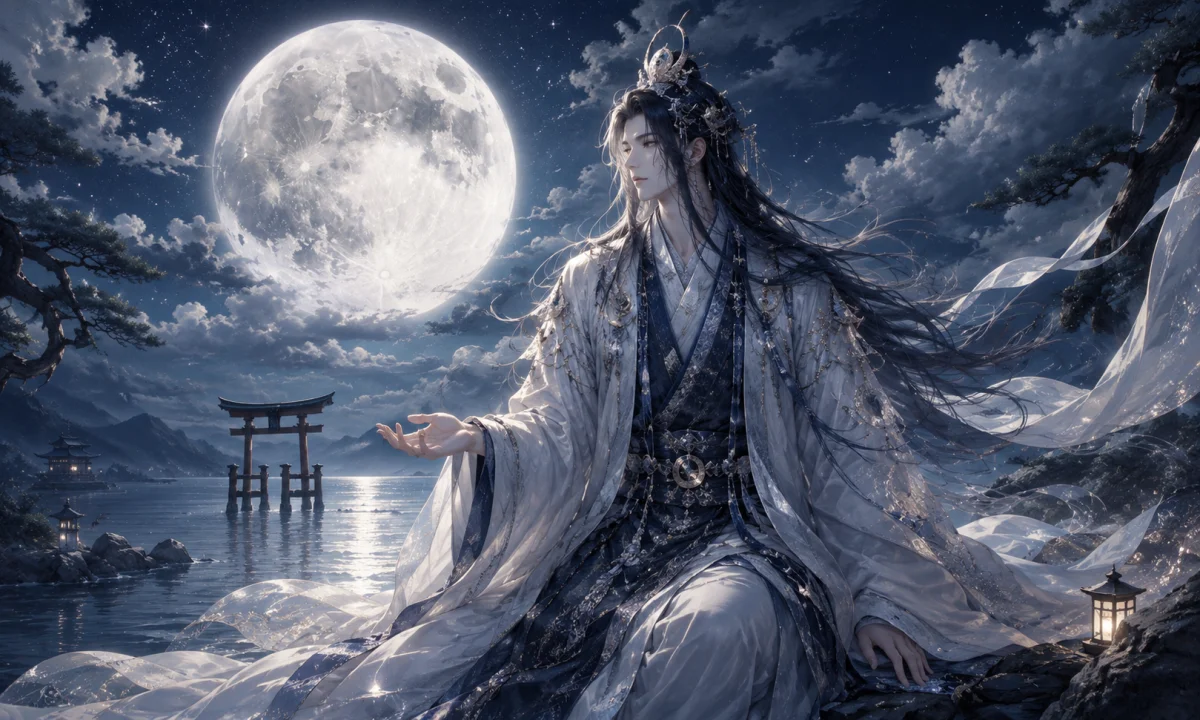
Tsukuyomi is a major deity in Japanese mythology, usually understood as the moon god. In the oldest surviving written sources of Japan, he appears as one of the children of the creator deities Izanagi and Izanami, and he is commonly linked with night, the moon, and a more restrained, distant divine presence than many other kami. His role is important, but the traditions about him are comparatively sparse, and some details vary across texts and later interpretation.
Origins and place in Japanese tradition
Tsukuyomi belongs to the mythological world preserved in early Japanese chronicles, especially the Kojiki and the Nihon Shoki, compiled in the 8th century. These works preserve creation myths, genealogies, and early divine narratives that were later woven into the broader religious and cultural landscape of Japan. In those traditions, Tsukuyomi is generally counted among the central kami associated with the heavens.
The name is usually written in Japanese as Tsukuyomi or Tsukuyomi-no-Mikoto. The spelling and reading can vary slightly in transliteration, and scholars have discussed the etymology of the name without reaching complete agreement. The first element is commonly linked to the moon, while the second has been interpreted in different ways, sometimes as relating to reading, counting, or night imagery. Because early texts are limited and later religious practice developed unevenly, the exact original meaning of the name remains uncertain.
In many modern retellings, Tsukuyomi is treated simply as the moon deity of Japan. That broad identification is reasonable, but the older sources present him less as a richly characterized personality and more as a divine figure whose significance emerges through a few key mythic episodes and through his genealogical position among the kami.
Mythic family and divine status
In the best-known version of the creation myths, Tsukuyomi is born from Izanagi after the primordial couple’s activities of generation and purification. He is typically described as one of three important children born from Izanagi’s cleansing after his return from the land of the dead: Amaterasu, the sun goddess; Tsukuyomi, the moon deity; and Susanoo, the stormy and impetuous god associated with sea and chaos. This triad has been highly influential in later imagination, though the sources do not always present the siblings in a perfectly symmetrical way.
Among these divine siblings, Tsukuyomi is often the least elaborated in the surviving mythology. Amaterasu becomes central to imperial legitimacy and divine rulership; Susanoo is the subject of numerous dramatic myths; Tsukuyomi, by contrast, appears mainly in relation to the moon and one famous act that causes his estrangement from Amaterasu. The relative scarcity of stories about him does not mean he was unimportant. Rather, it reflects the uneven preservation of traditions and the different ritual and political functions attached to various kami.
The moon deity and his symbolic role
Tsukuyomi is usually associated with the moon as a celestial body and as a symbol of the night, calm, rhythm, and distance. In Japanese religious and literary culture, the moon has often carried layered meanings: beauty, seasonal change, cyclical time, illumination without the sun’s intensity, and a sense of quiet otherness. Tsukuyomi fits these associations well, even if the early texts do not develop a full iconography or theology for him.
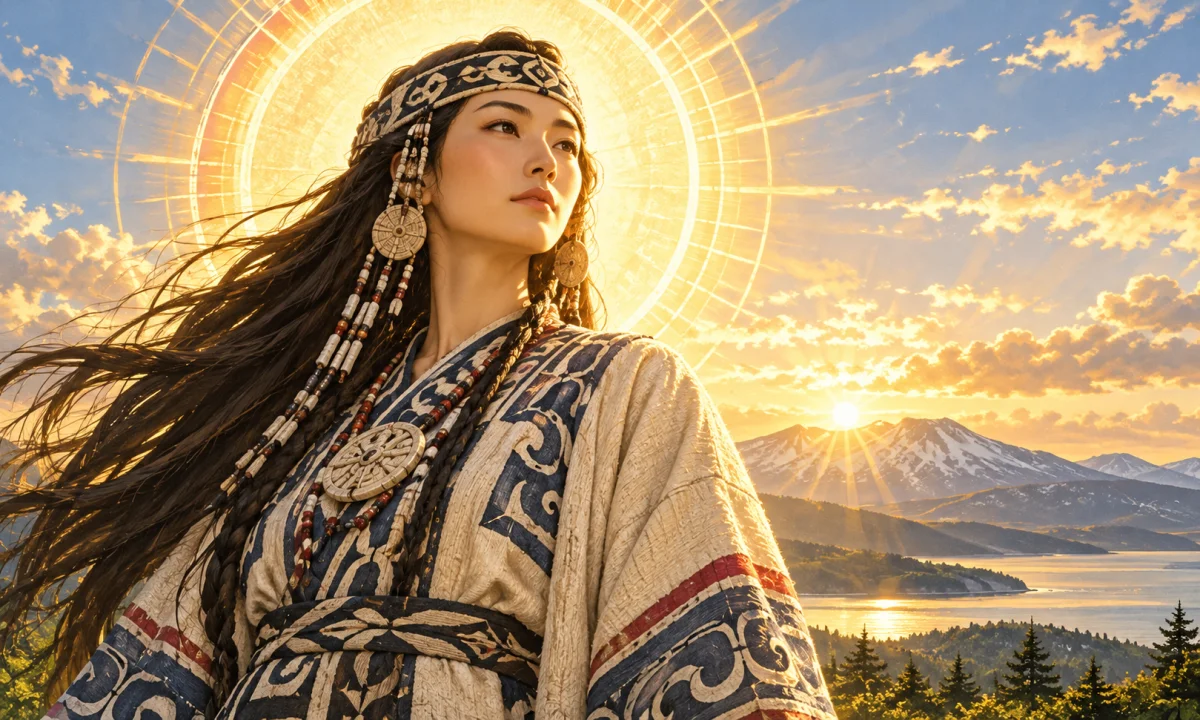
Unlike some deities in other mythologies, Tsukuyomi does not have a fixed and detailed visual form in the oldest sources. There is no standard ancient description of his face, clothing, or bodily features that can be treated as authoritative across the tradition. Later artistic and popular depictions sometimes portray him as elegant, pale, or austere, but such images belong to later imagination rather than secure early evidence.
His divine function is therefore best understood through his place in the cosmos: he governs or embodies the moon, one of the central heavenly lights, and stands as a counterpart to Amaterasu’s solar brilliance. This pairing of sun and moon has encouraged symbolic readings about order, complementarity, and separation. However, it is important not to impose later philosophical systems too rigidly on the older myths. The classical sources offer a narrative framework more than an explicit doctrine.
The banquet of the food goddess
The most famous myth involving Tsukuyomi concerns his visit to the food goddess Uke Mochi or, in some tellings, a similar deity associated with food generation. In the Nihon Shoki and related tradition, Tsukuyomi is sent by Amaterasu to attend a feast or to act as her representative. He then sees the goddess produce food in a manner that he finds offensive. In one version, Uke Mochi creates various foods from her body or from facing different directions, and Tsukuyomi becomes disgusted by the source or method of the offering. He kills her.
This story is significant because it explains a cosmic separation: after the killing, Amaterasu refuses to see Tsukuyomi again, and as a result the sun and moon come to occupy different times of the sky. The myth offers a narrative explanation for why sun and moon do not appear together for long and why day and night are distinct. It also contains a moral dimension: Tsukuyomi’s violence ruptures a relationship of divine hospitality and order.
The details of this episode vary by source. Some traditions emphasize that Tsukuyomi was acting on behalf of Amaterasu; others focus more on his personal disgust or on the shocking nature of Uke Mochi’s food production. Because the texts are not uniform, it is better to treat the story as a cluster of related versions rather than a single fixed tale.
The myth has often been read as reflecting cultural values connected with food, purity, and the proper boundaries between divine beings. At the same time, modern readers should avoid over-literalizing the scene. The symbolism is complex and may have been shaped by ritual ideas, court culture, and mythic logic rather than by a single simple meaning.
Relationship with Amaterasu
Tsukuyomi’s most important relationship in surviving mythology is with Amaterasu. Their connection is often interpreted in cosmological terms as the relationship between sun and moon, but the surviving texts present it chiefly through narrative separation rather than through ongoing dialogue or joint rule. After the killing of Uke Mochi, Amaterasu turns away from Tsukuyomi, and the two celestial deities are said to live apart.
This separation has had lasting influence on later Japanese imagery, where the sun and moon are sometimes understood as related but fundamentally distinct powers. In religious symbolism, the contrast can suggest complementary forces that do not fully merge: brightness and reflection, presence and distance, vitality and quietness. Yet these are interpretive patterns rather than strict ancient doctrines.
Tsukuyomi’s relationship to Susanoo is less developed in the myths than his relationship to Amaterasu. The three siblings are often discussed together because they are all children of Izanagi, but only Amaterasu and Susanoo receive extensive narrative treatment in the canonical sources. Tsukuyomi’s relative silence in the stories has led some scholars to suspect that his cult or mythic importance may have been more regionally varied or less central to the political narratives preserved by the court compilers.
Worship and religious context
Tsukuyomi has been venerated within Shinto, though the nature and intensity of his worship have varied over time and place. As with many kami, ritual practice, local shrine traditions, and historical developments matter more than any single universal doctrine. The deity known as Tsukuyomi is not best understood as a distant abstract god in the monotheistic sense; rather, he belongs to a living network of kami connected with place, lineage, nature, and ritual life.
One of the best-known shrine associations is Tsukiyomi-no-miya in Ise tradition, though shrine histories can be complex and local traditions may differ. Tsukuyomi’s cult has never been as centrally dominant as that of Amaterasu at the Grand Shrine of Ise, but he has remained a recognizable figure in Japanese religious memory. In some local contexts, moon worship and lunar calendrical observance have also helped sustain broader reverence for moon-associated kami, including Tsukuyomi.
Historically, the moon has been important in Japanese calendar systems, seasonal festivals, agriculture, and poetry. Even when Tsukuyomi himself is not named in a rite, lunar imagery may still reflect a cultural atmosphere in which the moon is sacred or auspicious. It is better, however, to distinguish general moon symbolism from direct cultic evidence for Tsukuyomi, since not every moon-related custom can be traced confidently to him.
Historical development and literary presence
Because Tsukuyomi appears in early chronicles rather than in a large body of dedicated mythic literature, his image was shaped as much by omission as by direct storytelling. The courtly compilers of the Kojiki and Nihon Shoki were interested in divine genealogy, imperial legitimacy, and the ordering of the cosmos. Figures like Amaterasu were emphasized for their relevance to the imperial line, while Tsukuyomi remained more marginal.
Later Japanese literature and visual culture occasionally referenced him, usually in connection with the moon or with the broader network of kami. Poetic and artistic traditions often favor evocation over narrative explanation, so Tsukuyomi could function as a cultural symbol of the moon even where his mythic biography was not retold in full. That symbolic afterlife is an important part of his historical presence.
In some interpretations influenced by later religious syncretism, Tsukuyomi was brought into conversation with Buddhist or esoteric ideas about lunar imagery. Such associations should be treated carefully. While Japanese religion often blended kami worship, Buddhist thought, and local customs, not every later moon deity or lunar icon can be directly identified with the ancient Tsukuyomi of the court myths.
Interpretation and scholarly discussion
Scholars have long noted that Tsukuyomi is unusual among the major Japanese kami because he is so prominent in genealogy yet relatively quiet in narrative. This has led to several interpretations. One possibility is that his cult or mythic importance declined as Amaterasu-centered imperial ideology became more prominent. Another is that the surviving texts simply preserve a selective version of a much broader tradition. A third is that Tsukuyomi functioned primarily as a cosmological counterpart, whose narrative role was never meant to be extensive.
His strange and sudden violence in the Uke Mochi episode has also attracted interpretation. Some readers see it as a mythic explanation for taboo, disgust, or the boundary between sacred food production and bodily transformation. Others view it as a symbolic account of why moon and sun are separated. Because the sources are terse, no single interpretation should be presented as definitive.
The unevenness of Tsukuyomi’s tradition is itself significant. Unlike deities whose cults generated abundant shrine records, local legends, or narrative cycles, Tsukuyomi survives mainly through a few highly influential references. That does not make him minor in the broader system of Japanese mythology. It means his importance lies in a concentrated set of associations rather than in a large body of stories.
Distinction from similar figures
Tsukuyomi is sometimes confused with other moon-related beings in Japanese religion and folklore, but they should not be merged. The moon goddess Chang'e belongs to Chinese tradition, not Japanese mythology, even though East Asian cultures share some lunar symbolism. Likewise, a number of local or later religious figures may be associated with the moon, but that does not make them Tsukuyomi.
It is also useful to distinguish Tsukuyomi from deities or spirits whose names begin with “tsuki” or whose imagery evokes the moon. Japanese myth and folklore contain many overlapping figures, and modern popular culture sometimes simplifies these distinctions. In historical and religious terms, Tsukuyomi is the divine moon figure of the classical Japanese mythic corpus, not a generic moon spirit.
There is also a tendency in modern retelling to equate Tsukuyomi with a sleek, masculine, aloof lunar ruler modeled on fantasy aesthetics. Such portrayals may be creative and visually compelling, but they are interpretations rather than ancient descriptions. The traditional sources preserve a god of the moon, not a detailed personality profile.
Modern popular culture
Tsukuyomi appears occasionally in modern literature, manga, anime, games, and other popular media, often as a symbol of lunar power, secrecy, illusion, or control over night and time. These depictions can be highly inventive and are not bound by classical myth. Some works reimagine Tsukuyomi as a warrior, antagonist, or mysterious celestial being, while others borrow the name for techniques, places, or organizations.
Such uses have made the name widely recognizable beyond religious studies, but they often depart from historical tradition. In many cases, modern creators draw more from the evocative sound of the name and the general association with the moon than from the limited ancient narratives. For accurate understanding, it is important to separate these creative reinterpretations from the early Japanese myths.
Even so, modern adaptations have helped keep Tsukuyomi visible in global culture. They also reveal why the figure remains attractive: he embodies a moon deity whose traditional image is partly defined by mystery, absence, and distance. That openness has allowed later generations to imagine him in diverse ways while still drawing on his place in Japanese mythology.
Why Tsukuyomi remains significant
Tsukuyomi’s importance lies not in an abundance of stories but in the concentrated power of the ones that survive. He is one of the central children of Izanagi, a moon deity tied to the cosmic order, and the figure whose violent act explains the separation of sun and moon. Through him, Japanese mythology links celestial pattern, divine behavior, purity, and rupture.
His tradition also shows how myth can preserve both prominence and silence. Tsukuyomi stands near the center of the divine family, yet the surviving texts leave much unsaid. That combination of presence and obscurity has given him a distinctive place in Japanese religious imagination, where the moon’s beauty is matched by the god’s elusive profile.