WORLD
WORLD
Obatala
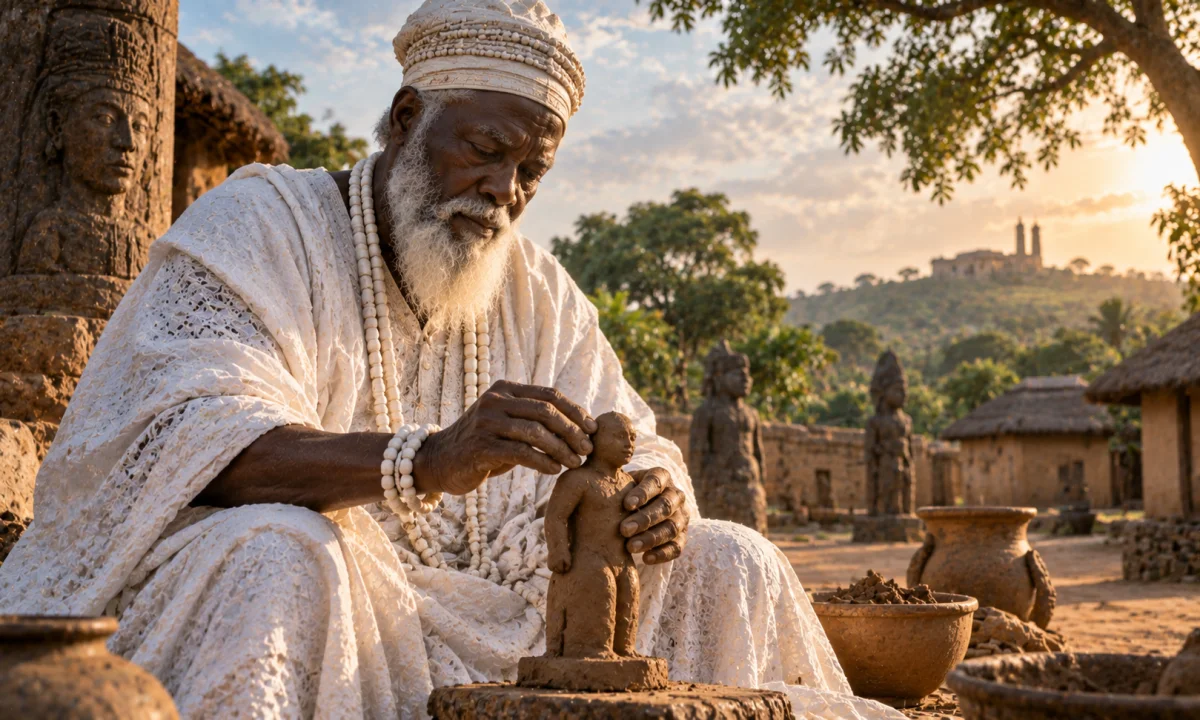
Obatala is a major orisha of the Yoruba religious tradition of West Africa. Often described as an elder among the divine powers, Obatala is associated with creation, moral authority, wisdom, purity, calmness and the shaping of the human body. Yoruba traditions are diverse, and stories about Obatala differ between towns, lineages, priests and forms of worship. In some accounts he is the creator of human forms; in others he is especially the divine craftsman who moulded them under the authority of Olodumare, the supreme deity.
Obatala in Yoruba religious tradition
Yoruba religion is not based on a single canonical scripture or one universally fixed mythology. Its teachings have been preserved through oral transmission, praise poetry, ritual practice, divination literature, songs, family traditions and stories associated with particular orishas. Accounts written down by outsiders and later scholars record only parts of this living tradition, and often reflect the region or community from which they were collected.
Within this religious world, the orishas are powerful divine beings connected with natural forces, human activities, moral principles and the history of the Yoruba people. They are not simply “gods” in an exact equivalent to every use of that word in European mythology. Some are understood as primordial powers, while others are associated with eminent ancestors or beings who became sacred. Their identities and relationships can vary across Yoruba-speaking regions.
Obatala is commonly regarded as one of the most senior and respected orishas. He is frequently portrayed as patient, dignified and deliberate, although traditional stories also show him making serious mistakes. His authority is therefore not based on being incapable of error. Instead, his stories often explore responsibility, self-control, justice and the consequences of failing to observe ritual or ethical discipline.
Name and identity
The name is commonly written Obàtálá in a Yoruba orthography that marks tones, although English-language writing often omits the diacritics and uses “Obatala.” He is also widely known by titles and related names such as Orìṣàńlá or Òṣàlá. These names are not always used in precisely the same way everywhere. In many traditions, Orìṣàńlá means “the great orisha” and refers to Obatala, while some communities preserve distinctions in names, manifestations or ritual identities.
The meaning of “Obatala” is also explained in different ways. It is often interpreted as a title connected with royalty, seniority or divine authority, sometimes translated as “king in white” or “king of white cloth.” Such translations are useful approximations rather than exact equivalents. Yoruba names and praise names frequently carry several layers of meaning, and their interpretation can depend on pronunciation, context and local tradition.
Obatala is generally presented as male in Yoruba narratives, especially in accounts that describe him as an elder, king or fatherly creator. However, religious identities are not always confined to modern Western assumptions about gender. In different communities and diaspora traditions, aspects of Obatala may be expressed in varied ways, and some stories or ritual interpretations emphasize a complementary or encompassing quality rather than a narrowly defined human personality.
Obatala and the creation of the world
One of the best-known groups of stories concerns the formation of the earth and the creation of human beings. In a common version, Olodumare sends Obatala from the heavenly realm to establish habitable land upon the primeval waters. He is given materials for the task, including a chain or other means of descent, a snail shell or container holding earth, and a bird. Obatala spreads the earth over the waters, while the bird helps distribute the soil. The details differ among tellings, and not every Yoruba community recounts the story in exactly this form.
Another important figure in creation narratives is Oduduwa. In some versions, Obatala is entrusted with the work but becomes delayed or incapacitated after drinking palm wine. Oduduwa then takes the materials and completes the establishment of the earth. In other accounts, the relationship is presented differently, with Oduduwa playing a foundational role in the origin of the Yoruba people and the sacred history of Ile-Ife. These narratives are not merely interchangeable plot variations: they can reflect different traditions about political authority, sacred kingship and the ancient status of Ife.
Stories of Obatala’s intoxication are significant because they prevent him from being represented as a flawless creator. Palm wine is sometimes described as a substance he vowed not to consume, and his failure to keep that discipline leads to disorder or delay. In many versions, the episode helps explain why Obatala’s worshippers observe restrictions concerning alcohol. It also provides a moral lesson about restraint, promises and the dangers of allowing appetite to interfere with sacred responsibility.
Obatala is especially associated with the shaping of human bodies. Some narratives say that he moulded human forms from clay before Olodumare gave them life. Stories may explain physical differences, including blindness, limb differences or other conditions, as the result of accidents during the creative process or of imperfect shaping. These accounts should be understood as traditional mythic explanations rather than medical descriptions. They have also been interpreted in different ways: some emphasize the sacred dignity of bodily difference, while others reflect older attempts to explain visible variation through divine narrative.
In many Yoruba religious settings, people with particular disabilities or bodily differences have been regarded as having a special connection with Obatala. The details and social implications vary widely, and it would be misleading to reduce these traditions to a single rule. The association does, however, reinforce Obatala’s role as a protector and patron of human embodiment. His myths can present imperfection not as proof of worthlessness but as part of the complicated work of creation.
Attributes and sacred symbolism
White is Obatala’s most recognizable colour. White clothing, white beads and white ritual materials may signify purity, clarity, seniority, coolness and peaceful authority. In Yoruba thought, “coolness” can have a moral and spiritual meaning: a cool person is composed, patient and able to prevent anger from causing destructive action. Obatala’s whiteness therefore involves more than physical colour. It expresses a condition of spiritual cleanliness, balance and calm judgment.
Obatala is often associated with white cloth, a staff, a crown and other signs of elderhood or kingship. Ritual objects vary according to locality and religious house. Some representations show him carrying a staff or sceptre, emphasizing his authority as a judge and senior orisha. White metal, chalk, shells and pale substances may also appear in rituals connected with him, although no single set of objects is universal throughout Yoruba worship.
His virtues include patience, honesty, restraint, wisdom and fairness. Devotees may appeal to him for clear judgment, protection, peace in the household and help in matters involving children, health or bodily well-being. He is also associated with the head in some interpretations, both literally through his connection with human form and symbolically through thought, consciousness and moral direction.
Obatala’s power is sometimes described as cooling forces that have become hot, violent or chaotic. This does not make him a passive figure. His calmness can represent disciplined authority capable of correcting wrongdoing. In stories, he may punish deceit or disrespect, but his justice is often connected with restoring balance rather than satisfying anger.
Important relationships and stories
Olodumare and the orishas
Olodumare, also called Olorun or by related names in different contexts, occupies the highest position in many Yoruba understandings of the divine order. Obatala is not simply another name for Olodumare. He acts as a powerful intermediary and creative agent under the supreme deity’s authority. Yoruba concepts of the relationship between the supreme being and the orishas vary, but Obatala’s seniority never necessarily makes him the supreme creator in the same sense as Olodumare.
Other major divine figures, including Orunmila, Esu and Oshun, have distinct identities and roles. Orunmila is linked with wisdom and the Ifa divination system; Esu is associated with communication, choice, crossroads and the proper transmission of sacrifice; Oshun is connected with rivers, fertility, beauty, diplomacy and sweetness. Their relationships with Obatala may be cooperative, competitive or shaped by particular stories, but they should not be collapsed into aspects of Obatala.
Oduduwa and Ile-Ife
Obatala and Oduduwa are sometimes presented as rivals in accounts of the creation of the earth or the foundation of Yoruba political order. Oduduwa is strongly associated with Ile-Ife and with traditions concerning the origins of Yoruba kingship. Obatala, meanwhile, is frequently associated with sacred authority, creation and the making of human bodies. The balance between them differs by tradition.
These narratives have sometimes been used to support competing claims about which figure represents the earliest or most important foundation of Yoruba civilization. They should not be treated as a single historical record. Mythic accounts of Ife express religious and political ideas, while archaeological and historical evidence must be considered separately. The stories are culturally important even where their literal details cannot be established as historical events.
Yemowo and other associations
In some traditions, Yemowo is named as Obatala’s wife or companion. She is especially associated with the Obatala tradition at Ile-Ife and with a sacred shrine there, but accounts of her importance and identity vary. She should not automatically be equated with Yemaya, Yemoja or other water-associated figures whose names may resemble hers in English-language writing. Similar spellings do not prove that two religious beings are the same.
Obatala’s stories may also involve other orishas, ancestors and sacred kings. Because the mythology is transmitted through local ritual communities, one version may emphasize his role as creator while another focuses on his relationship with a particular town, shrine or lineage. Variation is a normal feature of Yoruba religious tradition, not necessarily evidence that one version is authentic and all others are false.
Worship and cultural significance
Obatala is honoured through prayer, praise poetry, offerings, divination, music, dance, festivals and the wearing of white garments. Devotees may seek his assistance when they need peace, sound judgment or relief from conflict. Priests and worshippers may also observe taboos associated with his stories, including restrictions on alcohol in traditions that connect such abstinence with his failure during creation.
His worship has been especially important in places associated with ancient Yoruba religious history, including Ile-Ife and other towns with established Obatala shrines. Practices differ from one community to another. A festival, offering or ritual object used in one place should not automatically be presented as a universal feature of Obatala worship.
Obatala’s cultural significance extends beyond his supernatural attributes. He represents ideals of seniority, responsible leadership and the ability to remain composed in moments of crisis. His myths acknowledge that a respected elder may still fail, and that authority carries obligations. The stories about human creation also place bodily existence within a sacred framework, making the formation of the body part of divine history rather than a merely biological event.
Obatala in the African diaspora
Yoruba religious traditions travelled across the Atlantic through the forced migration of enslaved Africans and later developed in dialogue with local cultures, Christianity and other African traditions. Obatala remains important in several diaspora religions, but these forms are not simply unchanged copies of practices in Nigeria and neighbouring Yoruba-speaking regions.
In Cuba’s Regla de Ocha, also known as Santería, Obatalá is a major orisha associated with wisdom, purity, justice and white clothing. Cuban religious tradition commonly links him with Our Lady of Mercy, a process known as syncretism. This identification belongs to the historical development of Cuban worship; it does not mean that Obatala and the Catholic Virgin Mary are identical figures in Yoruba religion.
In Brazilian Candomblé, the related name Oxalá is used for a central orisha associated with creation, seniority and white ritual imagery. Oxalá is connected historically with Yoruba-derived religious traditions, but Brazilian Candomblé has its own ritual languages, lineages, histories and classifications. It is therefore more accurate to describe Oxalá as a related diaspora expression than to assume that every detail of Oxalá worship is directly interchangeable with every Yoruba account of Obatala.
Obatala and related forms such as Oxalá appear in modern music, visual art, literature, religious communities and popular discussions of African mythology. These representations may simplify or combine traditions for artistic purposes. Traditional Yoruba religion, Cuban Regla de Ocha and Brazilian Candomblé should remain distinguishable, since each has its own practitioners and historical context.