WORLD
WORLD
Oduduwa
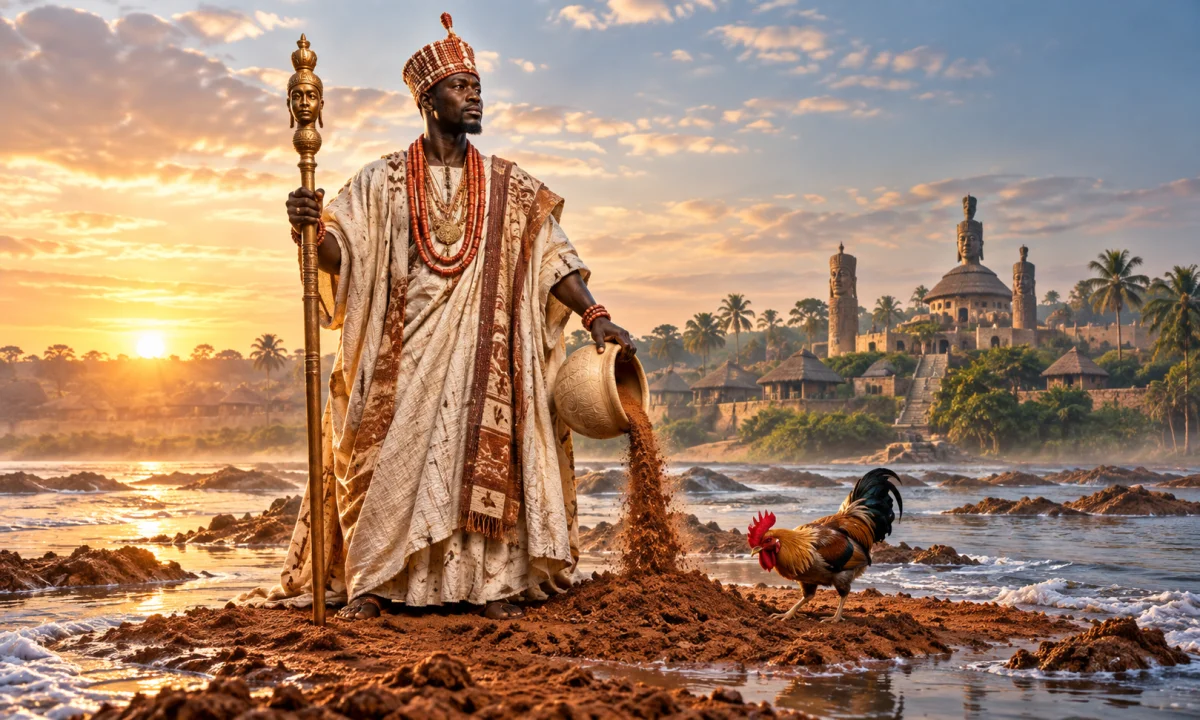
Oduduwa is a major ancestral and sacred figure in Yoruba tradition, especially in the origin traditions of Ilé-Ifẹ̀, the ancient Yoruba religious and cultural centre in present-day southwestern Nigeria. Depending on the source, Oduduwa is described as the first ruler of Ifẹ̀, the ancestor of Yoruba dynasties, a culture hero who established ordered society, or a primordial being involved in the creation of the earth. These descriptions belong to overlapping but not identical traditions.
Yoruba accounts of Oduduwa have been preserved primarily through oral traditions, praise poetry, royal histories, ritual knowledge and verses associated with Ifá divination. Written accounts were recorded much later, particularly during the nineteenth and twentieth centuries, and often reflect the perspectives of particular towns, dynasties, religious specialists or colonial-era observers. As a result, there is no single universally accepted biography of Oduduwa. The figure’s identity, gender, origin and relationship to other sacred beings vary between traditions.
Oduduwa in Yoruba cultural and religious tradition
In many Yoruba traditions, Oduduwa is regarded as the founder or first ruler of Ilé-Ifẹ̀. Ifẹ̀ is not simply treated as an old settlement: it is widely understood as the place where the earth became habitable and where human society first received political and ritual order. For this reason, Oduduwa’s importance extends beyond the history of one city. He or she represents the beginning of Yoruba kingship, community and civilisation.
The Yoruba-speaking peoples have historically lived in numerous kingdoms and city-states, including Ifẹ̀, Ọ̀yọ́, Kétu, Ìjẹ̀ṣà, Èkìtì, Ọ̀wò, Ọ̀wọ̀, Ìjẹ̀bú and others. Their traditions are related but not uniform. Some royal genealogies present the rulers of these states as descendants of Oduduwa, while other communities preserve different accounts of settlement, migration and political origin. The widespread descent tradition expresses cultural connection, but it should not automatically be read as a literal, historically verified family tree.
The sacred and political authority associated with Oduduwa is especially connected with the Oòni of Ifẹ̀, the traditional ruler of Ilé-Ifẹ̀. Royal narratives may portray the Oòni as inheriting Oduduwa’s authority, although the exact interpretation of that inheritance differs between ritual, historical and political contexts. Oduduwa therefore belongs to both religious memory and the history of Yoruba kingship.
The name and identity of Oduduwa
The name is commonly written Oduduwa, Odùduwà, Odùduwá or Oòduà, depending on orthography and local usage. Yoruba tone marks are important, and different spellings may represent differences in pronunciation or transcription rather than completely separate figures. Proposed explanations of the name’s meaning vary, and there is no universally accepted etymology. Interpretations that present one translation as certain should therefore be treated cautiously.
Oduduwa is often referred to with masculine pronouns in modern English-language discussions because many royal traditions describe a male founder and king. In other Yoruba religious accounts, however, Oduduwa may appear as a female primordial power or as a figure whose identity does not fit neatly into modern Western categories of gender. Some scholars and religious interpreters understand these versions as evidence that Oduduwa’s identity changed across regions and historical periods; others emphasise different ritual or literary layers within Yoruba cosmology.
Oduduwa is also classified differently from one context to another. The figure may be called an ancestor, a culture hero, a founder, a king or a sacred being. These categories are not always mutually exclusive in Yoruba thought. A historically remembered ruler can become an object of ritual honour, while an ancestral figure can also be treated as part of a broader sacred order. Calling Oduduwa an “orisha” without qualification can therefore be misleading: some traditions give the figure divine or primordial significance, while others focus on ancestral and dynastic status.
The creation of the earth at Ilé-Ifẹ̀
The best-known story involving Oduduwa concerns the creation or completion of habitable land at Ilé-Ifẹ̀. In a widespread version, the supreme deity Olódùmarè or Olórun sends a sacred being to descend from the heavenly realm and prepare the earth for life. The earth is initially covered with water. The mission involves a chain or other means of descent, a quantity of earth or sand, and a bird that spreads the material across the surface.
In many popular tellings, Ọ̀bàtálá is originally entrusted with the task. He becomes intoxicated by palm wine and fails to complete the mission. Oduduwa then takes the materials, descends from heaven and spreads the earth, allowing solid ground to expand. The bird scratches or scatters the earth outward, producing the landscape around Ifẹ̀. Oduduwa subsequently establishes a settlement and becomes its first ruler.
This story is not identical in every source. Some versions make Oduduwa the principal agent from the beginning, while others give Ọ̀bàtálá the central creative role and treat Oduduwa as a later political founder. The relationship between the two figures also changes: they may be portrayed as rivals, brothers, members of the same divine company, or representatives of different kinds of authority. The variations are important because Yoruba religious traditions have been transmitted through performance and local ritual lineages rather than through one fixed canonical scripture.
The story’s imagery has several levels of meaning. The descent from the sky connects the human world with the divine realm. The spreading of earth over water explains the formation of habitable territory, while the bird’s action represents expansion and transformation. The founding of a settlement after the creation of land links cosmology with political order: the beginning of the world and the beginning of organised human life are presented as related events.
Oduduwa as founder and ancestor
In dynastic traditions, Oduduwa is not merely a participant in a creation story. Oduduwa is the progenitor of a royal line and the ancestor from whom important Yoruba rulers descend. Stories commonly associate Oduduwa with several children or successors whose movements led to the establishment or consolidation of other kingdoms. The names and number of these descendants vary considerably between accounts.
Oranmiyan is one of the most important figures in these traditions. He is often described as a descendant or son of Oduduwa and is associated with the foundations of Ọ̀yọ́ and, in some accounts, the establishment of a ruling line in Benin. Benin traditions have their own complex histories and should not be reduced to a Yoruba legend, but the figure of Oranmiyan appears in both Yoruba and Benin historical narratives. The relationship between the two traditions is a subject of historical interpretation rather than a simple, uncontested fact.
Other versions name descendants connected with places such as Kétu, Ọ̀wù, Ṣábẹ̀, Ìlá and various Yoruba-speaking kingdoms. These genealogies helped explain relationships between ruling houses and supported claims to seniority, legitimacy or shared origin. They may preserve memories of political interaction, migration and alliance, but they also served political purposes. A claim of descent from Ifẹ̀ could strengthen a dynasty’s status, especially when royal authority was being negotiated or challenged.
Oduduwa’s role as ancestor is therefore both genealogical and symbolic. The figure represents a source of legitimate authority, a link between communities and a point of return for stories about Yoruba unity. This does not mean that all Yoruba people share one political origin in the same historical sense. Rather, Oduduwa provides a powerful cultural framework through which diverse communities can express relatedness.
Relationship with other sacred figures
Olódùmarè and the heavenly realm
Olódùmarè is generally understood as the supreme source of creation and ultimate authority in Yoruba religious thought. Oduduwa does not normally replace Olódùmarè as the supreme deity. In creation narratives, Oduduwa acts within a world ordered by Olódùmarè, whether as an appointed agent, a founder or a sacred ancestor. The exact roles of Olódùmarè, Ọ̀bàtálá and Oduduwa depend on the version being told.
Ọ̀bàtálá
Ọ̀bàtálá is a major orisha associated in many traditions with the creation of human bodies, moral authority, seniority, whiteness and clarity. His connection with the creation of land and with Oduduwa is one of the most variable parts of Ifẹ̀ origin narratives. In some accounts, their conflict explains ritual differences or establishes competing claims to authority. It is inaccurate to assume that every Yoruba community tells the same story of rivalry between them.
Òrúnmìlà and Ifá
Òrúnmìlà, the sacred witness to creation and principal figure associated with Ifá divination, is distinct from Oduduwa. Ifá verses may preserve accounts of origins, rulers and relationships among sacred beings, but Oduduwa is not simply another name for Òrúnmìlà. Likewise, odù, the patterns or literary configurations used in Ifá divination, should not be confused with the personal name Oduduwa, despite the visual similarity of the words in unmarked writing.
Ogun and other founding figures
Ogun is associated with iron, tools, warfare, roads and the opening of paths. Some Yoruba communities have their own founders, hunters, heroes or royal ancestors whose traditions overlap with the broader Ifẹ̀ origin narrative. These figures should not automatically be merged with Oduduwa. Similar stories of migration, settlement and state formation may reflect shared themes without referring to the same person.
Symbols and representation
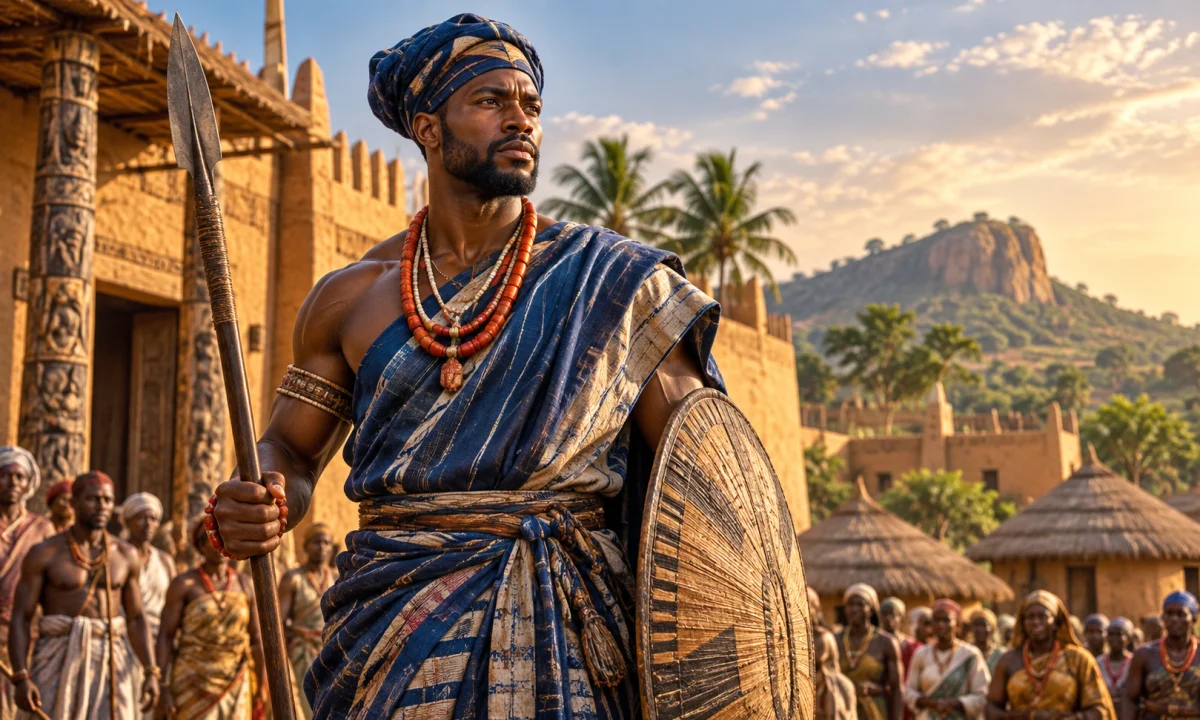
Oduduwa does not have one universally standardised physical appearance. Unlike figures represented through a widely shared set of sculptural attributes, Oduduwa may be represented through royal insignia, ancestral emblems, oral praise names, ritual objects or the authority of the Oòni of Ifẹ̀. Descriptions of clothing, weapons, crowns or other attributes may belong to specific local traditions rather than to Yoruba tradition as a whole.
The most persistent symbols connected with Oduduwa are those of descent, land, kingship and origin. The chain links heaven and earth. The earth or sand represents the making of habitable territory. The bird suggests the spreading of land. The settlement at Ifẹ̀ transforms a cosmic event into a social and political beginning. Royal regalia and ancestral shrines, where used in particular traditions, express continuity between the founder and later generations.
Ilé-Ifẹ̀ itself is central to Oduduwa’s symbolism. Its sacred geography includes places associated with creation, early rulers and the emergence of Yoruba civilisation. Archaeological evidence confirms that Ifẹ̀ was a major centre of artistic production and political life, especially during the period when its famous naturalistic metal and terracotta sculptures were made. Archaeology cannot by itself prove the literal events of the Oduduwa narratives, but it demonstrates the antiquity and complexity of the society in which such traditions developed.
Historical interpretation
Historians and anthropologists generally distinguish between the religious significance of Oduduwa and the question of whether a single historical individual founded all the kingdoms attributed to the figure. There may have been early rulers whose memories contributed to the Oduduwa tradition, but the available evidence does not establish a complete biography or a universally agreed date for Oduduwa’s life.
Some older accounts attempted to trace Oduduwa’s origin to places outside Yorubaland, including the Middle East or northeastern Africa. Such claims often arose from royal traditions, missionary writings, colonial-era theories or efforts to fit African histories into familiar biblical and Near Eastern frameworks. They remain disputed and should not be presented as established fact. Other interpretations understand “eastern origin” more generally as a sacred direction of emergence or as a memory of migration within West Africa.
The oral traditions themselves have changed through contact, political competition, religious transformation and the formation of modern ethnic identities. They should not be dismissed as mere inventions, but neither should every mythic detail be treated as a straightforward chronicle. Their value includes the way they express ideas about legitimate rule, community, sacred geography, ancestry and the relationship between divine power and human society.
Oduduwa in Yoruba identity and public memory
Oduduwa remains an important symbol of Yoruba cultural identity. References to the figure appear in royal ceremonies, historical education, political speeches, cultural organisations and discussions of shared Yoruba heritage. These uses may emphasise different aspects: Ifẹ̀ as the sacred source, Oduduwa as a founding ancestor, the unity of Yoruba-speaking peoples or the antiquity of Yoruba civilisation.
Modern public representations sometimes simplify the traditions into a single narrative in which Oduduwa is an unquestionably male king who migrated from a clearly identified foreign homeland and founded every Yoruba kingdom. That version is influential, but it combines elements that are disputed or variant. A fuller understanding recognises the coexistence of creation stories, dynastic genealogies, local histories and religious interpretations.
Oduduwa is also encountered in the Yoruba diaspora, although the figure is generally less central there than widely worshipped orisha such as Èṣù, Ọ̀ṣun, Ṣàngó, Yemọja and Ọ̀bàtálá. Diasporic communities may preserve or reinterpret Oduduwa as an ancestral or foundational presence, but practices vary by region, lineage and religious house. References in contemporary literature, music, visual art and popular historical writing likewise often adapt the figure for themes of African origins, heritage and political identity. These modern uses should be distinguished from the diverse ritual and oral traditions in which Oduduwa has been preserved.