WORLD
WORLD
Bayani
Bayani—also written Bayanni, Bàyànì, or in related forms such as Dada-Bayanni—is a relatively regional figure in Yoruba religious tradition. The name is especially associated with the royal and ritual culture of Oyo, the historic Yoruba kingdom, where Bayani is connected in some accounts with the Shango tradition and with the sacred authority of kingship. Unlike major orishas such as Ọ̀ṣun, Yemoja, Ògún, or Ṣàngó, Bayani is not equally prominent in every Yoruba community, and descriptions of the figure vary between local traditions and written accounts.
The spelling Bayani can also cause confusion. In several Philippine languages, bayani means “hero” or “patriot,” and it has no necessary connection with the Yoruba religious figure. The Yoruba name is more accurately represented in some contexts as Bàyànì or Bayanni, although English-language writing often omits tone marks and uses a simplified spelling.
Yoruba religious and cultural setting
Yoruba religion is not a single centrally administered system with one universally fixed list of gods. It consists of related traditions maintained by communities in southwestern Nigeria, neighbouring parts of Benin and Togo, and the Yoruba diaspora in the Americas and elsewhere. Local priests, royal institutions, families, towns, and initiation lineages may preserve different names, stories, ritual practices, and interpretations.
The orishas are sacred powers and divine personalities who mediate between human beings and Olódùmarè, the supreme source of creation in many Yoruba accounts. They may be understood as deities, spiritual powers, ancestral beings, or a combination of these categories, depending on the tradition and the context. Some are closely associated with natural forces, crafts, moral principles, towns, royal dynasties, or specific groups of worshippers.
Bayani belongs to a part of Yoruba tradition in which religious identity is closely tied to political history. The Oyo kingdom developed a powerful monarchy, and its capital became an important centre of ritual, military, artistic, and intellectual life. In this setting, stories about sacred figures could also explain the legitimacy of royal authority, the protection of the kingdom, and the relationship between rulers and divine powers.
Name and identity
The exact meaning and grammatical interpretation of the name are not uniform in English-language descriptions. Yoruba names depend on tone, vowel length, spelling conventions, and local pronunciation, so Bayani may represent more than one Yoruba form when tone marks are removed. The form Bàyànì is often used for the religious figure, while Bayanni is another common rendering.
Bayani is sometimes presented as a distinct orisha and sometimes discussed together with Dada or under the compound name Dada-Bayanni. These identifications should not automatically be treated as universally interchangeable. In some traditions, Dada and Bayani appear as closely related names or aspects; in others, they are treated as separate figures with overlapping associations. The available descriptions do not support a single standard account accepted by all Yoruba communities.
Bayani is also sometimes described as female and sometimes given a less clearly defined gendered identity. Accounts that associate the figure with Shango may call Bayani his elder sister, while other presentations emphasise a relationship within the royal or divine family without agreeing on a precise genealogy. These differences reflect the regional and lineage-based character of Yoruba traditions rather than a simple error that can be resolved by choosing one version.
Connection with Oyo and Shango
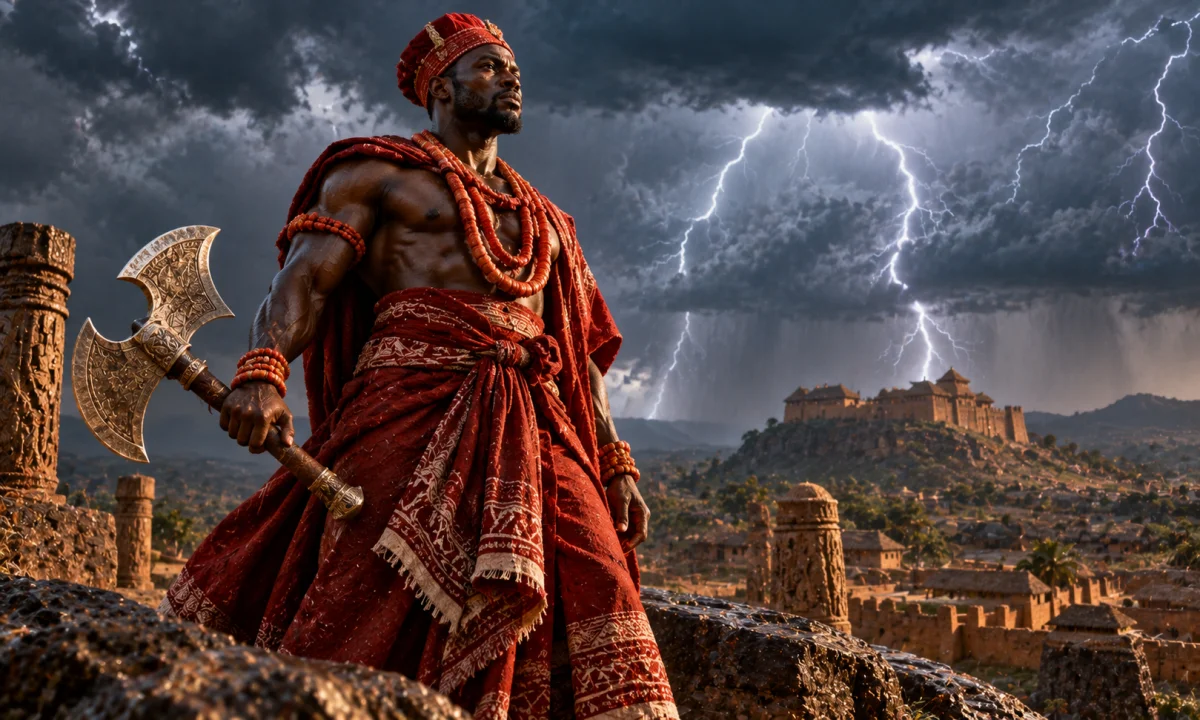
The strongest recurring setting for Bayani is the Oyo religious world. Shango, known in Yoruba as Ṣàngó, is one of the most prominent orishas and is associated with thunder, lightning, fire, royal power, virility, justice, and the history of the Oyo monarchy. Historical traditions identify Shango with a former Alaafin, or king, of Oyo who became divinised after death. The boundary between historical ruler, culture hero, ancestor, and deity is not identical in every account.
Within some traditions, Bayani is described as an elder sister or close female relative of Shango. Her role is not usually presented as a simple duplicate of Shango’s powers. Instead, she belongs to the wider sacred network surrounding him and the Oyo throne. The relationship may express the importance of female relatives, dynastic continuity, and ritual support in the constitution of royal authority.
Some accounts connect Bayani with the transfer or preservation of Shango’s authority. Such narratives can be read as stories about divine succession, the protection of a royal line, or the persistence of a sacred power after political crisis. However, the details of these stories differ, and broad statements about Bayani “giving” Shango his powers should be treated cautiously unless they are tied to a particular local version.
Bayani is therefore best understood not as a universally defined Yoruba goddess with one canonical biography, but as a figure whose importance emerges from particular Oyo-related ritual and dynastic traditions.
Attributes and ritual associations
There is no single widely agreed physical appearance for Bayani. Yoruba orishas are not always represented through one fixed human form, costume, or iconographic image. Their presence may be expressed through sacred objects, ritual vessels, staffs, crowns, colours, songs, praise poetry, dance, possession, or the material symbols of a particular shrine.
Descriptions of Bayani frequently place emphasis on royal symbolism. The connection with Oyo and Shango makes crowns, palace authority, dynastic memory, and the maintenance of sacred order relevant to interpretations of the figure. This does not mean that every image of a crown is specifically an image of Bayani, nor that every Oyo royal object belongs to her worship. Rather, royal imagery provides a useful context for understanding why Bayani appears in accounts of the Oyo sacred landscape.
Where Bayani is linked with Dada, some writers associate the figure with children, distinctive hair, or forms of sacred difference. In Yoruba culture, physical traits and unusual circumstances of birth can carry religious significance, but the exact relationship between Bayani, Dada, children, and hair varies by source. It is safer to describe these as associated interpretations than as fixed universal attributes.
As with other orishas, Bayani’s identity may be conveyed through praise names and oral performance more effectively than through a short list of powers. Yoruba oríkì, or praise poetry, preserves genealogies, historical memories, moral qualities, and relationships with places and communities. A praise name can identify a sacred being by recalling what that being has done, whom it protects, or what kind of authority it embodies. The meaning of Bayani can therefore be larger in ritual practice than the brief descriptions commonly found in general reference works.
Stories and traditional variations
Bayani does not have one universally recognised cycle of myths comparable in popularity to the stories of Shango, Ọ̀ṣun, or Èṣù. References to the figure tend to be brief, localised, or embedded in accounts of other sacred personalities. This partly reflects the fact that Yoruba religious knowledge has traditionally been transmitted through performance, initiation, family inheritance, shrine practice, and oral teaching rather than through one canonical scripture.
One recurring type of account places Bayani within the family or political circle of Shango. In such versions, Bayani’s significance lies in the relationship between the female member of a royal or divine household and the ruler whose power becomes associated with thunder and kingship. The story may highlight loyalty, succession, protection, or the preservation of sacred authority.
Other accounts connect Bayani with Dada and describe a figure concerned with children or with forms of unusual birth and appearance. These traditions should not be flattened into a single biography. A name used in an Oyo palace context may not carry exactly the same meaning in a family shrine, an Ifa interpretation, or an Afro-Atlantic religious community.
It is also important not to treat every story involving Shango’s relatives as a story about Bayani. Yoruba traditions include several figures associated with Shango, and later retellings sometimes combine names or relationships that were distinct in particular communities. The fact that two figures appear in the same royal mythology does not prove that they are identical.
Bayani, Dada, and related figures
Dada is the figure most likely to be confused or combined with Bayani. In Yoruba religious writing, Dada may be associated with children born with naturally matted or unusually abundant hair, and with protective or nurturing powers. The name may also appear in connection with royal or Shango traditions. Yet the relationship between Dada and Bayani is not consistent enough to justify treating them as the same being in all contexts.
Some sources use a compound form such as Dada-Bayanni, suggesting a close association or an alternate name. Other sources distinguish the names. The correct interpretation may depend on the town, lineage, language form, and religious community being described. A careful account should therefore preserve both possibilities rather than presenting one arrangement as universally authoritative.
Bayani should also be distinguished from Ọya, a major orisha often connected with Shango as a wife or companion in Yoruba and Afro-Atlantic traditions. Ọya is associated with winds, storms, transformation, the marketplace, and the cemetery or boundary between life and death in some traditions. A female figure connected to Shango is not automatically Ọya, and Bayani’s possible relationship with Shango does not make the two interchangeable.
Likewise, Bayani should not be confused with Yemoja, Ọ̀ṣun, or other prominent female orishas. Their names, ritual histories, and regional worship traditions are distinct, even when modern summaries place many of them within a general list of Yoruba deities.
Cultural significance
Bayani’s importance lies partly in showing how Yoruba religious traditions preserve multiple levels of identity. A sacred figure may be simultaneously connected with a town, a royal institution, a family lineage, a divine genealogy, and a wider network of orishas. The figure need not have a large independent mythology to be meaningful within the ritual world that recognises her or him.
The association with Oyo also demonstrates that Yoruba religion cannot be separated entirely from political and social history. Kingship was not merely an administrative institution. In the Oyo context, the palace, the royal ancestors, sacred specialists, and the orishas formed an interdependent system of authority. Figures such as Bayani could help express how power was inherited, protected, legitimised, and remembered.
Bayani’s relative obscurity outside specialist or regional discussions is also significant. The most famous Yoruba orishas have been widely represented in literature, visual art, music, initiation traditions, and diaspora religions. Less prominent figures may survive in local oral traditions or specialised ritual contexts without acquiring a single standard form in global popular culture. Lack of worldwide recognition does not imply lack of importance within the communities that maintain the tradition.
Presence in the African diaspora
Yoruba religious traditions travelled throughout the Atlantic world through the forced migration of enslaved Africans, later cultural exchange, religious organisation, and continuing links with West Africa. In Cuba, Brazil, Trinidad, the United States, and elsewhere, Yoruba-derived religions developed their own names, ritual systems, pronunciations, and patterns of identification.
Shango became especially prominent in several diaspora traditions, while Bayani is much less consistently represented. Where the name appears, it may reflect an Oyo-derived lineage, a specialised interpretation of Shango’s sacred family, or a modern effort to recover a less familiar Yoruba figure. Diaspora usage should not automatically be treated as evidence of a single ancient pan-Yoruba doctrine.
Modern books, websites, games, and fantasy works may present Bayani as a clearly defined goddess with a fixed appearance, a standard set of powers, or a complete mythological biography. Such portrayals can be creative interpretations, but they should be distinguished from the more variable evidence of Yoruba religious tradition. The traditional figure is better approached through regional context, variant names, oral history, royal symbolism, and the changing relationship between Bayani, Dada, and Shango.