WORLD
WORLD
Aje Shaluga
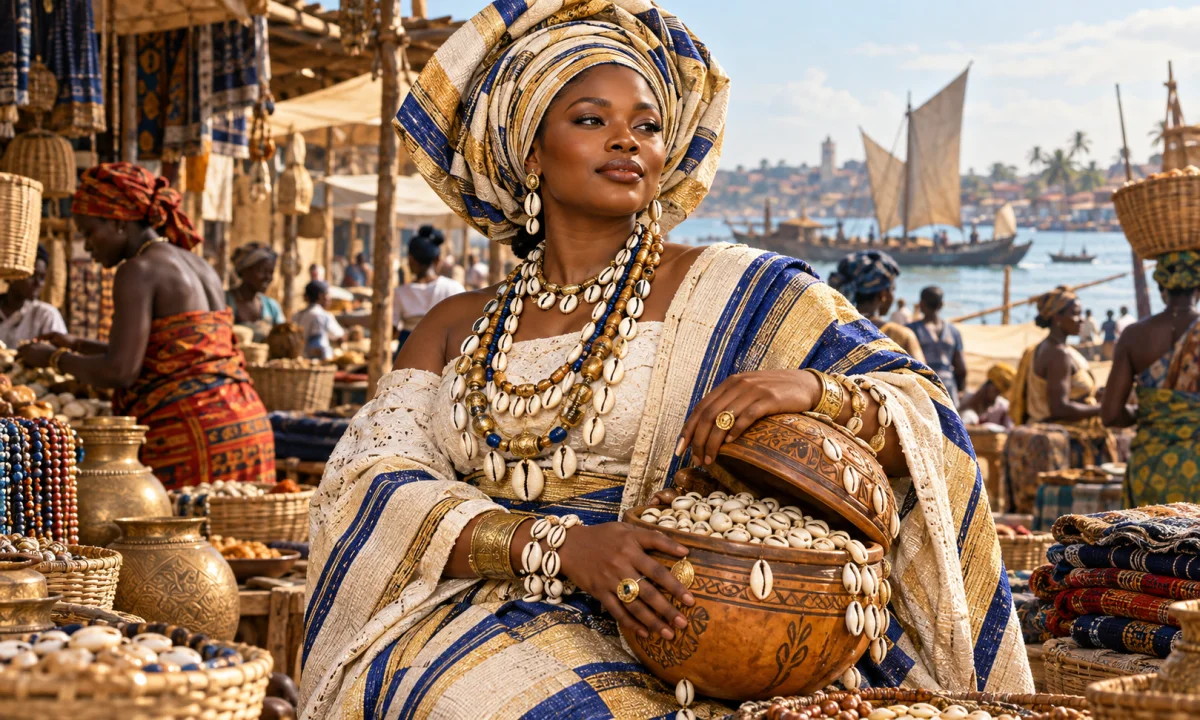
Àjẹ́ Ṣàlùgá, often written in English as Aje Shaluga or Aje Saluga, is a figure associated in Yoruba religious thought with wealth, prosperity, commerce and the circulation of valuable goods. The spelling and the extent of Àjẹ́ Ṣàlùgá’s independent identity vary between communities and modern accounts. In some descriptions, the figure is treated as an òrìṣà or divinity of riches; in others, the name refers more broadly to a spiritual power or personification of wealth rather than to a universally defined deity with one fixed mythology.
Yoruba religious and cultural setting
Yoruba religion developed among Yoruba-speaking peoples of West Africa, especially in present-day Nigeria and parts of Benin and Togo. It is not a single system controlled by one scripture or institution. Religious knowledge is preserved through oral traditions, praise poetry, divination verses, ritual practice, family and town cults, priestly instruction, and regional interpretations. As a result, an òrìṣà may have different names, stories, ritual emphases and degrees of importance in different places.
The Yoruba word òrìṣà is commonly translated as “deity” or “divine power,” although that translation does not capture every aspect of the term. Òrìṣà are connected with natural forces, social institutions, human activities, moral principles and particular lineages or communities. They are approached through prayer, offerings, praise names, divination and ritual specialists. Their influence is generally understood within a larger religious order that includes Olódùmarè, the supreme source of existence, the ancestors, and other spiritual beings.
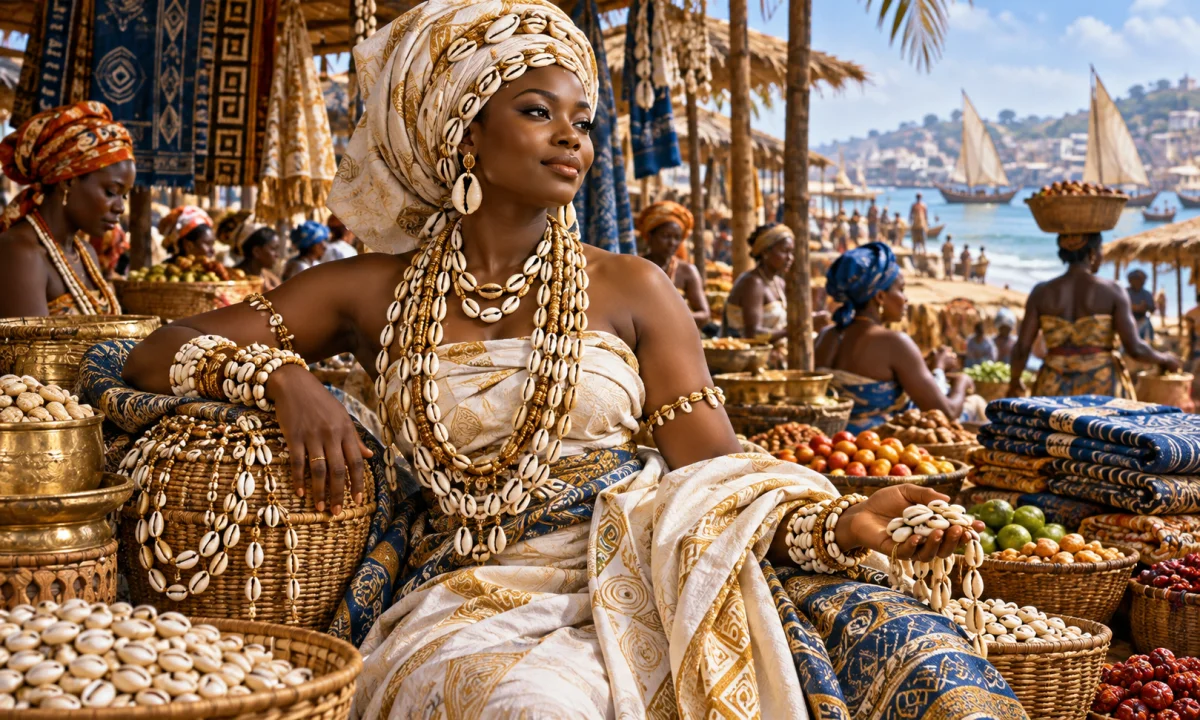
Wealth in this setting is not limited to money in the modern sense. It may include food, livestock, land, children, customers, social influence, good fortune, protection, health and the ability to sustain a household. Cowrie shells were especially important historical symbols because they served as currency in parts of West Africa and also had ritual and ornamental uses. Their association with Àjẹ́ Ṣàlùgá reflects the close relationship between material prosperity, exchange and sacred power.
The name Àjẹ́ Ṣàlùgá
The name is commonly represented without Yoruba tone and underdots as “Aje Shaluga” or “Aje Saluga.” In careful Yoruba writing, forms such as Àjẹ́ Ṣàlùgá may be used, although spellings are not entirely consistent in English-language discussions. The difference between sh and s reflects attempts to represent Yoruba sounds for readers who may not use Yoruba orthography.
The element àjẹ́ requires particular care. In Yoruba contexts, àjẹ́ can refer to a spiritual power associated with women, nocturnal forces and what English-language sources often call “witchcraft.” It can also occur in discussions of wealth and prosperity. These meanings are related in some religious interpretations but should not automatically be treated as identical. The name Àjẹ́ Ṣàlùgá does not simply mean “a witch,” and the figure should not be reduced to the sensationalized image of a witch found in some popular retellings.
The second part of the name is variously written Ṣàlùgá, Saluga or Shaluga. Explanations of its precise meaning and grammatical derivation differ. Some modern descriptions interpret the complete name as referring to the owner, source or distributor of wealth. Such explanations may express a theological understanding rather than a universally agreed literal translation. It is therefore safer to describe Àjẹ́ Ṣàlùgá as a wealth-associated divine figure than to insist on one definitive English rendering of the name.
Identity and classification
Àjẹ́ Ṣàlùgá is frequently classified in modern writing as an òrìṣà of wealth. That description is useful, but it should not imply that every Yoruba community recognizes the figure in exactly the same way. Some religious traditions give Àjẹ́ Ṣàlùgá a distinct personality and ritual identity. Other accounts place greater emphasis on àjẹ́ as a force or power connected with prosperity, female spiritual authority and the hidden sources of abundance.
There is no single canonical Yoruba text that supplies a universally accepted biography for Àjẹ́ Ṣàlùgá. Yoruba religious knowledge is transmitted through multiple genres, and the importance of a figure may be preserved through worship and praise rather than through a long, standardized narrative. Internet summaries sometimes present one genealogy or one set of attributes as though it were shared by all Yoruba traditions. Claims of this kind should be treated cautiously unless they are tied to a particular community, lineage or ritual source.
Some accounts describe Àjẹ́ Ṣàlùgá as connected with Olókun, a major divinity associated with the sea, deep waters, riches and abundance. This relationship is plausible within traditions that link wealth to Olókun’s underwater realm, but it is not a universally fixed genealogy. Other sources mention relationships with additional òrìṣà or present Àjẹ́ Ṣàlùgá independently. The variation reflects the regional and oral character of Yoruba religion rather than a simple contradiction that can be resolved by selecting one online version.
Wealth, prosperity and exchange
The central theme associated with Àjẹ́ Ṣàlùgá is the arrival and preservation of wealth. Prosperity is often imagined as something that must be attracted, welcomed, protected and properly managed. A person may receive opportunities yet lose them through carelessness, dishonesty, envy or poor judgment. In this moral and religious framework, wealth is not merely an object possessed by an individual; it is a force that moves through households, markets, communities and relationships.
Àjẹ́ Ṣàlùgá can therefore be understood as representing more than sudden riches. The figure may symbolize successful trade, a well-supplied home, commercial opportunity, financial stability and the ability to make resources circulate productively. The connection with markets is particularly significant. Markets are places where people meet, goods change hands, information spreads and social obligations are negotiated. A wealth divinity belongs naturally to this world of exchange, but also to the uncertainties that accompany it.
In Yoruba thought, abundance usually carries responsibilities. Wealth may be expected to support relatives, honor the divinities, assist the vulnerable and strengthen the community. A prosperity figure is not necessarily a divine guarantee of unlimited personal accumulation. The religious question may instead concern whether wealth is obtained legitimately, whether it is used wisely and whether it remains in harmony with other forms of well-being.
Symbols and visual associations
Cowrie shells are the most widely recognized symbol associated with Àjẹ́ Ṣàlùgá in contemporary descriptions. Historically, cowries functioned as currency in parts of West Africa, and they remain important in Yoruba ritual and artistic contexts. They can suggest money, abundance, fertility, prestige and the visible presence of prosperity. Their use in divination also gives them a relationship with hidden knowledge and the interpretation of destiny.
Descriptions of Àjẹ́ Ṣàlùgá’s appearance are not consistent enough to establish a single traditional portrait. Some modern representations show a figure adorned with cowries, beads or other signs of affluence. These images communicate the deity’s association with wealth, but they should not automatically be treated as evidence of an ancient, standardized iconography. Yoruba òrìṣà are often represented through ritual objects, colors, emblems, sacred vessels and priests’ regalia rather than through one fixed human-shaped statue.
Gold, beads, valuable cloth, market goods and containers for money may also appear in artistic or devotional representations of prosperity. Their significance depends on context. An object associated with wealth may function as an emblem, an offering, a ritual instrument or a general sign of status. It is not always possible to identify an object as belonging specifically to Àjẹ́ Ṣàlùgá merely from its appearance.
Stories and relationships
Compared with highly popular figures such as Èṣù, Ọ̀ṣun, Ṣàngó, Yemoja and Ọ̀rúnmìlà, Àjẹ́ Ṣàlùgá has a less standardized body of widely circulated stories in English. Many online accounts repeat brief statements about the deity’s power over money or describe a family relationship with Olókun, but they do not preserve a full cycle of narratives. It would be misleading to invent a detailed life story, a fixed spouse, or a single canonical conflict from these fragments.
Where stories or praise traditions exist, they may present wealth as a force that can appear unexpectedly, depart without warning or remain with those who respect its obligations. Such themes fit wider Yoruba ideas about fortune, destiny and the proper management of sacred gifts. They should be understood as interpretive motifs unless a specific oral tradition identifies them as part of a particular Àjẹ́ Ṣàlùgá narrative.
Relationships with other wealth-associated divinities are also interpreted differently. Olókun’s connection with the sea and riches makes the figure an important point of comparison. Ọ̀ṣun is associated with rivers, beauty, fertility, diplomacy, sensuality and forms of prosperity, but she is not simply another name for Àjẹ́ Ṣàlùgá. Ọ̀rúnmìlà is linked with wisdom and Ifá divination, through which questions about fortune and destiny may be addressed, but he is not a wealth deity in the same specific sense. Èṣù governs movement, communication, crossroads and the consequences of choices; his role in transactions does not make him identical with Àjẹ́ Ṣàlùgá.
Àjẹ́, women and hidden power
The broader concept of àjẹ́ has a complex place in Yoruba religious thought. In many traditions, it is associated with powerful female spiritual beings or with a form of authority connected to women, the night and the invisible dimensions of life. Outsiders have often translated this material simply as “witchcraft,” a word that can carry strongly negative assumptions. That translation may obscure the respect, fear, ambiguity and political significance attached to the concept.
Because the word Àjẹ́ appears in the name Àjẹ́ Ṣàlùgá, some interpretations emphasize the deity’s relationship to feminine power and the generative forces that produce wealth. Others focus almost entirely on the figure’s economic role. Neither emphasis should be treated as the only possible one across all Yoruba settings. The presence of the term does not prove that Àjẹ́ Ṣàlùgá is identical with every being or institution called àjẹ́.
This distinction is important because descriptions of “African witch gods” often collapse different traditions into one category. Yoruba religious concepts do not map neatly onto European Christian ideas of witches, demons or devils. A figure connected with hidden power may be feared, honored, respected or ritually approached without fitting any of those imported categories.
Worship and religious significance
Information about the worship of Àjẹ́ Ṣàlùgá is less uniform than information about more extensively documented òrìṣà. Ritual practice may depend on the community, the religious lineage and the particular purpose for which the divinity is approached. In Yoruba religion, offerings and prayers are not normally separated from questions of character, destiny and ritual correctness. Divination may determine what is appropriate in a given case rather than allowing a general list of offerings to apply everywhere.
Devotion to a wealth-associated power may involve requests for successful trade, protection from loss, customers, household abundance or relief from financial difficulty. Yet prosperity rituals should not be interpreted as a simple supernatural version of modern investment advice. Their purpose is embedded in a religious world where personal conduct, family obligations, destiny, sacrifice and relations with other spiritual powers all matter.
Àjẹ́ Ṣàlùgá’s significance also lies in the recognition that economic life has a sacred dimension. Markets are not only places of calculation. They involve trust, reputation, competition, cooperation, risk and the distribution of necessities. A divinity of wealth reflects the hope that resources will arrive, but also the anxiety that they may be blocked, stolen, wasted or withdrawn.
Distinguishing Àjẹ́ Ṣàlùgá from similar figures
- Àjẹ́: This is a broader Yoruba religious concept with meanings that can include spiritual power associated with women, the night and hidden forces. Àjẹ́ Ṣàlùgá should not automatically be equated with every use of the word àjẹ́.
- Olókun: Olókun is a major divinity associated with the sea, depth, mystery and great wealth. Some traditions connect Àjẹ́ Ṣàlùgá with Olókun, but the two names are not universally interchangeable.
- Ọ̀ṣun: Ọ̀ṣun is strongly associated with rivers, fertility, beauty, diplomacy, sensuality and life-giving abundance. Her prosperity-related qualities overlap with those attributed to Àjẹ́ Ṣàlùgá, but she has her own extensive traditions and identity.
- Èṣù: Èṣù is linked with crossroads, communication, movement, exchange and the effects of human choices. His connection with commerce does not make him a synonym for a wealth divinity.
- Fortune figures from other religions: Àjẹ́ Ṣàlùgá should not be casually identified with figures such as Lakshmi, Plutus or other deities of wealth from unrelated traditions. Similar functions do not establish a shared origin.
Historical evidence and modern representations
Evidence for Àjẹ́ Ṣàlùgá comes primarily through Yoruba religious traditions, oral knowledge, ritual practice, language and later written descriptions. There is no universally accepted ancient biography comparable to a single sacred book. Written records about Yoruba religion were often produced by outsiders, missionaries, colonial officials, travelers or later interpreters, each with particular limitations. Modern descriptions may also simplify regional traditions for general audiences.
In the African diaspora, Yoruba-derived religions such as Santería or Regla de Ocha, Candomblé and related traditions preserve and transform many Yoruba religious concepts. However, Àjẹ́ Ṣàlùgá is not equally prominent or identically represented in every diaspora tradition. A reference to an òrìṣà in one Yoruba-speaking community cannot automatically be transferred into another religious system without examining that system’s own history and ritual vocabulary.
Contemporary spiritual and popular-cultural material sometimes presents Aje Shaluga as a neatly defined “goddess of money,” gives the figure a fixed appearance, or assigns a complete mythology assembled from several unrelated sources. Such portrayals may be meaningful as modern devotional or creative interpretations, but they should be distinguished from documented Yoruba tradition. The historical figure is better approached as a culturally situated and variably understood power of wealth, prosperity and sacred exchange.