WORLD
WORLD
Yemaya
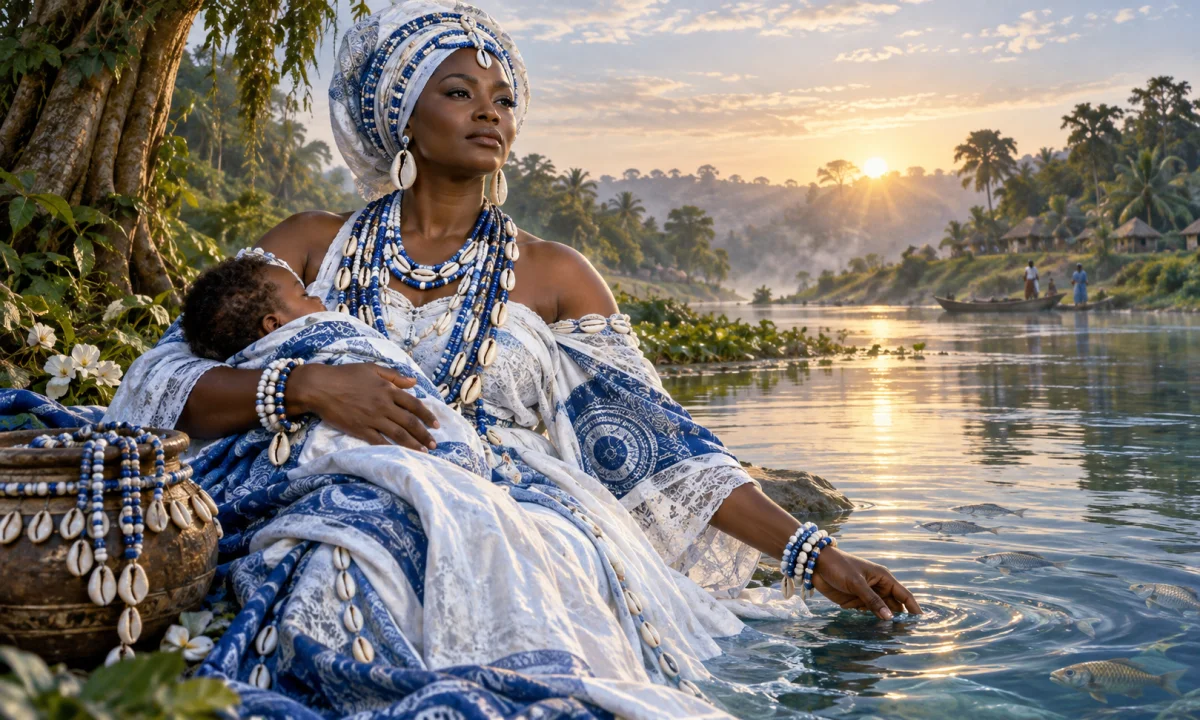
Yemaya is one of the best-known names associated with Yemoja, a powerful female water divinity in Yoruba religious tradition. In Yoruba contexts, the name is more commonly written Yemoja or Yemọja. She is connected especially with motherhood, fertility, protection and river water. In several African diasporic religions, including Cuban Santería and Brazilian Candomblé, she became strongly associated with the sea and acquired forms such as Yemayá, Yemanjá and Iemanjá.
These names and traditions are related, but they are not identical. Yemoja in southwestern Nigeria belongs to a Yoruba religious setting in which rivers, forests, rocks and other natural places may be associated with particular òrìṣà, or sacred divine powers. Diasporic Yemayá and Iemanjá developed through the movement of Yoruba-speaking and other West African peoples across the Atlantic, the preservation of religious knowledge under slavery, and interaction with local cultures and Christian institutions. As a result, Yemaya is both a Yoruba religious figure and a wider Atlantic symbol whose identity varies considerably by community.
Yemoja in Yoruba religious tradition
Yemoja is an òrìṣà associated with water and maternal power. The word òrìṣà does not correspond exactly to the English word “god” or “goddess.” An òrìṣà may be understood as a sacred power, divine being or spiritual presence connected with particular natural forces, communities, ancestors, myths and forms of ritual practice. Yoruba religious life does not depend on one universally fixed mythology. Knowledge is transmitted through oral traditions, praise poetry, ritual specialists, festivals, family practices and systems of divination such as Ifá.
Within this setting, Yemoja is especially linked with a river rather than originally being only, or principally, a goddess of the open ocean. Yoruba traditions associate her with the Ogun River and with communities in and around Abeokuta in present-day Ogun State, Nigeria. Local traditions and annual celebrations have helped maintain her importance as a protectress and mother. The details of her worship, stories and titles can differ between towns, lineages and ritual communities.
Water has several meanings in this religious context. It sustains life, nourishes crops, cleanses the body and carries people and goods, but it can also be deep, dangerous and unpredictable. A river may therefore be understood as a source of fertility and healing as well as a powerful spiritual presence. Yemoja’s connection with water reflects these several qualities rather than a simple association with one element or one human emotion.
The name and its forms
The Yoruba name is usually represented in English as Yemoja, with the more precise Yoruba spelling Yemọja. The name is often explained as a contraction of a Yoruba phrase meaning something like “mother whose children are fish” or “mother of fish.” This interpretation fits her maternal and aquatic associations and is widely repeated in religious and popular explanations. The exact linguistic history of the name and the relationship between its parts are not always presented in the same way, however, so the explanation should be treated as a traditional or common interpretation rather than an uncontested etymology.
Atlantic forms include Yemayá in Cuba and Yemanjá or Iemanjá in Brazil. These spellings reflect changes in pronunciation, orthography and language as Yoruba religious traditions entered Spanish- and Portuguese-speaking societies. The figures represented by these names share important roots with Yemoja, but each has developed within a particular ritual history.
“Yemaya” without diacritics is now widely used in English-language writing. It can refer broadly to Yemoja and to her diasporic forms, although it sometimes encourages the mistaken impression that there is one single, uniform tradition with the same stories and practices everywhere.
Identity and classification
Yemoja is generally described as a female òrìṣà and a motherly power. English-language accounts often call her a goddess, which is understandable but incomplete. Yoruba religious categories do not map perfectly onto the categories of classical European mythology. Her significance is shaped by worship, ritual relationships, local history and sacred geography, not only by a collection of stories about a personified deity.
She is associated with motherhood in both a literal and symbolic sense. Yemoja may be regarded as a protectress of children, a source of fertility and a compassionate presence for people who seek care or assistance. Her maternal identity does not make her merely gentle or passive. Like water itself, she can be nourishing, forceful, protective and dangerous. The strength attributed to her is part of her role as a powerful female divinity.
Yemoja should also not be reduced to a universal “mother goddess” who represents all forms of femininity. That broad modern label can obscure the specificity of Yoruba religious ideas. Her identity is connected to particular rivers, communities, ritual obligations, praise names and inherited traditions. The meaning of motherhood in her worship is also religious and social, not simply a metaphor for nature.
Attributes and symbolism
Water is Yemoja’s central symbol, especially river water in Yoruba contexts and ocean water in many diasporic contexts. Fish are associated with her name and imagery, while boats, shells and waves became particularly important in Atlantic coastal traditions. These symbols should not be treated as universal rules. Ritual objects, colours, foods and emblems vary according to region and religious community.
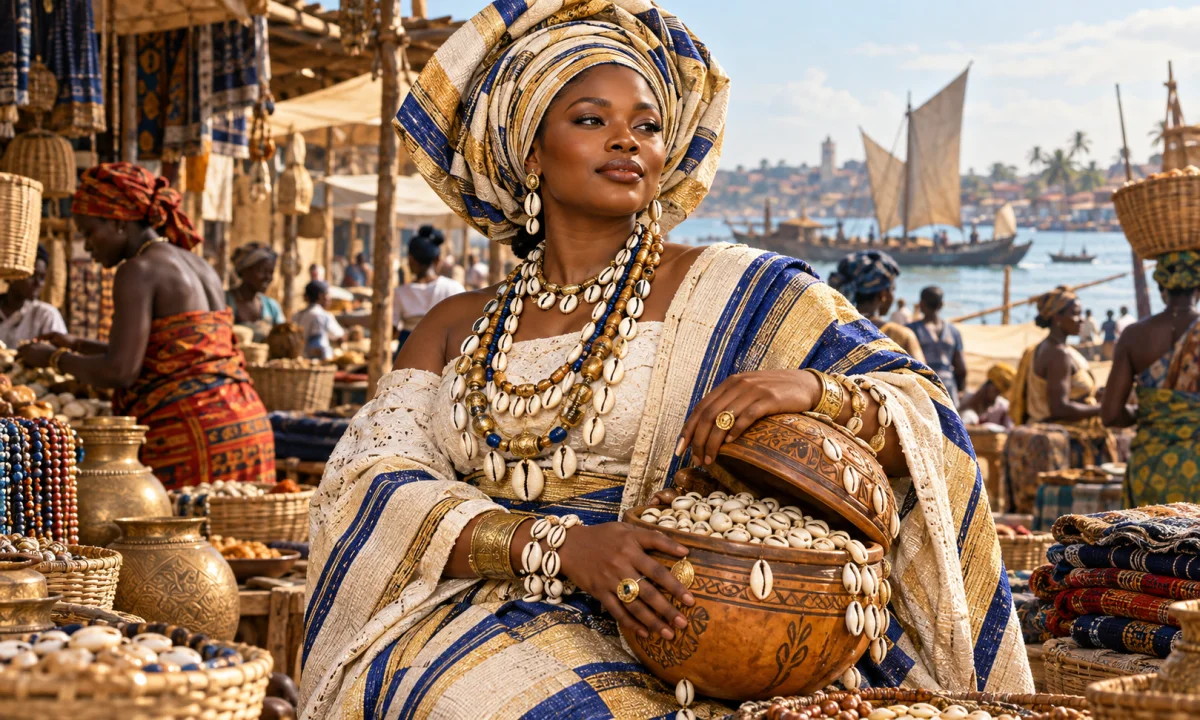
In Cuban practice, Yemayá is often represented through blue and white colours, ocean imagery, shells and a broad maternal presence. She is connected with the sea, sailors, childbirth, protection and the mysteries of the deep. In Brazil, Iemanjá is widely represented as a majestic woman associated with the sea, long hair, white or blue clothing and offerings carried to the water. Such images are highly visible during public celebrations, especially in coastal cities, but they do not describe every form of worship.
Yoruba representations may be less standardized than the familiar popular images of a mermaid-like or oceanic Yemaya. In Yoruba religious life, the importance of a sacred river, shrine, grove, priesthood or festival can be greater than a fixed visual appearance. Some modern illustrations combine African, European and Caribbean ideas about water spirits. Those images may be meaningful in contemporary religious or artistic settings, but they should not automatically be projected backward onto ancient Yoruba tradition.
Stories and relationships
Yemoja’s stories do not form one universally agreed narrative cycle. Different Yoruba communities preserve different accounts of her origin, movement, marriages, children and relationship with other òrìṣà. Some traditions describe her as an ancient mother associated with the beginnings of important divine lineages. Other accounts focus on her river, her powers of protection or the consequences of disrespecting sacred water.
In many diasporic traditions, Yemayá is described as the mother of several major orishas. The names of these children and her relationships with other divine beings vary by country, religious house and ritual lineage. Stories may identify her as the partner or wife of different male orishas, and some genealogies overlap with stories about Obatalá, Orunmila, Olokun, Aganyú or Changó. These accounts should not be assembled into one supposedly definitive family tree. A relationship found in Cuban religious tradition may not have the same place in Yoruba practice, and a story popular in Brazil may differ from both.
One reason for these variations is that African diasporic religions preserved religious knowledge under difficult conditions. Enslaved people came from different West African societies and language groups, and colonial authorities often suppressed or misunderstood their practices. Religious communities therefore maintained, reorganized and interpreted inherited traditions in new environments. The result was not simply a perfect transfer of one African system, but the creation of living traditions with both African continuities and local developments.
Stories about Yemoja can also express moral ideas. Water must be approached with respect, and a community that neglects its obligations may suffer loss or misfortune. Maternal protection is linked with responsibility: a mother may nurture and defend, but she may also punish arrogance, cruelty or broken promises. These themes are found in many water traditions, though their exact expression differs among Yoruba and diasporic communities.
Yemoja, Olokun and other water powers
Confusion often arises because Yemoja is not the only important water-related figure in Yoruba religion. Olokun is associated with the deep ocean, wealth, mystery and the unfathomable powers of the sea. In some traditions Olokun is male, in others female, and in still others the figure has a gender presentation that does not fit simple binary descriptions. The relationship between Olokun and Yemoja varies. They may be treated as distinct òrìṣà with different spheres, while popular accounts sometimes merge or closely connect them.
Oshun is another major Yoruba female òrìṣà associated with fresh water, especially rivers, beauty, fertility, love and diplomacy. Oshun and Yemoja are not interchangeable. Both may be connected with rivers, motherhood or fertility, but they have different histories, ritual identities and communities of worship. In diasporic religions their attributes sometimes overlap, yet practitioners generally distinguish them.
Yemoja should also not be confused with mermaids in European folklore. Some Atlantic images portray her as a fish-tailed woman, and she may be compared with local water spirits such as Brazil’s Iara. These comparisons reflect cultural exchange and artistic adaptation. They do not mean that Yemoja originated as a European mermaid or that every tradition regards her as part human and part fish.
Worship, festivals and religious significance
Yemoja is honoured through prayer, praise names, offerings, songs, dance, divination and festivals. The details depend on the community and the authority of its priests or ritual specialists. Sacred water sites may be approached with particular rules concerning behaviour, clothing, offerings and ritual purity. These practices are not merely performances for outsiders; they form part of relationships between worshippers, communities, natural places and divine powers.
In Nigeria, celebrations associated with Yemoja have been especially important around Abeokuta and the Ogun River. Public festivals can include processions, music, drumming, dancing, prayer and the presentation of offerings. Their form may change over time because of local politics, tourism, environmental concerns, religious pluralism and state regulation. A festival observed publicly is only one part of a broader religious tradition that also includes private devotion and family or lineage practices.
In Cuba, Yemayá is one of the central orishas of Regla de Ocha, often called Santería in English. Through a process known as syncretism, she was historically associated in some contexts with the Virgin Mary, especially Our Lady of Regla. This does not mean that Yemayá and the Virgin Mary are simply the same figure. The association emerged from specific historical conditions, including Catholic colonial rule and the need to preserve African religious identities within or alongside Christian forms.
In Brazil, Iemanjá is honoured in Candomblé and in other religious and cultural settings. Large public celebrations, especially those involving the sea, have made her one of the most recognizable religious figures in Brazil. People may place flowers or other offerings in boats or on the water, though practices and views about environmental impact differ. Commercial festivals, tourism and mass media have also shaped the public image of Iemanjá without replacing the religious traditions maintained by Candomblé communities.
Cultural significance and modern reception
Yemaya has become a powerful symbol of African heritage, Black Atlantic identity, motherhood and the enduring presence of African religions in the Americas. Artists, musicians, writers and activists use her image to explore migration, slavery, memory, gender, ecological responsibility and the experience of belonging to more than one culture. Her sea-based diasporic form can evoke both the forced crossings of the Atlantic and the spiritual continuities that survived those crossings.
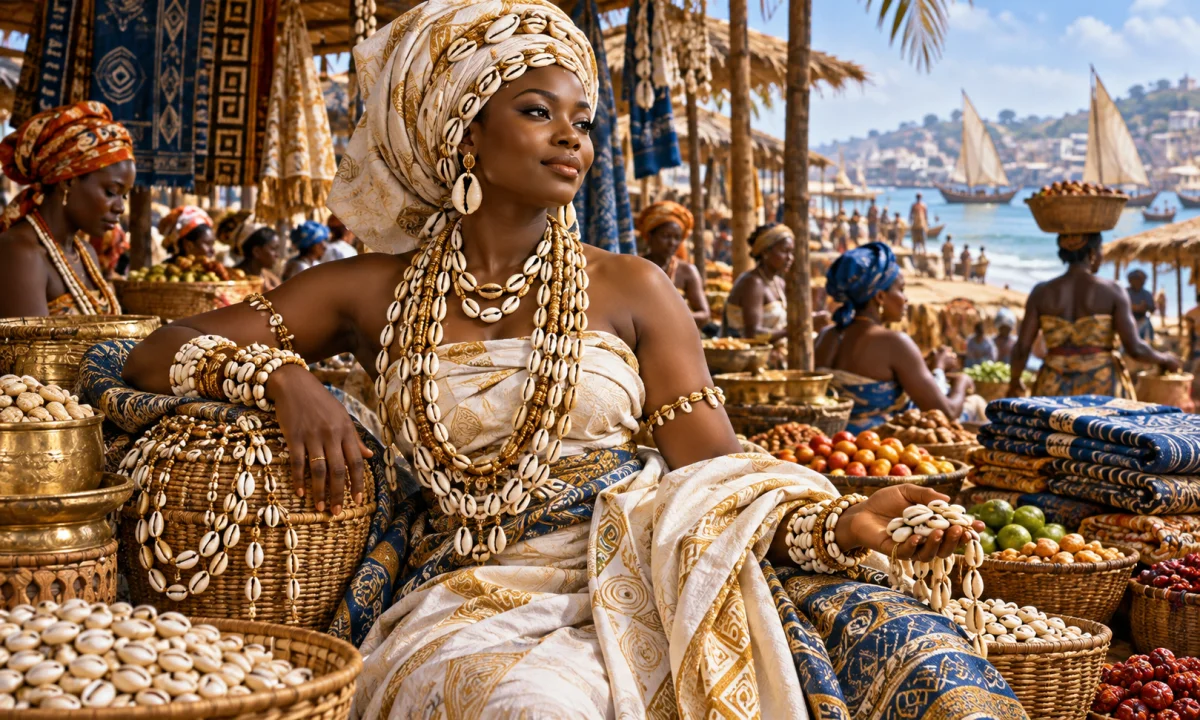
Modern representations often emphasize a beautiful woman in a flowing blue dress, surrounded by waves, fish or shells. This imagery can be meaningful, but it is selective. It usually reflects a combination of Yoruba inheritance, Cuban or Brazilian religious developments, romantic artistic conventions and modern ideas about femininity. It should not be mistaken for a complete description of Yemoja’s worship in Nigeria or of every tradition using the name Yemayá.
Environmental concerns have become increasingly relevant to public devotion near rivers and seas. Plastic, glass and other non-biodegradable offerings can damage sacred waterways, and some religious communities have encouraged more sustainable forms of ritual practice. This discussion illustrates how living traditions respond to present circumstances while retaining relationships with water, ancestors, communities and divine powers.
Yemoja therefore cannot be defined by a single image or a single family story. In Yoruba tradition she is a powerful water òrìṣà, particularly connected with motherhood and the Ogun River. Across the Atlantic, she became Yemayá or Iemanjá, a protector and maternal sea power whose worship developed in distinctive Cuban, Brazilian and other diasporic settings. Understanding her requires keeping these related but different traditions together without treating them as identical.