WORLD
WORLD
Abiku
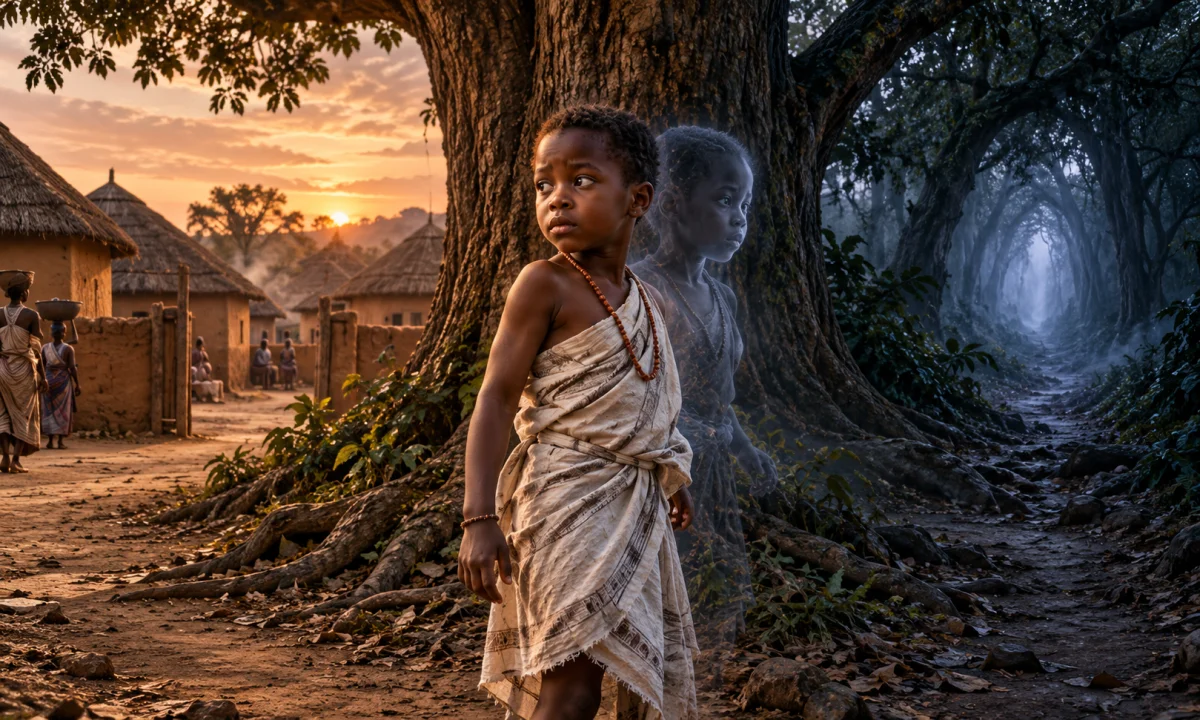
Abiku is a concept in Yoruba religious tradition concerning a child believed to move repeatedly between the human world and the spirit world. The Yoruba term is commonly written àbíkú, often translated as “born to die” or “one born to die.” In many accounts, an abiku is born, dies during infancy or childhood, and is then believed to return through the same mother or family. The term does not describe one individual monster or deity. It refers to a class of spiritually unusual children and to a set of beliefs about repeated birth, death, and return.
Abiku traditions belong to the religious and cultural world of the Yoruba peoples of West Africa, especially communities in present-day southwestern Nigeria and neighbouring parts of Benin and Togo. Accounts differ between communities, families, religious specialists, and historical periods. Some descriptions present the abiku as belonging to a company of spirits who make agreements to return to the spirit world after a short time. Other interpretations place greater emphasis on the mysterious recurrence of infant deaths and the rituals used to protect a surviving child. These explanations should not be treated as a single, uniform doctrine shared by every Yoruba community.
Name and meaning
The name àbíkú is generally analysed through Yoruba words associated with birth and death. Àbí relates to being born, while ikú means death. The resulting expression is often rendered in English as “born to die,” although translations can simplify the range of meanings carried by the term. In ordinary discussion, abiku may refer to a child thought to have this condition, to the repeated pattern of a child’s births and deaths, or to the spiritual beings believed to cause or accompany that pattern.
Yoruba language uses tonal distinctions, and the marks in àbíkú represent tones that may be omitted in English-language writing. Spellings such as abiku are therefore common, particularly in literature and popular reference works. The related word ogbanje is often used in discussions of a similar idea among the Igbo, but it is not simply another Yoruba spelling of abiku. The two traditions have been compared because both concern a child who repeatedly returns after death, yet their cultural settings, terminology, and religious interpretations are distinct.
Cultural and religious setting
Traditional Yoruba religious thought includes a complex relationship between the visible world of human beings and invisible spiritual realms. Human life is connected with family ancestry, divinities known as òrìṣà, personal destiny, ritual obligations, and forces that may help or harm a person. Birth is therefore not understood only as a biological event. It can also be interpreted as the arrival of a being whose relationship with the family and the unseen world must be discovered and maintained.
Within this setting, repeated infant deaths could be understood as evidence that a child had not fully accepted life in the human community. A family might believe that the child was tied to companions in the spirit world or had made a promise to return after a particular period. The death of another baby born to the same mother could then be interpreted as part of the same cycle, especially when the deaths occurred at similar ages.
Such beliefs existed alongside practical knowledge about pregnancy, childbirth, illness, nutrition, and infant care. It is misleading to assume that a spiritual explanation excluded medical observation or treatment. Families could consult healers, diviners, elders, and other specialists while also using protective medicines and religious rites. The category of abiku belongs to a cultural system for explaining suffering and uncertainty; it should not be used to dismiss the real physical causes of childhood illness and mortality.
The abiku and the spirit company
One of the best-known elements of abiku tradition is the belief in a group or company of spirit children. In some accounts, these spirits exist together before birth and make an agreement about entering the human world. They may promise to die young, return to the company, and be born again. The repeated loss of children is consequently understood as the work of a continuing spiritual relationship rather than a series of unrelated births.
Different narratives describe the company in different ways. It may be portrayed as a group of companions who call the child back, as a community to which the child remains emotionally attached, or as a set of beings who resent the child’s attempt to remain among humans. Some stories say that the child can be persuaded to break the agreement. Others focus on identifying and weakening the bond between the child and the spirit company.
These stories do not establish a fixed hierarchy, appearance, or personal history for the spirit companions. Abiku is not generally described as a ruler of the dead, an òrìṣà with a universal mythology, or a demon with one standard form. The company is a recurring motif within oral traditions, and its details vary according to the teller and the community.
Attributes and signs
Abiku has no universally prescribed physical appearance. A child believed to be abiku may look like any other child. The identification usually arises from events surrounding birth, illness, survival, and repeated loss rather than from supernatural features visible to everyone.
Some accounts associate an abiku child with a distinctive mark, unusual scar, or bodily sign. If a child dies and a later child is born with a similar mark, family members may interpret it as evidence that the same child has returned. In certain traditions, a body may be marked after death so that a returning child can be recognised. The precise practices and meanings vary, and not every Yoruba community follows them.
Repeated illness, unexplained weakness, or a pattern of children dying at a similar age could also lead a family to suspect an abiku relationship. In other accounts, a child who survives despite serious danger may be treated as having escaped the power of the spirit company. These interpretations were shaped by local understandings of illness and destiny, not by a standard list of supernatural powers.
Abiku is sometimes described as having the ability to choose when to die, return, or remain alive. In traditional narratives, this apparent power reflects the child’s connection to the spirit world and to an earlier pact. It does not mean that all Yoruba people regard children as responsible for their illnesses or deaths. The concept can express fear, grief, and the search for meaning in circumstances that families cannot control.
Ritual responses and protection
When a family believed that a child might be abiku, it could seek the help of a diviner, healer, elder, or ritual specialist. The appropriate response depended on the local tradition and on the interpretation of the child’s condition. Divination might be used to investigate the child’s destiny, the cause of repeated deaths, or the ritual obligations believed to surround the birth.
Protective measures described in ethnographic and literary accounts include medicinal preparations, amulets, changes of name, offerings, prayers, and rites intended to detach the child from the spirit company. A name could be chosen to express a family’s refusal to accept another death or to appeal to the child to remain in the human community. Names associated with difficulty, return, refusal, or endurance are sometimes discussed in connection with these traditions, but there is no single prescribed abiku name used everywhere.
Some practices were directed toward the relationship between the child and the unseen world, while others marked the child as a person who had survived danger. The use of charms or medicinal substances could combine religious, protective, and healing purposes. Their meaning cannot always be separated into categories that match modern distinctions between “medicine” and “religion.”
Ritual intervention was not necessarily presented as an attempt to destroy the child. In many interpretations, the goal was to persuade, bind, protect, or reconcile the child so that it would accept a longer human life. The child remained part of the family and community, even when its birth was surrounded by fear and uncertainty.
Stories and narrative patterns
Abiku stories commonly centre on a mother or family that has suffered the deaths of several infants. A new child is born, and relatives notice a resemblance to an earlier baby or recognise a mark associated with a previous death. The family then seeks a way to prevent the child from departing again. The story may end with the child surviving, or it may leave the outcome uncertain.
Another recurring pattern presents the child as divided between two communities. The human family offers affection, food, protection, and a future, while the spirit companions call the child back to the place from which it came. The child’s repeated movement between these worlds turns infancy into a conflict over belonging. The emotional focus is often the grief of the parents, particularly the mother, rather than the adventures of a supernatural hero.
In some narratives, the child’s survival is associated with a broken promise or a ritual discovery. The family may learn the name of a spirit companion, locate an object connected with the agreement, or perform a rite that changes the child’s relationship with the unseen world. Other stories do not offer such a clear solution. Their power lies in representing vulnerability and the limits of human control.
Because much Yoruba religious knowledge has been transmitted orally, no single canonical book contains all abiku stories. Elements of the tradition may appear in oral narratives, praise poetry, divinatory material, family histories, ritual speech, and accounts recorded by outsiders. Written versions preserve important evidence, but they can also reflect the language, assumptions, and purposes of the person who recorded them. A literary retelling should not automatically be treated as a direct transcript of universal Yoruba belief.
Interpretation and cultural significance
Abiku beliefs can be understood as part of a broader Yoruba concern with continuity between generations and with the obligations surrounding birth. The repeated return of a child creates an especially disturbing form of family continuity: the child seems both new and familiar, present and absent, alive and already claimed by another world.
The concept also gives cultural form to mourning. Repeated infant death can produce an experience in which grief is never fully separated from hope. When another baby is born, the family may feel joy and fear at the same time. The possibility that the child is returning can make the new birth meaningful, but it can also intensify anxiety about another loss.
Scholars have interpreted abiku from several perspectives. It may be studied as a religious explanation of reincarnation and destiny, as an oral narrative tradition, as a response to historical patterns of infant mortality, or as a symbolic expression of family trauma. These interpretations are not mutually exclusive, but none should be treated as the only correct explanation of what the belief means to every person who uses the term.
The tradition also raises important questions about identity. Is the child the same person as the one who died, a spirit taking human form, or a living child interpreted through the memory of earlier losses? Different accounts answer these questions differently. The uncertainty is central to the concept: abiku describes an unstable boundary between individual life, family memory, and spiritual destiny.
Abiku in Yoruba and African literature
Abiku has had a significant presence in modern African literature, where writers have used the figure to explore colonial history, political violence, poverty, creativity, and the relationship between visible and invisible worlds. In these works, abiku may become a metaphor for a nation that repeatedly begins and collapses, a society caught in cycles of suffering, or a people negotiating between inherited traditions and modern institutions.
Poets including Wole Soyinka and J. P. Clark have written works titled “Abiku,” although their poems are individual literary creations rather than interchangeable statements of traditional doctrine. Their treatments draw on the cultural associations of the term while developing distinct poetic arguments and images. Literary abiku may speak in the first person, possess a strongly defined personality, or represent historical forces in ways that differ from oral religious accounts.
Ben Okri’s novel The Famished Road is also frequently discussed alongside abiku traditions because its narrator, Azaro, is a spirit child who moves between the spirit and human worlds. The novel draws particularly on Igbo cultural material and uses the term ogbanje, not Yoruba abiku, for the relevant tradition. The resemblance between the concepts has encouraged comparison, but the two should not be merged.
Distinction from related figures
- Ogbanje: An Igbo term associated with a child who repeatedly dies and returns, often in connection with a spirit group or agreement. It belongs to Igbo religious and cultural traditions, not Yoruba terminology.
- Egungun: Yoruba ancestral masquerades and the wider ancestral presence they represent. Egungun are not abiku children, although both concepts involve relationships between the living and the dead.
- Òrìṣà: Powerful divine beings in Yoruba religious traditions. Abiku is not normally the name of an òrìṣà and should not be treated as a deity with a standard cult or universal mythology.
- Ghost or restless dead child: An abiku is not simply the ghost of a dead child. The tradition concerns a continuing cycle of birth and death, often involving a child who is alive in the present.
Modern uses of “abiku” may extend beyond religious belief. The word can appear in novels, poems, music, journalism, academic discussion, and everyday descriptions of repeated hardship. In metaphorical contexts, it may suggest recurrence, fragility, or a cycle that refuses to end. Such uses can preserve elements of the traditional image while changing its meaning. The religious concept remains rooted in Yoruba understandings of birth, destiny, family, and the interaction between human and spirit worlds.