WORLD
WORLD
Aganju
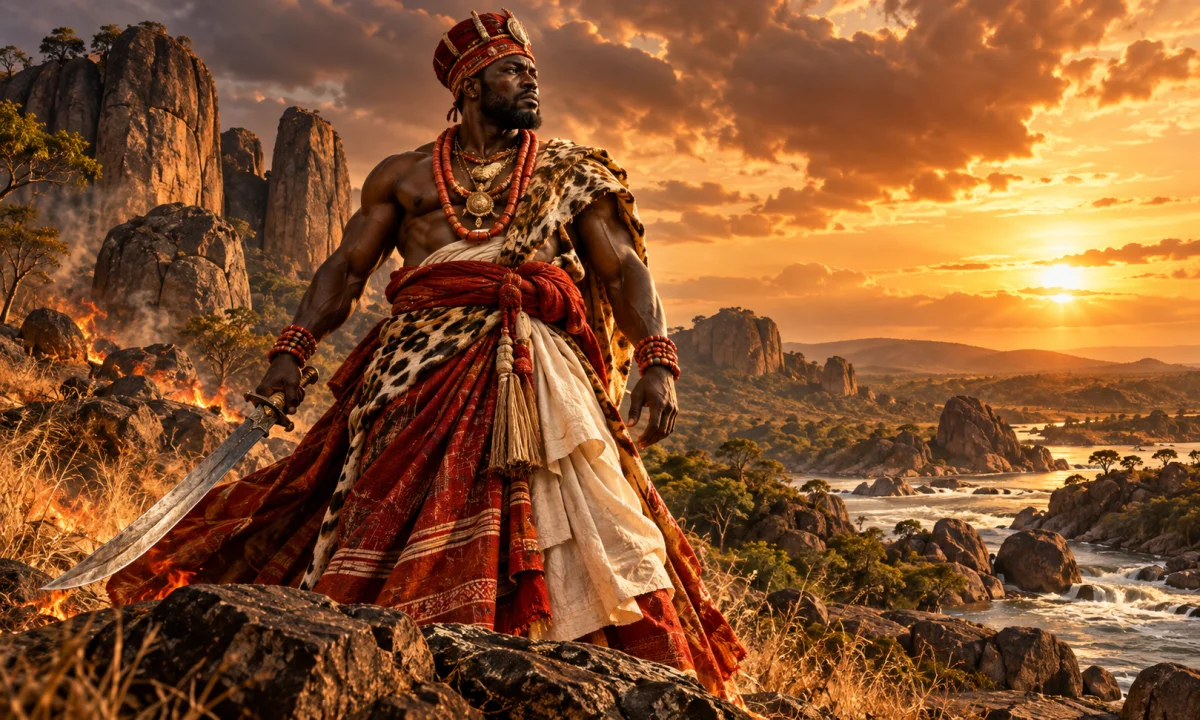
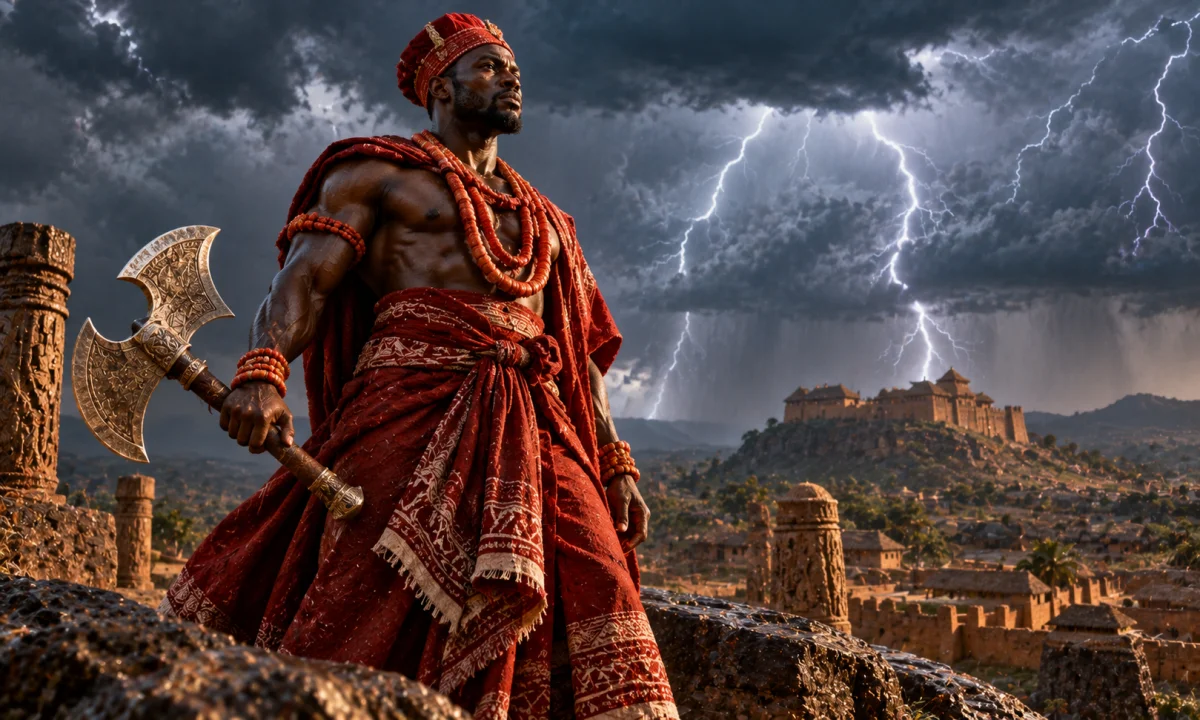
Aganju, also written Aganjú or Agayú in some West African and African-diaspora traditions, is an orisha associated with powerful natural forces, difficult landscapes and the strength required to cross them. He belongs to the religious world of the Yoruba-speaking peoples of West Africa, especially southwestern Nigeria and neighbouring regions, although his identity and attributes have developed differently in Yoruba, Cuban and Brazilian traditions. Aganju is often connected with the wilderness, broad open spaces, earth, heat, volcanoes, rivers and physical endurance. These associations are not identical in every community, and no single description represents all traditions that use the name.
Aganju in Yoruba religious tradition
In Yoruba religion, an òrìṣà is not simply a “god” in the narrow sense. Orishas are sacred powers and personalities involved in the ordering of the world, the forces of nature, human communities and relationships with the supreme divinity, Olódùmarè. They may be approached through prayer, sacrifice, praise poetry, possession, divination and ritual observance. Their identities are preserved through oral traditions, local cults, family histories and bodies of sacred poetry rather than through one universally authoritative scripture.
Aganju is one of the figures whose character varies considerably according to region and religious lineage. His name is commonly associated with open, uncultivated or difficult country. In this sense, Aganju represents places that are not easily controlled by human settlement: wilderness, rocky ground, immense distances and landscapes where ordinary travel becomes dangerous. The name is also connected in many interpretations with the elemental power of the earth, particularly heat, fire and volcanic force.
Descriptions of Aganju as an orisha of volcanoes are especially widespread in later summaries and in African-diaspora religions. Volcanoes are not a dominant feature of the Yoruba landscape in the way they are in parts of East Africa, the Mediterranean or the Caribbean. For that reason, the volcanic image should not automatically be treated as an unchanged description of an ancient Yoruba deity. In Yoruba contexts, Aganju may be understood more broadly through earth, wilderness, heat, dangerous terrain and overwhelming natural power. The volcanic symbolism became particularly influential in Cuba and other places where the orisha was interpreted through local religious experience.
The name and the question of identity
The spelling Aganju reflects attempts to represent a Yoruba name in writing without all the features of Yoruba pronunciation. Aganjú indicates a tonal distinction in standard Yoruba orthography, while Agayú is a common form in Cuban Lucumí, a ritual language and religious vocabulary shaped from Yoruba and related languages in the Atlantic diaspora. Other spellings may occur in English and Portuguese writing.
The word and the personal name should not be treated as completely separate or completely identical. In Yoruba, words referring to wilderness or open country can carry descriptive meaning, while Aganju also appears as a sacred personality and, in some traditions, as a royal or ancestral figure. The historical relationship between these uses is not certain. Oral traditions frequently preserve more than one layer of meaning at the same time: a place, a power of nature, a personal name and the memory of a ruler or ancestor may become connected through ritual and storytelling.
Some accounts identify Aganju with an early ruler of Oyo, sometimes placing him among the predecessors of the better-documented Oyo kings. Such accounts are important within Yoruba historical and religious traditions, but they should not be presented as securely established biography in the modern historical sense. Early Oyo chronology is difficult to reconstruct, and the boundaries between sacred genealogy, royal tradition and historical memory are not always clear. Aganju may therefore be described as a figure who can appear both as an orisha and as a culture hero or ancestral king, depending on the source and community.
Domains and symbolism
Aganju’s central symbolism concerns power that is difficult to contain. He is associated with strength, endurance and the ability to move through places that defeat ordinary human effort. Stories and praise traditions connected with him may emphasize great physical force, the control or crossing of dangerous spaces, and the transformation of hostile land into a route, settlement or kingdom.
- Wilderness and open country: Aganju is linked with uncultivated land, distant spaces and the challenges of travel beyond settled territory.
- Earth and heat: His imagery may involve the deep, heated or unstable powers of the ground.
- Fire and volcanic force: These associations are particularly prominent in Cuban and other diaspora forms of his worship, though they should not be projected without qualification onto every Yoruba account.
- Strength and endurance: Aganju can symbolize bodily power, courage and the capacity to bear severe conditions.
- Passage and difficult crossings: In several traditions he is connected with overcoming barriers, whether those barriers are natural, political or spiritual.
Symbolic attributes are not fixed across all temples or lineages. Colours, ritual objects, foods, songs and taboos may differ. Modern descriptions often present a standardized set of colours or emblems, but Yoruba religion has historically been organized through local communities and ritual specialists. An attribute used in one lineage may be absent or interpreted differently in another.
Stories and relationships
Aganju is frequently placed within stories concerning the formation of kingdoms and the relationship between wild land and political order. In such narratives, the wilderness is not merely empty space. It is a powerful realm that must be approached with respect. A ruler or hero who claims land without acknowledging its sacred forces risks failure, while one who receives the support of an orisha can cross boundaries and establish a new centre of life.
His relationship with Shango, the orisha of thunder and lightning and the celebrated former king of Oyo, is one of the most widely discussed features of Aganju’s mythology. In a number of Yoruba and diaspora genealogies, Aganju is described as Shango’s father. In other accounts, the two figures are connected as predecessors, companions, ritual counterparts or members of a sacred royal lineage rather than through a single consistent biological genealogy. The details vary substantially.
These differences are not necessarily errors that can be resolved by selecting one “correct” family tree. Yoruba mythology is transmitted through regional traditions, praise poetry, initiation lineages and ritual performance. The same relationship may carry different meanings in different settings. A father-son connection can express succession, shared authority or the transmission of a dangerous power as much as it can describe ordinary parentage.
Some later accounts connect Aganju with Yemoja, a major water-associated orisha whose identity also varies between Yoruba regions and diaspora traditions. In Cuban Lucumí, Agayú and Yemayá may be presented as the parents of Changó in some religious narratives. This genealogy is not universal in Yoruba tradition, and it should not be treated as a single ancient myth preserved unchanged across the Atlantic. The prominence of this relationship in Cuba reflects the development of Lucumí theology under conditions of enslavement, cultural exchange and the reorganization of Yoruba religious practices in the Americas.
Aganju’s relationship with Shango is also symbolically meaningful. Fire, heated earth and volcanic power can be contrasted with or connected to thunder, lightning and storm energy. In some interpretations, the two orishas represent related forms of explosive power: one rooted in the earth and the other descending from the sky. This is an interpretive pattern rather than a universal doctrine, but it helps explain why they are often discussed together.
Aganju in Cuban Lucumí religion
The Cuban form Agayú Solá is one of the most recognizable versions of Aganju. Lucumí developed among enslaved and formerly enslaved people in Cuba, especially through the preservation and reorganization of Yoruba-derived religious practices. The religion is often called Santería in popular English, although many practitioners use terms such as Regla de Ocha or Lucumí and may have different preferences about naming.
In Lucumí, Agayú is strongly associated with volcanoes, the earth’s heat, massive physical strength and dangerous natural power. He is also linked with travel through difficult terrain and with protection during demanding journeys. The image of Agayú as a giant or immensely powerful being is common in popular explanations of his role, though ritual understandings can be more complex than a simple character profile.
Agayú is often associated with Saint Christopher through the process known as religious syncretism. Saint Christopher is traditionally represented in Christian art as a powerful bearer who carries a child across a dangerous river. That image offered a meaningful parallel to Agayú’s associations with strength, passage and the crossing of difficult spaces. The comparison does not mean that Agayú and Saint Christopher are historically the same figure. It reflects a specific colonial and Afro-Cuban religious development in which African sacred identities were expressed alongside, beneath or through Catholic forms.
Agayú’s relationship with Shango is especially prominent in Lucumí practice. Some houses describe Agayú as Shango’s father, while other ritual traditions emphasize a close spiritual relationship without using the same genealogy. In some communities, Agayú and Shango may share or alternate ritual settings, and practices surrounding possession, songs and ceremonial obligations can vary by house. There is no single institution that governs every Lucumí lineage.
Aganju in Brazil and other diaspora traditions
Forms of Aganju also occur in Afro-Brazilian religions, including Candomblé, where the name may appear as Aganju or in related spellings. Brazilian traditions developed through the interaction of Yoruba, Fon, Ewe and other West and Central African religious heritages, as well as through local historical conditions. Consequently, an orixá called Aganju in Brazil cannot simply be assumed to have exactly the same attributes as Aganju in Nigeria or Agayú in Cuba.
In some Brazilian contexts, Aganju is associated with earth, heat, fire, strength and the broader family of powers connected with Xangô. Ritual songs, colours, sacred objects and genealogies may differ among nations and houses. The term “nation” in Candomblé refers to a religious and historical tradition, not to a modern African nation in a straightforward political sense. It is therefore more accurate to speak of related developments than of one uniform transatlantic version.
Across the Americas, Aganju’s presence demonstrates how African religious traditions survived without remaining static. Enslaved Africans and their descendants preserved names, songs, ritual technologies and sacred relationships while adapting them to new environments, languages and political pressures. Changes in emphasis do not make diaspora forms less authentic; they show that religious traditions can remain continuous through transformation.
Distinguishing Aganju from related figures
Aganju is sometimes confused with other powerful or fire-associated beings. The differences are important.
- Shango is chiefly associated with thunder, lightning, royal authority and the power of the storm. He may be related to Aganju in genealogy or ritual, but he is not simply another name for Aganju.
- Ogun is associated with iron, tools, warfare, roads, labour and the technological transformation of the environment. His connection with dangerous routes does not make him identical with Aganju, whose symbolism centres more on wilderness, earth and overwhelming natural force.
- Obaluaye or Babalu-Aye is associated with illness, healing and the earth in many Yoruba and diaspora traditions. Earth symbolism alone does not establish an identity with Aganju.
- Esu or Elegba is connected with crossroads, communication, movement and the mediation of offerings. Aganju may be invoked in connection with difficult passage, but he is not the same as the orisha of the crossroads.
Names can also create confusion. Agayú is the major Cuban form of Aganju, but the meaning and ritual setting of the name depend on the tradition using it. Similarly, descriptions of Aganju as a “volcano god” can be useful shorthand for some diaspora contexts but are too narrow to represent the full range of Yoruba interpretations.
Cultural and religious significance
Aganju’s importance lies partly in the way he gives sacred meaning to landscapes that appear barren, dangerous or beyond human control. He represents the recognition that settlement, kingship and civilization exist beside older and more powerful natural realities. Roads, cities and political institutions depend on the ability to cross, inhabit or negotiate difficult ground; Aganju embodies that challenge.
His symbolism also links physical endurance with moral and spiritual capacity. Strength is not merely brute force. It can mean the patience to survive hardship, the courage to enter unknown territory and the discipline required to handle power without being destroyed by it. In ritual settings, such meanings are inseparable from obligations to community, lineage and the sacred forces addressed through ceremony.
Because Aganju is preserved through living religious traditions rather than a single canonical myth, his portrayal should remain open to variation. A Yoruba devotee, a Cuban Lucumí practitioner and a Brazilian Candomblé practitioner may all recognize the name while emphasizing different histories, relationships and ritual attributes. Treating those differences as part of the subject, rather than forcing them into one standardized biography, gives a more accurate picture of Aganju’s place in African and African-diaspora religious life.