WORLD
WORLD
Oshun
Ọ̀ṣun, commonly written as Oshun in English, is a major òrìṣà of Yoruba religious tradition. She is associated especially with fresh water, rivers, fertility, love, beauty, prosperity, diplomacy and forms of feminine power. Ọ̀ṣun is also understood through the river that bears her name, particularly the Osun River in southwestern Nigeria. Her identity is not limited to a single fixed “goddess” category: in Yoruba thought, an òrìṣà may be a divine power, a sacred presence in nature, an ancestral or cosmic personality, and a focus of worship at the same time.
Yoruba religious setting
Yoruba religion developed among Yoruba-speaking peoples, whose historic homeland lies chiefly in present-day southwestern Nigeria and parts of the neighbouring region, including Benin. It includes reverence for Olódùmarè, the supreme source of existence, together with numerous òrìṣà who govern, embody or mediate different aspects of the world. Religious practice has traditionally involved divination, sacrifice, prayer, possession, healing, initiation, praise poetry, music and festivals.
Information about Ọ̀ṣun comes from several overlapping traditions rather than from one canonical scripture. Oral histories, praise names, songs, ritual knowledge, divination verses and local traditions preserve accounts of her character and deeds. The corpus of Ifá, transmitted by trained diviners, contains many narratives concerning the òrìṣà, although the interpretation and wording of these narratives vary by lineage and region. Written descriptions by outsiders and later scholars provide historical evidence about Yoruba religion, but they do not replace the authority of living religious traditions.
Ọ̀ṣun is especially connected with the Osun River and with the city of Ọ̀ṣogbo, now commonly spelled Osogbo. The Osun-Osogbo Sacred Grove is a major centre of her worship and a place of shrines, sculptures, sacred trees and ritual activity. Its importance reflects a continuing religious relationship between a community, a river and the òrìṣà associated with that river. The grove was designated a UNESCO World Heritage Site in 2005, but its significance is religious and cultural, not merely artistic or historical.
Name and identity
The name is properly written Ọ̀ṣun with Yoruba tone and underdot marks. “Oshun” is the most familiar English spelling; “Osun” is also widely used, particularly in the names of the river, state and sacred grove. In Portuguese-speaking contexts and in religions of the African diaspora, related forms include Oxum and Ochún. These names refer to related religious traditions, but the practices and interpretations surrounding them are not identical.
The precise linguistic history of the name is not universally agreed upon. It is safest to understand Ọ̀ṣun as the name of a divinity and sacred river within Yoruba tradition rather than to assign it a simple translated meaning. Her river identity is particularly important: she is not merely a supernatural patron of rivers, but is intimately present in the waters, landscape and communities associated with the Osun River.
English descriptions often call Ọ̀ṣun a “goddess.” This can be useful as a rough comparison, but it may obscure Yoruba categories. Òrìṣà does not correspond exactly to the word “goddess,” and Ọ̀ṣun’s religious identity includes natural, social, moral and spiritual dimensions. She is represented as feminine in many traditions, yet her power is not confined to romantic attraction or physical beauty.
Attributes and spheres of influence
Fresh water and the river
Ọ̀ṣun’s most fundamental association is with fresh water. Rivers provide drinking water, food, transport, fertile soil and the conditions for human settlement. In ritual thought, flowing water can also cleanse, heal, nourish and carry àṣẹ, the vital force or authority through which divine and human action becomes effective. Ọ̀ṣun therefore represents the life-giving and socially sustaining qualities of water.
Her relationship with water is distinct from the sea-associated identities of other water divinities. In Yoruba tradition, different bodies of water and different òrìṣà may have their own histories, rituals and communities of worship. Later diaspora traditions sometimes develop broader or different classifications, so descriptions of Ọ̀ṣun as a “water goddess” should not erase the important distinction between rivers and the ocean.
Fertility, motherhood and healing
Ọ̀ṣun is associated with fertility, pregnancy, childbirth and the protection of children. These associations arise partly from the nourishing character of fresh water and partly from stories in which her presence makes life possible. Worshippers may turn to her for assistance with conception, healthy birth, family well-being and recovery from illness, although particular prayers and rituals differ among communities.
Her fertility should not be reduced to biological reproduction. Ọ̀ṣun’s generative power can also refer to abundance, creativity, social continuity and the flourishing of a community. Water makes crops grow and allows settlements to endure; in this broader sense, her power concerns the conditions under which life and prosperity can develop.
Love, beauty and attraction
Ọ̀ṣun is widely associated with love, sensuality, adornment and beauty. Mirrors, combs, jewellery, elegant clothing and other objects connected with personal presentation may appear in her iconography or devotional practice. Honey is also strongly associated with her in many traditions, reflecting sweetness, attraction, pleasure and persuasive speech.
These qualities do not make Ọ̀ṣun a passive figure concerned only with seduction. Beauty in her stories can be a form of authority. Charm, eloquence, generosity and emotional intelligence may succeed where force fails. Her power often operates through negotiation, diplomacy and the ability to draw people into cooperation.
Wealth, diplomacy and political influence
Ọ̀ṣun is connected in many traditions with prosperity, commerce and the social skills needed to maintain peaceful relationships. She may be invoked when reconciliation, tact or persuasive communication is required. Her influence demonstrates that power in Yoruba religious imagination is not represented only by warfare or physical strength. The ability to nurture alliances, preserve social harmony and secure abundance can be equally decisive.
Some Yoruba praise traditions emphasise her royal dignity and splendour. Others highlight her independence, generosity, sensuality, wisdom or capacity to punish disrespect. These qualities are not always presented in the same balance. Ọ̀ṣun can be gentle and nurturing, but she can also withdraw her favour or respond forcefully when dishonoured.
Appearance, colours and sacred objects
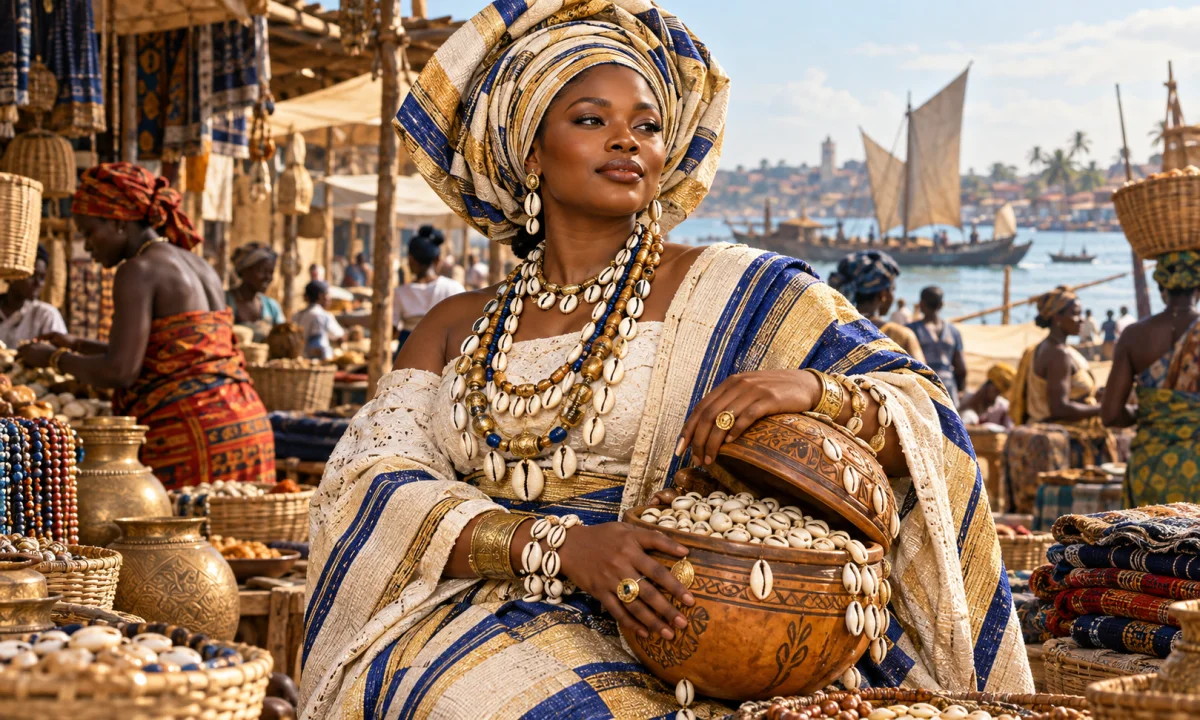
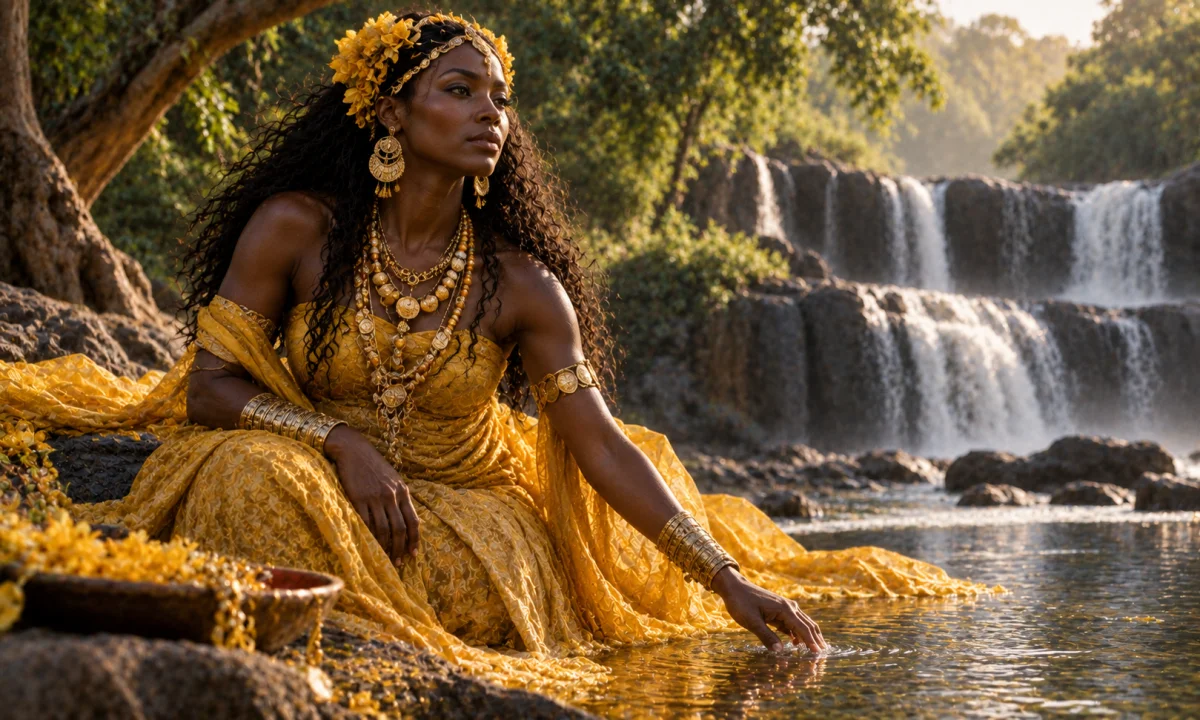
Descriptions of Ọ̀ṣun commonly emphasise elegance, radiance and ornament. She may be represented wearing yellow or gold-coloured clothing and jewellery, though colours and ritual conventions vary by community. Brass is particularly associated with her in many Yoruba and diaspora settings. Fans, mirrors, combs, vessels, beads and river water may also carry symbolic or ritual importance.
Artists have often portrayed her as a beautiful woman near or within a river. Such images communicate important aspects of her identity, but no single visual form is universal. Yoruba religious art is diverse, and the appearance of a shrine figure depends on local history, materials, the artist and the purpose of the object. A statue created for a public sacred grove should not automatically be treated as a literal portrait of how every worshipper imagines Ọ̀ṣun.
Offerings associated with Ọ̀ṣun may include honey, river water, fruits, sweets, cooked foods, brass objects, cloth or other items specified by a priest or community. Practices are not interchangeable across all Yoruba temples or diaspora religions. Honey, for example, is widely linked with her, but the details of acceptable offerings, taboos and ceremonies belong to particular ritual traditions rather than to a universal list.
Stories of creation and feminine authority
One of the best-known narratives presents Ọ̀ṣun as the only woman among a group of primordial òrìṣà sent to establish order in the world. In some versions, the male òrìṣà disregard her and attempt to carry out their work without her participation. Their efforts fail. The world remains barren or disordered until Ọ̀ṣun is recognised, invited to join them and treated with proper respect. Once her presence and power are included, the work can succeed.
The details differ considerably among tellers and textual collections. In some accounts, Ọ̀ṣun returns to Olódùmarè or appeals to a higher authority; in others, her absence causes the earth to lack fertility, moisture or social balance. The central idea is consistent in many versions: creation and community cannot be complete when feminine power is excluded or dismissed.
This story is sometimes interpreted as a simple statement about gender equality, but its religious meaning is broader. Ọ̀ṣun embodies the life-giving, relational and generative forces required for cosmic order. The narrative also warns against arrogance. Technical ability, political authority or physical strength cannot substitute for the participation of every power necessary to sustain the world.
Relationships with other òrìṣà
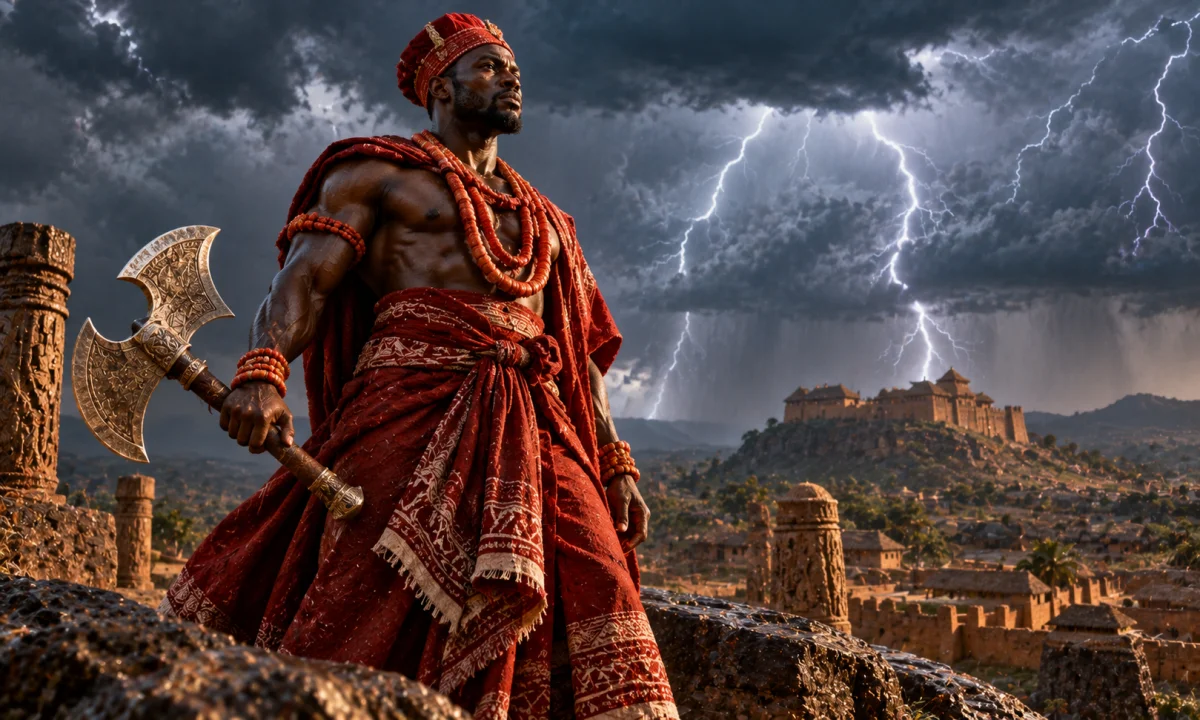
Ọ̀ṣun appears in stories involving several other òrìṣà, but there is no single universally accepted family tree. In different traditions she is described as a wife, consort or companion of Ṣàngó, the òrìṣà associated with thunder, lightning, kingship and justice. Some narratives also connect her with Ògún, Òrúnmìlà or other figures. These relationships may change according to the local corpus, ritual lineage or diaspora tradition.
It is misleading to treat every story about these relationships as one consistent mythology. Yoruba religious narratives are transmitted through multiple regional and specialist traditions, and a relationship that is central in one account may be absent or differently understood in another. In many stories, Ọ̀ṣun’s importance lies not simply in being someone’s wife but in possessing her own indispensable authority.
Her connection with Ṣàngó is especially prominent in several modern representations, where the pair may symbolise complementary forces such as fire and water, masculine and feminine power, royal authority and emotional or diplomatic influence. Such symbolism can be meaningful, but it should not be presented as the only traditional interpretation of either òrìṣà.
Ọ̀ṣun at Ọ̀ṣogbo
The annual Ọ̀ṣun-Ọ̀ṣogbo festival is one of the most visible living expressions of her worship. It takes place in and around the sacred grove at Ọ̀ṣogbo, where devotees, priests, community leaders, performers and visitors participate in processions, prayers, music and offerings. A central figure in the festival is the Arugba, a young woman who carries a ritual vessel. Her role is connected with the community’s relationship with Ọ̀ṣun and with the continuity of the festival.
The festival has both religious and civic dimensions. It renews a relationship between the people of Ọ̀ṣogbo and the divinity associated with their river, while also affirming collective identity and the protection of the grove. The grove’s sculptures and architectural features include work associated with the Austrian artist and priest Susanne Wenger, who lived in Nigeria and participated in the restoration and development of the sacred site during the twentieth century. Her contribution is part of the grove’s modern history, but Ọ̀ṣun worship there is not simply a product of her artistic work.
Ọ̀ṣun, gender and social power
Ọ̀ṣun’s traditions offer a complex image of feminine power. She can be a mother, lover, healer, queen, negotiator, provider of wealth and guardian of social balance. Her beauty is not separated from intelligence, and her sensuality is not separated from political influence. Stories in which male figures fail without her participation present an important critique of exclusion and overconfidence.
At the same time, it would be inaccurate to turn Ọ̀ṣun into a modern symbol detached from Yoruba religious practice. Her significance includes ritual obligations, inherited praise names, sacred places, divination and relationships with particular communities. Contemporary people may draw feminist, environmental or artistic interpretations from her traditions, but those interpretations should be distinguished from the categories and purposes of traditional worship.
Distinctions from related figures
Ọ̀ṣun should not be confused with Yemọja, although both are associated with water and motherhood and are frequently discussed together in the African diaspora. In many Yoruba traditions, Ọ̀ṣun is linked primarily with fresh rivers, while Yemọja has strong associations with motherhood and, in many diaspora traditions, the sea. Their identities and ritual histories are distinct, even where later religious systems place them within a shared family of water divinities.
Nor should Ọ̀ṣun be treated as identical to every figure called a love or beauty goddess in another mythology. Comparisons with Aphrodite, Venus or other deities may help explain one aspect of her popular image, but they do not establish historical equivalence. Ọ̀ṣun’s river identity, relationship to Yoruba cosmology, role in creation narratives and place in Ifá-related traditions give her a distinct religious character.
Traditions in the African diaspora
Through the forced migration of Africans during the Atlantic slave trade, Yoruba religious concepts became part of new traditions in the Caribbean and the Americas. Ọ̀ṣun is revered in Candomblé as Oxum and in Santería, also called Regla de Ocha, as Ochún. These traditions preserved Yoruba-derived elements while developing in dialogue with local cultures, Catholic forms, other African religious systems and changing historical conditions.
In Candomblé, Oxum is strongly associated with rivers, fertility, beauty, wealth and sweetness, while in Santería Ochún has her own ritual songs, colours, stories and relationships. Details vary among houses and lineages. Diaspora forms should neither be treated as imperfect copies of African religion nor collapsed into a single worldwide version of Ọ̀ṣun worship. They are distinct living traditions with their own histories and authorities.
Ọ̀ṣun has also become an important figure in contemporary art, poetry, music, environmental activism and discussions of Black identity. Popular culture often highlights her golden adornment, mirrors, honey, beauty or association with sensuality. These images may draw genuinely from traditional symbolism, but commercial or simplified portrayals can omit her roles as a river power, negotiator, protector, source of fertility and essential participant in the ordering of the world.