WORLD
WORLD
Olorun
Olorun is a supreme divine being in Yoruba religious thought, traditionally associated with the sky, creation, life and the ultimate ordering of the universe. The name is commonly written Ọlọ́run in Yoruba, from elements often understood as “owner” or “lord” and ọ̀run, the heavenly or spiritual realm. Olorun is frequently discussed alongside Olódùmarè, another name for the highest divine power, although Yoruba traditions and later descriptions do not always use these names in exactly the same way.
Yoruba religion is not a single, centrally defined creed. It developed among Yoruba-speaking communities in what is now southwestern Nigeria and parts of Benin and Togo, with important local differences in language, ritual and theology. Religious knowledge has been preserved especially through oral traditions, divination verses, praise poetry, myths, ritual practice and the teachings of priests and elders. As a result, accounts of Olorun can differ in emphasis. Some describe Olorun and Olódùmarè as names for one supreme being; others distinguish them as related aspects or titles within a wider understanding of divine reality.
Olorun in Yoruba religious thought
Olorun is generally placed above the òrìṣà, the divine powers and sacred beings who participate in the ordering of the world. The supreme deity is not usually imagined as one member of a divine family competing with other gods. Instead, Olorun represents the highest source of authority, existence and life. The òrìṣà have particular functions, histories, personalities and ritual communities, while Olorun is often portrayed as more remote and less directly involved in ordinary human affairs.
This difference is important. Yoruba religion is sometimes inaccurately described as simple polytheism, with Olorun treated as merely the “chief god” among many. It is more accurate to say that Yoruba religious traditions contain a supreme divine principle or creator, together with numerous òrìṣà who mediate particular forces, places, virtues, destinies and forms of social life. The relationship between the supreme deity and the òrìṣà is interpreted differently across communities, but Olorun is normally understood as occupying the highest position.
Olorun is also not simply equivalent to a human-like sky god. The name connects the deity with ọ̀run, but the heavenly realm in Yoruba thought is not merely the visible atmosphere above the earth. It is also a spiritual domain associated with divine beings, ancestors and the destiny of human lives. The boundaries between physical and spiritual existence are therefore more complex than a simple division between “sky” and “earth.”
Name, identity and related titles
The spelling Ọlọ́run represents Yoruba pronunciation more accurately than the unmarked form “Olorun,” although “Olorun” is widely used in English-language writing. The name is commonly translated as “Lord of Heaven,” “Owner of Heaven” or “Lord of the spiritual realm.” Such translations are useful approximations rather than complete definitions. Yoruba words can carry religious and philosophical associations that are not fully captured by a short English gloss.
Olódùmarè is another major name associated with the supreme deity. In many accounts, Olódùmarè is the creator and ultimate source of existence, while Olorun is a title emphasizing divine sovereignty over the heavenly realm. In other accounts, the two names are effectively interchangeable. Some writers have attempted to construct a fixed hierarchy in which Olódùmarè, Olorun and a third title occupy separate levels, but this arrangement should not be presented as universal Yoruba doctrine.
Olọ́fin may also appear in discussions of supreme authority, although the word can have different uses and should not automatically be treated as another personal name for Olorun. It is particularly important not to confuse Olorun with Orunmila, the òrìṣà associated with wisdom, divination and the Ifa tradition. Their names are sometimes confused by readers unfamiliar with Yoruba religious vocabulary, but they are distinct figures.
Older European and missionary descriptions often translated Yoruba religious concepts through Christian categories. These accounts helped preserve valuable observations, but they can also make Yoruba ideas appear more systematized or more similar to Christian theology than they were in local practice. Modern discussions therefore distinguish between Yoruba terms as used in living traditions and the classifications imposed by outside observers.
Creation and the ordering of the world
Yoruba creation traditions exist in multiple forms rather than in one canonical account. A widespread pattern begins with a separation or distinction between ọ̀run, the spiritual or heavenly realm, and ayé, the visible world. Olorun or Olódùmarè is associated with the original divine authority from which creation and life proceed. The òrìṣà then carry out particular tasks in bringing the world into its present form.
One well-known narrative tells of the formation of solid land from a watery or undifferentiated expanse. A divine figure, often Obàtálá, is sent from the heavenly realm with materials such as sand and a chain. A bird spreads the sand over the waters, allowing land to emerge. In many versions, Obatala becomes intoxicated before completing the task, and Odùduwà takes over and finishes the work. Other versions assign the leading role differently or give additional importance to Orunmila and other òrìṣà.
These stories should not be treated as a single official Yoruba creation myth. They are part of a broad body of oral traditions whose details vary by town, lineage, priestly tradition and performer. In some accounts, Obatala is especially associated with shaping human bodies from clay, while the supreme deity gives them life or breath. This division of responsibility expresses a general pattern: the supreme power establishes existence, while particular òrìṣà organize its forms and conditions.
Creation in these traditions is not always described as a completed event belonging only to the distant past. The continuing maintenance of life, fertility, moral order and social balance remains a religious concern. Rituals address the òrìṣà, ancestors and other spiritual powers because the world is understood as sustained through relationships between visible and invisible domains.
Attributes and religious significance
Olorun is associated with creative power, sovereignty and the source of life. The concept of àṣẹ, often translated as authority, power or the capacity to make things happen, is central to Yoruba religious thought. Speech, ritual action, divine command and moral force can all be connected with àṣẹ. The supreme deity is understood as possessing the highest and most fundamental form of this power, while òrìṣà, human beings, rulers and ritual specialists exercise it in more limited ways.
Olorun is also associated with the giving of life. In accounts concerning the creation of human beings, the shaping of a body and the granting of life may be attributed to different divine acts. This distinction reflects an understanding of human existence as dependent upon powers beyond material form. Life is not merely a physical condition; it is linked to spiritual destiny, divine permission and the relationship between a person and the wider cosmic order.
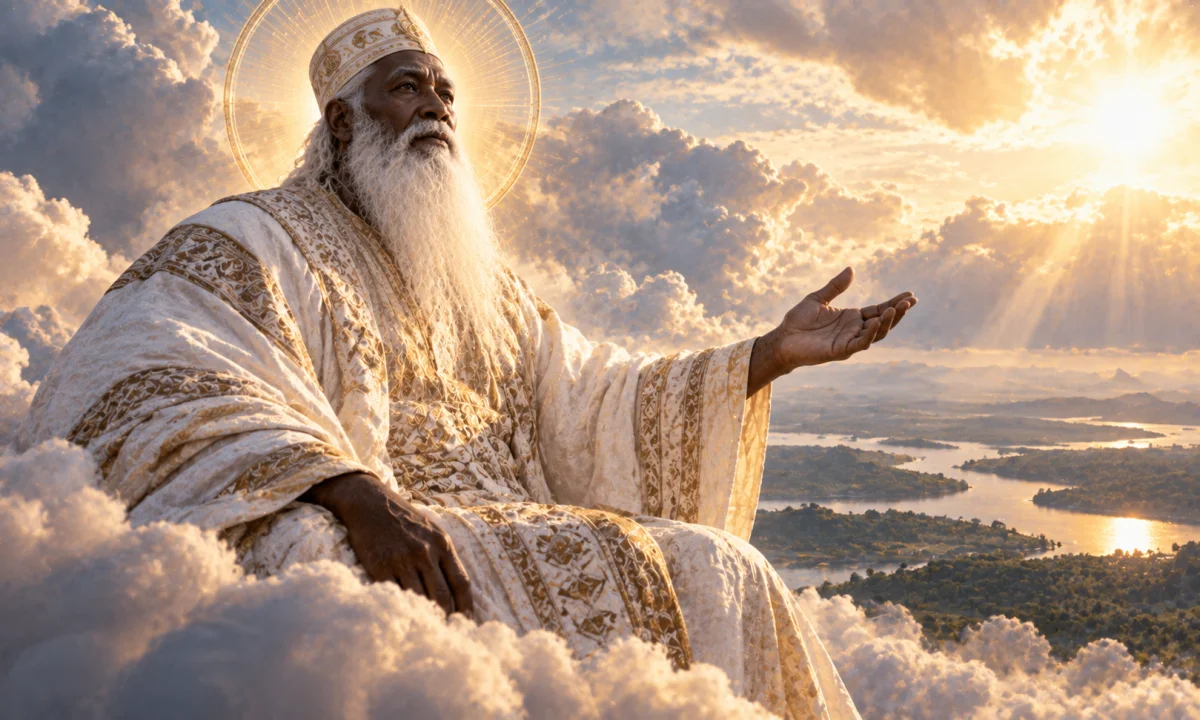
Unlike many òrìṣà, Olorun is not usually represented through a standard human-shaped image or a single animal emblem. The supreme deity is often described in abstract or transcendent terms rather than through a fixed physical appearance. Statements that Olorun is “the sun” or “a sun god” are therefore misleading. Light, sky and celestial imagery can be associated with the deity, but Olorun should not be reduced to a personification of the sun.
Many accounts also describe Olorun as not receiving the same kind of regular shrine-centered worship given to individual òrìṣà. Devotion is commonly directed through the òrìṣà, divination, prayers, blessings and ethical conduct. This does not mean that Olorun is absent from Yoruba religious life. Rather, the supreme deity may be approached as the ultimate source of authority while more immediate ritual relationships are maintained with particular òrìṣà, ancestors and local sacred powers. Practices differ, and no single statement about worship applies equally to every Yoruba community.
Relationships with the òrìṣà
The òrìṣà are often understood as divine beings or sacred powers who operate within the order established by the supreme deity. Their roles are distinct. Obatala is associated in many traditions with creation, human form, clarity and seniority. Orunmila is connected with wisdom, divination and knowledge of destiny. Èṣù is a messenger and guardian of crossings, communication and the consequences of choices; he is not the Christian Devil. Yemọja, Ṣàngó, Ọ̀ṣun, Olókun and numerous other òrìṣà have their own histories and areas of religious significance.
Olorun should not be merged with these figures simply because they appear in the same creation stories or ritual universe. The supreme deity and the òrìṣà may be linked by authority, descent, commission or function, but they remain conceptually distinct in most descriptions. The relationship is often better understood as an ordered network of divine powers than as a set of interchangeable gods.
There is also no universal agreement about whether the òrìṣà are independent divine beings, manifestations of a single sacred reality, deified ancestors, forces of nature or combinations of these categories. Different Yoruba traditions emphasize different aspects. These differences are part of the religion’s historical richness and should not be forced into one rigid theological system.
Destiny, morality and human life
Yoruba religious thought places strong emphasis on the connection between divine order and personal destiny. The concept of orí, literally “head,” can refer both to the physical head and to a person’s inner spiritual principle or destiny. Orí is especially important in questions of character, fortune and the direction of a person’s life. Olorun is not always the deity directly consulted in such matters; divination and relationships with particular òrìṣà provide the practical religious framework. Nevertheless, the supreme deity remains the highest source of the order within which destiny operates.
Ethical life is likewise relational. Good character, often discussed through the ideal of ìwà pẹ̀lẹ́, is valued alongside ritual observance. Respect for elders, honesty, self-control, responsibility and the maintenance of social harmony are important themes, though their expression varies among communities. Religious power is not treated as a substitute for moral conduct. A person may possess knowledge or ritual ability yet still be judged by the quality of their character and the consequences of their actions.
Olorun’s distance in many traditional accounts does not imply indifference. It reflects a structure in which the supreme deity is the source of existence and authority, while the òrìṣà, ancestors and human communities participate in the daily work of maintaining the world. Divination, sacrifice, prayer and ritual help restore balance when relationships between these levels have been damaged.
Surviving traditions and historical interpretation
Knowledge of Olorun comes from several overlapping sources. Oral narratives, praise names, prayers, Ifa verses, ritual songs and teachings preserved by priests and elders remain important. Written accounts by Yoruba scholars, historians, missionaries and anthropologists have also influenced modern understanding. These materials do not all describe the deity in the same way, partly because they reflect different communities and partly because outside observers often selected or translated traditions according to their own assumptions.
Ifa is especially valuable for understanding Yoruba religious concepts, but it should not be treated as a single book containing one definitive theology. Its verses are transmitted, interpreted and performed within a living divinatory system. References to the supreme deity, òrìṣà, destiny and moral behavior appear in different contexts, and their meaning depends on the verse and ritual situation.
The Atlantic slave trade carried Yoruba religious ideas into the Americas, where they developed in new historical circumstances. Traditions such as Santería or Regla de Ocha in Cuba, Candomblé in Brazil and related practices elsewhere preserve Yoruba-derived religious elements, although they are not identical to religion in Yoruba-speaking West Africa. In some diasporic traditions, Olorun or Olódùmarè is recognized as the supreme creator, while everyday devotion centers more visibly on the òrìṣà and their local forms.
Olorun in Christianity, Islam and popular culture
Yoruba-speaking communities have long interacted with Christianity and Islam. Some Yoruba Christians and Muslims use “Olorun” as a word for God in their respective religious languages. In that setting, the term may refer directly to the monotheistic God of Christian or Islamic belief rather than to every feature of pre-Christian Yoruba theology. This linguistic overlap should not be mistaken for proof that the traditions are historically identical. It reflects translation, adaptation and the use of familiar religious vocabulary.
Modern novels, films, comics, games and online discussions sometimes present Olorun as a conventional fantasy deity with a fixed appearance, weapon, family tree or set of superpowers. Such portrayals may draw inspiration from Yoruba mythology, but invented details belong to modern adaptation rather than established traditional material. The same applies to claims that assign Olorun a simple gender, a universal physical form or a standardized list of symbols. Traditional accounts more often emphasize supreme authority, creation, life and the heavenly realm than a visually defined character.
For Yoruba religious traditions, Olorun is therefore best understood not as a single mythological character with one canonical biography, but as a supreme divine reality whose names, roles and relationships are expressed differently across communities and historical settings. The figure’s importance lies in the source of existence and authority that stands behind the many òrìṣà, the living world and the continuing relationship between heaven, earth, destiny and human conduct.