WORLD
WORLD
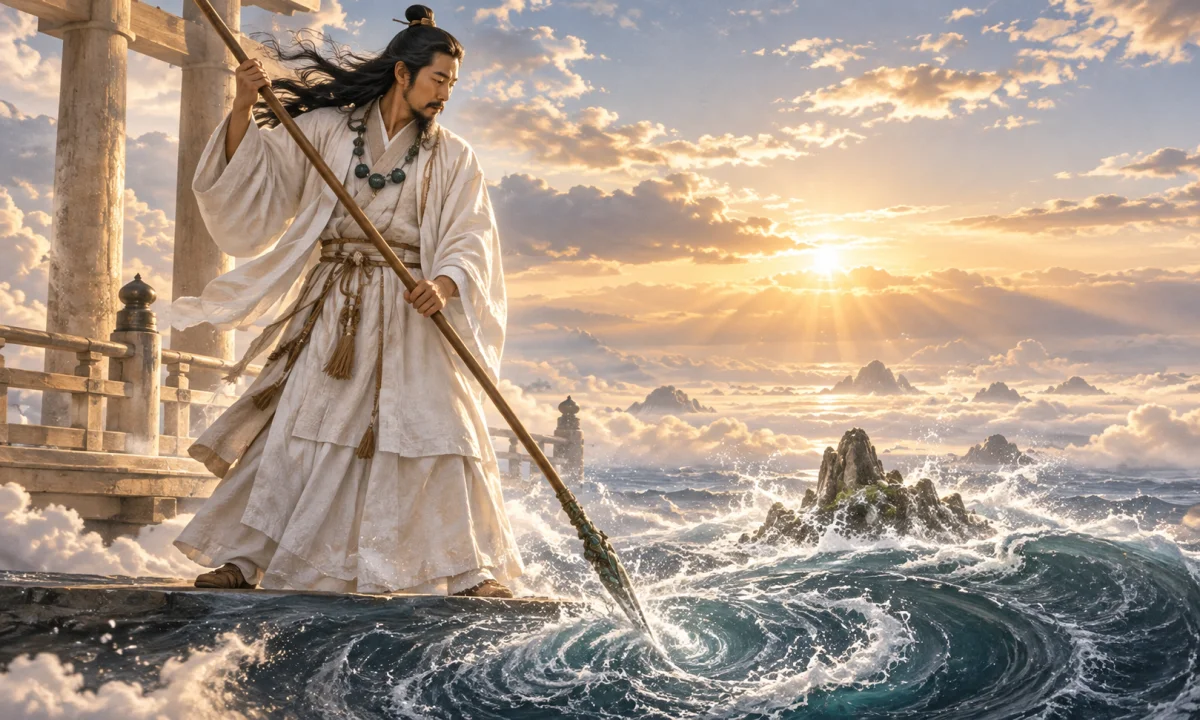
O-ana-mochi

O-ana-mochi is a rare English rendering of a name associated with the Japanese kami usually identified as Ōnamochi, Ōnamuji or Ōnamuchi no Mikoto. In the major traditions of Japanese mythology, this figure is generally understood to be another name or an earlier name of Ōkuninushi, the powerful kami connected with the formation of the land, marriage, healing, agriculture and the establishment of the earthly realm. The spelling “O-ana-mochi” is not the most common modern romanization, and it can obscure the fact that the name belongs to a group of closely related forms preserved in different Japanese texts.
Name and identity
The name appears in several written forms, including Ōnamuji, Ōnamuchi, Ōnamochi and forms written with the characters 大穴牟遅 or 大己貴. Romanization differs because Japanese historical texts used Chinese characters in ways that do not always correspond neatly to later Japanese pronunciation. As a result, “O-ana-mochi” may represent an attempt to transliterate a form such as Ōnamuji or Ōnamuchi, rather than the name of a separate god.
In the Kojiki, completed in 712, the young deity who later becomes Ōkuninushi is called Ōnamuji-no-kami. In the Nihon Shoki, completed in 720, related forms such as Ōnamuchi and Ōnamochi occur among the names and descriptions of the same broad mythological figure. The exact relationship between these names is not entirely uniform from passage to passage. Some traditions treat them as names used by one deity at different stages or in different contexts; others preserve a more complex collection of local and theological identities.
For practical purposes, O-ana-mochi is best treated as a variant name connected with Ōkuninushi, not as an independently documented god with a wholly separate mythology. The identification is strong in the classical mythological tradition, although the names do not always function identically in every source or shrine tradition.
Sources and cultural setting
The stories associated with O-ana-mochi belong to the mythology of ancient Japan, especially the traditions connected with the region of Izumo in present-day Shimane Prefecture. Izumo was remembered as an important sacred and political landscape, and its traditions played a major role in accounts of the formation and transfer of rule over the Japanese islands.
The most important surviving literary sources are the Kojiki and the Nihon Shoki. These works were compiled in the early eighth century under the Yamato court. They are not neutral records of an unchanged prehistoric religion. They preserve older oral traditions while arranging them to support ideas about imperial descent, sacred authority and the place of different regional cults within a larger political order.
The Izumo Fudoki, compiled in 733, is also important for understanding the religious landscape surrounding Ōkuninushi and related figures. A fudoki was a provincial account containing information about geography, place names, products, local customs and legends. The surviving Izumo text is especially valuable because it preserves local traditions that do not always correspond exactly to the court-centered narratives of the Kojiki and Nihon Shoki.
These sources should not be read as if they were chapters in one perfectly consistent mythology. Japanese kami could have several names, local manifestations and overlapping functions. A deity’s identity was often shaped by the place where it was worshipped, the lineage that served its shrine and the ritual or political setting in which its story was told.
Relationship with Ōkuninushi
O-ana-mochi is most closely associated with the figure known as Ōkuninushi-no-kami, whose name can be translated approximately as “Great Master of the Land” or “Great Lord of the Country.” Ōkuninushi is one of the central kami of the Izumo mythological cycle. He is portrayed as a ruler, culture hero, healer, husband and builder of the earthly realm.
The Kojiki presents Ōnamuji as a younger form or earlier name of Ōkuninushi. In the story, he belongs to a large family of divine brothers who seek the hand of Princess Yakamihime of Inaba. The brothers behave arrogantly and force Ōnamuji to carry their baggage. During the journey, they encounter a hare whose skin has been torn away. The brothers give the injured animal cruel advice, telling it to bathe in salt water and lie in the wind. Ōnamuji instead advises the hare to wash in fresh water and cover itself with the pollen of a flowering plant. The hare recovers and foretells that Ōnamuji will marry Yakamihime.
This episode establishes a major feature of the deity’s character. He is not introduced only as a warrior or conqueror. His power is linked to compassion, practical knowledge and the ability to restore life. The story of the Hare of Inaba is one of the best-known episodes associated with the Ōnamuji-Ōkuninushi cycle, although the hare itself is a separate mythic animal and should not be confused with the deity.
Persecution, death and renewal
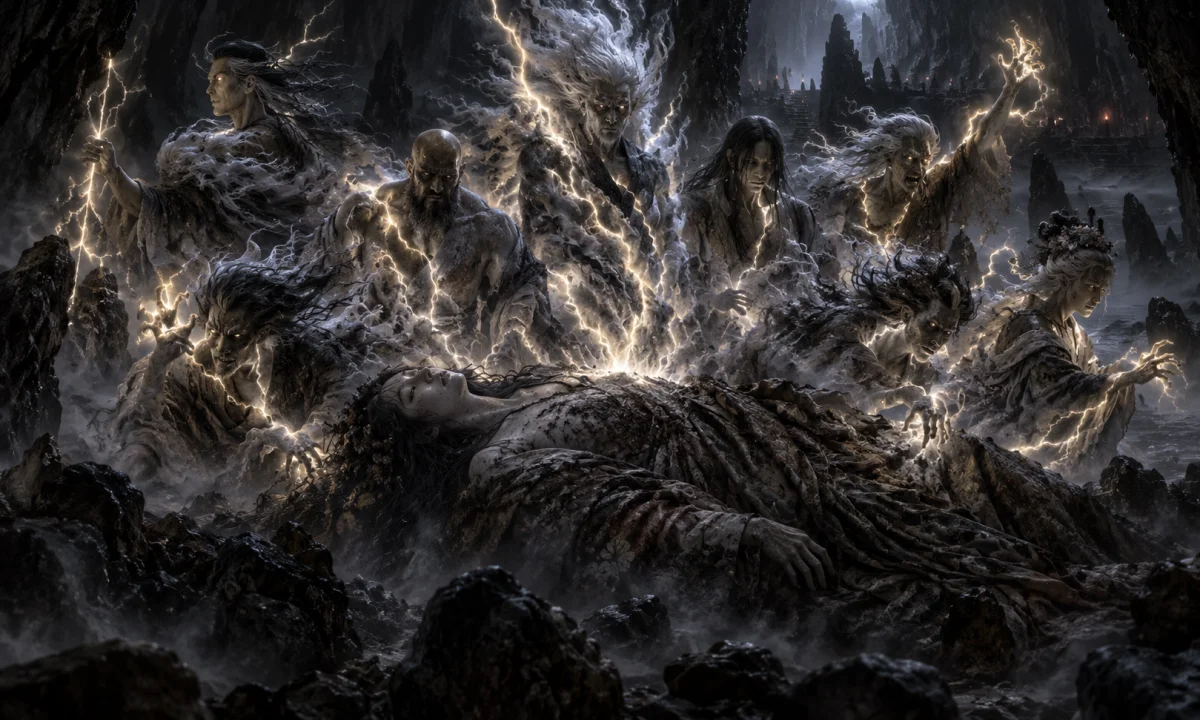
Ōnamuji’s brothers become jealous of the prediction and repeatedly attempt to kill him. In one episode, they crush him beneath a boulder. His mother mourns him and obtains his restoration through the aid of other divine beings. In another episode, the brothers drive him into a burning forest. A mouse helps him escape by revealing a hidden passage and assisting him in locating the arrow that he has been sent to retrieve.
These stories give Ōnamuji an initiatory pattern. He suffers humiliation, death or near-death, and rebirth before becoming the powerful lord associated with the land. His eventual authority is therefore not presented as simple inheritance. It is achieved through endurance, assistance from nonhuman allies and encounters with danger.
After these ordeals, Ōnamuji travels to the underworld, or realm of the deity Susanoo. There he meets Susanoo’s daughter, Suseribime, and becomes involved in a series of trials. Susanoo tests him with arrows, fire and dangerous creatures. Ōnamuji survives with Suseribime’s help and eventually escapes with her, taking weapons and other objects that contribute to his later sovereignty.
The precise identity of the underworld in this story is debated. It is often called Ne-no-kuni, the Land of Roots, or associated with Yomi, the land of the dead. The terms do not always have identical meanings in Japanese myth. They should not automatically be treated as a single, fully defined afterlife comparable to a later theological concept of hell.
Construction of the earthly realm
After his transformation and return, Ōnamuji becomes the ruler who develops or organizes the land. He is connected with the ordering of mountains, fields, settlements and the knowledge needed for human life. In this role, he is not simply a creator who brings the world into existence from nothing. Rather, he is a developer and civilizing ruler who makes the existing land habitable and socially ordered.
A further divine figure, Sukunabikona, joins him. Sukunabikona is a very small kami who arrives across the sea in a tiny vessel made from a pod or husk. Depending on the account, Ōnamuji learns Sukunabikona’s identity through the intervention of another deity. Together, the two kami establish medicines, methods of healing and techniques useful to human communities.
The partnership between Ōnamuji and Sukunabikona is important because it presents the ordering of the world as cooperative. Ōnamuji possesses authority over the land, while Sukunabikona contributes specialized knowledge. When Sukunabikona later departs, Ōnamuji laments that he must continue the work alone. The tradition therefore links the deity with both achievement and the loss of a divine companion.
The transfer of the land
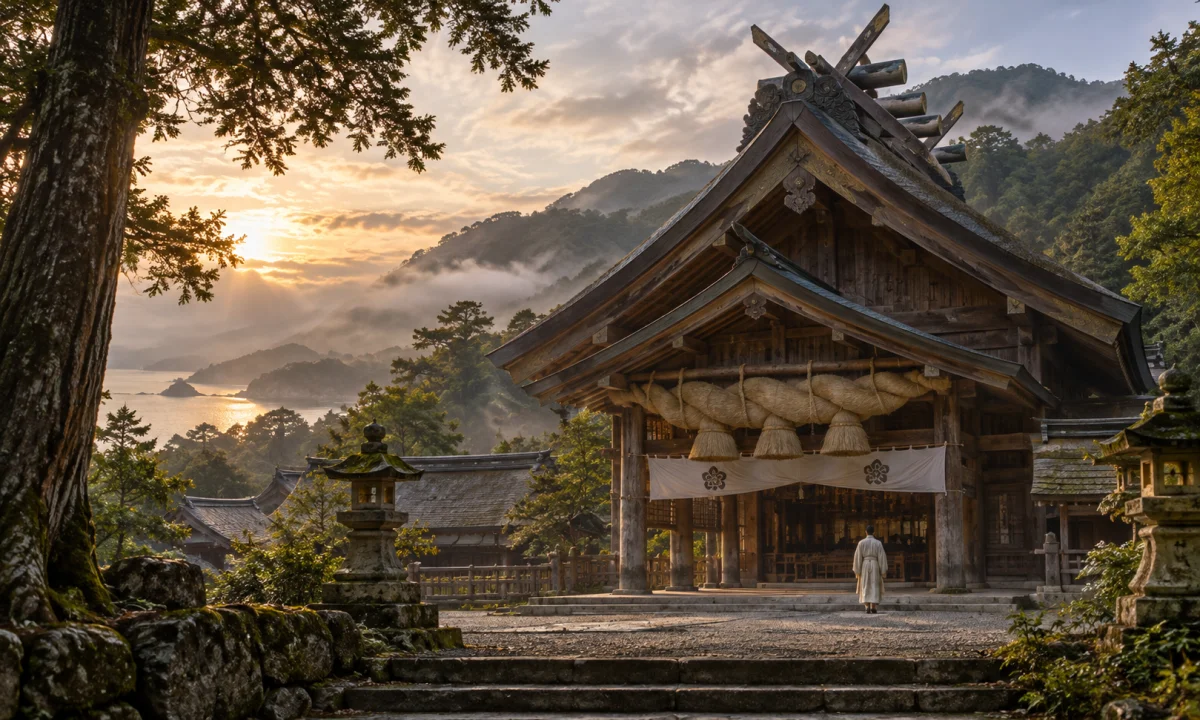
One of the central myths concerning Ōkuninushi is the transfer of the land to the descendants of the heavenly kami. The heavenly deity Takemikazuchi is sent to demand that Ōkuninushi surrender authority over the earthly realm. In return, Ōkuninushi requests the construction of a magnificent shrine where he can be worshipped. This request is associated with the origins of Izumo-taisha, one of the most important shrines connected with him.
The event is sometimes called the “transfer of the land,” although the English phrase can make the story sound like a simple political treaty. The narrative expresses a mythological relationship between two forms of authority. Ōkuninushi represents the power of the earthly land and its established divine order, while the heavenly lineage represented by Amaterasu and her descendants claims the right to rule. Ōkuninushi’s withdrawal is not the end of his importance. His continuing worship becomes part of the settlement that makes the transfer legitimate.
Different versions of the story vary in detail. Some emphasize Ōkuninushi’s son Kotoshironushi, who agrees to the transfer. Others include Takeminakata, another son who resists and is defeated by Takemikazuchi. These figures have their own shrine traditions and should not be collapsed into O-ana-mochi himself, even though they belong to the same mythological family.
Roles and religious significance
As a name associated with Ōkuninushi, O-ana-mochi participates in a broad range of religious functions. Ōkuninushi is revered as a deity of land and territorial prosperity, but his worship extends well beyond agriculture or political sovereignty.
- Marriage and relationships: He is associated with forming bonds between people and with the establishment of marital relationships. His many stories involving marriage, courtship and family have contributed to his reputation as a deity of matchmaking.
- Healing and medicine: His partnership with Sukunabikona links him with medical knowledge, recovery and remedies. This aspect is especially visible in traditions that portray the two kami as benefactors of human health.
- Agriculture and abundance: As a lord of the land, he is connected with cultivated fields, food production and the prosperity of communities.
- Social order: His myths describe the organization of territory and the establishment of institutions needed for human life.
- Spiritual mediation: His role in the transfer of the land places him between the older powers of the earthly realm and the heavenly lineage that becomes central to imperial mythology.
These functions did not necessarily develop from one original, fixed meaning. They reflect the accumulation of local cults, shrine traditions, literary interpretations and later religious practice. In some settings, the name Ōkuninushi has greater prominence than Ōnamuji or Ōnamuchi; in others, an older name may preserve a distinct local emphasis.
Names that should not be treated as identical without qualification
Several names associated with Ōkuninushi can create confusion. Ōnamuji is the form especially prominent in the Kojiki during the deity’s youth and adventures. Ōnamuchi and Ōnamochi are related forms found in other textual and religious contexts. Ōkuninushi is the title or name by which the mature ruler is most widely known.
Another important name is Ōmononushi, the deity of Mount Miwa. Ōmononushi is sometimes identified with Ōkuninushi, or described as an aspect, spirit or manifestation of him, but the relationship is not handled identically by every source. The two should not be treated as interchangeable in every context. Ōmononushi has a distinctive mythology centered on Mount Miwa, the water serpent or dragon-like appearance of the deity in certain stories, and the origins of the Miwa cult.
Ashihara no Shikoo, meaning roughly “Ugly Man of the Reed Plains,” is another name used for Ōkuninushi in the classical tradition. It belongs to the same broad cycle but emphasizes a different stage or aspect of the deity’s identity. Such multiple names are characteristic of Japanese kami traditions, where a divine figure may be known by a personal name, a title, a local name or a name expressing a particular function.
Interpretation of the figure
Scholars have interpreted the Ōnamuji-Ōkuninushi complex in several ways. One approach emphasizes the political meaning of the land-transfer myth: the story may encode the incorporation of regional religious and political traditions into the authority of the Yamato court. From this perspective, the deity’s surrender of the land reflects the subordination of an important local cult, while his grand shrine preserves his prestige within the new order.
Another approach focuses on the deity’s older functions as a culture hero. His myths connect him with healing, marriage, agriculture, territorial development and the acquisition of useful knowledge. These roles may reflect a wide range of local traditions rather than a single original biography.
The stories of persecution, descent into the underworld and return also invite comparison with broader patterns of death and renewal. Such comparisons can be useful when carefully made, but they should not erase the specifically Japanese meanings of the narratives. O-ana-mochi is not simply a Japanese version of a generic vegetation god, underworld hero or fertility deity. His significance arises from the particular relationships among Izumo traditions, shrine worship, land-making myths and the political theology of early Japan.
Worship and continuing presence
The figure most commonly worshipped under the name Ōkuninushi is especially associated with Izumo-taisha, also called Izumo Ōyashiro. The shrine’s traditions place great importance on the deity’s relationship with human connections and divine assemblies. In popular explanations, the kami are said to gather in Izumo during the tenth month of the traditional lunar calendar, a period that is called “the month without gods” in many parts of Japan but “the month with gods” in Izumo. This belief belongs to later religious and folkloric tradition and should not be projected unchanged into the earliest textual sources.
Ōkuninushi is also worshipped at many other Shinto shrines, sometimes alongside Sukunabikona or under one of his alternative names. The presence of a name such as Ōnamuchi or Ōnamochi in a shrine tradition does not always prove that local worshippers understood the deity in precisely the same way as the court texts did. Shrine identities were shaped by local history, ritual practice and the theological interpretations of priests and communities.
Modern reception
O-ana-mochi is far less familiar internationally than the more commonly presented names Ōkuninushi or Ōnamuji. Modern retellings, reference works and games may choose one spelling, combine several names or simplify the deity into a god of a single function, such as love, wealth or the underworld. These presentations can be useful introductions, but they are modern selections rather than complete representations of the historical tradition.
When the name “O-ana-mochi” appears in modern material, it is therefore important to check whether it is being used as a variant of Ōnamuji, Ōnamuchi or Ōkuninushi. The spelling by itself does not establish a separate mythology. The safest traditional identification is with the complex of names and stories surrounding Ōkuninushi, while recognizing that Japanese sources preserve genuine differences in wording, emphasis and divine identity.